Ration Card under NFSA: Free 5 kg Foodgrain
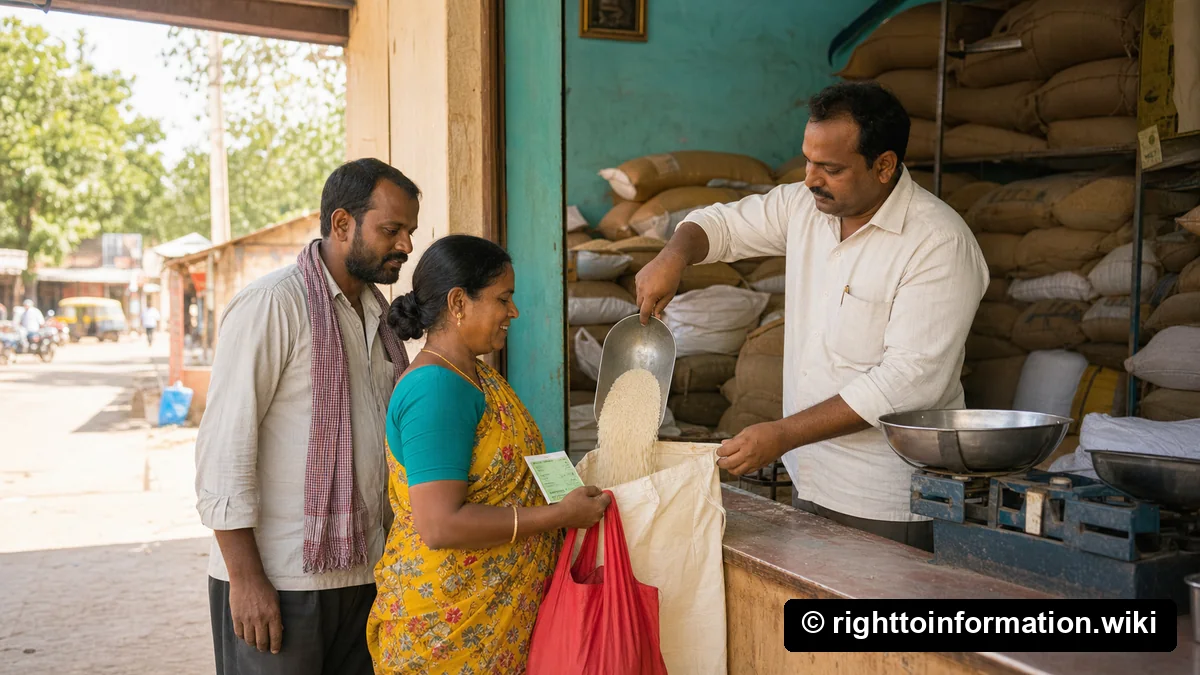
Quick Reply: NFSA ration card gives 5 kg foodgrain per person a month for priority homes and 35 kg per AAY family, free under PMGKAY to 2028. Eligibility, categories, ONORC portability, apply…
Before you stand in any queue or open any portal, run through the checklist below. A ration card under the National Food Security Act is issued by your state food and civil supplies department, so the exact form and portal change from state to state, but the papers you carry and the eligibility test are close to the same everywhere. Get these ready first and the rest of the process moves faster.
Documents checklist, keep these ready before you apply
- Aadhaar of every family member you want on the card
- A recent passport photo of the head of the family
- Proof of residence, such as a voter ID, electricity bill, rent agreement or domicile paper
- Income certificate or self-declaration of income, as your state asks
- Bank passbook copy of the head of the family
- A mobile number that is linked to Aadhaar for the OTP
- A cancelled or surrendered copy of any old ration card, if the family held one elsewhere
Eligibility checklist, tick these before you start
- Your family is not already named on a valid ration card anywhere in India
- Your household income is within your state ceiling for a priority or Antyodaya card
- You can link Aadhaar for each member you add
- You are a resident of the state where you are applying
If every line above is ticked, you can apply. If one is missing, fix that first, because a missing Aadhaar link or an old card in another state is the most common reason an application stalls.
A ration card under NFSA gives 5 kg of foodgrain per person per month to a priority household, and 35 kg per family per month to an Antyodaya household. This grain is free at the fair price shop under PMGKAY through December 2028.
Enacted: National Food Security Act, 2013 · Issued by: State food and civil supplies department, under the Ministry of Consumer Affairs, Food and Public Distribution
About this article — Expertise, Experience, Authoritativeness, Trust (E-E-A-T)
- Reviewed by: Dr. Shrawan Kumar Pathak, RTI Wiki editorial team
- Expertise: Indian government welfare schemes, Public Distribution System, NFSA beneficiary categories, RTI for PDS grievances
- Last reviewed: 1 September 2026
- Accuracy note: Entitlement figures and PMGKAY free-grain extension cross-checked against nfsa.gov.in and dfpd.gov.in. State-wise portals change; always confirm on your state PDS portal.
Who is covered under NFSA and how many people benefit?
The National Food Security Act, 2013 is the largest food security programme in the world by coverage. It legally entitles up to 75 percent of the rural population and up to 50 percent of the urban population to receive subsidised foodgrains through the Targeted Public Distribution System. In absolute numbers this works out to roughly 81.35 crore beneficiaries across India, drawn from households identified by their respective state governments under guidelines issued by the central government.
The Act does not name individual families. It gives each state a coverage ceiling expressed as a percentage of its rural and urban population, determined from the 2011 Census. The state government then identifies which households within that ceiling fall into the priority or Antyodaya categories, based on exclusion criteria or inclusion criteria that the state itself frames. This is why the exact eligibility test, the income ceiling and the documentation differ from state to state, even though the entitlement quantity is uniform across India.
The central pool allocations are published on nfsa.gov.in, and the Department of Food and Public Distribution provides updated beneficiary figures and state-wise coverage data on dfpd.gov.in. The National Portal of India at india.gov.in also lists the scheme under government welfare programmes. If you want to confirm whether your household is already counted as a covered beneficiary, you can check through the official One Nation One Ration Card dashboard or contact your state food and civil supplies department. For a detailed walk-through of checking your name on the beneficiary list, see how to check your ration card status.
What are the NFSA beneficiary categories and entitlements?
Under the Act there are two main beneficiary categories for ration card purposes. The table below summarises who falls into each, what each household receives, and the key operational rules.
| Category | Who it covers | Monthly entitlement | Price at FPS (current) | Key rule |
|---|---|---|---|---|
| Priority Household (PHH) | Households identified by the state as eligible under the state's priority criteria, within the central coverage ceiling | 5 kg foodgrain per person per month | Free under PMGKAY (through Dec 2028) | Entitlement scales with family size — a family of 5 gets 25 kg |
| Antyodaya Anna Yojana (AAY) | Poorest of the poor — landless labour, marginal farmers, aged/infirm persons with no regular support, primitive tribal groups, destitute | 35 kg foodgrain per family per month (flat) | Free under PMGKAY (through Dec 2028) | Flat quota regardless of family size; higher per-person entitlement for small families |
| Non-priority (NPHH / NPHHL) | Households above the exclusion criteria — they do not receive central NFSA grain | Nil under NFSA | N/A | Some states allow an NPHH card as proof of identity or for state-specific subsidies |
Important distinction: The 5 kg per person under PHH and the 35 kg per family under AAY are central NFSA entitlements. During the COVID-19 period the central government separately provided an additional 5 kg per person under the Pradhan Mantri Garib Kalyan Anna Yojana. That additional quota was distinct from the regular NFSA entitlement, and since January 2024 the regular NFSA grain itself is distributed free of cost under the integrated PMGKAY scheme.
A few states go beyond the central entitlement and add their own grain or items on top. For instance, states like Tamil Nadu and Odisha provide additional rice or other commodities through their own budgets, but these are state-level add-ons and are separate from the central NFSA quota. Always read the printed rate slip at the fair price shop for the month, because the add-on items follow the state price and are not part of the free central grain.
The two card types, and what each one gets
The National Food Security Act covers about two thirds of the country, close to 81 crore people. Inside that cover there are two kinds of card, and it matters which one your family holds.
- Priority household, often printed as PHH. This is the larger group. Each named member gets 5 kg of foodgrain per person per month. A family of five therefore draws 25 kg a month. The grain is usually a mix of rice and wheat, and the exact split is set by your state.
- Antyodaya Anna Yojana, printed as AAY. This is for the poorest of the poor. An AAY family gets a flat 35 kg per family per month, whatever the family size. This is the higher entitlement, meant for households with no stable income, aged or infirm heads, landless labour and similar cases your state identifies.
Under the plain text of the 2013 Act the grain carried a nominal price of Rs 3 per kg for rice, Rs 2 for wheat and Rs 1 for coarse grain. That nominal price no longer reaches your pocket. From January 2024 the central government folded the cost into the Pradhan Mantri Garib Kalyan Anna Yojana, so the same NFSA grain now comes free at the fair price shop. Treat the old Rs 1 to Rs 3 figure as the law on paper, and free as what you pay at the counter today.
How does One Nation One Ration Card portability work?
If you or a family member has moved for work, this is the most important feature of the modern ration card system. Under One Nation One Ration Card, the entire NFSA network is portable across all states and union territories that have implemented the system. A card issued in Bihar can be used to draw the family ration at a fair price shop in Surat, Mumbai or Delhi, through the electronic point of sale machine and an Aadhaar fingerprint authentication.
The portability works through a central database that links every ration card in the country to the Aadhaar numbers of its members. When a member presents a card at a fair price shop in any state, the ePoS machine checks the central server, authenticates the person through Aadhaar biometrics, and deducts the grain from the family's monthly quota. The family back home can still draw the balance on the same card, because the quota adjusts in real time.
This system is specifically designed for migrant families where one earner travels for work and the rest of the household stays in the home village. You do not need to apply separately for portability — it is built into every NFSA card whose members have completed Aadhaar seeding. To check whether your card is portability-enabled, verify your e-KYC status at Mera Ration eKYC status or through your state PDS portal.
If the biometric authentication fails at the shop — a common problem for manual labourers with worn fingerprints — see the Aadhaar authentication failure guide for the alternative verification routes available. The Department of Food and Public Distribution maintains the ONORC implementation dashboard at dfpd.gov.in/one-nation-one-ration-card.
Is the grain free right now?
Yes, for the NFSA quota. The Union Cabinet extended free distribution under PMGKAY for five years with effect from 1 January 2024, which runs the free window through 31 December 2028. So a priority family of five collects its 25 kg, and an AAY family its 35 kg, at zero cost at the shop for that period. Anything your state adds on top, such as pulses, oil, salt or sugar, follows the state price and is separate from the central NFSA grain. Always read the printed rate slip at the fair price shop for the month before you pay for any add-on.
The official PMGKAY page on the Department of Food and Public Distribution website at dfpd.gov.in/pmgkay carries the current extension notification. The Press Information Bureau announcement of the five-year extension is at PIB release PRID 1987026.
How to apply, step by step
The application is made to your state food and civil supplies department. The portal name changes by state, but the flow is the same.
- Open your state PDS portal or visit the office. Search for the food and civil supplies department of your state, or go to the Tehsildar office, a Common Service Centre or the ward office that handles ration cards. The national hub at nfsa.gov.in links out to the state portals.
- Fill the new ration card form. Enter the head of the family and every member you want covered. The head of the family is usually the eldest woman of the house, which the Act encourages.
- Attach the checklist documents. Upload or hand in Aadhaar for each member, the residence proof, the income declaration and the photo of the head of the family.
- Complete Aadhaar e-KYC. Each member is linked through an Aadhaar based check so the same person is not counted on two cards.
- Field verification. A local officer, often the Patwari or a food inspector, checks the household details. This is where most of the waiting happens.
- Approval and card issue. Once cleared, the card is issued, and you are tagged to a fair price shop from where you collect the monthly grain.
There is no fee to apply for a ration card. If anyone asks for money to make or approve the card, that is a demand you can report and challenge. For the full list of documents in detail, see Documents required for a new ration card, and for a complete walk-through, follow Ration card apply guide.
How do I check my ration card status after applying?
After you submit the application, the state food and civil supplies department gives you an acknowledgement number or registration reference. With that number you can track the stage of your application on the state PDS portal. The status typically moves through: submitted, under field verification, pending at the office, approved, or rejected.
The national portal at nfsa.gov.in links out to state PDS dashboards where you can enter your reference number or Aadhaar to see the current stage. If you applied through a Common Service Centre, the operator can also look it up for you.
If the status shows pending for much longer than the state's declared timeline — typically 15 to 30 days — see the detailed guide at how to check ration card status for the exact steps and escalation options. If you specifically need to check the status of an add-member request, the dedicated guide at ration card add member status walks through that process. For rejected applications, see ration card rejection recovery.
Adding or removing a name on an existing card
Families change, so the card has to be updated. To add a newborn, a new bride or a member who was left out, you file a correction or add-member request on the same state PDS portal, with the new member's Aadhaar and a proof of the relationship, such as a birth certificate or a marriage record. To remove a member who has died or moved to another card, you file a deletion request with the supporting proof. Keep the acknowledgement number, because an add-member request is the second most common thing that gets stuck after a fresh application.
For a detailed walk-through of the add-name process, see how to add a name on a ration card. For deletion requests specifically, ration card deletion through RTI explains the escalation path when a deletion is stuck. If your add-name or deletion request has been pending for months, ration card name addition or deletion pending covers the exact steps.
What happens if Aadhaar e-KYC fails at the fair price shop?
Aadhaar-based biometric authentication is the backbone of the modern PDS. Every time you draw grain at the fair price shop, the ePoS machine reads your fingerprint or iris scan, matches it against the Aadhaar database, and only then releases the grain from your quota. This prevents duplicate draws and ghost cards, but it also means that if your biometric fails, you cannot draw grain.
The most common reasons for biometric failure are worn fingerprints (especially for manual labourers and elderly persons), poor network at the shop, or an unlinked Aadhaar. If your fingerprint is not being accepted, there are three fallbacks:
- Iris scan. Ask the dealer to switch the ePoS machine to iris mode. Iris scans are more reliable for persons with worn fingerprints.
- One-time password. Some states allow OTP-based authentication on the mobile number linked to Aadhaar, as a backup when biometrics fail.
- e-KYC update. If the Aadhaar is not seeded onto the card at all, you must complete e-KYC at the CSC or food office. Check the status at Mera Ration eKYC status.
For the full troubleshooting flow — including what to do when authentication fails repeatedly across multiple visits — see Aadhaar authentication failure at bank and ration shop. If Aadhaar seeding itself is stuck across multiple services, Aadhaar seeding failed for LPG, ration and pension covers the cross-service fix.
What is the difference between PMGKAY and NFSA?
This is a common point of confusion. The National Food Security Act, 2013 is the law that creates the entitlement to subsidised foodgrain. PMGKAY, the Pradhan Mantri Garib Kalyan Anna Yojana, is the scheme under which the government makes that grain free. They are not two separate programmes handing out two separate quotas — since January 2024, PMGKAY is the vehicle through which the regular NFSA grain is delivered free of cost.
| Feature | NFSA (2013 Act) | PMGKAY (2024 extension) |
|---|---|---|
| What it is | The law that creates the entitlement | The scheme that funds free distribution |
| Entitlement | 5 kg/person (PHH) or 35 kg/family (AAY) | Same quota, distributed free |
| Statutory price | Rs 1–3/kg on paper | Zero at the shop |
| Validity | Permanent law | Extended through 31 Dec 2028 |
| Extra grain during COVID | Regular quota | Additional 5 kg/person (phase ended) |
So when you hear that ration grain is free, it is the NFSA entitlement that you are receiving, delivered free under the PMGKAY umbrella. When PMGKAY was first launched during the pandemic it provided an additional 5 kg per person on top of the regular NFSA quota. That additional quota was discontinued and the regular NFSA quota itself was made free from January 2024.
A common situation, before and after
Think of a household that moved from a village to a city for construction work. Before they understood portability, the family kept its old village card but could not draw ration in the city, so in the lean months they bought grain at the open market and the monthly budget broke every time work was thin. Nobody had told them the card already worked across states.
After they learned the rule, the son who works in the city draws his share at a fair price shop near the site using the same card and his Aadhaar fingerprint, while the parents draw the rest of the family quota back in the village on the same card. The 5 kg per person keeps the plate full in both places, and the free grain under PMGKAY means the money that used to go on rice now goes to rent and school. Nothing about the card changed. Only their knowledge of what it could already do changed.
Can a married daughter or separated family member claim separate grain?
This is one of the most asked questions about NFSA ration cards, and the answer depends on where the family member now lives and whether they are already on a card. A married daughter who has moved to her husband's household is expected to be on the husband's family card in the new location. She cannot simultaneously be on her parents' card and draw grain there, because the NFSA system allows each person to be counted on only one card at a time — the Aadhaar e-KYC check prevents duplicate counting.
If a married daughter is not on any card at her new residence, she can apply for inclusion there. If the parents' card still shows her name and she has moved, the parents should file a deletion request so the record is clean. For the specific rules around married daughters and fair price shop quota claims, see married daughter welfare scheme and fair price shop quota.
For families that have separated due to disputes or partition, each separated household that lives independently and cooks separately can apply for a separate card, provided every member completes Aadhaar e-KYC and no member is duplicated across two cards. The key test is whether the household is genuinely a separate cooking and living unit.
Common problems and how to fix them
- An old card exists in another state. You must surrender the old card and get a surrender certificate before the new state will issue a fresh one. Two live cards for one family is the top reason for rejection.
- A member's Aadhaar is missing or not linked. Get that member's Aadhaar first, then link it, because the e-KYC step will block the whole card otherwise.
- Verification is stuck well past the state timeline. Ask the office for the file status in writing. If there is no clear answer, the RTI route below is built for this.
- The family was put in the wrong category. If a genuinely poor household is marked as non-priority, or an AAY family is shown as priority, file a category correction with current income proof at the same department.
- The name is spelled differently on Aadhaar and the card. Correct the spelling on one record so the two match, or the electronic point of sale machine may reject the ration draw.
If your card has been cancelled or suspended without explanation, see RTI for a cancelled ration card. If you need to verify the authenticity of a card, ration card verification through RTI explains the process. For the full list of common problems with the state-wise contact routes, visit your state page at state ration card directory.
Benefit delayed or rejected, file an RTI
When the counter and the phone line lead nowhere, a short Right to Information application to the public information officer of your food and civil supplies department usually moves the file, since the office then has to answer in writing within the statutory time. Ask for the present status of your application number, the officer handling it, the reason for any delay and the likely date of decision. Keep the questions factual and narrow.
- Draft it in minutes: AI RTI Drafter
- File RTI online through the central portal: rtionline.gov.in
- Full filing and appeal process: The RTI Playbook
- Ration specific RTI help: RTI for a ration card status
- If the card is stuck and nobody answers: RTI for a stuck ration card
- PDS grievance escalation: RTI for a PDS grievance
For your state-specific contact details and grievance portal links, see state ration card directory or state PDS grievance directory. The Central Information Commission has ruled in multiple orders that ration card application status, beneficiary lists and category assignments are disclosable under RTI — see CIC ration card case 2015 for precedent.
Where this scheme sits
The National Food Security Act was passed by Parliament in 2013. The free grain you collect today comes through the Pradhan Mantri Garib Kalyan Anna Yojana, which the Union government led by Prime Minister Narendra Modi extended for five years from January 2024. You can see it beside every other central and state welfare scheme on the All Modi-era Sarkari Yojana index 2014 to 2026.
If you also hold a PM Jan Dhan Yojana account, a PM Ujjwala Yojana cooking gas connection, or an Ayushman Bharat PM-JAY health card, those are separate benefits that do not interfere with your ration card — in fact they are designed to stack together for the same eligible household. Unorganised sector workers with an e-Shram card and rural families under PM Awas Yojana Gramin are common NFSA beneficiaries, and the schemes complement each other.
Frequently asked questions
Is the ration grain free right now?
Yes. The NFSA quota of 5 kg per person or 35 kg per AAY family is free at the fair price shop under PMGKAY through 31 December 2028. The old Rs 1 to Rs 3 price is the figure in the Act, not what you pay today.
What is the difference between a priority and an Antyodaya card?
A priority household gets 5 kg per person per month. An Antyodaya household, meant for the poorest families, gets a flat 35 kg per family per month whatever the family size.
Can I use my card in another state?
Yes. Under One Nation One Ration Card the whole NFSA network is portable, so you can draw your family share at a fair price shop in another state using the same card and an Aadhaar fingerprint.
How do I add a newborn or a new member?
File an add-member request on your state PDS portal with the new member's Aadhaar and a proof of relationship such as a birth certificate. Keep the acknowledgement number.
Is there any fee to make a ration card?
No. Applying for a ration card is free. If anyone asks for money to make or approve the card, you can report and challenge it.
Can one family hold more than one ration card?
No. One family gets one card, with every member named on it. A second card for the same family is a common reason for rejection or cancellation.
What is the difference between NFSA and PMGKAY?
NFSA is the law that creates the entitlement to subsidised foodgrain. PMGKAY is the scheme under which that grain is distributed free. Since January 2024, PMGKAY covers the NFSA grain cost so the grain is free at the shop through December 2028.
My fingerprint is not accepted at the fair price shop. What do I do?
Ask the dealer to switch the ePoS machine to iris mode, or request OTP-based authentication if your state supports it. If Aadhaar is not seeded on the card, complete e-KYC at the CSC first. See Aadhaar authentication failure guide.
How long does it take to get a ration card after applying?
Most states aim for 15 to 30 days from application to card issue, including field verification. If it takes longer, check the status on your state PDS portal and file an RTI if the delay is unreasonable.
Can I apply for both AAY and a priority card?
No. A household is placed in one category — either AAY or PHH — based on the state's identification criteria. AAY is for the poorest of the poor and has a higher flat entitlement. If you believe your family was wrongly categorised, file a category correction with income proof.
Can I check my ration card status online?
Yes. Visit your state PDS portal linked from nfsa.gov.in and enter your acknowledgement number or Aadhaar. For the full step-by-step, see how to check ration card status.
Is the additional 5 kg free grain from COVID still available?
No. The additional 5 kg per person under the PMGKAY COVID phase was discontinued in December 2022. Since January 2024, the regular NFSA quota itself is distributed free under the extended PMGKAY, so there is no separate additional quota anymore.
What if my ration card is cancelled?
You have the right to know the reason. File an RTI to the food and civil supplies department asking for the grounds of cancellation and the officer who ordered it. See RTI for a cancelled ration card.
Where do I complain about a fair price shop dealer?
Complain to the food and civil supplies department of your state, either through the state grievance portal or by post. If unresolved, file an RTI — see RTI for PDS grievance.
Summary and next step
Bottom line: an NFSA ration card gives 5 kg of foodgrain per person a month to a priority family, and 35 kg per family to an Antyodaya family, free under PMGKAY through December 2028. Apply through your state PDS portal linked from nfsa.gov.in. If a card or an add-member request is stuck, an RTI usually clears it.
- Start at the national hub: nfsa.gov.in
- PMGKAY official page: dfpd.gov.in/pmgkay
- ONORC official page: dfpd.gov.in/one-nation-one-ration-card
- Documents in detail: Documents required for a new ration card
- Track your application: How to check ration card status
- Step by step walkthrough: Ration card apply guide
- If delayed, draft an RTI: AI RTI Drafter
- All government schemes: Sarkari Yojana index
Related schemes
Related ration card guides
Sources
- National Food Security Act 2013, Department of Food and Public Distribution: nfsa.gov.in
- PIB, Cabinet extends PMGKAY free foodgrain for five years from 1 January 2024: PIB release PRID 1987026
- Department of Food and Public Distribution, PMGKAY official page: dfpd.gov.in/pmgkay
- One Nation One Ration Card, Department of Food and Public Distribution: dfpd.gov.in/one-nation-one-ration-card
- Department of Food and Public Distribution, Year End Review 2024: dfpd.gov.in
- National Portal of India, government welfare programmes: india.gov.in
- Central RTI Online portal, file and track RTI applications: rtionline.gov.in
- NFSA beneficiary coverage and state-wise allocation data: dfpd.gov.in allocations
Last reviewed: 1 September 2026.
By Dr. Shrawan Kumar Pathak