MGNREGA job card: now the Gramin Rozgar Guarantee Card
Quick reply. Your household is now guaranteed 125 days of unskilled manual wage work a year under the VB-G RAM G Act, 2025. The paper is the Gramin Rozgar Guarantee Card, valid three years. Any adult of a rural household can register at the Gram Panchayat, which must issue the card within 15 days. Work must be given within 15 days of your dated demand, or an unemployment allowance is owed. Wages are paid weekly, and never later than a fortnight after the work, into each worker's own bank or post office account. Check records at vbgramg.dord.gov.in. An existing MGNREGA job card with e-KYC completed stays valid until the new card is issued.
The law changed on 1 July 2026. The Mahatma Gandhi National Rural Employment Guarantee Act, 2005, Act 42 of 2005, stands repealed. The Viksit Bharat Guarantee for Rozgar and Ajeevika Mission (Gramin): VB-G RAM G Act, 2025, Act 36 of 2025, is now the governing law, brought into force in every State and Union territory by S.O. 2382(E) dated 11 May 2026. The Ministry of Rural Development states in its own published FAQ that Mahatma Gandhi NREGA stands repealed from that date.
Deep-dive guide: The job card and the BDO RTI when a panchayat refuses
Last reviewed: 11 September 2026.
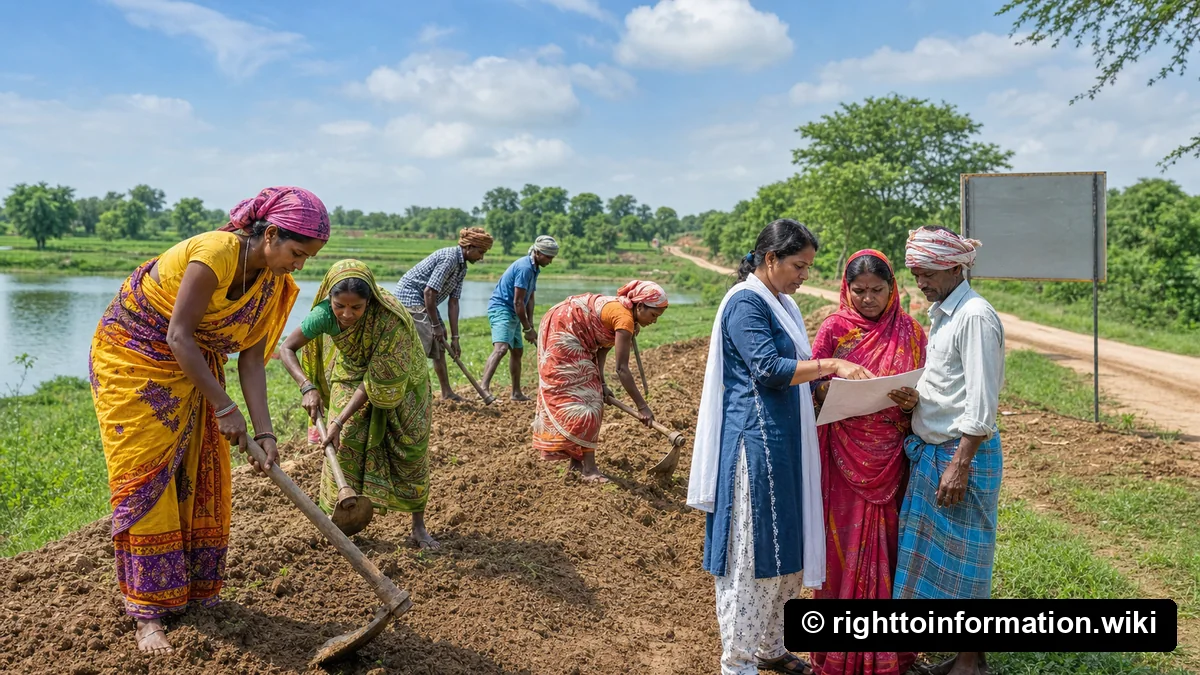
For a landless family in the lean months after a harvest, a day of work once depended on whether somebody offered one. The rural work guarantee changed that, and it did not end on 1 July 2026. It moved to a new Act and grew.
Governing law: VB-G RAM G Act, 2025, Act 36 of 2025 · In force: 1 July 2026 · Guarantee: not less than 125 days a household a year · Run by: Ministry of Rural Development · Replaces: Mahatma Gandhi NREGA, 2005, now repealed
What changed on 1 July 2026
The entitlement is the same idea under a new statute, but several numbers you may have memorised are out of date.
| Point | Under the repealed Mahatma Gandhi NREGA, 2005 | Under the VB-G RAM G Act, 2025, in force now |
|---|---|---|
| Days guaranteed per household | One hundred days a year | Not less than 125 days a year under section 5(1) |
| The household paper | MGNREGA job card | Gramin Rozgar Guarantee Card, valid three years, Schedule II paragraph 1 |
| Who fixes the wage rate | Section 6 of the 2005 Act | The Central Government by notification under section 10 |
| Wage notification in force | S.O. 463 of 2013 | S.O. 3518 of 2026, effective 1 July 2026, which supersedes it |
Four things are also new, each covered below: attendance by face authentication, a notified peak-farming period of 60 days a year, a social audit every six months, and a grievance appeal ladder with fixed clocks.
Work already done is protected. Section 37(2) deems anything duly done under the repealed Act, including a muster roll prepared or a wage liability accrued, to have been done under the new Act. Section 37(4) keeps pending inquiries, audits and proceedings alive as if the old Act had not been repealed. An unpaid wage from June 2026 does not vanish because the statute changed.
Who is eligible and how do you get a Gramin Rozgar Guarantee Card?
The rule is wide on purpose, because the law is meant to reach the poorest.
- Any adult member of a rural household may apply. An adult is a person who has completed the eighteenth year of age. Registration is of the household, and the card carries its registered adults.
- A household means members of a family related by blood, marriage or adoption who normally reside together and share meals or hold a common ration card. That is the only place a ration card appears in the law. It is not a document you must produce.
- A rural area means any area in a State except one covered by an urban local body or a Cantonment Board.
- The adult must be willing to do unskilled manual work, defined as any physical work an adult can do without skill or special training.
- There is no caste, income, gender or education test in the Act.
Register with the Gram Panchayat in whose jurisdiction the household resides, giving the names, ages and address of the household. It may make such enquiry as it thinks fit and must issue the card within 15 days of receiving the application. There is no separate verification window, so the date on your receipt is the date that counts.
A Special Gramin Rozgar Guarantee Card of a distinct colour is provided where the job seeker is a single woman, a person with disability, a person above sixty, a released bonded labourer, a member of a Particularly Vulnerable Tribal Group, or a transgender person.
If you already hold an MGNREGA job card you do not start again. The Ministry states that existing cards and workers for whom e-KYC has been completed remain valid until new cards are issued. See our apply walkthrough and the 2026 deep-dive guide.
What exactly are you entitled to now?
Most disputes at a counter start with a worker who does not know the exact right.
- Not less than 125 days of work a year per household. Section 5(1) puts the duty on the State Government. It is a combined family entitlement, not a quota for each adult. Section 5(4) lets the Centre or the State provide work beyond that.
- A wage rate notified by the Central Government. Section 10 empowers the Centre to specify the rate and to set different rates for different areas. The rates in force since 1 July 2026 are in S.O. 3518(E) dated 30 June 2026, set out below.
- Wages weekly, and never later than a fortnight. Section 5(3) requires disbursement weekly, or in any case not later than a fortnight after the date the work was done.
- Delay compensation of 0.05 per cent a day. Where wages are not paid within 15 days of the closure of the muster roll, Schedule II paragraph 6(1) entitles you to 0.05 per cent of the unpaid wages a day beyond the sixteenth day.
- Work close to home. As far as possible, employment is within five kilometres of the village where you live. Beyond that it must still be inside the Block, and you are paid ten per cent of the wage rate as extra wages for transport and living costs.
- An unemployment allowance. If work is not provided within 15 days of your application, section 11(1) entitles you to a daily allowance. The State fixes the rate, but it can never be less than one-fourth of the notified wage rate for the first thirty days of the financial year and one-half for the rest of it. It must be paid or offered within 15 days of falling due.
- A spell worth travelling for, on hours you can plan. A period of employment is at least six days continuously, with not more than six days a week. The Schedule of Rates is framed so an adult working eight hours, including one hour of rest, earns the notified rate. Hours cannot exceed twelve in a day.
One new limit matters before you plan a year. Section 6 opens “Notwithstanding anything contained in this Act”, so it overrides the rest. Every State must notify in advance a period totalling 60 days in a financial year covering the peak sowing and harvesting seasons, when works are not taken up. The notification can differ by district or block, so ask your Gram Panchayat which dates apply.
How to get the card and demand work, step by step
- Register at your Gram Panchayat. Give the names, ages and address of the household through any adult member. No registration form is prescribed in the Act or the Ministry's FAQ, and no fee is fixed in either. The card must be issued within 15 days.
- Check what is written on the card. It carries a unique card number, the registered adults with photographs, the bank or post office account number, the insurance policy number and the Aadhaar numbers, if any. The State must keep it updated with days demanded and allocated, the work and its muster roll number, measurement details, any unemployment allowance, date-wise wages paid, any delay compensation and any asset provided.
- Demand work and take the dated receipt. The application may be oral or written, to the Ward member, the Gram Panchayat, the Programme Officer, a person authorised by the State, or through a digital platform. Every application must be compulsorily registered and a receipt issued with the date. The Ministry says a written demand uses the same form 6 as before. That receipt starts the 15 day clock.
- Report to the worksite when work is allotted. Applicants provided with work must be told in writing at the address on the card, by another effective mode, or by public notice at the Panchayat office. The list of persons given work is displayed on the Gram Panchayat notice board and at the Programme Officer's office, open to any interested person.
- Collect your wage in your own account. Payment is made through each worker's individual savings account in a bank or post office, which the Ministry describes as Direct Benefit Transfer.
If the process stalls, see our guide to filing RTI at a Gram Panchayat.
What documents do you need?
The Act names only three particulars for registration. The rest of this table fills the card once it is opened.
| Item | What the law actually says |
|---|---|
| Names, ages and address of the household | The only particulars Schedule II paragraph 1(1) requires for registration |
| Photographs of the adult members | The card must carry the photos of the registered adults, Schedule II paragraph 1(4) |
| Bank or post office account number | Recorded on the card, and wages are paid into each worker's own account, Schedule II paragraph 7 |
| Aadhaar number | Recorded on the card only “if any”. For an existing MGNREGA job card the Ministry ties continued validity to e-KYC |
| Ration card | Appears in the definition of a household in section 2(g), not as a registration document |
Full document checklist: Documents required for a job card
No account yet? See PM Jan Dhan Yojana for a zero-balance account, or how to check Aadhaar update status if your Aadhaar details need correcting.
How to check your card and work records online
You do not have to wait for the panchayat to tell you whether your card exists or how many days you have worked. The database is published and searchable, so a worker with a smartphone can verify the record independently.
Where to check:
- VB-G RAM G portal. The current portal is vbgramg.dord.gov.in. Reports sit under its Analytics and Reports menu.
- The legacy NREGA site. Older records sit on nrega.nic.in, which redirects to nrega.dord.gov.in. Its home page now carries a notice sending visitors to the new portal, and some legacy state drill-down links returned a server error when this page was reviewed.
- Wage rates by state. See the table below, our state-wise wage rate list and the job card status guide.
- Payment tracking. See payment status check.
How the drill-down works:
- Open the portal's job card report.
- Select your State.
- Select the Financial Year. Only the current year may be offered.
- Select your District, then Block, then Panchayat.
- Open your household record and compare it with the entries in your physical card.
There is no all-India search by name. The VB-G RAM G search page needs a State and District plus a full identifier, such as a job card number, muster roll number, wage list number or Fund Transfer Order number. If you find fewer days recorded, a missing payment, or a stranger listed under your household, raise it in writing at once and follow up with an RTI.
State-wise wage rates notified from 1 July 2026
The Central Government notified the rates below by S.O. 3518(E) dated 30 June 2026, under section 10 of the VB-G RAM G Act, 2025, superseding S.O. 463(E) of 26 February 2013. They took effect on 1 July 2026 and are rupees per day for unskilled manual work.
| State or Union territory | Daily wage from 1 July 2026 |
|---|---|
| Sikkim, the Gram Panchayats of Gnathang, Lachung and Lachen | Rs 450 |
| Haryana | Rs 409 |
| Goa | Rs 406 |
| Kerala | Rs 401 |
| Karnataka | Rs 382 |
| Himachal Pradesh, scheduled areas | Rs 375 |
| Andaman and Nicobar, Nicobar district | Rs 367 |
| Punjab | Rs 360 |
| Andaman and Nicobar, Andaman district | Rs 348 |
| Lakshadweep | Rs 348 |
| Puducherry | Rs 347 |
| Tamil Nadu | Rs 345 |
| Dadra and Nagar Haveli and Daman and Diu | Rs 340 |
| Maharashtra | Rs 317 |
| Andhra Pradesh | Rs 312 |
| Telangana | Rs 308 |
| Every other State and Union territory | Rs 300 |
The Rs 300 rate covers Arunachal Pradesh, Assam, Bihar, Chhattisgarh, Gujarat, Himachal Pradesh non-scheduled areas, Jammu and Kashmir, Ladakh, Jharkhand, Madhya Pradesh, Manipur, Meghalaya, Mizoram, Nagaland, Odisha, Rajasthan, Sikkim outside the three named Panchayats, Tripura, Uttar Pradesh, Uttarakhand and West Bengal.
Note. The lowest rate is Rs 300 and the highest is Rs 450. Rates are revised by notification under section 10, so check the current gazette before you argue a figure at a counter. Earnings are also linked to the quantum of work completed under the State's Rural Schedule of Rates, notified on the basis of time-and-motion studies.
What are the common problems and how do you fix them?
- The panchayat refuses to register your household. Issuing the card is a duty under Schedule II paragraph 1(4), not a discretion. Put the request in writing, keep a copy, and escalate to the Programme Officer. A card may be cancelled only where it is a duplicate, where the whole household has permanently migrated out of the Gram Panchayat, or where all adult members have died.
- You demanded work and none came. If 15 days pass after a dated demand with no work, an unemployment allowance is owed under section 11. Ask in writing for the demand to be recorded and the allowance paid. The State's liability stops only when you are directed to report for work, when the period you asked for ends with nobody turning up, or when the household has already had 125 days of work or the equivalent in wages and allowance.
- Your wage is late. Compensation runs at 0.05 per cent of the unpaid wages a day from the sixteenth day after the muster roll closed. The system must calculate it automatically from the closure date and the date the wages reached your account, and the State must pay it upfront and recover it from whoever caused the delay. The days of delay and the compensation must show in the management information system. See RTI for a wage delay for a template.
- Attendance was not captured. Attendance is taken by face authentication, and the Ministry states an exception route exists for poor or no network, technical issues or device problems. Ask in writing for it to be used and for the muster roll to be corrected.
- The worksite is far from your village. Beyond five kilometres you are owed ten per cent of the wage rate as extra wages, and the work must still be inside the Block. Note the distance and raise it with the Programme Officer.
- Payment went to the wrong account or was rejected. Wages must go to the worker's own savings account in a bank or post office. If the account details on the card are wrong or the account is dormant, get them corrected before the next muster roll closes. See Aadhaar authentication issues and account freeze recovery.
- Someone else is using your card. Work recorded against your household that nobody did is a financial irregularity. Where a preliminary enquiry or a social audit shows prima facie evidence of one, the District Programme Coordinator must, after legal advice, ensure a First Information Report is lodged. Ask in writing, and by RTI, for the muster roll and attendance record for those dates.
How are attendance and payment tracked?
Knowing the pipeline tells you where a payment is stuck.
Attendance. The Ministry states that attendance is captured through a face authentication based mechanism, with an exception route for genuine cases such as poor or no network, technical issues or device problems. Section 24 backs this with biometric authentication of workers and transactions, geospatial planning, dashboard monitoring, and weekly public disclosure of key metrics including muster rolls and payments.
Measurement. Payment may only be made on measurements taken at the worksite by authorised technical personnel within three days of the closure of the muster roll, recorded digitally.
The five wage stages. Schedule II paragraph 6(3) requires States to break the process between work and wage into stages, each with a maximum time limit and a responsible functionary. The stages named in the Act are:
- Measurement of work.
- Computerising the muster rolls.
- Computerising the measurements.
- Generation of wage lists.
- Uploading Fund Transfer Orders.
That list is the vocabulary to use when you ask where your money is. Ask which stage the muster roll for your dates has reached, who is responsible for it, and on what date it was completed.
Payment. Wages go through each worker's own savings account in a bank or post office, unless the Central Government exempts a case. For account problems see Aadhaar Enabled Payment System and opening a Jan Dhan account.
Work or wages refused? File an RTI
When a written complaint at the panchayat leads nowhere, a Right to Information request often moves the file, because the public authority must then answer in writing or explain why it has not. Ask narrow, factual questions about the status of your card or wage, the officer handling it, and the reason for delay.
Two routes sit alongside RTI and are often faster.
- Public scrutiny under the Act. Schedule I paragraph 32 requires all accounts and records including muster rolls to be available for public scrutiny free of cost, and provides for a copy or extract on demand not later than three working days from the application.
- Social audit records. Under section 20 the Gram Sabha conducts regular social audits, and the Gram Panchayat must give it every record needed, including muster rolls, bills, vouchers, measurement books, sanction orders and geo-tagged photographs.
Where those are refused, use RTI.
- Draft it in minutes: AI RTI Drafter
- Filing and appeals: The RTI Playbook
- Scheme specific help: RTI for a job card or wage
- Wage delay template: Wage delay RTI
- Wages not paid: RTI when wages are not paid
- Ombudsperson route: Ombudsperson complaint for unpaid wages
- Sample RTI: Sample rural employment RTI application
- At the panchayat level: How to file RTI at a Gram Panchayat
The RTI Act, 2005 is untouched by the change of scheme law. Section 7(1) gives the public authority 30 days to reply. If the reply is evasive or does not come, file a first appeal under section 19(1) within 30 days, using our first appeal guide and section 19 walkthrough. The new Act also requires the Ministry and the State departments to keep their websites updated in compliance with section 4(1)(b) of the RTI Act. For how RTI compares with grievance portals, see RTI versus grievance portals and CPGRAMS and RTI.
What rights do women workers have?
The Act carries express provisions on women's participation and on pay.
- No discrimination on gender. Schedule II paragraph 8 states there shall be no discrimination solely on the ground of gender in employment under the Scheme, and that the Equal Remuneration Act, 1976 must be complied with.
- Wages linked to output without gender bias. Schedule I paragraph 17 requires the State to ensure wages without any gender bias are linked to the quantum of work completed under the Rural Schedule of Rates.
- A separate Schedule of Rates. Schedule I paragraph 18 requires one for women, the elderly, persons with disabilities and persons with debilitating ailments.
- One-third priority. Schedule II paragraph 3(2) requires priority to women so that at least one-third of the beneficiaries are women who registered and requested work. Efforts are to be made to raise the participation of single women and persons with disabilities.
- Childcare at the worksite. Where five or more children below the age of five accompany the women working at a site, one of those women workers must be deputed to look after them, and is paid the wage rate.
- A card of her own. A single woman is entitled to a Special Gramin Rozgar Guarantee Card of a distinct colour.
- Work near home. The five kilometre rule matters most to women, for whom travel is the usual barrier.
See also women's workplace rights under the new labour codes.
Where did this scheme come from and how has it changed?
The guarantee began with the Mahatma Gandhi National Rural Employment Guarantee Act, 2005, Act 42 of 2005, and ran for two decades before Parliament replaced it. The transition runs as follows.
- 20 December 2025. The VB-G RAM G Bill, Bill No. 197-F of 2025, receives the President's assent and becomes Act 36 of 2025, published in the Gazette of India Extraordinary, Part II Section 1, No. 60, on 21 December 2025. Its long title promises a statutory guarantee of one hundred and twenty-five days of wage employment to every rural household whose adult members volunteer for unskilled manual work.
- 11 May 2026. S.O. 2382(E) appoints 1 July 2026 as the date the Act comes into force in all States and Union territories. The Ministry publishes its FAQ the same day.
- 30 June 2026. S.O. 3518(E) notifies the state-wise wage rates under section 10, superseding the 2013 notification, with effect from 1 July 2026.
- 1 July 2026. The new Act comes into force and Mahatma Gandhi NREGA stands repealed. The Ministry states ongoing works may continue and are to be migrated and prioritised for completion so that public assets are not left incomplete.
- Until new rules are notified, social audits continue under the Mahatma Gandhi National Rural Employment Guarantee Audit of Schemes Rules, 2011.
Three design choices are worth noting. The Ministry states a fund split of 90:10 for North Eastern and Himalayan States, 60:40 for other States and Union territories with a legislature, and full central funding for those without one. Material expenditure may not exceed 40 per cent at district level. No contractor may be engaged for work financed under the Act, and as far as practicable works use manual labour with no labour-displacing machines. See this scheme beside every other one on the Sarkari Yojana index 2014 to 2026.
What types of work are done under the new Act?
Works no longer come from a long open list. Every work must originate from a Viksit Gram Panchayat Plan prepared by the Gram Panchayat. Schedule I groups the works into four categories.
- Category I, water-related works for water security. Canals, flood and diversion channels, check dams, gully plugs, ponds, percolation tanks, recharge pits, irrigation open wells, micro-irrigation channels, reclamation of waterlogged land, afforestation linked to soil and moisture conservation, and rooftop rainwater harvesting.
- Category II, core rural infrastructure. Rural roads and culverts, Gram Panchayat Bhawans, Anganwadi centres, rural libraries, school classrooms and playgrounds, crematoria, waste management assets, community sanitary complexes, solar lighting, rural housing under central schemes, and repair of Jal Jeevan Mission assets.
- Category III, livelihood-related infrastructure. Skill development centres and work sheds, rural haats, food grain and cold storage, buildings for Self Help Groups, compost units, silvipasture and livestock shelters, fisheries infrastructure and nurseries.
- Category IV, special works for extreme weather and disaster preparedness. Cyclone and flood shelters, disaster resilient structures, diversion channels and embankments, post-disaster restoration of roads and community assets, shelterbelt plantations and forest fire management.
Individual assets notified by the Centre are prioritised on land owned by Scheduled Caste, Scheduled Tribe, nomadic and denotified tribe households, economically weaker sections, women-headed households and households headed by persons with disabilities. Sanitation works link to the Swachh Bharat Mission and housing to PM Awas Yojana Gramin, which the Ministry says may be taken up for 90 or 95 person-days of wage support.
Where to complain if the panchayat does not act
Schedule I paragraph 28 builds a grievance ladder with fixed clocks. Use it in order and keep every acknowledgement.
- A designated day each week. Grievances must be received at Ward, Gram Panchayat, Block and District level, with at least one day a week when officials must be available to take them.
- A dated acknowledgement. Every grievance made in writing, by telephone, online or orally to an authorised functionary must get one.
- Seven working days to enquire, fifteen to resolve. Enquiry by spot verification or inspection and disposal must finish within seven working days of receipt, and failure is treated as a contravention of the Act. Corrective action must then resolve the grievance within 15 days, and anything unresolved after 15 days is escalated automatically to the next level.
- The appeal ladder. An appeal against the Gram Panchayat lies to the Programme Officer, against the Programme Officer to the District Programme Coordinator, and against the District Programme Coordinator to the State Grievance Redressal Authority or a designated officer. Appeals must be filed within 45 days of the order and disposed of within 30 days.
- District Ombudsperson. The State Government must appoint one for each District to receive grievances, hold enquiries and issue awards. See our Ombudsperson complaint guide.
- Online. Use the VB-G RAM G grievance redressal page.
- CPGRAMS or RTI. A central grievance can go through CPGRAMS, and where nothing moves, the RTI route above. Compare them at RTI versus grievance portals.
Section 25 requires the State to run a time-bound, multi-tier mechanism at Block and District level covering failure to provide employment in time, non-payment or delayed payment of wages, non-payment of unemployment allowance, lack of the worksite facilities in Schedule II, and discrimination or harassment. Contravention of the Act attracts a penalty which may extend to ten thousand rupees.
No helpline number is printed here. The numbers displayed on the official pages checked for this review did not agree with each other, and no toll-free citizen helpline is published on the portal home page. Do not trust a number from a search result. Use the written routes above, or ask at the block development office.
Frequently Asked Questions
Is the 125 days per person or per household?
Per household. Section 5(1) guarantees not less than 125 days in a financial year to every household whose adult members volunteer for unskilled manual work. Every adult on the card contributes to the same total. The Centre or the State may provide work beyond the guarantee under section 5(4).
What is the daily wage now?
It is fixed by the Central Government under section 10 and differs by area. The rates in force from 1 July 2026 are in S.O. 3518(E) dated 30 June 2026 and run from Rs 300 to Rs 450 a day. What you earn is linked to the quantum of work completed under your State's Rural Schedule of Rates, framed so that eight hours including one hour of rest earns the notified rate.
What if the panchayat gives me no work?
If you made a dated demand and no work came within 15 days, section 11(1) entitles you to a daily unemployment allowance. The State fixes the rate but it cannot be less than one-fourth of the notified wage rate for the first 30 days of the financial year, or one-half for the rest, and it must be paid or offered within 15 days of falling due. Ask in writing for the demand to be recorded.
What if my wage is paid late?
Wages are due weekly, and in any case within a fortnight of the day the work was done. If they are not paid within 15 days of the closure of the muster roll, you are entitled to 0.05 per cent of the unpaid wages per day of delay beyond the sixteenth day. The system must calculate it automatically, the State must pay it upfront, and both must appear in the management information system.
Can women work under the new Act?
Yes. There must be no discrimination solely on the ground of gender, and the Equal Remuneration Act, 1976 applies. At least one-third of beneficiaries are to be women who registered and requested work. A separate Schedule of Rates is required for women, the elderly and persons with disabilities, and a single woman is entitled to a Special Gramin Rozgar Guarantee Card of a distinct colour.
How is my attendance marked now?
The Ministry states that attendance is captured through a face authentication based mechanism, with an exception handling route for genuine cases such as poor or no network, technical issues or device problems. If a day is missed for one of those reasons, ask in writing for that route and for the muster roll to be corrected.
Can I check my card details online?
Yes. Use vbgramg.dord.gov.in, select your State, the financial year, then district, block and panchayat, and open your household record. There is no all-India name search. For a payment trace see payment status check.
Is my old MGNREGA job card still valid?
Yes, for now. The Ministry states that existing MGNREGA job cards and workers for whom e-KYC has been completed remain valid until new Gramin Rozgar Guarantee Cards are issued. Keep using the old card until your Gram Panchayat issues the new one, which is valid for three years and renewable after verification.
Do I need Aadhaar to get the card?
The Act records Aadhaar numbers on the card “if any”, so it is not stated as a precondition for registering a new household. Separately, the Ministry ties the continued validity of an existing MGNREGA job card to e-KYC having been completed. If a counter tells you Aadhaar is mandatory to register, ask for that instruction in writing and see our Aadhaar update guide.
Can I work in another district or state?
Registration is with the Gram Panchayat where your household resides, and a card is cancelled only where the whole household has permanently migrated out of that jurisdiction. Ask the Gram Panchayat where you now live what it requires. Where a national calamity causes mass dislocation, the Act allows registration and a card at the place of temporary relocation, and those days count towards the 125.
Is there any fee to apply?
No registration fee is fixed in the Act or in the Ministry's FAQ, and neither document authorises anyone to charge for making or renewing the card. If money is demanded, put a written complaint to the Programme Officer and use the grievance ladder above.
Can I file an RTI for wage problems?
Yes. An RTI application obliges the public authority to answer in writing within 30 days under section 7(1) of the RTI Act, 2005. Try the Act's own route first, since records including muster rolls must be open to public scrutiny free of cost, with a copy or extract provided for on demand within three working days. For templates see wage delay RTI, wages RTI and wages not paid RTI. The Citizen RTI Playbook covers filing and appeals.
What is the social audit?
Under section 20 the Gram Sabha reviews every work in the Gram Panchayat and conducts regular social audits, and the Gram Panchayat must give it every record needed, including muster rolls, bills, vouchers, measurement books, sanction orders and geo-tagged photographs. Schedule I requires all works, expenditures and guarantees to be audited at least once every six months, and until new rules are notified the 2011 audit rules apply. You can take part in the audit of your own panchayat.
Summary and next step
Bottom line: the rural work guarantee survived the change of law and grew. Every rural household can demand 125 days of paid unskilled work a year under the VB-G RAM G Act, 2025, at a centrally notified wage paid into each worker's own account. Where work or wages are refused, the Act's grievance clocks and an RTI usually clear the file.
- Current portal: vbgramg.dord.gov.in
- Step-by-step apply guide: Apply walkthrough
- Documents needed: Required documents
- Track an existing payment: Payment status check
- Wage rate for your State: Wage rates and card status
- If delayed, draft an RTI: AI RTI Drafter
- All government schemes: Sarkari Yojana index
Related schemes
Sources
- VB-G RAM G Act, 2025, Act 36 of 2025, Gazette of India Extraordinary, 21 December 2025: full text of the Act
- S.O. 2382(E), 11 May 2026, commencement on 1 July 2026: commencement notification
- S.O. 3518(E), 30 June 2026, state-wise wage rates: wage rate notification
- Ministry of Rural Development FAQ on the Act, 11 May 2026: official FAQ
- VB-G RAM G portal: vbgramg.dord.gov.in
- Department of Rural Development: dord.gov.in
- Legacy NREGA system: nrega.nic.in and nrega.dord.gov.in
- Press Information Bureau: pib.gov.in
Last reviewed: 11 September 2026.