PM Surya Ghar: Rooftop Solar and 300 Free Units
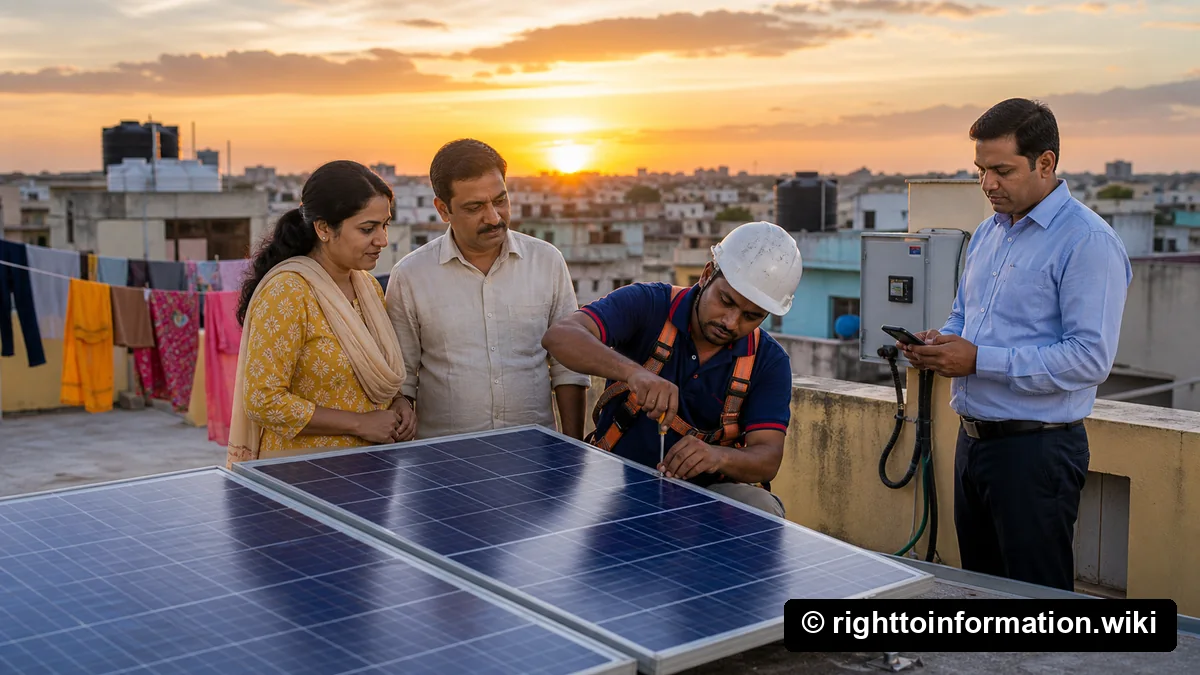
Quick Reply: PM Surya Ghar pays a central subsidy of Rs 30,000 to Rs 78,000 on 1 to 3 kW of rooftop solar, and 10% more in special category states. The aim is free or low-cost electricity of up to 300 units a month from your own panels. Applications are made on pmsuryaghar.gov.in, and the scheme runs until 31 March 2027.
2026 update (checked 15 September 2026). Registration is still open, and the scheme closes on 31 March 2027. New rules this year: the name on your bank account must exactly match your electricity bill, applications with a confidence score below 70% need a signed undertaking and name proof before the subsidy can be redeemed, and scheme-loan subsidies now go to the loan account. For the stage-by-stage checklist, read PM Surya Ghar 2026: subsidy, eligibility, status and deadline.
Want to cut your light bill with a subsidised rooftop solar panel? Here is what to do first, before anything else.
- Open pmsuryaghar.gov.in and register. Choose Apply Now, verify your mobile number with an OTP and fill your profile.
- Apply for rooftop solar. Select your state, district and DISCOM, and enter the consumer number printed on your electricity bill.
- Get feasibility cleared. Your DISCOM checks that your connection is ready. For systems up to 10 kW, the guidelines treat this as deemed approved once your state has put that rule in place.
- Choose a vendor registered on the national portal. Agree the price and terms in writing, and check the vendor's bank details shown on the portal before you pay anything.
- Get it installed and inspected. Your vendor uploads the installation details, you check and submit them, and the DISCOM inspects the system and certifies it.
- Redeem the subsidy. Enter your bank details before installation is submitted. After DISCOM approval, you redeem the subsidy in your login, and it is processed within 15 days.
That is the whole journey in one glance. Now let us slow down and explain each part, because small mistakes here can hold an application up for weeks.
PM Surya Ghar Muft Bijli Yojana gives a central subsidy of Rs 30,000 to Rs 78,000 on a 1 to 3 kW rooftop solar system, and aims to provide free or low-cost electricity of up to 300 units a month through the household's own panels.
Launched: 13 February 2024 · Issued by: Ministry of New and Renewable Energy
| Trust box: Editorial review | |
|---|---|
| Reviewed by: Dr. Shrawan Kumar Pathak, RTI researcher and civic-rights analyst with 12+ years of experience covering central government schemes, subsidy delivery, and citizen grievance redress under the RTI Act. | |
| Expertise: Central welfare schemes, DISCOM procedures, subsidy tracking, and RTI-based escalation for stalled applications. | |
| Sources: Official scheme portal pmsuryaghar.gov.in, MNRE Operational Guidelines for CFA to Residential Consumers (OM dated 7 June 2024) and its 2025 and 2026 amendments, MNRE scheme pages, and the PIB Cabinet approval press release. | |
| Last reviewed: 15 September 2026. | |
| Accuracy policy: All subsidy figures, dates, and process steps are cross-checked against the official portal and ministry guidelines at the time of review. Figures may change; always confirm on pmsuryaghar.gov.in before applying. | |
What you get
Let us be plain about the money, because the “free electricity” name confuses a lot of people.
The central government pays a fixed subsidy based on the size of your system. The slab works like this.
| System size | Central subsidy | Special category states and UTs |
|---|---|---|
| 1 kW | Rs 30,000 | Rs 33,000 |
| 2 kW | Rs 60,000 | Rs 66,000 |
| 3 kW and above | Rs 78,000 (capped) | Rs 85,800 (capped) |
The rule behind the table is simple. You get Rs 30,000 for each of the first two kilowatts, then Rs 18,000 for the third kilowatt, and the subsidy stops growing after that. So a 3 kW system and a 5 kW system both get the same Rs 78,000 from the centre. Anything above 3 kW, you pay for yourself.
Special category means Uttarakhand, Himachal Pradesh, Jammu and Kashmir, Ladakh, the North Eastern states including Sikkim, Andaman and Nicobar Islands, and Lakshadweep. There the per-kW amounts are Rs 33,000 and Rs 19,800.
The “up to 300 units a month free” line is the part people misread. The government is not handing you 300 free units as a gift. The subsidy lowers the cost of the panels, and the electricity comes from your own roof. The Press Information Bureau release on the Cabinet approval says a 3 kW system generates more than 300 units a month on average. When your panels make more than you use, the surplus goes to the grid, and it is credited or bought back under the metering rules your state regulator has approved. Your real saving depends on your roof, your sunlight, and how much power you use.
Who is eligible
The scheme is built for ordinary home users, not for factories or big commercial buildings. You can apply if you tick these boxes.
- You have a residential electricity connection with a DISCOM consumer number. Commercial, industrial and government connections get no subsidy.
- You have a bank account in exactly the same name as the consumer name on your electricity bill. If the names do not match, the subsidy is not processed.
- You have a roof, terrace, balcony or elevated structure where a grid-connected system can go. Ground-mounted elevated structures are allowed. Off-grid systems are not.
- You use a vendor registered on the national portal and made-in-India panels that meet the Domestic Content Requirement and are on MNRE's approved list (ALMM).
There is no income limit in the scheme guidelines. If your home already received an MNRE rooftop solar subsidy under an earlier scheme, you can claim only the balance up to 3 kW. The target is one crore households across the country by the financial year 2026 to 2027, so check the current rules on the portal before you apply.
How much roof space and sunlight do you need?
This is a practical first question, and the answer decides whether the scheme makes sense for your home.
System size: The national portal suggests sizing by your monthly electricity use:
| Average monthly use | Suggested rooftop system |
|---|---|
| Up to 150 units | 1 to 2 kW |
| 150 to 300 units | 2 to 3 kW |
| More than 300 units | Above 3 kW |
Roof area: Ask the vendor to measure the shadow-free area on your roof before you sign. The panels can go on a roof, terrace or balcony, or on an elevated structure, including a ground-mounted elevated structure. Tiled or weak roofs may need a structural check first.
Sunlight and shade: Output depends on your location, the direction the panels face, and shade from nearby buildings, water tanks or trees. The vendor's site visit should flag shading problems before installation, not after.
Inverter and capacity: The subsidy is worked out on the capacity of the solar panels, not the inverter. MNRE has advised DISCOMs to allow up to 10% tolerance between the panel capacity applied for and the panels installed, as long as the inverter stays within the allowed limit.
What is the full subsidy timeline from registration to money in your bank?
Families often ask how long each step takes. The national guidelines do not fix a total number of days, but they do set some clocks. Here is what the official rules say at each step.
| Step | What happens | Official time rule | Who acts |
|---|---|---|---|
| 1. Registration and application | You register with your mobile number and apply with your consumer number | None fixed | You |
| 2. Feasibility | DISCOM clears technical feasibility | Deemed approved up to 10 kW once your state has put the rule in place | DISCOM |
| 3. Vendor selection | You pick a registered vendor and upload the work agreement | Switch freely until the agreement is uploaded | You |
| 4. Installation | Vendor installs and uploads installation details for you to check | If details are not submitted within 60 days of the agreement upload, you can switch vendor (applications without a loan) | Vendor, then you |
| 5. Inspection and commissioning | DISCOM inspects, signs the metering agreement and certifies the system | No fixed national clock. MNRE asked DISCOMs in May 2026 to inspect and commission on time | DISCOM |
| 6. Subsidy | You redeem the subsidy in your login | Processed within 15 days of DISCOM approval | You, then REC Limited for MNRE |
If a step stalls, raise a grievance on the portal. The guidelines say grievances are to be resolved within 30 days. You can also check your PM Surya Ghar subsidy status for 2026 for tracking methods.
How to apply, step by step
- Register on the portal. Go to pmsuryaghar.gov.in, choose Apply Now, enter your mobile number and the captcha, and verify with the SMS OTP. Fill your name, state, district and email.
- Fill the rooftop solar application. Choose Apply for Solar Rooftop, select your state, district and DISCOM, enter your consumer number, press Fetch Details and submit.
- Get feasibility cleared. Your DISCOM confirms your connection can take a rooftop plant. For systems up to 10 kW this is deemed approved once your state has put the rule in place.
- Pick a registered vendor. The portal lists vendors registered for your DISCOM. Choose one, agree the price in writing, and check the vendor's bank details shown on the portal before paying.
- Enter your bank details. Add them before installation is submitted, with a cancelled cheque or passbook copy. These bank documents are the only mandatory documents at application.
- Install the plant. The vendor fits the panels, the inverter and the wiring, then uploads geo-tagged photos and the DCR certificate details and sends the data to you. Check it and submit it to the DISCOM, or send it back.
- Inspection and commissioning. The DISCOM inspects the system, signs the metering agreement and certifies the installation.
- Redeem the subsidy. Log in and redeem the subsidy. It is processed within 15 days of DISCOM approval and paid to your bank account, or to your loan account if you took the scheme loan.
A real-world before and after
Think about a typical four-person family in a small town who own their house and pay a heavy electricity bill every summer. The fans and the cooler run all day, and there is always a quiet worry about the next reading.
Now picture the same home a few months after a 3 kW rooftop system goes in. The panels carry most of the daytime load. On bright days they make more than the family uses, and that extra goes to the grid under the state's metering rules. The bill falls. The system cost the family a large sum up front, but the Rs 78,000 central subsidy took a real bite out of it, and a scheme loan spread the rest into small instalments. This is the shape of the deal: a big one-time push at the start, then years of lower bills. It is an illustration, not a promise, because the numbers depend on your own roof, sunlight and usage.
What is the collateral-free loan and how does it work?
If you cannot pay the full system cost in one go, the scheme links you to a standard bank loan product. You apply from inside your portal login, which is connected to the JanSamarth portal. The loan is for residential consumers only.
For loans up to Rs 2 lakh, the standard product listed on the portal is:
- Interest linked to the RBI repo rate plus 0.50%. The portal table showed 6.00% a year.
- No collateral beyond hypothecation of the solar equipment itself, and no processing fee.
- At least 10% of the project cost from you, and no PAN needed.
- A CIBIL score of 680 or more, or no credit history at all.
- Up to 120 months, a 6-month moratorium and no prepayment charge.
For loans above Rs 2 lakh, up to Rs 6 lakh, PAN is mandatory, your share rises to 20%, and you need a net annual income of at least Rs 3 lakh.
How the loan fits with the subsidy: For scheme loan cases that redeem the subsidy on or after 14 August 2026, the subsidy is credited to the loan account. If JanSamarth does not send your loan details within 15 days of inspection approval, the portal lets you give your savings account details instead.
What documents do you need?
| Document | When it is needed |
|---|---|
| Cancelled cheque or passbook copy | At application, for the subsidy. This is the only mandatory document at that stage |
| Latest electricity bill | For your consumer number. Uploading it is optional |
| Geo-tagged photos of the installed plant | At installation, uploaded by the vendor |
| DCR undertaking certificate | At installation, for the made-in-India panels |
| Aadhaar number | For a scheme loan up to Rs 2 lakh |
| KYC, ITR or Form 16 for 2 years, 6 months of salary statements, electricity bill | For a scheme loan above Rs 2 lakh |
Make sure the name on your bank account matches the name on your electricity bill letter by letter. Since 3 September 2026, applications with a confidence score below 70% need a signed undertaking and a Government of India name proof, such as Aadhaar or Voter ID, before the subsidy can be redeemed.
How does net metering work under PM Surya Ghar?
Net metering is the core mechanism that turns rooftop solar into real savings. Without it, you would only save on power used while the sun shines. With it, extra units your panels produce are recorded and set off against the power you draw at other times.
How it works in practice:
- The DISCOM provides a bidirectional (two-way) meter at your connection, or you may buy one from enlisted meter vendors. This meter records both the energy you import from the grid and the energy you export to it.
- During the day, your panels power your home first. Any surplus flows to the grid and is recorded as exported energy.
- At night or on cloudy days, you draw power from the grid as usual, recorded as imported energy.
- At the end of each billing cycle, the DISCOM calculates the difference. How any surplus is carried forward or paid for depends on your state's rules.
Settlement: The scheme covers every metering arrangement your State Electricity Regulatory Commission has approved, including net metering, gross metering, net billing, virtual net metering and group net metering. Settlement periods and payment for annual surplus differ from state to state, so check your state's regulations.
Delays at the meter stage: The DISCOM has to inspect the installation against what was applied for, sign the metering agreement and fit the meter. MNRE issued an advisory in May 2026 asking DISCOMs to inspect and commission installations on time. If your net meter is delayed, see the practical guide on solar net meter installation delays for escalation steps.
What are common problems and how do you clear them?
- Roof load looks too low. A weak roof structure may need light reinforcement before panels go up. Ask about it during the site visit, not after.
- DISCOM feasibility or inspection is stuck. Raise a grievance on the portal first. A short written request, and then an RTI to a government-owned DISCOM, puts the reason on record. See electricity connection delay and CGRF ombudsman for structured escalation.
- Vendor asks for payment to a personal account. Check the vendor's bank details shown on the national portal before you pay, as the portal itself advises. Use only a vendor registered on the portal.
- Name mismatch or low confidence score. Correct the name with your DISCOM or bank, or upload the undertaking and name proof the portal asks for.
- Subsidy is delayed. Once the DISCOM has approved your installation and you have redeemed the subsidy, it should be processed within 15 days. If it is not, use the written routes below. See also rooftop solar subsidy not credited or application rejected.
- Wrong bill after net metering starts. Sometimes the DISCOM continues billing under the old meter reading or fails to apply net metering credits. If your first post-solar bill looks wrong, file a billing correction request with the DISCOM immediately. See electricity bill doubled after meter installation for troubleshooting steps.
- Vendor stops responding. File a grievance on the portal. Under MNRE's June 2026 procedure, the vendor gets 8 days to explain, then a reminder, then a show-cause notice, and can be deactivated for a month. You can also file a consumer complaint.
Subsidy delayed or feasibility refused? File an RTI
When the helpline and the portal grievance lead nowhere, a written Right to Information request makes the office answer in writing or explain why it cannot.
The Ministry of New and Renewable Energy runs the scheme, and REC Limited runs the national portal for it. MNRE is a public authority under the RTI Act, and so are government-owned DISCOMs, so you can ask each for the records on your own application.
- Draft it in minutes: AI RTI Drafter
- Stage-by-stage 2026 checklist and a sample RTI to MNRE: PM Surya Ghar 2026: subsidy, eligibility, status and deadline
- Full filing and appeal process: The RTI Playbook
- If your subsidy itself is stuck: how to use RTI for delayed subsidy payments
- If the issue is a billing dispute post-installation: RTI for electricity bill disputes
- If the DISCOM connection itself is delayed: RTI for electricity connection delays
- General electricity complaint RTI template: electricity complaint RTI guide
Where this scheme came from
PM Surya Ghar Muft Bijli Yojana was launched on 13 February 2024 by the Union government led by Prime Minister Narendra Modi, and the Cabinet approved it on 29 February 2024 with an outlay of Rs 75,021 crore. It is run by the Ministry of New and Renewable Energy, and it aims to put rooftop solar on one crore homes, with the scheme period ending on 31 March 2027. The earlier Grid-Connected Rooftop Solar Phase II programme was subsumed into it. You can see it next to every other central and state welfare scheme on the All Modi-era Sarkari Yojana index 2014 to 2026.
Frequently asked questions
How much will I save every year?
It depends on your roof, sunlight, system size and tariff. The PIB release on the Cabinet approval says a 3 kW system generates more than 300 units a month on average. Every unit your panels make is a unit you do not buy from the DISCOM, and surplus is handled under your state's metering rules.
Is it truly free electricity for everyone?
No. The scheme gives a subsidy on the system, and the electricity comes from your own panels and net metering. A right-sized plant can bring the bill down sharply, but the exact result varies home to home. It is not a free units gift card.
Can I get a loan for the installation?
Yes. Apply from your portal login through JanSamarth. For loans up to Rs 2 lakh the standard product is linked to the repo rate plus 0.50%, needs a CIBIL score of 680 or more or no credit history, needs no PAN and no processing fee, and asks for at least 10% from you.
Do I pay the vendor directly in cash?
Pay the vendor through a traceable bank payment, and check the vendor's bank details shown on the national portal first. The portal advises consumers to verify those details before making any payment.
What about cleaning and repairs later?
Panels need a wash now and then to stay efficient. Registered vendors must repair and maintain the system free of cost for 5 years from commissioning, under a comprehensive maintenance contract. After that, the manufacturers' warranties apply.
How long does the whole process take?
The guidelines do not fix a total. They do say the subsidy is processed within 15 days of DISCOM approval, grievances are to be resolved within 30 days, and you can switch vendor if installation details are not submitted within 60 days of the agreement upload for applications without a loan.
Can a tenant apply, or does the owner need to?
The guidelines do not set a separate process for tenants. The subsidy follows the consumer name on the electricity bill, and the bank account must match it. If the panels will sit on a roof you do not own, get the owner's written agreement before any work starts.
What happens to my solar system if I move house?
If you move, agree with the buyer or landlord what happens to the panels. A rooftop installation gets the subsidy only once, and a system shifted to a new place is not eligible again. Ask your DISCOM how the metering agreement is handled for the new occupant.
Can I install a system larger than 3 kW?
Yes, but the central subsidy is capped at Rs 78,000 for 3 kW and above, or Rs 85,800 in special category states. If you install a 4 kW or 5 kW system, you pay the full cost of the additional capacity yourself. Your inverter must stay within the sanctioned load or the capacity allowed by your state's rules.
Do all states offer the same subsidy?
No. The central subsidy is 10% higher in special category states and UTs. Some states also add their own top-up. Uttar Pradesh adds Rs 15,000 per kW up to 2 kW. Delhi's notified rate is Rs 10,000 per kW up to Rs 30,000. A September 2026 notice on the Delhi Solar Portal announces Rs 78,000, with free installation for homes using less than 400 units a month. See what is confirmed about Delhi's new terms. Check the portal and your state agency for current amounts.
What is the difference between PM Surya Ghar and the earlier rooftop solar scheme?
The Grid-Connected Rooftop Solar Phase II programme was subsumed into PM Surya Ghar. Phase II applications that were already installed, inspected or redeemed can still be claimed if the claim is received by 30 November 2026. Phase II applications that were not installed on 1 April 2025 were deleted, and those households can apply again under PM Surya Ghar.
Is there any income limit to apply?
No. The scheme guidelines set no income limit. The scheme is for residential consumers, not commercial or industrial users.
What happens if my vendor stops work mid-project?
File a grievance on the portal against the vendor. You can switch vendor freely before the work agreement is uploaded. After that, for applications without a loan, you can switch if the vendor has not submitted installation details within 60 days of the agreement upload.
Summary and next step
Bottom line: a central subsidy of Rs 30,000 to Rs 78,000 on a 1 to 3 kW rooftop solar system, 10% more in special category states, a standard bank loan for the rest, and panels that can offset a large part of your monthly use. Apply at pmsuryaghar.gov.in before the scheme closes on 31 March 2027. If feasibility, inspection or the subsidy is stuck, a portal grievance and then an RTI put the reasons on record.
- Apply now: pmsuryaghar.gov.in
- 2026 stage checklist: PM Surya Ghar 2026 guide
- If delayed, draft an RTI: AI RTI Drafter
- All government schemes: Sarkari Yojana index
Related schemes
Sources
- Official portal: pmsuryaghar.gov.in (home page, FAQs, consumer application journey and standard loan product, read 15 September 2026)
- Ministry of New and Renewable Energy, OM No. 318/17/2024-Grid Connected Rooftop dated 7 June 2024, Operational Guidelines for the component CFA to Residential Consumers, with amendments dated 7 July 2025 and 31 August 2026
- MNRE advisories dated 25 March 2026 (capacity tolerance) and 21 May 2026 (timely inspection and commissioning), and OM dated 22 June 2026 (vendor complaint procedure)
- Ministry of New and Renewable Energy, scheme guidelines: MNRE schemes and guidelines
- Press Information Bureau, Cabinet approves PM-Surya Ghar: Muft Bijli Yojana, 29 February 2024, outlay Rs 75,021 crore: PIB release ID 2010133
- Delhi Solar Portal, About Delhi Solar Energy Policy, 2023, and UPNEDA PM Surya Ghar flyer, for the state top-ups
- National helpline: 15555
By Dr. Shrawan Kumar Pathak
Last reviewed: 15 September 2026.