Find Unclaimed Deposits on UDGAM 2026
RBI Ombudsman as of 1 July 2026: Bank, certain NBFC, prepaid-instrument and credit-information complaints go under the Reserve Bank - Integrated Ombudsman Scheme, 2026, which replaced RB-IOS 2021 from 1 July 2026. First complain to the entity. If there is no reply in 30 days (or the longer NPCI/card-network window, if it applies) or you reject the reply, file free at cms.rbi.org.in within 90 days. The Ombudsman can award up to Rs 30 lakh for consequential loss and up to Rs 3 lakh for time, expenses and harassment. Complaints received before 1 July 2026 stay under the 2021 scheme. Source: RBI FAQ, updated 1 July 2026 and the RB-IOS 2026 FAQ PDF dated 1 July 2026.

Reviewed on 2026-06-20 by Dr. Shrawan Kumar Pathak.
Quick Reply: Go to the RBI portal udgam.rbi.org.in, register with your mobile number, then search by account holder name, bank and one ID such as PAN or date of birth. If a match appears with a UDRN, take that reference to the named bank branch with your KYC and claim the deposit with interest.
The money that quietly left your account
Here is something most depositors never learn. When a savings or current account sits untouched, with no transaction you yourself made, for over ten years, or when a fixed deposit matures and nobody claims it for ten years, the bank does not keep that balance. It ships the money to the Reserve Bank of India, into a pool called the Depositor Education and Awareness Fund, the DEA Fund. By mid-2025 that pool had swollen to tens of thousands of crores of rupees, money that belongs to ordinary people who simply forgot, moved house, or passed away without telling their family where the passbook was.
For years there was no way to trace it. You would have had to guess which bank, walk into a branch, and hope. That changed on 17 August 2023, when the RBI launched UDGAM, short for Unclaimed Deposits, Gateway to Access inforMation. It is a single search window across many banks at once. This guide follows the paper trail from a dead account to cash in your hand, and shows you exactly where claims tend to stall.
Why 2026 is the year to look
The timing matters. On 1 October 2025 the RBI opened a one-year drive called the Scheme for Facilitating Accelerated Payout of Inoperative Accounts and Unclaimed Deposits. It runs until 30 September 2026 and pushes every bank registered with the DEA Fund to actively chase down depositors and return the money. In plain terms, banks are under instruction to say yes faster this year. If you have ever suspected a forgotten account, this is the window to act in.
Step 1: Register on UDGAM
Open udgam.rbi.org.in in a browser. Do not trust look-alike apps or links from messages; type the address yourself. Click Register, enter your name and mobile number, set a password, clear the captcha, accept the disclaimer, and verify the one-time password sent to your phone. There is no fee. The account you create here is only a search login; it is not your bank login and asks for no account number.
A caution on imitators
Because real money is involved, fake “unclaimed deposit” sites and agents have appeared. UDGAM never asks you to pay a recovery fee, and it never settles money through the portal itself. If anyone demands a cut to “release” your deposit, walk away.
Step 2: Run the search
Once you are in, search in the individual category. You must supply the account holder name and the bank name, plus at least one identifier: PAN, Voter ID, Driving Licence number, Passport number, or the account holder's date of birth. An address can stand in if you lack those. Search one bank at a time if you are unsure which one held the deposit; the portal currently covers a panel of about thirty banks that together hold roughly nine-tenths of the DEA Fund money, so try the likeliest names first.
If you are searching for a company or trust rather than yourself, the non-individual search asks for the entity name, the bank, and one of: authorised signatory name, PAN, Corporate Identification Number, or date of incorporation.
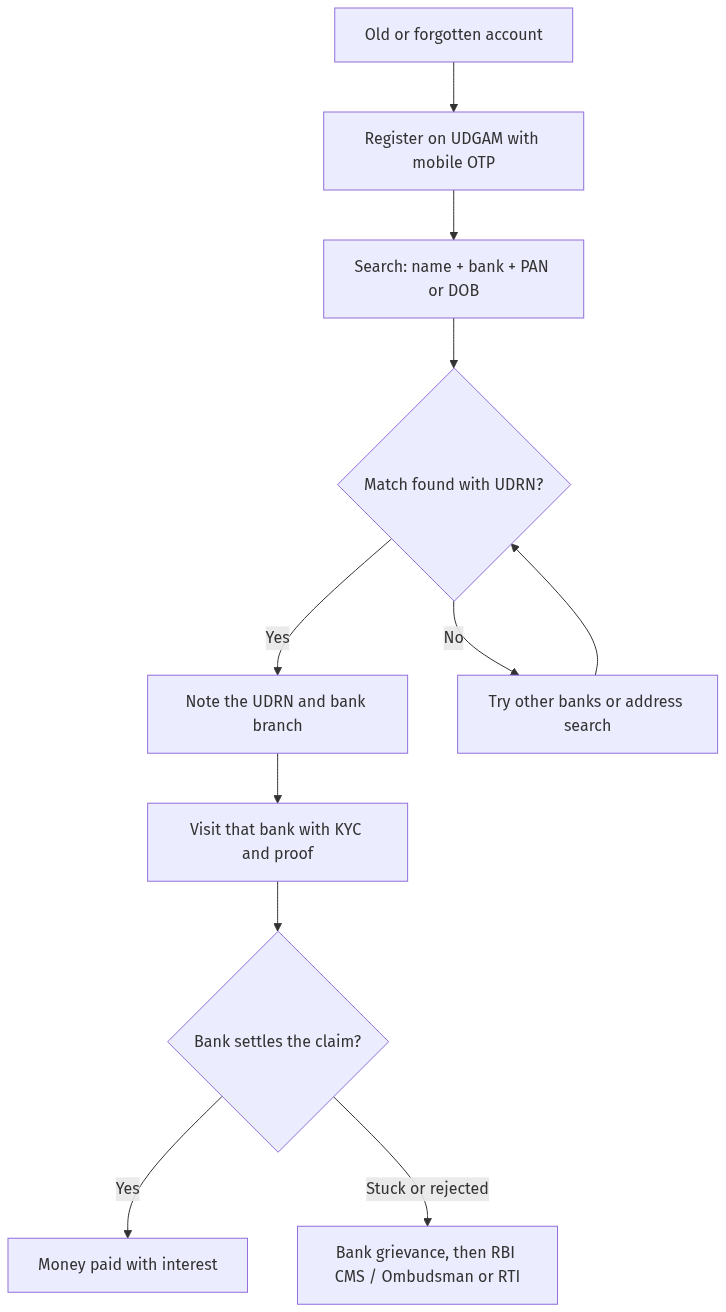
Figure: step-by-step flow. If a step stalls, use the grievance or RTI route shown.
Reading the result and the UDRN
A match does not show your full account number, and that is by design. Instead it returns the account holder name, the bank, the branch or location, and a code called the UDRN, the Unclaimed Deposit Reference Number. The bank's core banking system generates this number for every unclaimed deposit so that the portal can confirm the money exists while keeping the actual account details hidden from strangers. Write the UDRN down. It is the thread that links the search result to the real account inside the bank.
Step 3: Claim at the bank, not on the portal
This is the point everyone misses. UDGAM only tells you the money is there. The RBI is explicit: an unclaimed deposit can be claimed only from the respective bank. So take the UDRN and your identity proof to the branch named in the result. Ask for the unclaimed deposit or inoperative account claim form. You will typically submit fresh KYC documents, the deposit receipt if you have it, and a photograph. The deposit is repaid with the interest that kept accruing while it lay dormant.
If the account holder has died, the legal heir or nominee claims instead, adding the death certificate and the bank's nominee or legal-heir paperwork. The same trail applies when a nominee is stuck claiming a deceased relative's account.
If the account is dormant, not yet unclaimed
Sometimes the search shows an account that is merely inoperative, meaning no transaction you made for over two years, rather than fully unclaimed after ten. Good news: under the revised RBI rules in force since 1 April 2024, reactivating it is free. Banks cannot charge you to revive an inoperative account, cannot levy penalty for low balance during that period, and must let you complete fresh KYC at any branch or by video KYC. Our guides on reactivating a dormant account and on updating bank KYC without a branch visit walk through that process.
When the claim stalls
Banks do not always move at the pace the RBI wants. If the branch delays, loses your form, or refuses without a written reason, first lodge a written grievance with the bank and keep the acknowledgement. If thirty days pass with no proper reply, or the reply is unsatisfactory, escalate to the RBI through the Complaint Management System at cms.rbi.org.in, which routes to the Banking Ombudsman. A parallel route is an RTI to the bank, if it is a public sector bank, asking for the status of your claim file and the UDRN record. If a wrongful freeze is blocking you, see how to handle a frozen bank account.
Frequently asked questions
Is there any fee to use UDGAM or to get my money?
No. Registration and searching on udgam.rbi.org.in are free, and the bank cannot charge you to reactivate an inoperative account or to settle an unclaimed deposit. Anyone asking for a recovery fee is a fraud.
How long does the money stay claimable after ten years?
There is no expiry on your right. Even after the balance is transferred to the RBI DEA Fund, you or your legal heir can still claim it from the bank, along with the interest due. The bank gets the amount back from the DEA Fund to pay you.
My bank is not on UDGAM. What then?
The portal covers a panel of about thirty banks that hold most of the DEA Fund. If yours is missing, approach that bank's branch directly with your old account details and ask for its unclaimed deposit list or claim form. Verify the current bank panel on udgam.rbi.org.in.
What if I do not have the account number or passbook?
You do not need it. UDGAM is built to work without the account number; you search by name, bank and one ID such as PAN or date of birth. The result gives a UDRN, not the account number, and the bank uses that to locate the deposit.
Can I claim a deceased parent's unclaimed deposit?
Yes. Search by their name and details, note the UDRN, then claim at the bank as the legal heir or nominee, attaching the death certificate and the bank's prescribed forms. Without a nominee, the succession process applies.
What is the difference between an inoperative account and an unclaimed deposit?
An account turns inoperative when you make no transaction yourself for over two years; it is still inside the bank and you can reactivate it free. It becomes an unclaimed deposit only after ten years, at which point the balance is moved to the RBI DEA Fund but stays claimable.
The bank is delaying my claim. What can I do?
File a written grievance with the bank first and keep the receipt. If unresolved in thirty days, complain to the RBI through cms.rbi.org.in, which feeds the Banking Ombudsman. For a public sector bank you may also file an RTI asking for your claim status and the UDRN record.
Sources
UDGAM unclaimed deposits portal: How to claim (2026)
- Step 1: What is UDGAM and how to claim unclaimed deposits? (a) UDGAM: (i) Unclaimed Deposits — Gateway to Access Information — RBI portal, (ii) launched August 2023 — search unclaimed deposits across banks, (iii) deposits unclaimed for 10+ years — transferred to RBI DEAF (Depositor Education and Awareness Fund), (b) key rules: (i) RBI Act 1934 Section 26A: unclaimed deposits transferred to DEAF after 10 years, (ii) depositor/legal heir can claim — even after transfer to DEAF, (iii) UDGAM portal: single window — search multiple banks, © common scenarios: (i) dormant account — no transaction 10+ years, (ii) deceased depositor — heir claims, (iii) forgotten FD — matured but not claimed, (iv) inoperative account — no activity, (v) savings account — balance unclaimed, (d) rights: (i) depositor/heir has right to claim — even after DEAF transfer, (ii) right to interest — as per RBI rules, (iii) right to nomination — check nominee details, (e) authority: RBI + Bank + DEAF Trust, (f) law: RBI Act 1934 Section 26A + Banking Regulation Act 1949.
- Step 2: Comparison table — unclaimed deposit types. (a) Savings account: (i) issue: no transaction 10+ years, (ii) remedy: UDGAM + bank claim, (iii) timeline: 30-60 days, (iv) example: dormant; searched; claimed, (b) Fixed deposit: (i) issue: matured but not claimed, (ii) remedy: UDGAM + bank + KYC, (iii) timeline: 30-60 days, (iv) example: forgotten; searched; claimed, © Deceased depositor: (i) issue: heir needs to claim, (ii) remedy: UDGAM + death cert + succession, (iii) timeline: 60-90 days, (iv) example: deceased; heir; claimed, (d) Inoperative: (i) issue: no activity 2+ years, (ii) remedy: bank + KYC reactivation, (iii) timeline: 15-30 days, (iv) example: inoperative; reactivated; claimed, (e) Recurring deposit: (i) issue: RD matured unclaimed, (ii) remedy: UDGAM + bank, (iii) timeline: 30 days, (iv) example: matured; searched; claimed. (Note: UDGAM is free. Search by name/PAN/account. Claim from bank even after DEAF transfer.)
- Step 3: How to claim unclaimed deposits via UDGAM. (a) Step 1: Visit udgam.rbi.org.in, (b) Step 2: Register with mobile + email, © Step 3: Search by name/PAN/account number, (d) Step 4: Select bank + deposit details, (e) Step 5: Visit bank branch with KYC + documents, (f) Step 6: Bank processes claim — deposit to account.
- Step 5: Practical tips. (a) search UDGAM — free portal, (b) check all family members — including deceased, © claim even after DEAF transfer — RBI returns, (d) nominee details crucial — check nomination, (e) Example: A depositor found Rs 50,000 unclaimed FD via UDGAM; claimed in 30 days.
- Step 6: Key provisions. (a) RBI Act 1934 Section 26A, (b) DEAF Fund, © UDGAM: free portal, (d) 10 years: transfer to DEAF, (e) Claim: even after transfer.
See UDGAM Portal and Banking and How to File RTI.