Claim a Deceased Person's Bank Money 2026
RBI Ombudsman as of 1 July 2026: Bank, certain NBFC, prepaid-instrument and credit-information complaints go under the Reserve Bank - Integrated Ombudsman Scheme, 2026, which replaced RB-IOS 2021 from 1 July 2026. First complain to the entity. If there is no reply in 30 days (or the longer NPCI/card-network window, if it applies) or you reject the reply, file free at cms.rbi.org.in within 90 days. The Ombudsman can award up to Rs 30 lakh for consequential loss and up to Rs 3 lakh for time, expenses and harassment. Complaints received before 1 July 2026 stay under the 2021 scheme. Source: RBI FAQ, updated 1 July 2026 and the RB-IOS 2026 FAQ PDF dated 1 July 2026.

Reviewed on 2026-06-20 by Dr. Shrawan Kumar Pathak.
Quick Reply: To claim a deceased relative's bank balance, take the death certificate, your ID and a claim form to the branch. If there is a nominee or a survivor clause, that is usually all you need. With no nominee, you add an indemnity bond and a legal heir certificate. Under the RBI 2025 Directions the bank must settle within 15 days of getting your full papers.
Losing someone is hard, and money worries make it harder. Take a breath. The process is more settled than it used to be, and most families get the balance released with a short list of documents. This guide walks you through it gently, one situation at a time, so you know exactly what to carry to the bank.
First, find out which situation you are in
The documents you need depend on one thing: what the account holder set up before they died. There are three common situations. Read the three short descriptions below and pick the one that matches.
Situation 1: there was a nominee
If your relative named a nominee on the account, that nominee can claim the balance. The bank treats the nominee as the person to pay, after basic checks. You will usually need only the claim form, the death certificate and the nominee's identity proof. You do not need a succession certificate or a court order for this route, whatever the amount. A nominee receives and holds the money as a trustee for the legal heirs, so the law on who finally owns it still applies, but the bank can release it quickly. Our guide to bank nomination rules explains the nominee's exact role.
Situation 2: it was a joint account with a survivor clause
If the account was held jointly with a clause like “either or survivor” or “former or survivor”, the surviving holder simply continues with the account. They give the bank the death certificate so the deceased name can be removed. No claim process, no succession certificate, no court. The survivor keeps the balance.
Situation 3: there was no nominee and no survivor
This is the situation families fear, but it is now manageable. The Reserve Bank of India (Settlement of Claims in respect of Deceased Customers of Banks) Directions, 2025 created a simplified route so you do not always need a court order. For amounts within your bank's threshold, you can claim with ordinary documents and an affidavit. Only larger or disputed claims need a succession certificate or probate.
The documents to carry
Carry photocopies and the originals. The bank keeps the copies and returns the originals after checking.
If there is a nominee or a survivor clause
- The bank's deceased-claim form (ask the branch or download it from the bank's website).
- The original death certificate, plus a copy.
- Your own identity proof as the nominee or survivor.
If there is no nominee and the amount is small
For accounts with no nominee and no survivor, where the balance is within your bank's simplified limit, you usually need:
- The claim form.
- The death certificate.
- Identity proof of each legal heir claiming.
- An indemnity bond on stamp paper (the bank gives the format).
- A legal heir certificate from the competent authority, or an affidavit declaring the heirs.
- A no-objection or disclaimer letter from any other heirs who are not claiming.
Each bank fixes its own threshold for this simplified route, and the RBI has set the floor: at least Rs 15 lakh for commercial banks and at least Rs 5 lakh for cooperative banks. Many banks set a higher limit, so do ask your branch what their simplified-claim ceiling is rather than assuming.
If the amount is large or the heirs disagree
Above your bank's threshold, or where there is a dispute about who inherits, the bank will ask for a court document: a succession certificate, a probate of the will, a letter of administration, or a court decree. These take time and a lawyer, but they protect everyone when the sums are big or the family is split.
The step-by-step claim
- Tell the branch. Visit the home branch and say the account holder has died. Ask for the deceased-claim form and the exact document list for your situation.
- Gather the papers. Collect the death certificate, your ID, and any heir certificate, indemnity bond or court document the form asks for. Get the affidavit notarised if required.
- Submit everything together. Hand over the complete set in one go. This matters, because the 15-day settlement clock starts only when the bank has all your documents.
- Get an acknowledgement. Ask for a dated receipt or acknowledgement of what you submitted. Keep it safe.
- Wait for settlement. Under the 2025 Directions, the bank must settle the claim within 15 calendar days of receiving the full set. The money is paid to the claimant or transferred to your account.
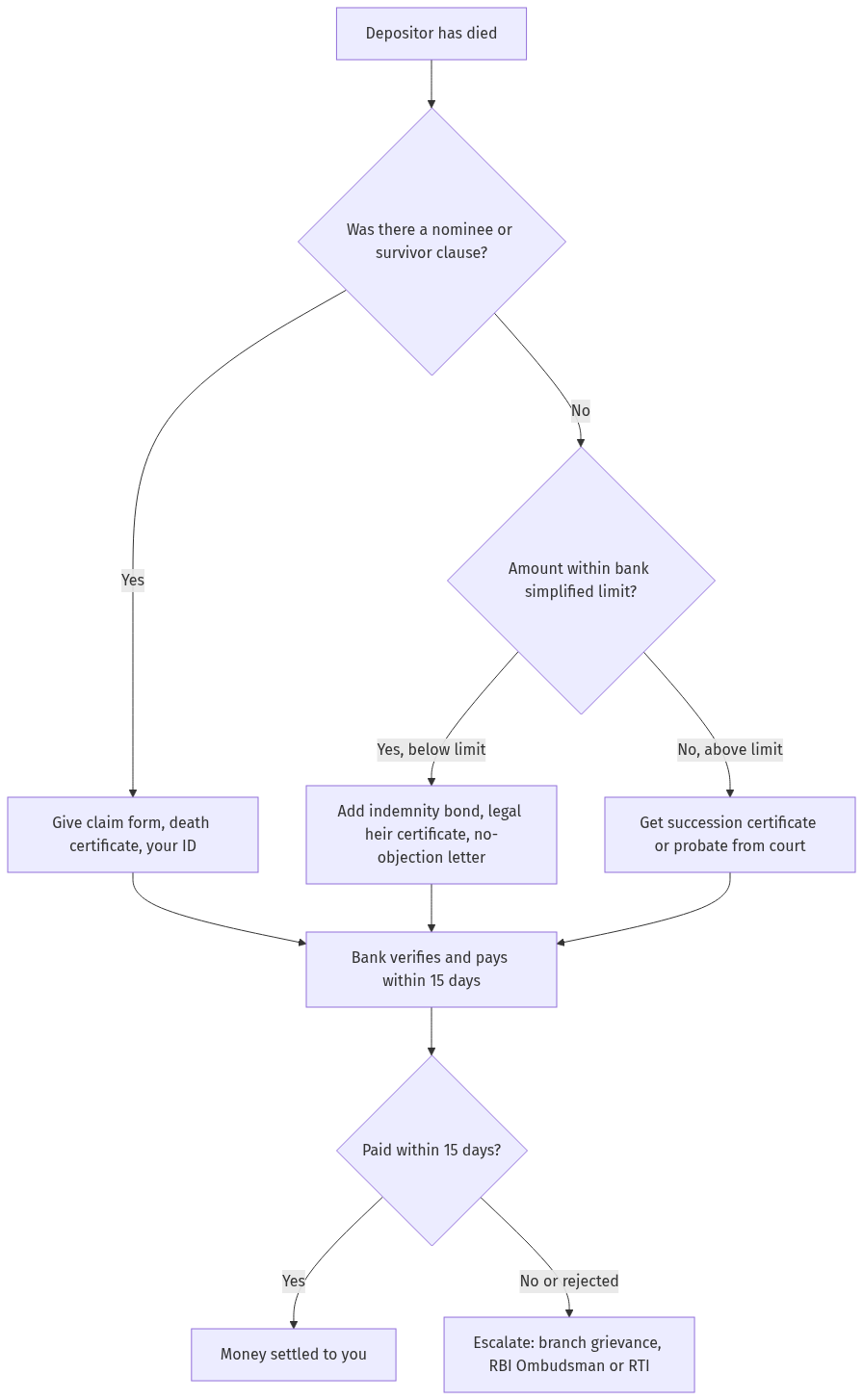
Figure: step-by-step flow. If a step stalls, use the grievance or RTI route shown.
What if the account was dormant or you cannot trace it
Sometimes families do not know where a relative banked, or an old account lay untouched for years. If an account has no customer activity for ten years or more, the balance moves to the RBI's Depositor Education and Awareness Fund. You can still claim it. The RBI runs a free search portal called UDGAM where legal heirs can look for unclaimed deposits across member banks. It only finds the account, it does not pay you, so after a match you approach that bank with the same claim documents. See our UDGAM unclaimed deposits guide for how to search.
If the bank delays or refuses
The bank cannot sit on a complete claim. If it crosses 15 days after you submitted everything, it owes you interest at the Bank Rate plus 4 per cent for the delay. Our guide to deceased-account claim delays shows how to count the days, calculate that compensation, write a follow-up letter and escalate to the banking ombudsman. For a public sector bank, you can also file an RTI to ask why your claim is pending. Start from the banking help hub to find the right next step.
Frequently asked questions
Do I need a succession certificate to claim my parent's bank account?
Not always. If your parent named a nominee, or the account was a survivor joint account, the bank pays without any court document. With no nominee, you need a succession certificate only when the balance is above your bank's simplified threshold or when the heirs disagree. Below that threshold you can claim with an affidavit and a legal heir certificate.
How long does the bank take to release a deceased person's money?
The RBI Directions of 2025 require the bank to settle within 15 calendar days of receiving every required document. The clock starts only when your file is complete, so submit everything together and keep a dated acknowledgement. If the bank misses 15 days, it owes you interest for the delay.
I am the nominee but my siblings say the money is theirs. Who gets it?
The bank will still pay you as the nominee, but a nominee is only a trustee who receives the money. Final ownership follows the will or the law of inheritance. So you hold the balance for the rightful heirs and must share it as the law requires. If there is a genuine dispute, the heirs may need a court to decide.
What is the threshold for claiming without a court order?
Each bank sets its own limit for the simplified, no-court route. The RBI has fixed a minimum of Rs 15 lakh for commercial banks and Rs 5 lakh for cooperative banks, and a bank may set a higher limit. Ask your branch for their exact simplified-claim ceiling before you assume you need a succession certificate.
The account holder banked somewhere we cannot trace. What do we do?
Use the RBI's free UDGAM portal to search for unclaimed deposits across member banks. If the account has been inactive for ten years or more, the balance sits in the RBI's Depositor Education and Awareness Fund and is still claimable. After UDGAM shows a match, approach that bank with the death certificate and your claim documents.
Can the bank refuse to give a claim form or the document list?
No. The bank must give you the claim form and tell you exactly what to submit. If a branch stalls, ask for the request in writing, escalate to the bank's grievance officer, and then to the RBI Ombudsman. For a public sector bank you can also file an RTI asking for the status and reasons for any delay.
Is an indemnity bond always needed for a no-nominee claim?
For the simplified no-nominee route, banks usually ask for an indemnity bond on stamp paper to protect themselves, along with a legal heir certificate or affidavit and a no-objection letter from other heirs. The bank gives you the bond format. For nominee or survivor claims, no indemnity bond is needed.
Sources
Deceased account claim: How to claim bank account of deceased person (2026)
Deceased account claim in banks: Complete guide (2026)
- What is a deceased account claim? (a) When account holder dies: (i) Bank account — savings/current/FD — needs to be settled, (ii) Legal heirs/nominee can claim the balance, (iii) Bank must release funds — to rightful claimants — after verification, (b) Types of claims: (i) Nominee claim: nominee named in account — simplest, (ii) Legal heir claim: no nominee — through legal heir certificate/succession certificate, (iii) Joint account: survivor becomes owner — if “either or survivor” mandate, © Common issues: (i) Bank delays release — despite nominee, (ii) Bank demands succession certificate — even with nominee, (iii) Bank freezes account — without informing family, (iv) Multiple legal heirs — dispute among themselves.
- How to claim deceased account balance? (a) Step 1: Gather documents: (i) Death certificate — original + copy, (ii) Account details — account number + bank + branch, (iii) Nominee details — if nominee exists, (iv) KYC of claimant — Aadhaar + PAN + photo, (v) Legal heir certificate — if no nominee, (vi) Succession certificate — if required by bank — for large amounts, (b) Step 2: Submit claim: (i) Visit bank branch — with documents, (ii) Fill claim form — death claim form — available at branch, (iii) Submit: death certificate + KYC + claim form + nominee proof, © Step 3: Bank verification: (i) Bank verifies: (1) Death certificate — with municipal records, (2) Nominee details — in account records, (3) KYC of claimant, (ii) Timeline: 7-15 days — for nominee claim, 15-30 days — for legal heir claim, (d) Step 4: Release of funds: (i) Bank transfers balance — to nominee/legal heir account, (ii) Or: issues cheque/DD — in claimant's name, (iii) Bank closes deceased account — after transfer.
- Comparison table: Claim types and requirements. (a) With nominee: (i) Documents: death certificate + KYC + claim form, (ii) Timeline: 7-15 days, (iii) Legal certificate: not needed, (iv) Limit: up to RBI prescribed amount — currently no limit if nominee registered, (b) Without nominee — legal heirs: (i) Documents: death certificate + legal heir certificate + KYC + claim form, (ii) Timeline: 15-30 days, (iii) Legal certificate: legal heir certificate — from Tahsildar, (iv) Limit: up to Rs 5 lakh — with legal heir certificate + indemnity, © Without nominee — succession certificate: (i) Documents: death certificate + succession certificate from court + KYC, (ii) Timeline: 3-6 months — court process, (iii) Legal certificate: succession certificate — mandatory, (iv) Limit: no limit — court order covers amount, (d) Joint account — survivor: (i) Documents: death certificate + KYC + survivorship proof, (ii) Timeline: 7-15 days, (iii) Legal certificate: not needed — if “survivor” mandate, (iv) Limit: no limit — survivor owns account. (Note: Nominee is simplest — always register nominee in all accounts.)
- What to do if bank delays or refuses deceased claim? (a) Step 1: Written complaint: (i) To branch manager — with claim details + delay period, (ii) Give 15 days — for resolution, (b) Step 2: Banking Ombudsman: (i) File complaint — with RBI Banking Ombudsman — cms.rbi.org.in, (ii) Grounds: (1) Unreasonable delay — despite complete documents, (2) Demanding unnecessary documents — succession cert for nominee claim, (3) Freezing account — without proper reason, (iii) Ombudsman can order bank — to release funds — within 30 days, © Step 3: Consumer forum: (i) File complaint — deficiency of service — if bank delays beyond 30 days, (ii) Claim: balance + interest + compensation for delay, (d) Step 4: RBI complaint: (i) File directly with RBI — through cms.rbi.org.in, (ii) RBI can take action — against bank — for violating deceased claim guidelines, (e) RBI guidelines: (i) Bank must release nominee claim — without succession certificate — RBI circular 2011, (ii) Bank must settle claim — within 15 days — for nominee, (iii) Bank must not freeze account — without intimation to family.
- Practical tips. (a) Always register nominee — in all bank accounts + FDs — saves months, (b) Keep death certificate — multiple copies — from municipality, © If bank demands succession cert despite nominee — cite RBI circular — file Ombudsman complaint, (d) Joint account with “survivor” mandate — survivor can operate immediately, (e) Example: Son filed nominee claim for father's FD — Rs 12 lakh; bank demanded succession certificate; filed RBI Ombudsman complaint; Ombudsman ordered bank to release — within 7 days — as nominee was registered; funds transferred in 5 days.
See Deceased Account Claim and Nominee Rules and How to File RTI.