Home Loan Property Documents Checklist 2026
RBI Ombudsman as of 1 July 2026: Bank, certain NBFC, prepaid-instrument and credit-information complaints go under the Reserve Bank - Integrated Ombudsman Scheme, 2026, which replaced RB-IOS 2021 from 1 July 2026. First complain to the entity. If there is no reply in 30 days (or the longer NPCI/card-network window, if it applies) or you reject the reply, file free at cms.rbi.org.in within 90 days. The Ombudsman can award up to Rs 30 lakh for consequential loss and up to Rs 3 lakh for time, expenses and harassment. Complaints received before 1 July 2026 stay under the 2021 scheme. Source: RBI FAQ, updated 1 July 2026 and the RB-IOS 2026 FAQ PDF dated 1 July 2026.

Reviewed on 2026-06-20 by Dr. Shrawan Kumar Pathak.
Quick Reply: A lender checks the registered sale or title deed, the chain of title (mother deed), the Encumbrance Certificate from your state registration office, the sanctioned plan, the occupancy certificate and current property tax receipts. After you repay, the lender must return all originals within 30 days or pay Rs 5,000 per day.
Tick this list before you sign anything. A home loan stalls far more often on a missing property paper than on your salary slip. Below is the full checklist, the pitfall that trips up each item, and the closure step most buyers forget.
The core document checklist
Treat each line as a box you must tick. Anything you cannot tick is a red flag to raise with the seller in writing, not to ignore.
Ownership and title papers
- Registered sale deed (or title deed). The stamped, registered deed in the current seller's name. Pitfall: an unregistered agreement to sell is not a title. Confirm the difference in our note on the sale deed versus agreement to sell.
- Chain of title (mother deed and prior deeds). A continuous link of past owners. Lenders usually trace ownership back about thirty years. Pitfall: one broken link, a gift or partition deed that was never registered, can sink the whole file.
- Encumbrance Certificate (EC). Issued by your state Sub-Registrar or IGR office, it lists registered charges and transactions for a period. Pitfall: the EC only shows registered dealings. An unregistered family claim will not appear, so ask the seller directly about co-owners and heirs.
Approvals and tax papers
- Sanctioned building plan or layout approval from the municipal body or development authority. Pitfall: deviations from the approved plan can make a flat hard to mortgage.
- Occupancy Certificate (OC) for a finished building, and the Completion Certificate (CC). For an under-construction unit you also need the Commencement Certificate. Pitfall: no OC means the building is not legally fit for occupation, and many lenders will refuse.
- Khata, patta or mutation extract plus the latest property tax receipts. These prove the local record is in the seller's name. Pitfall: the term and portal change by state, so use your own municipality's site. See khata and patta transfer and how to pay property tax online.
Project, society and special papers
- RERA registration number for any under-construction project. Verify it before you pay a rupee using our guide to check a RERA project. The central hub is rera.gov.in, which links to each state authority.
- Builder-buyer agreement and builder NOC for a builder flat; society NOC and share certificate for a cooperative society flat.
- Land-use or conversion certificate where agricultural land has been converted to residential use.
You will also hand over your own KYC, income and bank papers, but those rarely cause delay. The property side is where files die.
State by state: where each paper comes from
There is no single all-India window for property papers. The Encumbrance Certificate, khata or mutation, property tax record, and the approved building plan all come from your own state and city offices, not from one national portal.
- Registration and EC: your state Inspector General of Registration (IGR) or Sub-Registrar portal.
- Khata, patta, mutation and land records: your municipal body or state land-records portal.
- Approved plan and OC: the local municipal corporation or development authority.
- RERA: your state RERA authority, reachable through rera.gov.in.
Fees, form numbers and turnaround for an EC differ by state, so verify the current fee and process on your own state IGR portal before you plan around a date.
Pitfalls that quietly stall a sanction
These are the ones buyers learn about too late.
- Trusting a photocopy. Insist on seeing originals and getting certified copies. A clean photocopy can hide an erased page.
- Skipping the CERSAI check. The Central Registry of Securitisation Asset Reconstruction and Security Interest, set up under the SARFAESI Act 2002, records charges that lenders create on a property. Its public search tells you if the property is already mortgaged elsewhere. Run a search at cersai.org.in. There is a small public-search fee, so verify the current figure on cersai.org.in.
- Ignoring the stamp duty paper trail. An under-stamped deed can be impounded later. Plan your costs with our note on stamp duty and registration charges.
- Forgetting the closure papers. The day you repay, the job is not done until your originals are back and the charge is removed. That is the next section.
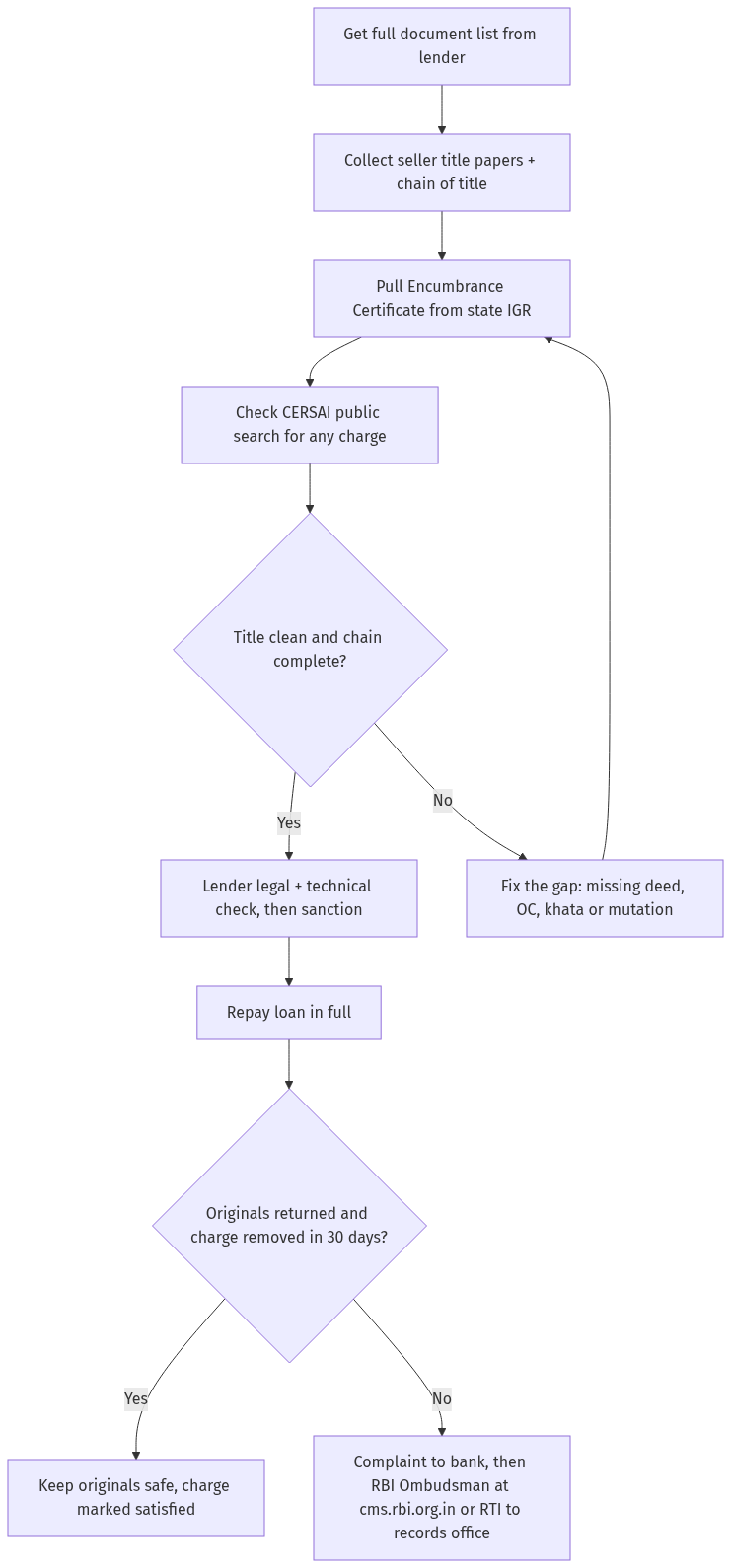
Figure: step-by-step flow. If a step stalls, use the grievance or RTI route shown.
Getting your originals back after you repay
This is the step most people miss, and it is now backed by a hard rule. Under the Reserve Bank of India circular on Responsible Lending Conduct (RBI/2023-24/60, dated 13 September 2023, applicable to releases due on or after 1 December 2023), your lender must:
- Release all original property documents within 30 days of full repayment or settlement of the loan account, and
- Remove the charge registered with any registry within the same period.
If the lender misses the 30 day window, it must pay you Rs 5,000 for each day of delay. You may collect the originals from the branch that serviced the loan or any other office of the lender where the papers are held, whichever you prefer.
If the lender has lost or damaged your documents, it must help you obtain duplicate or certified copies, and it gets an extra 30 days (a total of 60) before the daily penalty starts running.
What to do if the lender stalls
Send a written complaint to the bank first and keep proof. If it is not resolved within 30 days, escalate to the RBI Banking Ombudsman through the complaint portal at cms.rbi.org.in. If a government office is sitting on a land record you need, file an RTI to that office.
Frequently asked questions
What is the single most important property document?
The registered sale or title deed in the current seller's name. Everything else, the EC, khata and tax receipts, supports it. Without a clean registered deed and an unbroken chain of title, no lender will sanction the loan.
How far back does the chain of title need to go?
Lenders commonly trace ownership for about thirty years to confirm an unbroken link. Each transfer in that period should be a properly registered deed. A gap or an unregistered transfer is a problem you should fix before applying.
Is an Encumbrance Certificate enough to prove the property is clean?
No. An EC only reflects transactions that were registered at the Sub-Registrar. Unregistered family arrangements, oral partitions or pending disputes will not show up. Pair the EC with a CERSAI search and direct questions to the seller about co-owners and heirs.
How do I check if a property is already mortgaged?
Use the public search on the CERSAI portal at cersai.org.in, which records charges that lenders create on assets. There is a small search fee, so verify the current figure on cersai.org.in. Your lender's own legal check will also flag an existing charge.
My loan is fully repaid but the bank has not returned my papers. What now?
By RBI rule the lender must return all originals and remove the charge within 30 days of full repayment, or pay Rs 5,000 for each day of delay. Complain in writing to the bank, and if unresolved in 30 days, escalate to the RBI Banking Ombudsman at cms.rbi.org.in.
Do I need different papers for an under-construction flat?
Yes. Add the RERA registration number, the Commencement Certificate, the builder-buyer agreement and the builder NOC. Verify the RERA number on your state authority through rera.gov.in before paying, and insist on the Completion and Occupancy Certificates at handover.
The terms khata and patta confuse me. Are they the same?
They are local names for the municipal or revenue record of ownership and tax liability, and the word changes by state, khata in Karnataka, patta in Tamil Nadu, and so on. Always use your own city or state portal, and read our guide on khata and patta transfer.
Sources
- https://www.rbi.org.in (Responsible Lending Conduct, RBI/2023-24/60, 13 September 2023)
Home loan documents checklist: Complete guide (2026)
- Step 1: What documents are needed for a home loan in India? (a) Home loan documents: (i) identity proof — PAN, Aadhaar, passport, (ii) address proof — Aadhaar, voter ID, utility bill, (iii) income proof — salary slips, ITR, Form 16, (iv) property documents — sale deed, encumbrance certificate, (v) bank statements — 6 months, (b) additional: (i) employment proof — offer letter, (ii) business proof — GST registration (self-employed), (iii) property valuation report, © authority: bank/NBFC/HFC — RBI regulated, (d) law: RBI guidelines + NHB regulations, (e) portal: bank website — online application.
- Step 2: Comparison table — home loan document requirements. (a) Salaried employee: (i) identity: PAN + Aadhaar, (ii) income: 3 months salary slips + Form 16 + 2 years ITR, (iii) bank: 6 months statements, (iv) property: sale deed + EC + approval, (v) timeline: 7-15 days, (b) Self-employed: (i) identity: PAN + Aadhaar, (ii) income: 2 years ITR + P&L + balance sheet, (iii) bank: 6 months statements, (iv) property: sale deed + EC + approval, (v) timeline: 10-20 days, © NRI: (i) identity: passport + OCI, (ii) income: salary certificate + NRI account statements, (iii) bank: 6 months NRE/NRO statements, (iv) property: sale deed + EC + POA, (v) timeline: 15-30 days, (d) Business owner: (i) identity: PAN + Aadhaar, (ii) income: 2 years ITR + GST returns + audited financials, (iii) bank: 12 months statements, (iv) property: sale deed + EC + approval, (v) timeline: 10-20 days, (e) Second/ resale property: (i) identity: standard, (ii) income: standard, (iii) bank: standard, (iv) property: previous sale deed + chain of title + EC + occupancy certificate, (v) timeline: 15-30 days. (Note: Property documents are the most critical — banks verify chain of title and encumbrance.)
- Step 3: How to submit home loan documents. (a) Step 1: Collect all identity + income documents, (b) Step 2: Get property documents — sale deed, EC, building approval, © Step 3: Submit to bank — online or branch, (d) Step 4: Bank verification — property + income, (e) Step 5: Sanction letter — terms + interest rate, (f) Step 6: Disbursement — after property registration.
- Step 5: Practical tips. (a) keep original + photocopy of all documents, (b) encumbrance certificate is critical — get from sub-registrar, © ITR of 2 years is mandatory for self-employed, (d) check CIBIL score before applying — 750+ preferred, (e) Example: A salaried applicant submitted all documents; bank verified property in 5 days; loan sanctioned in 12 days; disbursement after registration.
- Step 6: Key provisions. (a) RBI guidelines: home loan KYC + documentation, (b) NHB: National Housing Bank — HFC regulations, © RERA: property approval verification, (d) Encumbrance certificate: sub-registrar office, (e) RTI: file with sub-registrar for EC or property record issues.
See Home Loan Documents and Ancestral Property Partition and Insurance Grace Period and How to File RTI and First Appeal.