Stamp Duty and Registration Charges 2026

Reviewed on 2026-06-20 by Dr. Shrawan Kumar Pathak.
Quick Reply: Your bill has two parts: stamp duty (a state tax, commonly 3 to 7 per cent of the property value) plus a registration fee (often near 1 per cent). Both are set by your state, so use your state IGR or registration portal to read the exact rate, pay e-stamp on shcilestamp.com, and register within four months.
Think of it as one bill with two line items
Most buyers ask one wrong question: “what is the stamp duty in India?” There is no single India-wide figure. Stamp duty is a state tax, so the rate that applies to your flat in Pune is not the rate for the same flat in Patna. The smarter question is: “what goes into my bill, and where do I read my own numbers?”
Treat the cost like a restaurant cheque. Line item one is stamp duty, charged under the Indian Stamp Act, 1899, at a percentage your state government fixes. Line item two is the registration fee, charged under the Registration Act, 1908, for entering your deed into the public record. Add the two, add any small page or scanning charges, and that is what you pay before the sub-registrar registers your sale deed.
The four inputs your bill depends on
Before you can work out a single rupee, you need four facts. Collect these first.
- Property value. Duty is charged on the value of the property, expressed as a percentage.
- Circle rate. Your state publishes a minimum value per square metre for every locality, called the circle rate, ready reckoner, guidance value or collector rate depending on the state. The sub-registrar values your deal against this.
- Your state stamp duty rate. A percentage set by your state, varying by location, property type and sometimes the buyer.
- Your category. Many states charge women buyers a lower rate or waive the registration fee for a sole female owner. Check whether you qualify.
Step one: find the chargeable value, not just the price
Here is the rule that catches first-time buyers. Duty is charged on the higher of two numbers: the price written in your agreement, or the circle rate value of that property as published by the state. You cannot write a low figure in the deed to shrink the duty. If your agreed price is below the circle rate, the sub-registrar values the property at the circle rate and charges duty on that higher amount.
So your first task is to look up the circle rate for your exact locality on your state IGR portal, multiply it by your built-up or super built-up area as the rules specify, and compare it with your agreed price. Whichever is higher becomes the chargeable value. Every later figure is a percentage of this.
Step two: apply your state stamp duty rate
Now apply the stamp duty percentage your state fixes for your kind of property. Across the country this commonly sits in a band of roughly 3 to 7 per cent of the chargeable value, but the exact figure, and any city surcharge, metro cess or local body tax added on top, is state-specific. Do not borrow a neighbour's number. Open your own state portal and read the rate for your property type.
A worked illustration helps. Suppose your chargeable value is the higher figure from step one. If your state rate is, say, four per cent, your stamp duty is four per cent of that value. If your state adds a one per cent local cess, you add that too. The arithmetic is simple once you have the correct rate, which is exactly why finding your own rate matters more than any formula.
Check for a concession
Before you finalise the figure, check two common reliefs. Many states charge a lower stamp duty for women buyers or for property registered in joint names with a woman, and some waive or reduce the registration fee for a sole female owner. A few states give concessions for affordable housing or for transfers within a family. These are state choices, so confirm whether yours applies on your state IGR portal rather than assuming.
Step three: add the registration fee
The registration fee is the second line item, paid under the Registration Act, 1908, for recording your deed. In most states it is a modest percentage of the chargeable value, frequently in the region of one per cent, and several states cap it at a fixed maximum so very high-value deals do not pay an unlimited fee. Read your state's exact registration fee and any cap on the registration department page. Small extras, such as scanning, photo or page charges, may apply on top.
If you are still comparing whether you even need a registered sale deed rather than an agreement, our note on a sale deed versus an agreement to sell explains which document transfers ownership and therefore attracts the full duty.
Step four: pay the stamp duty as e-stamp
You no longer queue for physical stamp paper in most states. Non-judicial stamp duty is paid electronically and printed as an e-Stamp certificate through the e-stamping portal run by Stock Holding Corporation of India Limited, shcilestamp.com, which is live across most states and union territories. You can also buy e-stamp at a SHCIL branch, a bank acting as a collection centre, or a Common Service Centre. Some states route payment through their own IGR or NGDRS portal instead, so follow whichever your state directs.
Keep your e-Stamp certificate safe. Its unique certificate number is what the sub-registrar verifies on the day of registration.
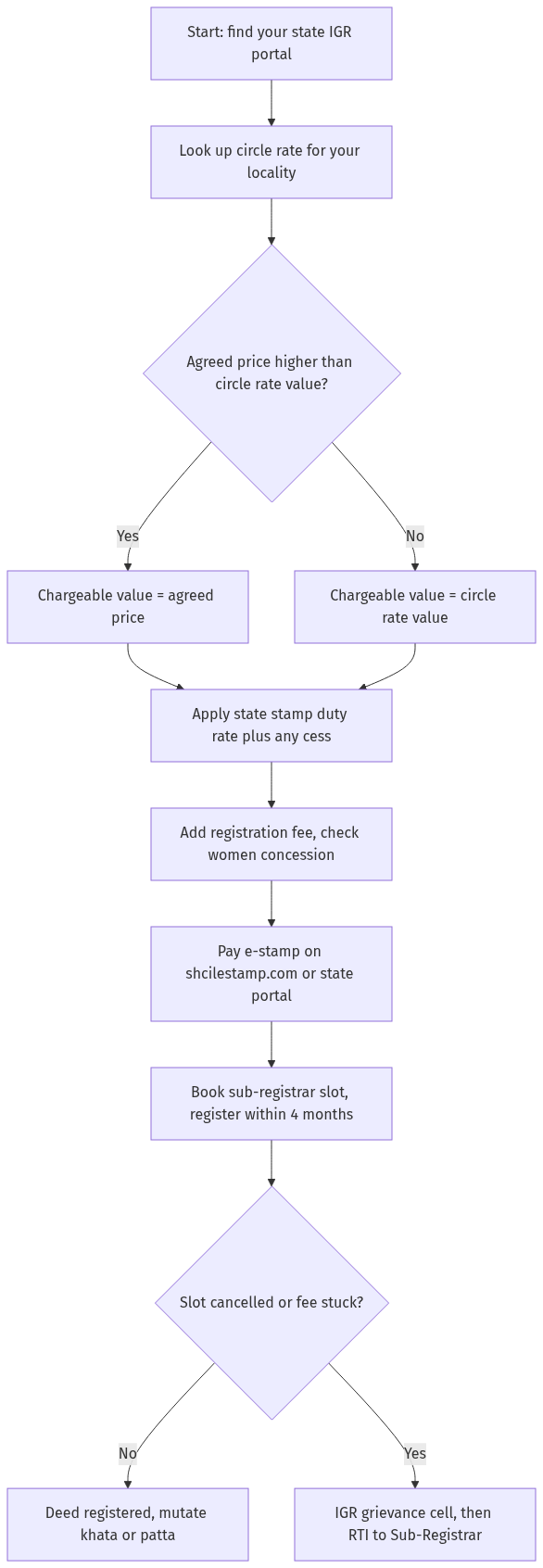
Figure: step-by-step flow. If a step stalls, use the grievance or RTI route shown.
Step five: register the deed, and do it on time
Paying the duty is not the end. Section 17 of the Registration Act, 1908 makes registration compulsory for any document that creates or transfers a right in immovable property worth Rs 100 or more, which covers every ordinary sale deed. Until the deed is registered, it does not transfer clean title.
The deadline is firm. Under Section 23, you must present the deed for registration within four months of the date it is executed. Miss that, and Section 25 lets the Registrar accept it within only a further four months, on payment of a fine of up to ten times the proper registration fee, and only if the delay was for genuine urgent necessity or unavoidable accident. After roughly eight months, registration is generally barred. So book your sub-registrar slot early.
Many states take the appointment and document upload online through the National Generic Document Registration System (NGDRS) or their own IGR portal, such as Maharashtra IGR, Telangana IGRS, Tamil Nadu TNREGINET, Karnataka Kaveri or UP IGRSUP. After registration, remember to mutate the records in your name; our guide on khata and patta transfer covers that next step, and the municipal side is in paying property tax online.
If your slot or refund gets stuck
If your online registration appointment is cancelled after you have paid, or the portal swallows your fee, do not pay twice. Use the registration department grievance cell or the IGR helpdesk first, and read our walkthrough on a cancelled registration appointment after payment. If you get no response, file an RTI under the Right to Information Act, 2005 with the Sub-Registrar or the Inspector General of Registration asking for the status and the file notings on your application.
Frequently asked questions
Is stamp duty the same all over India?
No. Stamp duty is a state tax under the Indian Stamp Act, 1899, so the rate, surcharges and concessions differ by state, city and property type. Always read your own state IGR or registration portal; never copy a rate quoted for another state.
What value is my stamp duty charged on?
On the higher of the price in your deed or the state circle rate, ready reckoner or guidance value for that locality. You cannot record a low price to cut the duty, because the sub-registrar values the property against the published circle rate.
How much is the registration fee?
It is a separate charge under the Registration Act, 1908, usually a modest percentage of the chargeable value, often around one per cent, and many states cap it at a fixed maximum. Confirm your exact fee and any cap on your state registration page.
Do women buyers pay less?
In many states, yes. Several states charge a lower stamp duty for women buyers or waive the registration fee for a sole female owner, and some give a concession for joint registration with a woman. Check whether your state offers it before you finalise the figure.
Where do I pay the stamp duty online?
Through the e-stamping portal of Stock Holding Corporation of India, shcilestamp.com, which issues an e-Stamp certificate, or through your state IGR or NGDRS portal if your state routes payment there. You can also buy e-stamp at SHCIL branches, banks and Common Service Centres.
Is there a deadline to register after I pay?
Yes. Under Section 23 you must present the deed within four months of execution. Section 25 allows a further four months at most, with a fine of up to ten times the registration fee, only for genuine unavoidable delay. After about eight months registration is generally barred.
What happens if I do not register the sale deed?
An unregistered deed for property worth Rs 100 or more does not pass clean title under Section 17, and an unstamped or under-stamped document is not admissible as evidence. You risk disputes and penalties, so register and stamp it properly.
My online registration slot was cancelled after payment, what now?
Raise it with the registration department grievance cell or IGR helpdesk and keep the payment reference. If there is no response, file an RTI with the Sub-Registrar or Inspector General of Registration asking for the status and the notings on your file.
Sources
Sale deed vs agreement to sell, khata and patta transfer, pay property tax online and registration appointment cancelled after payment continue this property series.
What are the stamp duty charges for property transactions?
Stamp duty is a tax levied on the transfer of property. The rate varies by state, gender, and property type. Here is a comprehensive guide:
- Step 1: What is stamp duty? Stamp duty is a tax payable under the Indian Stamp Act, 1899 (or state equivalent) on instruments that transfer or create rights in property. It is paid on: (a) sale deeds, (b) gift deeds, © lease deeds, (d) mortgage deeds, (e) partition deeds, (f) relinquishment deeds, (g) power of attorney (if it involves transfer of property).
- Step 2: How is it calculated? Stamp duty is calculated on the circle rate (guideline value) or the transaction value, whichever is higher. The rate varies by state:
- Delhi: 4% (women), 6% (men)
- Maharashtra: 5% (women), 6% (men) (within municipal limits)
- Karnataka: 5% (women, up to Rs 45 lakh), 5% (men)
- UP: 4% (women), 7% (men)
- Rajasthan: 4% (women), 6% (men)
- Tamil Nadu: 7% (both)
- Telangana: 4% (women), 5% (men)
- Step 3: Additional charges. In addition to stamp duty, you also pay: (a) registration fee (typically 1% of the property value, capped at a maximum), (b) transfer fee (to the society/authority, if applicable), © GST (if the property is under construction) — see our guide to GST on under-construction flats for the rates and slab rules.
- Step 4: Exemptions and concessions. (a) Women buyers get a reduced rate in most states, (b) first-time home buyers may get exemptions under PMAY, © gifts to family members may have a reduced rate, (d) agricultural land transactions may have lower rates.
- Step 5: Payment methods. Stamp duty can be paid via: (a) e-stamping (Stock Holding Corporation of India - SHCIL), (b) franking (through authorised banks), © adhesive stamps, (d) judicial stamp paper.
How to file RTI for stamp duty rates?
- File RTI with the Revenue Department/Inspector General of Registration: Ask for: (a) the current stamp duty rates for your district, (b) the last revision date, © the circle rates for your area, (d) the total stamp duty collection for the year.
Use AI RTI Drafter. See Stamp Duty Dispute Guide and Stamp Duty Charges.