Property Registration Online 2026

Reviewed on 2026-06-20 by Dr. Shrawan Kumar Pathak.
Quick Reply: Register property through your state IGR or registration department portal: pay stamp duty, buy an e-stamp, book a sub-registrar appointment, then both parties and two witnesses visit the office for biometrics and signing. Under the Registration Act, 1908, present the deed within four months of execution.
In 2026 much of property registration is online, but not all of it. You book the slot, pay stamp duty and the registration fee, and enter the document details on a portal. The actual sale deed is still signed in person at the Sub-Registrar Office. This guide walks you through the full sequence as a numbered standard procedure, so you know exactly what happens at each counter.
Why registration matters
A sale deed, gift deed or a lease of more than one year must be registered. Section 17 of the Registration Act, 1908 makes registration of these documents compulsory. Section 49 of the same Act says an unregistered document that ought to have been registered cannot transfer the property or be used as proof of the transaction in court. In plain terms, an unregistered sale “deed” does not make you the owner. Registration is what puts the transfer on the public record.
Stamp duty, the registration fee, the portal name and the e-stamp vendor all differ from state to state, because property registration is a state subject. This guide gives you the national process and tells you where to confirm the exact figures for your state. Never rely on a fixed percentage you read online; check your own state portal.
The numbered procedure
Step 1. Verify the title and get an Encumbrance Certificate
Before you pay anything, confirm the seller actually owns a clear title. Read the parent documents, check the survey or plot number, and obtain an Encumbrance Certificate (EC) from the Sub-Registrar or your state IGR portal. The EC lists registered charges and past transactions on the property. If the property is mortgaged, you will also need the bank's no-objection certificate. For an under-construction or booked flat, check the project on your state RERA authority through rera.mohua.gov.in.
Step 2. Draft the deed and calculate stamp duty
Have the sale deed drafted with the correct names, the full property schedule, the consideration amount and the agreed terms. The duty is calculated on the higher of the consideration or the government guideline (circle or ready-reckoner) value. Most state IGR portals have a stamp-duty and registration-fee calculator. Use it to get your figure, and verify the current rate on your state portal rather than assuming a number.
Step 3. Pay stamp duty and buy the e-stamp
Pay the stamp duty online and generate an e-stamp certificate. In many states this is done through SHCIL at shcilestamp.com, a government-authorised e-stamping agency that issues e-stamp certificates and lets you verify them online. Other states use their own treasury, e-GRAS or IGR payment gateway. Keep the e-stamp certificate, the challan and the transaction reference safe; they stay linked to your registration even if a slot is rescheduled.
Step 4. Pay the registration fee
Separately pay the registration fee. In several states this is around one per cent of the value, often with a ceiling, but the rate and any cap vary, so confirm the exact figure on your state IGR portal. Note the receipt or reference number.
Step 5. Book the sub-registrar appointment
Log in to your state registration portal, enter the document and party details, and book an appointment at the Sub-Registrar Office that has jurisdiction over the property's location. You will usually get a date, a time slot and a token. Print or save the acknowledgement.
Step 6. Visit the Sub-Registrar Office to execute the deed
This step is in person. Both the buyer and the seller, plus two witnesses, attend on the appointment date. Carry the printed deed on the e-stamp, identity proof (Aadhaar, PAN), photographs, the EC and the payment receipts. The office captures biometrics and photographs, the parties and witnesses sign, and the Sub-Registrar registers the document. You will receive a registration number and an endorsement.
Step 7. Collect the registered deed and update mutation
Collect the registered sale deed, or download the scanned copy where your state offers it. Registration is not the end. Apply for mutation (also called dakhil kharij or namantaran) at your tehsil, municipality or urban local body to move the property into your name in the revenue and tax records. Mutation is separate from registration and is what gets future tax bills issued in your name.
Watch the four-month clock
Section 23 of the Registration Act, 1908 requires you to present the document for registration within four months of the date it was executed. If you miss that window for an unavoidable reason, Section 25 lets the Registrar accept a document delayed by up to a further four months on payment of a fine that can go up to ten times the registration fee. Do not let it slide; register promptly.
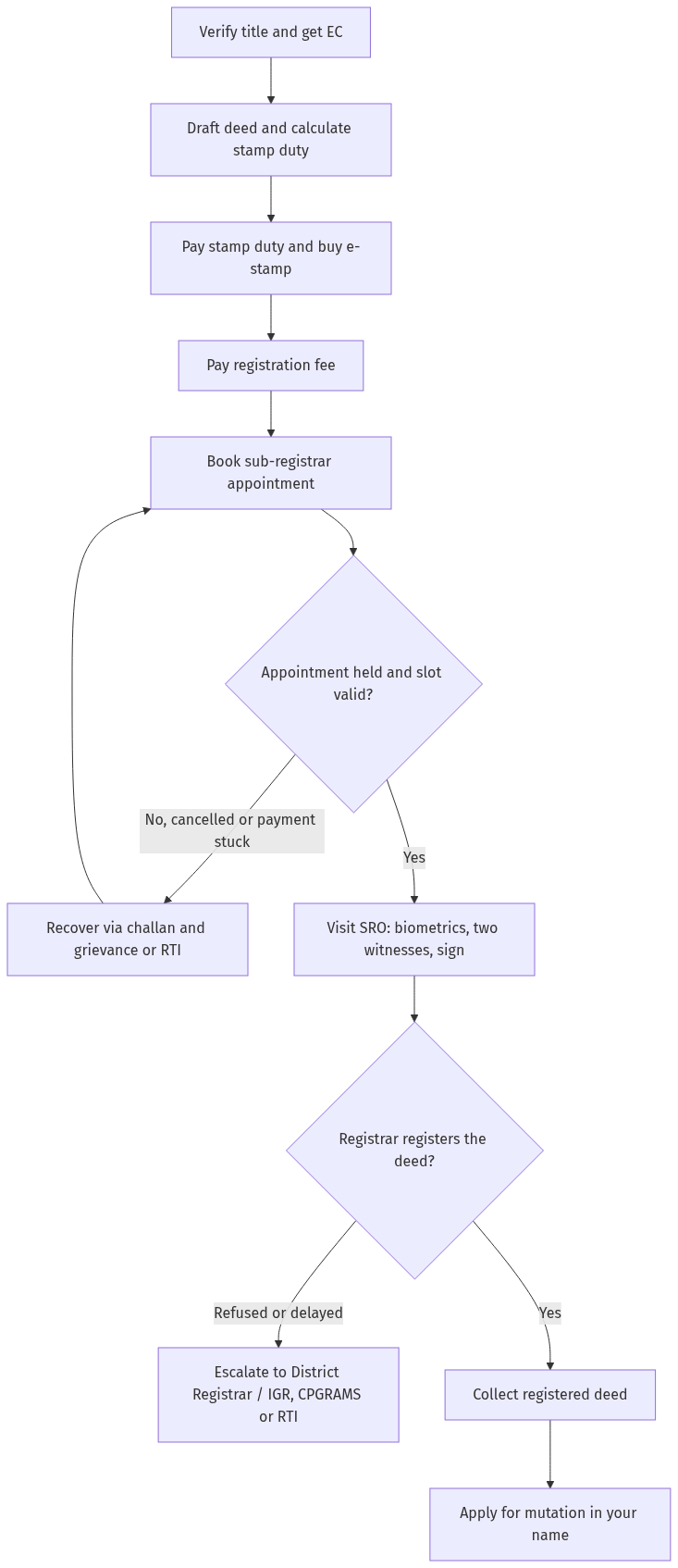
Figure: step-by-step flow. If a step stalls, use the grievance or RTI route shown.
If something goes wrong
If your slot is cancelled after you have already paid, or your payment is stuck, your money is tied to the challan and e-stamp and does not simply vanish. See our companion guide on a registration appointment cancelled after payment for the recovery and escalation steps. If the office refuses to register without giving a written reason, or sits on your file, you can escalate to the District Registrar or Inspector General of Registration, lodge a grievance on the state portal or CPGRAMS, and file an RTI asking for the status of your application and the reason for delay.
For related fixes, see how to handle a sale deed correction if a name or survey number is wrong, and what to do if you have lost the original sale deed. You can also browse the full property and RERA action guides hub.
Frequently asked questions
Can property be registered fully online in 2026?
Not in most states. Booking, stamp-duty payment, e-stamping and document data entry are online, but executing a sale deed still needs the buyer, seller and two witnesses to attend the Sub-Registrar Office in person for biometrics and signing. A few states have piloted doorstep or fully online registration for limited deeds; check your state portal.
How much is stamp duty and the registration fee?
Both vary by state because registration is a state subject. Stamp duty is charged on the higher of the sale price or the government guideline value. The registration fee in many states is around one per cent, often capped. Use your state IGR portal's calculator and verify the current figure there; do not rely on a fixed national rate.
What is the time limit to register a sale deed?
Section 23 of the Registration Act, 1908 requires you to present the document within four months of execution. Section 25 allows a further delay of up to four months on payment of a fine, which can be up to ten times the registration fee, if the delay was for an unavoidable reason.
What happens if I do not register the deed?
Under Section 49 of the Registration Act, 1908, an unregistered document that needed registration cannot transfer the property and is not accepted as evidence of the transaction in court. So you would not become the legal owner. Always register a sale, gift or long lease.
Is mutation the same as registration?
No. Registration records the transfer of the deed at the Sub-Registrar Office. Mutation updates the revenue and municipal records to show you as the owner for tax purposes. After registering, apply separately for mutation at your tehsil or local body.
Do I need an Encumbrance Certificate before buying?
It is strongly advised. An Encumbrance Certificate from the Sub-Registrar or state IGR portal shows registered charges and past transactions, helping you confirm a clear title. For an under-construction flat, also verify the project on your state RERA authority.
Whom do I approach if the registrar refuses or delays?
Escalate to the District Registrar and then the Inspector General of Registration. Lodge a grievance on the state registration portal or CPGRAMS, and file an RTI seeking the status of your file and the written reason for refusal or delay.
Sources
Use your own state IGR or registration department portal for stamp duty, fees, appointment booking and the encumbrance certificate.
Property registration: Complete process and documents (2026)
- Step 1: What is property registration and what documents are needed? (a) Property registration: (i) registration of sale deed at Sub-Registrar Office (SRO), (ii) mandatory under Registration Act 1908 — Section 17, (iii) establishes legal ownership — prevents disputes, (b) documents needed: (i) sale deed, (ii) previous title deeds (chain of ownership), (iii) encumbrance certificate (EC), (iv) property tax receipts, (v) khata/mutation extract, (vi) NOC from society/authority, (vii) Aadhaar + PAN of parties, (viii) photographs, © process: (i) draft sale deed → pay stamp duty + registration fee → submit at SRO → biometric verification → registered deed, (d) authority: Sub-Registrar Office (SRO) + Department of Stamps & Registration, (e) law: Registration Act 1908 + Transfer of Property Act 1882 + State Stamp Act.
- Step 2: Comparison table — property registration scenarios. (a) Standard registration: (i) process: draft deed → stamp duty → SRO → registered, (ii) timeline: 1-3 days, (iii) cost: stamp duty 5-8% + reg fee 1% (varies by state), (iv) example: apartment registered; stamp duty 6%; completed in 2 days, (b) Registration delayed: (i) issue: SRO delays registration, (ii) remedy: complain to Inspector General of Registration, (iii) timeline: 7-15 days, (iv) escalation: IG Registration, (v) example: SRO delayed 30 days; complained; registered in 7 days, © Document deficiency: (i) issue: missing documents, (ii) remedy: obtain missing docs + resubmit, (iii) timeline: 7-15 days, (iv) escalation: SRO, (v) example: EC missing; obtained; resubmitted; registered, (d) Stamp duty dispute: (i) issue: stamp duty amount disputed, (ii) remedy: clarification from SRO + IG Registration, (iii) timeline: 15-30 days, (iv) escalation: IG Registration, (v) example: duty disputed; clarified; paid; registered, (e) Online registration: (i) process: draft online → e-stamp → book slot → visit SRO, (ii) timeline: 1-7 days, (iii) cost: same + convenience fee, (iv) example: booked online slot; visited SRO; registered in 1 day. (Note: Property registration mandatory — sale deed at SRO with stamp duty + documents. File RTI if delayed.)
- Step 3: How to register property. (a) Step 1: Draft sale deed — engage lawyer, (b) Step 2: Obtain encumbrance certificate + property tax receipts, © Step 3: Pay stamp duty — e-stamping or franking, (d) Step 4: Book slot at SRO — online or in-person, (e) Step 5: Submit documents + biometric verification, (f) Step 6: File RTI with SRO if registration delayed.
- Step 5: Practical tips. (a) verify title chain before purchase, (b) encumbrance certificate — must have, © stamp duty varies by state — check rate, (d) RTI with SRO for delay, (e) Example: A buyer registered property; stamp duty 6% + reg fee 1%; EC clean; registered in 2 days; received registered deed in 7 days.
- Step 6: Key provisions. (a) Registration Act 1908 Section 17, (b) Transfer of Property Act 1882, © State Stamp Act: stamp duty, (d) SRO: registration, (e) RTI: file with SRO.
See Property Registration and Khata Transfer and Sale Deed Correction and How to File RTI.