Ancestral Property Partition 2026

Quick Reply: Divide ancestral property in 2026 without a court fight: agree shares, sign a registered partition deed, pay stamp duty and update mutation records today
Reviewed on 2026-06-20 by Dr. Shrawan Kumar Pathak.
Quick answer. If every coparcener agrees, you can divide ancestral property without a court. Fix each person's share, draft a partition deed, pay your state stamp duty, register it at the sub-registrar office, then apply for mutation in revenue or municipal records. A deed of immovable property must be registered to be valid.
You do not always need a court
Many families assume that splitting ancestral property means a long partition suit. It does not. The Supreme Court has long recognised that family members can settle their shares among themselves. In Kale v Deputy Director of Consolidation (1976) the Court held that a bona fide family arrangement, made voluntarily and without fraud or coercion, is binding on the members who join it. So if all the coparceners agree, the quickest, cheapest and least bitter route is an out of court partition by a registered deed.
This guide covers that amicable route end to end. If a co-owner refuses to sign or denies your share, the court route is different and is explained in our companion guide on the partition suit in India.
Who counts as a coparcener
In a Hindu Undivided Family, a coparcener acquires a share in ancestral property by birth. Since the 2005 amendment to Section 6 of the Hindu Succession Act 1956, daughters are coparceners on the same footing as sons. The Supreme Court settled any doubt in Vineeta Sharma v Rakesh Sharma (2020), holding that a daughter is a coparcener by birth whether she was born before or after 2005 and whether or not her father was alive on 9 September 2005. A partition that leaves out a daughter is open to challenge, so list every coparcener before you start.
Note that self acquired property is not ancestral. The person who earned or bought it can deal with it freely, so it is not split by birthright. Identify clearly which assets are ancestral before you draw up shares.
Step by step: partition by deed
Step 1: List the coparceners and the property
Write down every living coparcener and the exact ancestral assets to be divided, with survey numbers, plot or flat details and the present record of rights. Pull your land record (the 7/12, RoR, khatauni or property card for your state) and a fresh encumbrance certificate so you know the property is clear of loans or attachments. You can check this through our guide on the encumbrance certificate.
Step 2: Agree the shares
Sit together and agree each person's share. The default among coparceners is an equal share per branch, but families can agree to any honest division as long as every coparcener consents freely. Put the agreed shares in writing as a draft before you visit a lawyer or the sub-registrar, because the deed must describe each share precisely.
Step 3: Choose the right document
Two instruments do this job, and they are not the same.
A partition deed actually divides the property and allots a defined portion to each coparcener. Because it creates and transfers rights in immovable property, it must be registered.
A family settlement or family arrangement records a mutual understanding. Following Kale, if the arrangement is oral, it need not be registered; and a memorandum that merely records a past oral arrangement does not need registration either. But the moment a written document itself effects the partition, it must be registered like a deed. The safe, bankable choice is a registered partition deed. For the trade offs, see our comparison of the family settlement deed versus partition deed.
Step 4: Pay stamp duty
Stamp duty on a partition deed is a state subject, so the rate is set by your state and not by any single national figure. Many states charge a concessional rate on a partition among family members, which is far lower than the duty on a sale. Find the current rate and any family concession on your state stamp or registration department portal, usually the Inspector General of Registration (IGR) site, before you fix an appointment. Do not rely on a figure quoted by an agent; verify it on the official portal.
Step 5: Register the deed
A partition deed of immovable property is compulsorily registrable under Section 17 of the Registration Act 1908. All the coparceners named in the deed sign before the sub-registrar of the area where the property lies, with two witnesses and proof of identity. This matters because, under Section 49 of the same Act, an unregistered document that the law required to be registered cannot affect the property and cannot be used as evidence of the division. An unregistered partition may feel binding within the family, yet no bank or buyer will accept it. Register the deed and collect the registered copy.
Step 6: Update mutation in records
Registration transfers the right; mutation updates the public record. After registration, apply for mutation so that each coparcener's name appears against their allotted share. For rural land this is the revenue mutation register through the tehsildar or talathi; for a town flat or house it is the municipal property tax record. Submit the registered deed, the latest record of rights and your identity proof. Mutation does not by itself create title, but without it your name will not show on the record and property tax or future sale becomes messy. If mutation stalls, our guide on a pending property mutation sets out the fix.
If a co-owner refuses or the office stalls
If even one coparcener will not sign, an amicable deed is not possible and you fall back to a partition suit. If the sub-registrar or municipal office sits on your mutation, do not wait silently. File an RTI for the certified record of rights or the mutation register to force movement, and lodge a complaint on your state registration or municipal grievance portal, with the central CPGRAMS portal at pgportal.gov.in as a fallback. A paper trail usually unblocks a stuck file.
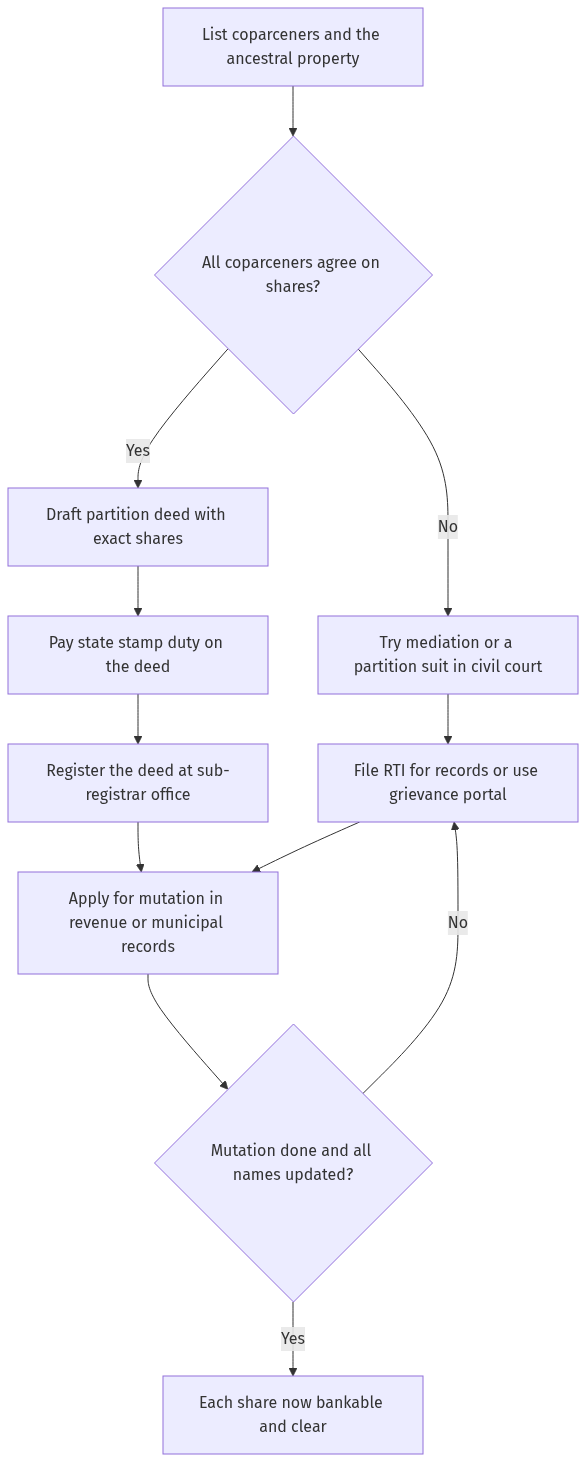
Figure: step-by-step flow. If a step stalls, use the grievance or RTI route shown.
Frequently asked questions
Can ancestral property be divided without going to court?
Yes. If all coparceners agree, you do not need a suit. You divide it through a registered partition deed or a valid family arrangement. A court is only needed when someone disputes a share or refuses to sign.
Does a partition deed have to be registered?
Yes. A partition deed of immovable property is compulsorily registrable under Section 17 of the Registration Act 1908. An unregistered deed cannot affect the property and is not accepted by banks or buyers, so always register it at the sub-registrar office.
Is an oral family partition valid?
An oral family arrangement can be valid under Kale v Deputy Director of Consolidation. A memorandum that only records a past oral arrangement also does not need registration. But any written document that itself effects the partition must be registered.
Do daughters get a share in ancestral property?
Yes. Since the 2005 amendment to Section 6 of the Hindu Succession Act, and as confirmed in Vineeta Sharma v Rakesh Sharma (2020), a daughter is a coparcener by birth with the same share as a son. A partition that omits a daughter can be challenged.
How much stamp duty does a partition deed attract?
Stamp duty is set by each state, so there is no single national rate. Many states give a concessional rate for a partition among family members. Check the current rate on your state registration or IGR portal before booking the appointment.
What is the difference between a partition deed and a family settlement?
A partition deed divides the property and allots defined shares, and must be registered. A family settlement records a mutual understanding and may be oral. The bankable, dispute proof choice for immovable property is a registered partition deed.
Does mutation give me ownership after partition?
No. Mutation updates revenue or municipal records and is essential for tax and future sale, but it does not by itself create title. Your title comes from the registered partition deed; mutation simply reflects it in the public record.
Sources
For the contested route, see the partition suit guide. Related help: partition deed versus family settlement, the encumbrance certificate and fixing a pending mutation.
Ancestral property partition: Legal guide (2026)
- Step 1: What is ancestral property and partition? (a) Ancestral property: (i) property inherited up to 4 generations of male lineage, (ii) Hindu Undivided Family (HUF) property, (iii) all coparceners have birthright, (b) Partition: (i) division of HUF property among coparceners, (ii) each coparcener gets equal share, (iii) after 2005 amendment: daughters are coparceners too, © types: (i) partial partition — some property divided, (ii) total partition — all property divided, (iii) partition by metes and bounds — physical division, (d) authority: civil court — partition suit, (e) law: Hindu Succession (Amendment) Act 2005.
- Step 2: Comparison table — ancestral property partition options. (a) Mutual partition: (i) method: family settlement deed, (ii) timeline: 1-3 months, (iii) cost: stamp duty + registration, (iv) dispute: none — all agree, (v) example: brothers mutually partitioned ancestral land — registered deed, (b) Partition suit: (i) method: civil court — Section 2(d) Hindu Succession Act, (ii) timeline: 2-5 years, (iii) cost: court fees + lawyer, (iv) dispute: disagreement on shares, (v) example: sister filed partition suit — court divided equally including her share, © Daughter's rights: (i) method: equal coparcenary right — post 2005, (ii) timeline: same as partition suit, (iii) cost: same, (iv) dispute: brothers denying share, (v) example: daughter claimed equal share — court granted — 2005 amendment, (d) Partition by sale: (i) method: sell property + divide proceeds, (ii) timeline: 3-6 months, (iii) cost: capital gains tax, (iv) dispute: agree to sell but not on price, (v) example: family agreed to sell — proceeds divided equally, (e) Arbitration: (i) method: family arbitration — Section 89 CPC, (ii) timeline: 6-12 months, (iii) cost: arbitrator fee, (iv) dispute: prefer private resolution, (v) example: family appointed arbitrator — decision binding. (Note: 2005 amendment gives daughters equal coparcenary rights — retrospective by birth.)
- Step 3: How to file partition suit. (a) Step 1: Issue legal notice to all coparceners, (b) Step 2: File partition suit in civil court — jurisdiction where property is, © Step 3: Court appoints commissioner — property valuation, (d) Step 4: Court decrees partition — shares + metes and bounds, (e) Step 5: If cannot divide physically — court orders sale, (f) Step 6: Register partition deed — sub-registrar.
- Step 5: Practical tips. (a) mutual partition is fastest — family settlement deed, (b) daughters have equal rights — post 2005 amendment, © partition suit is slow — 2-5 years, (d) keep property documents — title chain, mutation, (e) Example: A daughter was denied share in ancestral property; filed partition suit; court ruled in her favor — equal coparcenary right; got her share.
- Step 6: Key legal provisions. (a) Hindu Succession (Amendment) Act 2005: daughters as coparceners, (b) Mitakshara school: coparcenary by birth, © Section 2(d): partition definition, (d) civil court: partition suit, (e) RTI: file with revenue office for property records/mutation.
See Ancestral Property Partition and Home Loan Documents and How to File RTI and First Appeal and Section 9 Arbitration.