EPS Higher Pension: Should You Opt? 2026

Reviewed on 2026-06-20 by Dr. Shrawan Kumar Pathak.
Quick Reply: For most readers in 2026 you cannot opt afresh: the EPFO joint-option window for members shut on 11 July 2023. If you already applied, the real decision is whether the higher pension, after the pro-rata cut and large arrears taken from your PF, beats your existing pension. Check your order on the EPFO Member portal.
First, the uncomfortable truth: the door is mostly shut
Most articles still write about EPS higher pension as a choice you can make today. For nearly everyone, that is no longer true. EPFO launched the validation of option and joint option facility on 26 February 2023 after the Supreme Court order of 4 November 2022. Members could apply only until 11 July 2023. By then about 17.49 lakh applications had come in, and that window has not reopened.
What did stay open longer was the employer side. EPFO gave employers repeated extensions to upload wage details for pending cases, the last being a “final opportunity” until 31 January 2025 for roughly 3.1 lakh stuck applications. So if you are reading this hoping to start a fresh application in 2026, the contrarian point is simple: there is no live opt-in form for you. Your energy is better spent elsewhere, which we cover below.
This guide is therefore written for the people who genuinely still have a decision: those who applied in time and are now staring at a pending status, a demand letter for arrears, or a pension order that looks smaller than promised.
The decision nobody frames honestly
Higher pension is not free money. To get a pension on your real salary instead of the capped salary, you must pay for it, often heavily.
What you actually contribute
Normally only 8.33% of your wage goes to the Employees' Pension Scheme, and only on wages up to Rs 15,000 a month. That caps the diversion at roughly Rs 1,250 a month. To get higher pension, EPFO recomputes 8.33% on your actual higher wages, going back to 16 November 1995 or the date your pay first crossed the ceiling, plus an extra 1.16% on wages above Rs 15,000.
The catch is where that money comes from. The shortfall, the arrears, is usually recovered from your own EPF (provident fund) corpus, with interest. So your lump-sum PF balance shrinks, sometimes by lakhs, to buy a bigger monthly pension. You are trading a one-time sum you control for a lifelong stream you do not.
How the pension is worked out
The pension formula is: pensionable salary multiplied by pensionable service, divided by 70. Your pensionable salary is the average of your last 60 months of wages. On paper, a higher average lifts the pension sharply.
But EPFO's pro-rata method can blunt this. For service split across the pre and post September 2014 periods, EPFO has at times calculated the pensionable salary on a pro-rata basis rather than purely on your recent high wages. That single step has pushed many approved pensions well below what applicants expected. The rule has been contested in court and its exact form has shifted, so do not assume the figure in any online calculator is what you will receive. Read the actual computation on your demand or pension order.
A simple way to decide
Work it as a break-even, not a hope.
- Find the arrears EPFO wants from your PF (it is stated in your demand letter or order).
- Find the extra monthly pension after the pro-rata calculation, not the headline figure.
- Divide the arrears by twelve times the extra monthly pension. That is roughly how many years you must live, drawing the pension, just to get your own money back.
If that break-even runs well past your life expectancy, or if you would rather keep the PF lump sum for medical needs or family, declining or contesting may be the sounder call. If you are in good health, expect a long retirement, and value a guaranteed inflation-resistant income, the higher pension can still win. There is no universal right answer, which is exactly why the “always opt for higher pension” advice is misleading.
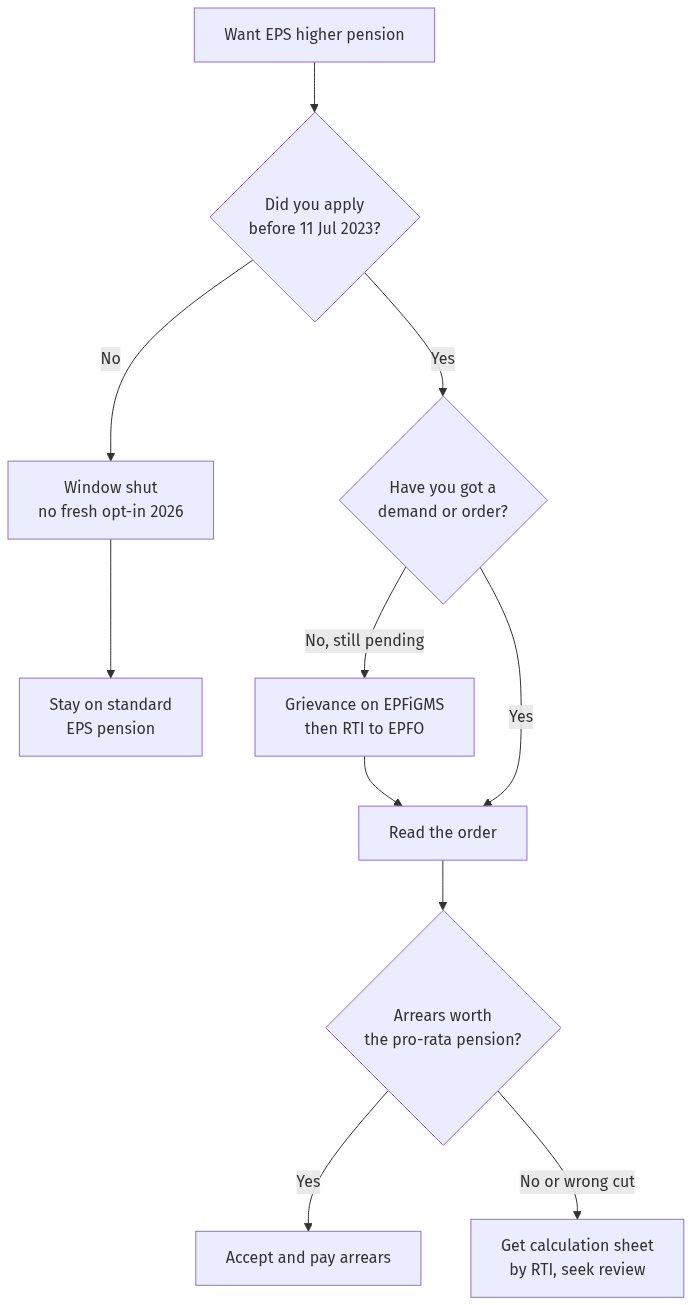
Figure: step-by-step flow. If a step stalls, use the grievance or RTI route shown.
If you applied in time and are stuck
A pending status is not a rejection. EPFO must verify wage data, confirm your employer's upload, and issue a Pension Payment Order. When this drags, you have formal levers. You can track and escalate through the EPFiGMS grievance portal, and you can compel a written, dated reply by filing a Right to Information application, which carries a Rs 10 fee and a 30-day reply limit under the RTI Act, 2005. For the full stuck-and-appeal route, see our companion guide linked below.
If your order has already arrived with a pro-rata cut you believe is wrong, you can ask EPFO in writing for the calculation sheet showing how your pensionable salary was derived, then decide whether to seek review. Getting that sheet, by RTI if needed, is the first concrete step.
Where to do everything
- Log in at the EPFO Member portal to see your application or pension status and your PPO number.
- Use EPFiGMS to raise a grievance with a reference number if your case is delayed.
- Read your demand letter or pension order carefully before paying any arrears; the numbers there override any online estimate.
Treat 2026 as a year of cleaning up legacy cases, not opening new ones.
Frequently asked questions
Can I still apply for EPS higher pension in 2026?
No fresh member application window is open. The last date for members to submit the validation of option or joint option was 11 July 2023, and it has not reopened. Verify the current position on the EPFO portal before acting on any contrary claim.
Is higher pension always worth it?
No. You pay for it, usually from your own PF corpus plus interest, and EPFO's pro-rata method can shrink the pension below the headline figure. Whether it is worth it depends on your arrears, your health and life expectancy, and how much you value a guaranteed lifelong income over a lump sum.
What is the pro-rata cut everyone complains about?
For service spanning the pre and post September 2014 periods, EPFO has computed pensionable salary on a pro-rata basis rather than on your recent high wages, lowering the pension. The rule has been challenged in court and its exact form has changed, so rely on the calculation in your own order, not online estimates.
How is the higher pension amount calculated?
The formula is pensionable salary multiplied by pensionable service, divided by 70, where pensionable salary is the average of your last 60 months of wages. The pro-rata step can reduce the pensionable salary that goes into this formula.
Where do the arrears come from?
EPFO recovers the shortfall, the extra 8.33% on your higher wages plus 1.16% above Rs 15,000, from your EPF accumulation with interest, or asks you to deposit it. This reduces your provident fund lump sum.
My application is stuck. What can I do?
File a grievance on EPFiGMS for a reference number, and if there is still no documented reply, file an RTI application to EPFO. The RTI fee is Rs 10 and the reply must come within 30 days. See our companion guide on stuck applications and appeals.
Can I challenge a pension order I think is wrong?
Yes. First obtain the calculation sheet showing how EPFO derived your pensionable salary, by RTI if it is not provided, then seek review or appeal through the proper EPFO channel based on what the sheet reveals.
Will declining now hurt my normal EPS pension?
No. If you do not take higher pension, your EPS pension continues on the standard capped basis, and your full PF lump sum stays intact for you to withdraw under the normal rules.
Sources
For the stuck-application and appeal route, see EPS higher pension application stuck, track and appeal. To draft a one-page RTI on a delayed higher-pension case, use file one RTI for EPS-95 higher pension. If you are weighing the basic scheme instead, read the EPS-95 minimum pension application process, and confirm your numbers by checking your EPF balance and claim status.
EPS higher pension: How to opt and common issues (2026)
- Step 1: What is EPS higher pension and how to opt for it? (a) EPS higher pension: (i) Employees' Pension Scheme 1995 — option to contribute on actual salary (not capped at Rs 15,000), (ii) Supreme Court verdict November 2022 — allowed higher pension, (iii) EPFO extended deadline — opt for higher pension, (b) eligibility: (i) EPF member on roll after September 1, 2014, (ii) employer-employee both must contribute on actual salary, (iii) must have exercised option — or can claim now, © process: (i) apply on EPFO portal — higher pension option, (ii) employer verifies + contributes arrears, (iii) EPFO calculates + approves higher pension, (d) authority: EPFO + RPFC + Central PRT, (e) law: EPS 1995 + Supreme Court verdict November 2022.
- Step 2: Comparison table — EPS higher pension scenarios. (a) Opting now: (i) process: apply on EPFO portal + employer verifies, (ii) timeline: 3-6 months, (iii) contribution: employee + employer arrears, (iv) example: member opted; employer contributed; higher pension approved, (b) Employer not cooperating: (i) issue: employer not verifying/contributing, (ii) remedy: complain to EPFO + RPFC, (iii) timeline: 30-60 days, (iv) escalation: EPFO, (v) example: employer not cooperating; complained to EPFO; verified; approved, © Arrears calculation: (i) issue: arrears amount disputed, (ii) remedy: EPFO calculation + verify, (iii) timeline: 30-60 days, (iv) escalation: RPFC, (v) example: arrears disputed; EPFO recalculated; paid, (d) Pension amount wrong: (i) issue: higher pension not reflected, (ii) remedy: complain to EPFO + RTI, (iii) timeline: 30-60 days, (iv) escalation: EPFO, (v) example: pension wrong; filed RTI; corrected, (e) Retired before 2014: (i) issue: retired before 2014 — eligibility unclear, (ii) remedy: legal consultation + EPFO, (iii) timeline: varies, (iv) escalation: EPFO + court, (v) example: retired 2012; approached EPFO; case pending. (Note: EPS higher pension — apply on EPFO portal, employer must verify + contribute arrears.)
- Step 3: How to opt for EPS higher pension. (a) Step 1: Check eligibility on EPFO portal, (b) Step 2: Apply for higher pension option, © Step 3: Employer verifies + contributes arrears, (d) Step 4: EPFO calculates higher pension, (e) Step 5: If employer delays — complain to EPFO + RPFC, (f) Step 6: File RTI with EPFO for application status.
- Step 5: Practical tips. (a) check eligibility — on roll after Sep 2014, (b) employer must cooperate — complain if not, © arrears — employee + employer, (d) RTI with EPFO — effective, (e) Example: A member opted for higher pension; employer contributed Rs 2 lakh arrears; pension increased from Rs 1,250 to Rs 4,500/month.
- Step 6: Key provisions. (a) EPS 1995: higher pension, (b) Supreme Court November 2022, © EPFO: application + calculation, (d) Employer: verification + arrears, (e) RTI: file with EPFO.
See EPS Higher Pension and PPO Download and PF Interest and How to File RTI.