Family Pension After Death 2026

Reviewed on 2026-06-20 by Dr. Shrawan Kumar Pathak.
Quick Reply: If a private-sector worker dies, the family can claim a monthly EPS-95 pension on Form 10D, an EDLI lump sum up to Rs 7 lakh on Form 5IF, an NPS death payout, or an ESIC dependants' benefit. File through the EPFO Member Portal with the death certificate and bank details.
Losing someone you love is hard enough without a maze of pension paperwork on top of it. Take a breath. This guide walks you through it calmly, one scheme at a time, so you know exactly what your family is owed and how to claim it. We cover workers in the organised and private sector, that is EPF, EPS-95, NPS and ESIC.
If the person who died was a central government employee, your route is different. Please see our companion guide on family pension after a husband's death for the CCS pension and Bhavishya process.
First, find out which schemes covered them
Most salaried workers in India are signed up to more than one safety net. Check the deceased person's salary slip, PF passbook or appointment letter for these:
- EPF and EPS-95: deducted from almost every private-sector salary above the wage threshold.
- EDLI: free life insurance that rides along with EPF, no extra deduction.
- NPS: a separate pension account, common with newer private and government jobs.
- ESIC: covers lower-wage workers and is the one that pays a family pension if death was caused by a job injury.
You may be able to claim from several at once. Gather the UAN (for EPF), the PRAN (for NPS) and the ESIC insurance number before you start.
EPS-95 family pension: the monthly amount
Under the Employees' Pension Scheme 1995, the spouse of a deceased member receives a monthly widow or widower pension for life, or until remarriage. The minimum monthly EPS pension is Rs 1,000. The exact amount depends on the member's pensionable salary and service.
Up to two children also get a child pension, each worth about 25% of the spouse's pension, until they turn 25. If there is no surviving spouse, the children receive an orphan pension at a higher rate. Percentages can change, so do confirm the current figure on epfindia.gov.in before you plan your budget.
How to claim the EPS-95 pension
- Log in to the EPFO Member Portal or visit the regional EPFO office.
- Fill Form 10D, the monthly pension claim form.
- Attach the death certificate, the claimant's bank passbook copy and KYC.
- If the member's e-nomination was filed, the claim moves much faster. If not, you may need extra proof of relationship.
- Track the claim status online and wait for the pension to start crediting your bank account.
EDLI: the lump-sum insurance payout
If the worker died while still in EPF-covered employment, the family is also entitled to EDLI life insurance. This is a one-time lump sum, paid on top of the pension. The maximum payout is Rs 7 lakh and the minimum is Rs 2.5 lakh.
You claim EDLI using Form 5IF, usually filed together with Form 10D. The money goes to the registered nominee. If no nominee was recorded, it passes to the legal heirs, which can mean extra paperwork, so e-nomination really does help your family later.
NPS: when the worker had a pension account
If the deceased held a National Pension System account, the corpus goes to the nominee or legal heir. For a non-government subscriber, the nominee can withdraw the savings and may also choose to buy an annuity for a regular income. For a smaller corpus the family can usually take the whole amount as a lump sum; confirm the current threshold on npscra.nsdl.co.in before you decide.
For a government NPS subscriber, once the corpus is above the prescribed limit the default rule sends a large share into an annuity for the spouse, with the balance paid out; below that limit the family can usually withdraw the full amount. You apply using the death withdrawal form through the nodal office or the CRA at npscra.nsdl.co.in.
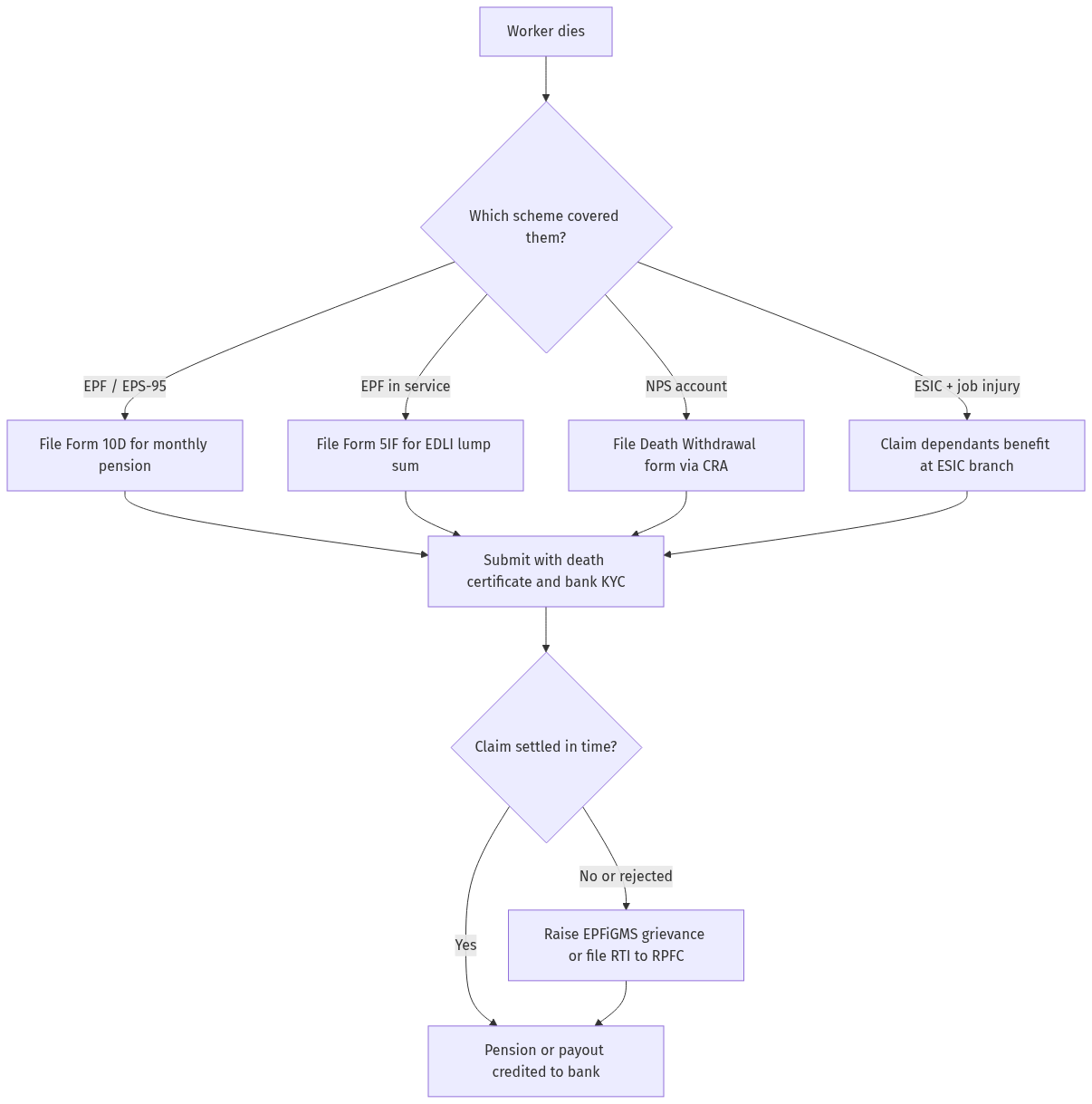
Figure: step-by-step flow. If a step stalls, use the grievance or RTI route shown.
ESIC dependants' benefit: only for a job-related death
This one is important and often misunderstood. The ESIC dependants' benefit is a monthly family pension, but it is payable only when death was caused by an employment injury or an occupational disease, not ordinary illness.
When it applies, the benefit is 90% of the deceased worker's standard wage rate, shared among the family: the widow gets the largest share for life or until remarriage, and each child gets a share until age 25. ESIC also pays Rs 15,000 towards funeral expenses. Claim it at the worker's ESIC branch office with the accident or medical records.
What documents you will need
Keep several certified copies of each, because every scheme asks for its own set:
- Original and copies of the death certificate.
- The claimant's Aadhaar, PAN and bank passbook.
- Proof of relationship: marriage certificate for a spouse, birth certificate for children.
- The deceased's UAN, PRAN or ESIC number as relevant.
- A recent passport photo of the claimant.
If your claim is stuck or rejected
Pension claims can stall over a missing nomination, a name mismatch or an incomplete service record. Do not give up. First, raise a grievance on the EPFiGMS portal for EPF and pension matters. If you still get no proper reply, file an RTI application to the Regional Provident Fund Commissioner asking for the status and reason for delay. For NPS use the CRA grievance route, and for ESIC use the branch manager or CPGRAMS. A polite, dated paper trail moves files faster than phone calls.
You can also check where your application stands using our status and complaint tracker, and read the closely related guide on claiming a PF death benefit as a nominee.
Frequently asked questions
Who gets the family pension first?
The spouse has first claim to the monthly EPS-95 or ESIC pension. Children come next, usually up to two at a time, and then dependent parents in some schemes. Each scheme has its own order, so check the rules for the one you are claiming under.
Does the widow pension stop on remarriage?
The EPS-95 spouse pension and the ESIC widow share generally continue for life but stop on remarriage. In that case the children's pension usually continues. NPS and EDLI are one-time corpus or lump-sum payouts, so remarriage does not affect money already received.
Can the family claim EPS-95, EDLI and NPS together?
Yes. These are separate schemes with separate funds. A worker covered by all of them can leave the family a monthly EPS pension, an EDLI lump sum and an NPS payout at the same time. File each claim on its own form.
What if there was no nominee registered?
The claim is still valid, but it takes longer. Without a nominee the money goes to the legal heirs, who may need a succession or legal heir certificate. This is why filing the e-nomination while alive is so helpful for the family.
Is the ESIC family pension available for any death?
No. The ESIC dependants' benefit is paid only when death resulted from an employment injury or occupational disease. For an ordinary death, the family should rely on the EPF, EPS-95, EDLI and NPS benefits instead.
How long does a pension claim take?
A clean EPS-95 or EDLI claim with e-nomination and full documents is often settled within a couple of months. Missing papers or a name mismatch can stretch this, which is when the EPFiGMS grievance and RTI routes become useful.
Is the family pension taxable?
Family pension is taxed under income from other sources, with a standard deduction allowed on it. Lump sums like EDLI and the EPF corpus have their own treatment. Confirm the current limits on the income tax portal before filing returns.
Which portal do I start with?
For EPF, EPS-95 and EDLI, start at the EPFO Member Portal on epfindia.gov.in. For NPS use npscra.nsdl.co.in, and for ESIC visit your local ESIC branch or esic.gov.in.