Get Free Legal Aid (NALSA) 2026

Reviewed on 2026-06-20 by Dr. Shrawan Kumar Pathak.
Quick Reply: Breathe. If you cannot afford a lawyer, the State pays for one. Apply free at your District Legal Services Authority (DLSA), online through NALSA, or by calling the helpline 15100. Women, children and Scheduled Caste or Scheduled Tribe members qualify whatever they earn. A decision must come within 7 days.
Take a moment. You are not on your own here
Maybe a notice has landed, a court date is looming, or someone has told you that you need a lawyer and you simply do not have the money. That fear is real, and it is also solvable. Free legal aid is not charity and it is not a favour. It is your right under the Legal Services Authorities Act, 1987, and there is a whole government machinery, from your taluk court right up to the Supreme Court, set up only to give it to you.
Let us go through it slowly, the way a helpline operator would on the phone. First we will check whether you qualify, then how to ask for help, then what happens if someone says no.
First, let us check if you qualify
There are two doors into free legal aid, and you only need to fit through one of them.
Door one: you belong to a protected group
Under Section 12 of the Legal Services Authorities Act, these people qualify no matter what they earn:
- Any woman or child.
- A member of a Scheduled Caste or Scheduled Tribe.
- A victim of human trafficking or forced labour.
- A person with a disability, including mental illness.
- Anyone facing undeserved hardship from a mass disaster, flood, drought, earthquake, caste or ethnic violence, or an industrial disaster.
- An industrial workman.
- A person in custody, including in a jail, protective home, juvenile home or psychiatric hospital.
If you see yourself on that list, your income does not even come into it. You are in.
Door two: you earn below your state's income limit
If you do not fit a protected group, you can still qualify on income. Here is the part people get wrong, so listen closely: every state and union territory sets its own annual income ceiling, and they are not the same. One state may draw the line near a lakh and a half, another higher. So do not trust a number someone quotes you from another state. Look up the current notification for your own State Legal Services Authority, or just ask when you walk into the DLSA.
There is one figure that is fixed across the country: for a case being fought in the Supreme Court, the income limit is less than Rs 5 lakh a year.
And do not panic about paperwork to prove your income. Under Section 13(2) of the Act, a simple affidavit stating your income is normally treated as enough, unless the authority has a real reason to doubt it.
How to actually ask for it
You have several ways in, and none of them cost a rupee. Pick whichever is easiest for you right now.
The calm phone call: dial 15100
If you are overwhelmed and just want a human to tell you what to do, ring the toll-free NALSA helpline 15100. They will hear you out and point you to the right office. Keep this number saved; it is the gentlest starting point.
Walk in to your nearest legal services office
You can apply in person at whichever of these fits your case:
- Taluka Legal Services Committee (TLSC), in the taluk court premises.
- District Legal Services Authority (DLSA), at the district court.
- State Legal Services Authority (SLSA), the state office.
- High Court Legal Services Committee (HCLSC), inside the High Court.
- Supreme Court Legal Services Committee (SCLSC), for Supreme Court matters.
You can hand in a form, write your request on a plain piece of paper, post it, email it, or simply tell the staff your problem out loud and let them help you write it down. No lawyer or agent is needed to apply.
Apply online and track it
If you would rather do it from your phone, go to the NALSA website at nalsa.gov.in and open the Legal Services application portal. When you file online, the system gives you an application number, so you can log back in and watch your status move. If a lawyer has already been assigned, you can also follow your matter through eCourts case status.
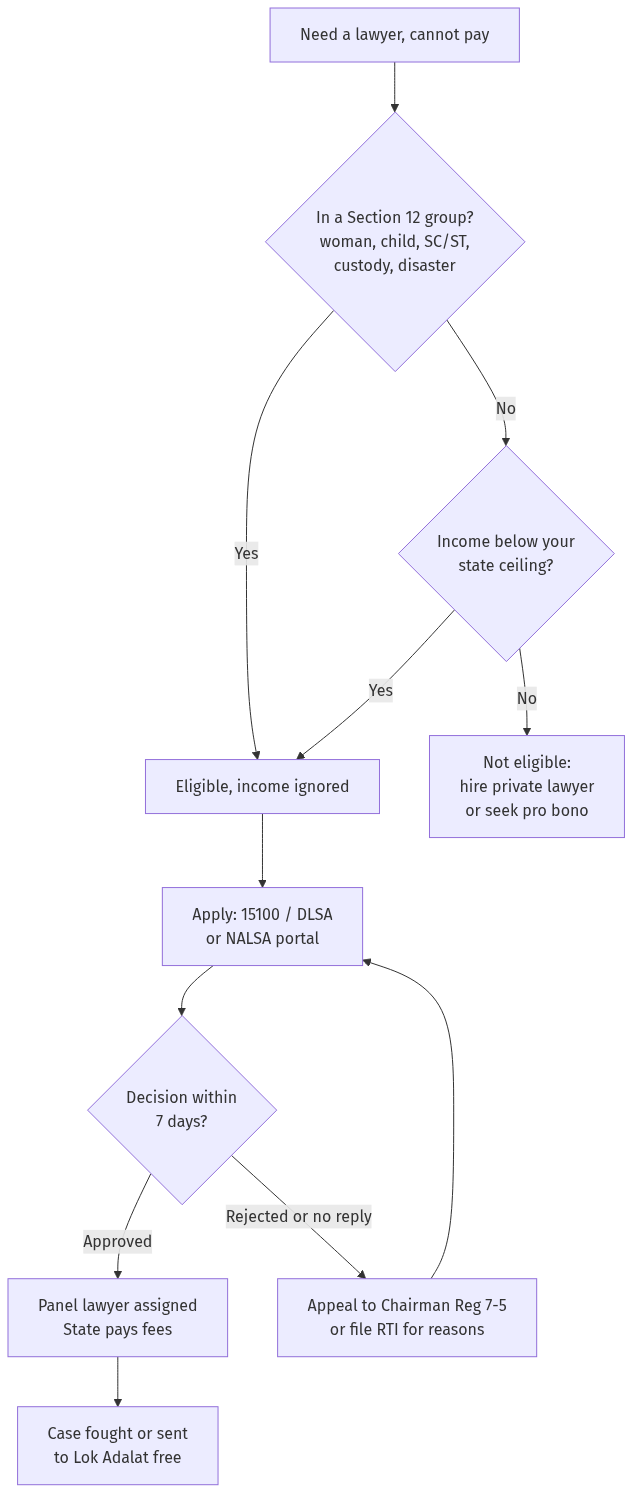
Figure: step-by-step flow. If a step stalls, use the grievance or RTI route shown.
What happens after you apply
This is the reassuring bit. The legal services authority cannot leave you hanging. Under Regulation 7(2) of the NALSA (Free and Competent Legal Services) Regulations, 2010, a decision on your application must be taken immediately, and in any case within 7 days. Once you are accepted, a panel lawyer is appointed and the State covers the lawyer's fees and the usual court costs.
If your matter is the kind that can be settled rather than fought, the same machinery runs Lok Adalat, where disputes are closed by agreement at no cost. Ask your DLSA whether your case can go there; it is often faster and far less stressful than a full trial.
If they say no, you still have moves
A refusal is not the end of the road. Take a breath and use these in order:
- Appeal in-house. Under Regulation 7(5) of the 2010 Regulations, if you are unhappy with the decision you may appeal to the Executive Chairman or Chairman of that legal services institution. Their decision on the appeal is final.
- Call 15100 again and ask exactly why you were refused and what document would fix it. Often it is a missing income affidavit, not a real rejection.
- File an RTI with the DLSA asking for the reasons recorded for rejecting your application and the criteria applied. Putting the question on record usually gets it taken seriously.
You have a right to a reason, and you have a right to push back.
Frequently asked questions
Does free legal aid really mean I pay nothing?
Yes. The State pays the panel lawyer's fees and meets the routine court and process costs of your case. You do not pay the lawyer. That is the whole point of the scheme; it exists so that being poor never decides a case.
I am a woman with a decent salary. Do I still qualify?
You do. Under Section 12, every woman and every child is eligible for free legal aid regardless of income. The income limit only applies to applicants who are not in a protected category.
What documents do I need to apply?
Keep it simple: an identity proof, anything that shows your case (a notice, FIR, summons or court papers), and an affidavit or declaration of your income if you are applying on the income ground. Section 13(2) treats your income affidavit as sufficient in most cases.
How long before I get a lawyer?
The authority must decide on your application immediately and within 7 days at the most, under Regulation 7(2) of the 2010 Regulations. If a week passes with no answer, call 15100 or go back to the DLSA and ask them to record the delay.
My application was rejected. Can I challenge it?
Yes. Under Regulation 7(5) you can appeal to the Executive Chairman or Chairman of the legal services institution. You can also file an RTI asking for the recorded reasons, which often surfaces a fixable gap rather than a real refusal.
Can I get free legal aid for any kind of case?
It covers most civil and criminal matters where you need representation or advice. The legal services authority decides based on the merits and your eligibility, and may steer settlement-friendly disputes to a Lok Adalat instead of a full court fight.
Is the 15100 helpline only for emergencies?
No. You can call 15100 for any legal aid question, to find your nearest office, or to start an application. Think of it as the front door, not the fire alarm.
Sources
Once you are accepted, you can track your matter through eCourts case status, and ask whether your dispute can be closed at a Lok Adalat for free. If your problem is really a maintenance claim, see maintenance under Section 125 CrPC; if you first need to put the other side on notice, follow our legal notice format; and if the police are refusing to register your complaint, learn how to file a Zero FIR anywhere.
Free legal aid NALSA: How to get free lawyer in India (2026)
- Step 1: How to get free legal aid from NALSA? (a) Free legal aid: (i) NALSA: National Legal Services Authority — free legal aid, (ii) eligibility: women, children, SC/ST, disabled, victims of trafficking, persons earning less than Rs 3 lakh, (iii) 2026: expanded eligibility + online application, (b) key rules: (i) Legal Services Authorities Act 1987: free legal aid — constitutional right, (ii) NALSA Regulations: eligibility + services, (iii) Supreme Court: free legal aid — fundamental right under Article 21, © common scenarios: (i) need free lawyer — for court case, (ii) legal aid denied — eligibility disputed, (iii) legal aid lawyer not effective — quality concerns, (iv) online application — NALSA portal, (v) Lok Adalat — free settlement, (d) rights: (i) eligible person has right to free legal aid, (ii) right to effective legal aid — competent lawyer, (iii) right to Lok Adalat — free settlement, (e) authority: NALSA + State Legal Services Authority + District Legal Services Authority, (f) law: Legal Services Authorities Act 1987 + Article 21.
- Step 2: Comparison table — legal aid scenarios. (a) Need lawyer: (i) issue: need free lawyer for court case, (ii) remedy: apply to NALSA/SLSA, (iii) timeline: 7-15 days, (iv) example: applied; lawyer assigned; represented, (b) Denied: (i) issue: legal aid denied — eligibility disputed, (ii) remedy: appeal + NALSA complaint, (iii) timeline: 15-30 days, (iv) example: denied; appealed; granted, © Not effective: (i) issue: legal aid lawyer not effective, (ii) remedy: request change + NALSA, (iii) timeline: 7-15 days, (iv) example: not effective; requested; changed, (d) Online: (i) issue: online application — NALSA portal, (ii) remedy: apply online — nalsa.gov.in, (iii) timeline: 7-15 days, (iv) example: applied online; assigned; represented, (e) Lok Adalat: (i) issue: Lok Adalat — free settlement, (ii) remedy: refer to Lok Adalat, (iii) timeline: 1-30 days, (iv) example: referred; settled; free. (Note: Free legal aid is constitutional right. NALSA online application. Lok Adalat for free settlement.)
- Step 3: How to get free legal aid. (a) Step 1: Check eligibility — NALSA criteria, (b) Step 2: Apply — NALSA/SLSA/DLSA, © Step 3: Online — nalsa.gov.in, (d) Step 4: Lawyer assigned — by NALSA, (e) Step 5: If denied — appeal, (f) Step 6: Lok Adalat — for free settlement.
- Step 4: E-E-A-T signals. (a) Sources: nalsa.gov.in, pib.gov.in, lawmin.gov.in, (b) Last reviewed: July 2026, © Author: RTI Wiki Editorial Team.
- Step 5: Practical tips. (a) check eligibility — women, SC/ST, disabled, low income, (b) apply online — nalsa.gov.in, © free legal aid is constitutional right — demand it, (d) Lok Adalat — free + fast settlement, (e) Example: A woman unable to afford a lawyer; applied to NALSA; lawyer assigned; case represented.
- Step 6: Key provisions. (a) Legal Services Authorities Act 1987, (b) Article 21, © NALSA: nalsa.gov.in, (d) Eligibility: women, SC/ST, disabled, low income, (e) Lok Adalat.
See Free Legal Aid and Section 125 and How to File RTI.
Reader signal
Was this article useful?
Tap once if it helped you. These counters show other citizens which pages are worth reading.