The Office vs Officer Test: RTI and the DPDP Privacy Shield
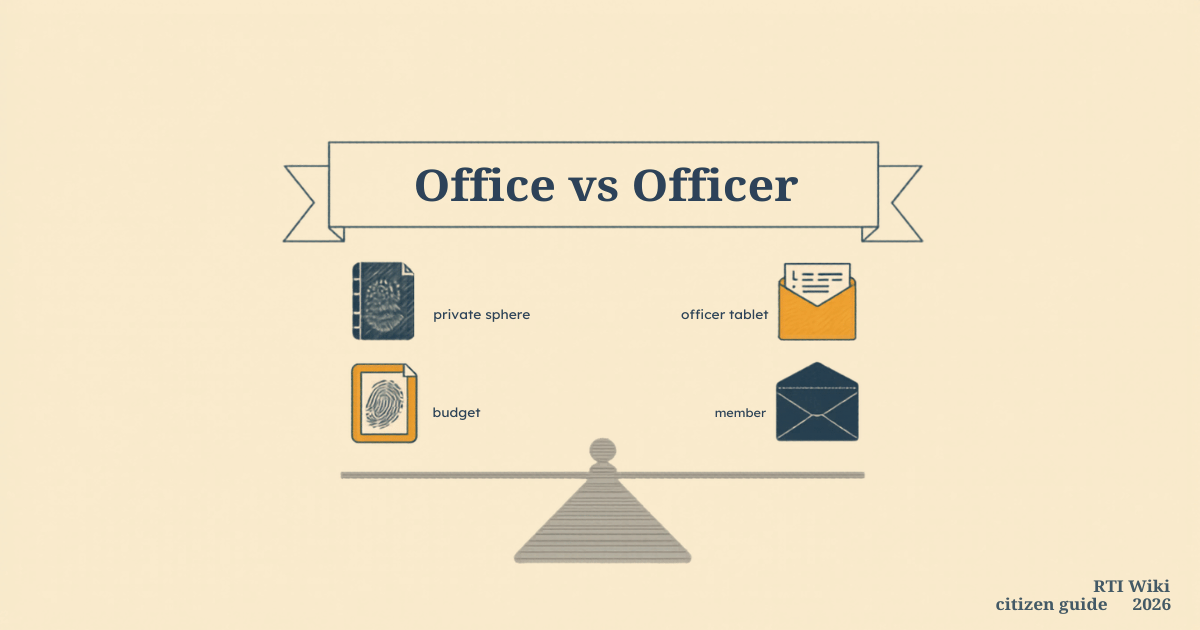
Quick Reply: DPDP Section 44 sub-3 is at the Supreme Court. Until it is decided, this is the citizen drafting test to keep your RTI alive — ask about the Office, not…
A five-judge bench of the Supreme Court is hearing five public-interest challenges to the Digital Personal Data Protection (DPDP) Act, 2023. The flashpoint is Section 44(3) — a single sub-section that lets a public authority refuse RTI replies simply by calling the information “personal”, without weighing it against the public interest. Whatever the Court decides, the way you draft your next RTI is what will decide whether you get an answer.
This is a hands-on guide. It is not a lament about what §44(3) does to democracy — others have written that powerfully, including Maja Daruwala in Hindustan Times on 26 May 2026. This post asks the next question: if the privacy shield holds, what does a citizen-proof RTI actually look like? The answer is what we call the Office vs Officer test.
Support this free analysis. RTI Wiki keeps these judgment explainers open to every citizen, applicant, PIO and student. If this page saves you drafting time, consider a voluntary donation. It can be as little as Rs 100. The article remains free and readable. Donate securely through Razorpay at BigHelpers.in
Quick answer
The test in one sentence. If your RTI asks about the office — the post, the file, the budget, the decision, the policy — Section 44(3) cannot touch it. If your RTI asks about the officer as a private person — their home address, family, medical record, personal bank account — §44(3) will (and should) shield it. Re-draft every line until each question is about the office, not the officer.
Use the AI RTI Drafter to generate the application, the PIO Reply Checker to test the reply for §44(3) misuse, and the First Appeal Builder when a PIO rejects on “personal data” grounds.
Why this matters now
Until 2023, the rule for “personal information” in an RTI was Section 8(1)(j) of the RTI Act, 2005. That section already let a Public Information Officer (PIO) refuse to disclose personal information but only if two conditions were met:
- the information had no relationship to any public activity or interest, and
- disclosure would cause an unwarranted invasion of the individual's privacy.
Section 8(1)(j) also contained a public-interest override — the PIO had to release the information anyway if the larger public interest justified disclosure. The proviso “information which cannot be denied to Parliament or a State Legislature shall not be denied to any person” was the citizen's safety net.
Section 44(3) of the DPDP Act amends 8(1)(j) by deleting the public-interest balancing test in many readings. A PIO can now mark something “personal data” and stop there. There is no statutory direction to weigh it against accountability or transparency. The petitioners before the Supreme Court argue that this fails the three-part Puttaswamy proportionality test (legitimacy, necessity, minimal impairment) and that it strips the right to know of its anchor in Article 19(1)(a).
The Court's central question, in its own words, is: can information about a person holding public office ever be called private?
That is the question you, as an RTI applicant, must answer inside your application — not wait for it to be answered for you in 2027 or 2028.
The Office vs Officer test in practice
The rule
- Office questions are about a role, function, decision, file, budget, scheme, project, tender, leave, posting, or empanelment. These are records that exist because public money paid for them. They cannot reasonably be “personal data” of any one human being. Section 44(3) does not apply.
- Officer questions are about a named human in their private capacity — their home, family, illness, salary credited to a private bank account, personal phone bill, or anything that exists about them outside their public role. §44(3) (and 8(1)(j)) protect this — and they should.
The trick is that most well-intentioned RTI applications mix the two. A PIO who wants to refuse will pick the one personal-looking line and use it to bury the whole reply.
Five drafting patterns that survive §44(3)
Pattern 1 — Anchor every question to a file number, scheme, or office order.
“Please give details of the salary of the Deputy Collector.”- “Please provide a certified copy of the office order notifying the pay-band, grade pay and allowances applicable to the post of Deputy Collector, Revenue Branch, District [blank], for FY 2025-26.”
The first asks about a person. The second asks about a post. Both will get you the same number, but only the second survives a §44(3) refusal because the post is not a natural person and cannot have “personal data”.
Pattern 2 — Replace names with designations.
Always write “the Tahsildar who signed mutation order dated 12 March 2026 in file [blank]” instead of “Shri [blank], Tahsildar”. The signatory's identity becomes a property of the file, not a fact about a private individual. This is exactly the line the CIC has held in dozens of decisions on file movement and noting sheets.
Pattern 3 — Ask for the public footprint, not the private fact.
- Personal: “What is the mobile number of the BDO?” → refuse-bait under §44(3).
- Public footprint: “Please supply a copy of the Block Development Office citizen-helpline circular issued under Section 4(1)(b) listing official contact numbers, with a copy of the order designating the holder of the BDO mobile.”
The number is the same. The framing transforms it from a “personal” data point into a Section 4(1)(b) suo-motu disclosure obligation.
Pattern 4 — Use Section 4(1)(b) as the spine of the application.
The RTI Act's Section 4 places an affirmative duty on every public authority to publish 17 categories of information without anyone having to ask. Salary structures, powers and duties of officers, budget allocations, beneficiary lists for subsidy programmes, and decision-making processes are all already disclosable under Section 4(1)(b)(x), (xi), (xii) and (xiii). Cite the sub-clause in your RTI body. Section 44(3) was not drafted to override Section 4 — that argument has not been raised by the Government even in its own pleadings. Make the PIO defend that overreach if they try it.
Pattern 5 — Build a “public interest paragraph” inside the application.
The public-interest override in §8(1)(j) was the second proviso. Even if 44(3) shrinks it, the constitutional override under Puttaswamy survives. Include a short, dated paragraph that says: “The information sought relates entirely to the conduct of a public office funded from public revenue. Disclosure is necessary to enable the citizen-petitioner to exercise the fundamental right to information protected under Article 19(1)(a) and the right to seek accountability of public functionaries as recognised in [Justice K.S. Puttaswamy (Retd) v. Union of India, (2017) 10 SCC 1, paragraphs 310-323]. The applicant claims, in the alternative, the public-interest override under Section 8(2) of the RTI Act, 2005.”
This single paragraph forces the PIO to give a reasoned rejection — and a reasoned rejection is a winnable first appeal.
A side-by-side worked example
A citizen wants to know which contractor built a damaged drinking-water tank in their village, what the bill was, when the engineer's inspection happened, and who signed off the completion certificate.
The bad draft (mixes Office + Officer)
- Name, age, address and qualifications of the Junior Engineer.
- Mobile number of the Junior Engineer.
- Salary drawn by the Junior Engineer in 2025.
- Name of the contractor.
- When was the tank built and who paid?
A PIO inclined to refuse will use Q1-Q3 to invoke §44(3) and then claim the whole application is “premised on seeking personal data”. The genuinely public Q4 and Q5 get dragged into the rejection.
The good draft (Office-only)
- Please provide a certified copy of the work order, agreement and completion certificate for the drinking-water tank constructed at GP [blank], Block [blank], District [blank], in the period 2024-25.
- Please supply the name of the contractor empanelled for the said work and a copy of the contractor's empanelment letter.
- Please supply copies of every inspection report and noting sheet relating to the said work, with the names of the posts of officers who signed each note.
- Please supply the total amount paid against the said work, the bank transaction reference, and the head of account.
- Please confirm whether any disciplinary or technical-audit proceeding has been initiated in connection with the said work, citing the file or order number.
Every question is now about a file. The “Junior Engineer” never appears as a person — only the post that signed each note. §44(3) cannot reach any of it.
Common §44(3) refusals and how to appeal them
"The information is personal data of a third party."
Ask in the first appeal: “Identify the natural person who is the third party. Specify the personal-data category from Section 2(t) of the DPDP Act. Demonstrate how disclosure causes unwarranted invasion of privacy, applying the three-part Puttaswamy proportionality test.” A PIO who cannot do all three has not discharged the burden under Section 19(5) of the RTI Act, which puts the onus of justifying refusal squarely on the public authority.
"We need the data principal's consent."
Section 44(3) does not introduce a consent requirement for records about a public role. It is also worth pointing out, in the first appeal, that the Government itself has been disclosing salary slabs, postings and inspection reports without obtaining consent since 2005, and that estoppel therefore applies to this category of records.
"Section 44(3) overrides everything."
It does not. Section 8(2) of the RTI Act — the larger public-interest clause — still applies to non-§8 exemptions, and §44(3) has not amended Section 8(2). Cite Section 8(2) in your first appeal and, if necessary, in the second appeal to the Central Information Commission or your State Information Commission.
What to do before the judgment comes
The five PILs at the Supreme Court will take time. Citizens cannot freeze their pension chases and ration disputes until then. Three practical steps:
- Refile pending RTIs using the Office vs Officer test. Withdraw the old application, send a fresh one with the Section 4(1)(b) anchor and the public-interest paragraph. You reset the 30-day clock and you give the PIO no easy refusal handle.
- Track every §44(3) rejection in a public log. Civil-society groups are already collecting these. The CIC and Supreme Court will need a record of how the section is being applied (and misapplied) on the ground. Send your rejection screenshots to RTI Wiki or your nearest state RTI federation.
- Use the RTI Playbook chapter on Section 8 refusals, which now has a 44(3)-specific appeal template you can adapt.
FAQ
Is Section 44(3) of the DPDP Act in force?
Yes. The DPDP Act, 2023 was notified, and Section 44(3) is part of the operative text. The DPDP Rules, 2025 fill in the procedural detail. The constitutional challenge is pending before the Supreme Court (five PILs, five-judge bench), but the section is presently being relied on by PIOs across India to refuse RTI requests.
Does Section 44(3) repeal Section 8(1)(j) of the RTI Act?
It amends, not repeals. The clearest legal reading is that the public-interest override built into 8(1)(j) is read down or substantially narrowed, and the proviso that “information which cannot be denied to Parliament or a State Legislature shall not be denied to any person” survives. The petitioners argue even this much is unconstitutional.
Can a PIO refuse to give the name of the officer who took a decision?
No, in our view, and in the view of dozens of CIC orders. The identity of the public functionary acting in their public capacity is part of the decision-making process that Section 4(1)(b)(iii) and (iv) require to be published. A name attached to a file note is not “personal data” — it is office data about who exercised power.
What about salaries of public servants?
Pay-band, grade pay, allowances applicable to a post are public — they appear in the Finance Department's pay manual. The actual credit to a private bank account is personal. Ask for the post's emoluments, not the individual's bank statement. (See Girish Ramchandra Deshpande, (2013) 1 SCC 212 for the conservative view, and recent CIC orders for the broader public-interest line.)
Can I cite Puttaswamy inside an RTI?
Yes, and you should — especially in the first appeal. Pin-cite paragraphs 310 to 323 of the judgment, where the Supreme Court records that informational privacy is a constitutional right but is subject to the proportionality test. The PIO's refusal must clear all three prongs (legitimacy, necessity, minimal impairment). Citizens routinely under-use this paragraph.
If §44(3) is struck down, do my old refusals come back?
If the Supreme Court strikes down or reads down Section 44(3), refusals issued under it become legally vulnerable. Keep every rejection letter and PIO order — the moment the judgment is published, you can file a fresh RTI with the original wording and force the PIO to comply.
Where is "public office" defined?
There is no single statutory definition. Courts use a functional test — does the person exercise statutory power, draw public funds, or act on behalf of a public authority? Judges, MPs, MLAs, IAS officers, university registrars in state universities, and PSU directors are clear examples. The boundary cases (private contractors handling public functions, NGOs receiving substantial state funding) have been steadily expanded by the CIC since 2015.
Does this apply to RTI requests filed to private bodies?
The RTI Act covers only “public authorities”. For private bodies that hold information on behalf of a public authority, Section 2(f) lets you route the request through the relevant department. §44(3) applies the same way — ask about the contract, the deliverable, the audit, never about the private employee's identity.
Sources & further reading
- The Right to Information Act, 2005 — full text on RTI Wiki.
- The Digital Personal Data Protection Act, 2023 — Section 44(3) at DPDP Act overview.
- The Digital Personal Data Protection Rules, 2025.
- Justice K.S. Puttaswamy (Retd) v. Union of India, (2017) 10 SCC 1.
- Maja Daruwala, “Weaponising privacy to curtail the right to know”, Hindustan Times, 26 May 2026.
- What changed in the RTI Act in 2025-26 — companion piece on this site.
- The RTI Playbook — full method, in book form.
Free citizen tools
- 🪧 AI RTI Drafter — drafts in the Office vs Officer style by default.
- ⚖️ First Appeal Builder — drop a §44(3) rejection in, get a first appeal back.
- 🔍 PIO Reply Checker — flags vague “personal data” refusals automatically.
- 🎙 AwaazRTI — dictate your problem in Hindi or a regional language; the tool will frame it in Office-not-Officer terms.
Published 26 May 2026 by the RTI Wiki editorial team. Citizen guide; not legal advice. The DPDP §44(3) constitutional challenge is sub judice — this guide is about drafting, not adjudication. Comments and case examples welcome at /contact.