Zero FIR: File Anywhere 2026

Reviewed on 2026-06-20 by Dr. Shrawan Kumar Pathak.
Quick Reply: A Zero FIR lets you report a cognizable crime at any police station, even if the offence happened in another city or state. Under BNSS Section 173, the station registers it with serial number 0, hands you a free copy, and transfers it to the correct station for investigation.
Most people only learn what a Zero FIR is on the worst night of their life, when a duty officer waves them away with the words “not our area”. That sentence is wrong in law. This guide takes the myths that send victims home empty-handed and sets each one against what the Bharatiya Nagarik Suraksha Sanhita (BNSS), 2023 actually says, so you walk in knowing your rights.
Myth 1: You can only file at the station where the crime happened
Fact. You can file at any police station in India. A Zero FIR is precisely the FIR that a station accepts when the offence falls outside its own territory. It is numbered “0” instead of a regular serial, registered on the spot, and then sent to the police station that has jurisdiction over the crime scene, which renumbers it as a normal FIR and investigates.
This matters when you are travelling, when an accident victim is rushed to a hospital in a different district, or when a woman who has moved to escape an abuser wants to complain near her current home. You should never be told to travel back to “the right area” before a complaint can be recorded.
Where this rule comes from
BNSS Section 173(1) says information about a cognizable offence may be given to any officer in charge of a police station, “irrespective of the area where the offence is committed”. The Supreme Court had already settled the principle in Lalita Kumari v Government of Uttar Pradesh, holding that registration of an FIR is mandatory once the information discloses a cognizable offence. BNSS turned that judgment into plain statute.
Myth 2: The police can refuse because it is "not their jurisdiction"
Fact. Jurisdiction is never a lawful reason to refuse a cognizable complaint. If the duty officer turns you away on that ground, the law gives you a clear escalation path, and the officer can face departmental action for the refusal.
If the station will not record your information, BNSS Section 173(4) lets you send the substance of the complaint, in writing and by post, to the Superintendent of Police (SP). If the SP is satisfied that a cognizable offence is disclosed, the SP must investigate or order a subordinate to do so. If even that fails, you can move the Magistrate under BNSS Section 175(3), but the law expects you to have written to the SP first. You can also file an RTI with the police public information officer asking why no FIR was registered, which often unsticks a stalled complaint.
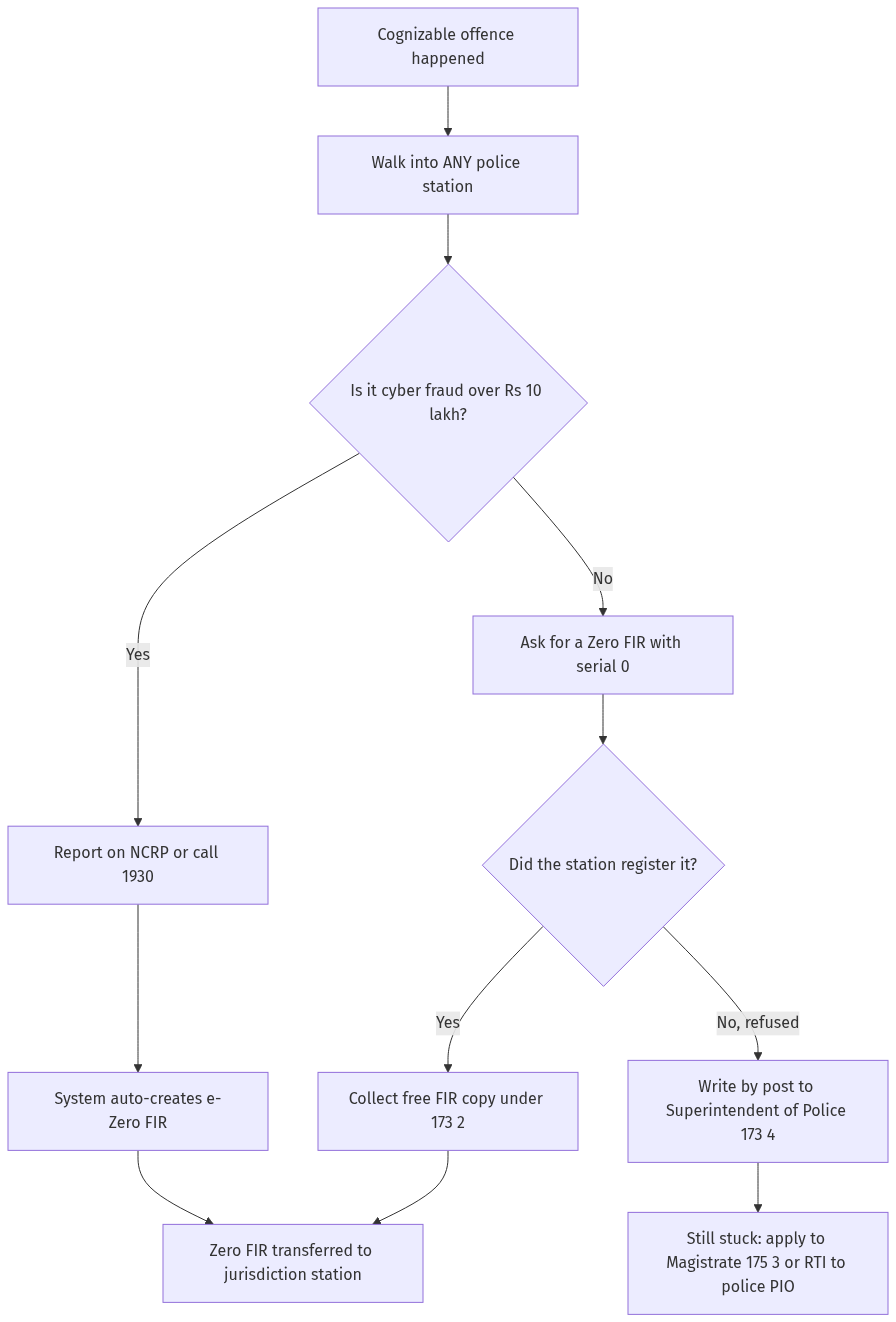
Figure: step-by-step flow. If a step stalls, use the grievance or RTI route shown.
Myth 3: A Zero FIR is a weaker or "fake" FIR
Fact. A Zero FIR has the same legal force as any other FIR. The “0” is only a serial-number convention to show the station is recording a matter outside its area. Once the papers reach the station with jurisdiction, it is given a regular number and the investigation continues normally. Nothing about your rights, your complaint, or the seriousness of the case is reduced by the zero.
For offences punishable with three years or more but less than seven years, BNSS Section 173(3) allows the officer, with prior permission of an officer not below the rank of Deputy Superintendent of Police, to run a short preliminary enquiry within fourteen days before full investigation. This is a check on frivolous cases, not a loophole to delay genuine ones.
Myth 4: You have to pay for, or beg for, a copy of the FIR
Fact. The copy is free and immediate. BNSS Section 173(2) says a copy of the recorded information shall be given forthwith, free of cost, to the informant or the victim. Insist on it before you leave the station, note the FIR number and the date, and keep a photograph of the document. You will need that number to track the case later.
Track the case after you file
Once a number is allotted you can follow the matter through court using the eCourts case status service, and you can separately request a certified FIR copy online from many state police portals.
Myth 5: Cyber fraud has no fast FIR route
Fact. Since 20 May 2025 there is a dedicated fast lane. The Ministry of Home Affairs, through the Indian Cyber Crime Coordination Centre (I4C), launched e-Zero FIR. When you report a financial cyber fraud above Rs 10 lakh on the National Cybercrime Reporting Portal at cybercrime.gov.in or by calling helpline 1930, the complaint is automatically converted into a Zero FIR.
The pilot runs through the e-Crime Police Station in Delhi and routes each case to the territorial cybercrime police station; the government has said it will be extended across India. You can then visit the cybercrime police station within three days to convert the Zero FIR into a regular FIR. For frauds below the threshold, report on the same portal or 1930 and ask your local cyber cell to register an FIR. Verify the current threshold on cybercrime.gov.in before you assume your case is in or out.
Myth 6: An online or electronic complaint is not a "real" FIR
Fact. Electronic reporting is now built into the law. BNSS Section 173(1) allows information to be given by electronic communication. To make it a valid FIR you must sign the information within three days of giving it electronically. So an email or portal complaint is a real first step, but do not skip the signature step that converts it into a recorded FIR.
If you are unsure of your rights or cannot afford a lawyer, free help exists. You can claim free legal aid through NALSA, and where a civil wrong sits alongside the crime you may also want to send a legal notice in the correct format.
Frequently asked questions
What is a Zero FIR in simple words?
It is an FIR that any police station registers with serial number 0 when the crime happened somewhere else. The station records your complaint at once and forwards it to the police station that has jurisdiction, which renumbers and investigates it. You should never be sent away on jurisdiction grounds.
Can a woman file a Zero FIR for an offence in another city?
Yes. BNSS Section 173(1) lets you report a cognizable offence at any station irrespective of where it happened. This is especially useful for harassment, assault, or domestic cases where the victim has moved. The station registers a Zero FIR and transfers it to the jurisdiction concerned.
What if the police refuse to register my Zero FIR?
Refusal on jurisdiction grounds is not lawful for a cognizable offence. Send the substance of your complaint in writing by post to the Superintendent of Police under BNSS Section 173(4). If still ignored, apply to the Magistrate under Section 175(3), and consider an RTI to the police asking why no FIR was registered.
Do I have to pay for the FIR copy?
No. Under BNSS Section 173(2) the copy is given to you forthwith and free of cost. Always collect it before leaving, note the FIR number and date, and keep a clear photograph or scan as your record.
Is a Zero FIR legally weaker than a normal FIR?
No. It carries the same legal weight. The zero is only a serial-number marker. After transfer to the right station it becomes a regular FIR with its own number, and the investigation proceeds in the usual way.
How does the e-Zero FIR for cyber fraud work?
For financial cyber fraud above Rs 10 lakh reported on cybercrime.gov.in or helpline 1930, the system auto-registers a Zero FIR through the e-Crime Police Station and routes it to the cybercrime police station. You then visit within three days to convert it into a regular FIR. Confirm the live threshold on the portal.
Can I report a Zero FIR online or by email?
You can give information electronically under BNSS Section 173(1), but you must sign it within three days for it to be taken on record as an FIR. Treat an online or email complaint as the first step, then complete the signature so it becomes a valid recorded FIR.
Sources
- https://www.indiacode.nic.in (Bharatiya Nagarik Suraksha Sanhita, 2023, Section 173)
- https://bprd.nic.in (Standard Operating Procedure on Zero FIR and e-FIR)
- https://cybercrime.gov.in (National Cybercrime Reporting Portal, helpline 1930, e-Zero FIR)
- https://nalsa.gov.in (free legal aid and legal services authorities)
- https://www.pib.gov.in (Ministry of Home Affairs press release on e-Zero FIR, 20 May 2025)
Zero FIR: How to file at any police station (2026)
Zero FIR: How to file at any police station regardless of jurisdiction (2026)
- What is a Zero FIR? (a) Zero FIR: (i) FIR registered at any police station — regardless of where the offence occurred, (ii) Numbered “0” initially — no regular FIR number, (iii) Later transferred to the police station with jurisdiction, (iv) Concept: introduced after Justice Verma Committee recommendations — post-Nirbhaya 2013, (v) Legal basis: Section 173 BNSS 2023 (formerly Section 154 CrPC), (b) Purpose: (i) Prevent delay in FIR registration — due to jurisdiction disputes, (ii) Ensure timely investigation — especially in serious offences, (iii) Protect victims — from being turned away.
- When should you file a Zero FIR? (a) Situations: (i) Serious offences: (1) Rape, sexual assault, (2) Murder, attempt to murder, (3) Cognizable offences — where arrest without warrant possible, (ii) When away from jurisdiction: (1) Crime occurred in another city/district/state, (2) Victim fled to another location, (iii) When local police refuse: (1) Police station with jurisdiction refuses to register, (2) Send victim to another station, (b) All police stations must accept: (i) Cannot refuse to register — Zero FIR for cognizable offences, (ii) Must register — and transfer to jurisdictional station.
- Comparison table: Zero FIR vs Regular FIR. (a) Zero FIR: (i) Jurisdiction: any station — regardless of location, (ii) Number: starts with “0” — no station number, (iii) Transfer: to jurisdictional station — after registration, (iv) Purpose: prevent delay — in serious cases, (v) Legal basis: Section 173 BNSS, (b) Regular FIR: (i) Jurisdiction: only station with territorial jurisdiction, (ii) Number: station-specific — e.g., FIR No. 123/2026, (iii) Transfer: not required — same station investigates, (iv) Purpose: general — all cognizable offences, (v) Legal basis: Section 173 BNSS — same. (Note: Zero FIR is for situations where jurisdiction is an issue. Regular FIR is standard.)
- How to file a Zero FIR? (a) Step 1: Go to any police station — nearest or convenient, (b) Step 2: Give complaint — orally or in writing, © Step 3: Police registers Zero FIR — assigns number “0”, (d) Step 4: Police reads over complaint — to you — for verification, (e) Step 5: Get FIR copy — free of cost — immediately, (f) Step 6: Police transfers Zero FIR — to jurisdictional station — within 24 hours, (g) Step 7: Jurisdictional station re-numbers — and investigates.
- What to do if police refuse to register Zero FIR? (a) Step 1: Send complaint by registered post — to Station House Officer (SHO), (b) Step 2: If still no action — send to Superintendent of Police (SP), © Step 3: File complaint before Magistrate — under Section 156(3) CrPC / Section 175 BNSS — directing police to register FIR, (d) Step 4: Complaint to State Human Rights Commission — for police inaction, (e) Step 5: Online complaint — state police website — or national police portal.
- Practical tips. (a) Zero FIR can be filed at any station — for cognizable offences, (b) Police cannot refuse — registration is mandatory, © Get FIR copy immediately — free of cost, (d) If refused — send by post + complain to SP, (e) Example: Victim of assault in Delhi fled to Jaipur; filed Zero FIR at Jaipur station; transferred to Delhi station within 24 hours; investigation started.
See Zero FIR and How to File RTI.