Apply Labour Card and Check Status 2026
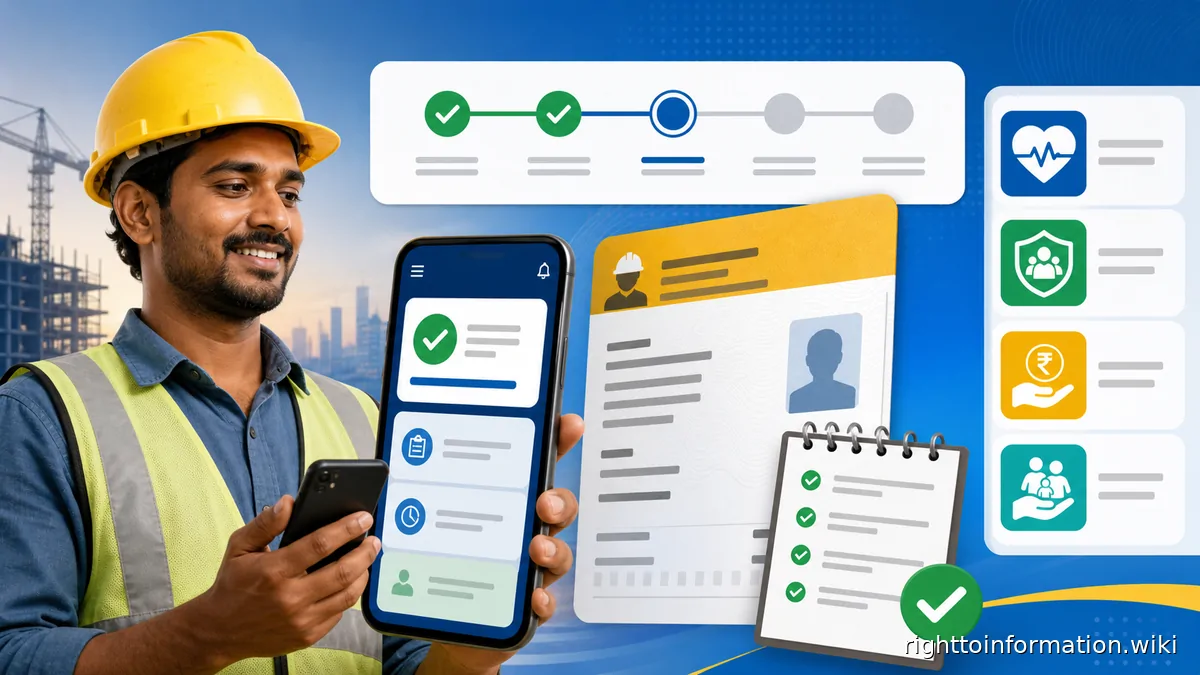
Quick Reply: Check your labour card status: e-Shram card – open eshram.gov.in, click “Already Registered? LOGIN”, sign in with your Aadhaar-linked mobile and OTP, download the UAN card. BOCW card – log in to your state board's portal with your registration number and mobile. e-Shram registration is free; construction workers should hold both cards. Citizen guidance page, not an official government page.
For the full legal background on labour law rights, see Labour Department Complaint: Employer, Salary & PF.
Check your e-Shram card status now
The e-Shram portal is the central registry for unorganised workers. Your “labour card status” for e-Shram is checked in one of three ways:
- On the portal, by mobile number. Open eshram.gov.in and click “Already Registered? LOGIN”. Enter your Aadhaar-linked mobile number and the captcha, verify with the OTP, and the dashboard shows your registered details with the option to download your UAN card. This is the standard route for the common search “status check by mobile number”.
- By Aadhaar number. The portal verifies your identity against Aadhaar inside this same login, so you do not need a separate Aadhaar-number lookup. If your mobile number is not linked to Aadhaar, you cannot use the OTP route — visit a Common Service Centre (CSC), where the operator verifies you by biometric fingerprint instead.
- On DigiLocker. The Ministry of Labour and Employment has integrated e-Shram with DigiLocker. Open DigiLocker, search for the e-Shram UAN card, and fetch it with your Aadhaar. The card is also available through the UMANG app.
If the dashboard shows an error or “under process”, see the FAQ below. The e-Shram helpline is 14434 (also 1800-889-6811, 9 AM to 6 PM, all days).
Check your BOCW card status now
The BOCW card is issued by your state's Building Workers' Welfare Board, so the status check happens on your state board's portal or at its office:
- Online, by registration number. Log in to your state board's portal with the registration number and the mobile number you gave at the time of applying. Live board portals include mahabocw.in (Maharashtra), bocw.delhi.gov.in (Delhi), bocw.punjab.gov.in (Punjab), and abocwwb.assam.gov.in (Assam). Most portals show pending / under verification / approved / rejected.
- At the board office. Carry your acknowledgement slip and ask the registration section for the file status in writing.
- If there is no update after about 30 days and no deficiency memo has been issued, submit a written complaint with your application number and date to the district labour officer, asking for the reason for delay in writing.
- RTI route. You can file an RTI application with the State Public Information Officer of the BOCW Board asking for the status of your file, the officer responsible, and the action taken — cite Section 6(1) of the RTI Act, 2005. See The RTI Playbook for ready-to-use letters.
What the two cards are
India has two main worker registration systems for the informal sector. The e-Shram card is a central government scheme run by the Ministry of Labour and Employment at eshram.gov.in. It covers hundreds of listed occupations and gives every registered worker a 12-digit Universal Account Number (UAN) linked to Aadhaar. The BOCW labour card is a state-level card issued by each state's Building and Other Construction Workers Welfare Board, specifically for construction workers, and unlocks state welfare benefits like pension, housing assistance, and educational scholarships. Construction workers are encouraged to hold both.
A legal update you should know: the two BOCW Acts of 1996 were repealed when the new labour codes came into force on 21 November 2025. The state welfare boards continue, and building-worker registration now sits in the Code on Social Security, 2020 (Sections 106 and 107), which keeps the same eligibility rules described below. Your existing card and benefits are unaffected; anything already done under the old Act is saved under the Code.
e-Shram card: who is eligible
You qualify for an e-Shram card if:
- You are aged 16-59 years.
- You work in the unorganised sector (home-based, self-employed, or casual wage worker).
- You are not a member of EPFO or ESIC.
- You are not an income-tax payer.
- Agricultural labourers and landless farmers are explicitly covered.
The card has no expiry date once issued.
e-Shram: documents and registration
Documents needed:
- Aadhaar number.
- Mobile number linked to Aadhaar (for OTP).
- Bank account number and IFSC code.
- If your mobile is not Aadhaar-linked, visit a Common Service Centre (CSC) – they can verify by biometric fingerprint.
Registration is completely free – no fee on the portal and no operator charge is permitted at CSCs.
Steps to register online:
- Go to eshram.gov.in and click “Register on eShram”.
- Enter your Aadhaar-linked mobile number and the captcha; submit the OTP.
- Confirm your Aadhaar number; a second OTP verifies your identity.
- Fill in your occupation, address, bank account, and nominee details.
- Submit – your 12-digit UAN is generated immediately and you can download the UAN card.
e-Shram benefits
On October 21, 2024, the government launched e-Shram One-Stop-Solution, integrating central welfare schemes into a single dashboard mapped to your UAN; by March 2025 the number of linked central schemes had grown to 13. Schemes accessible through e-Shram include:
- PMSBY – Pradhan Mantri Suraksha Bima Yojana: accident insurance cover of Rs. 2,00,000 for accidental death or permanent total disability, and Rs. 1,00,000 for partial disability. The annual premium is Rs. 20, auto-debited from your linked bank account for each scheme year starting June 1.
- PMJJBY – life insurance cover.
- MGNREGA – rural employment guarantee.
- PMAY-G and PMAY-U – housing schemes.
- AB-PMJAY – Ayushman Bharat health cover.
- PM-SVANidhi – working-capital loans for street vendors.
As of 3 March 2025, over 30.68 crore unorganised workers had registered on e-Shram, with women making up 53.68% of registrations.
BOCW card: who is eligible
Under Section 106 of the Code on Social Security, 2020 (which carried over the old BOCW Act, 1996 rules):
- Age: you must have completed 18 years but not 60 years of age.
- You must have worked in building or other construction work for at least 90 days in the preceding 12 months.
Under Section 107, registration ceases when you turn 60 or if you are not engaged in construction work for at least 90 days in a year — with one protection: absence caused by a workplace accident is not counted against you. A worker who has been registered continuously for at least three years before turning 60 remains eligible for benefits as prescribed.
Two protections from the earlier BOCW Act, 1996 are worth knowing as background: an application could not be rejected without giving the worker a hearing, and an aggrieved worker could appeal to the Secretary of the Board within 30 days. Since the boards continue under the Code, ask your board for its current appeal procedure in writing if your application is rejected.
Fee: boards charge a small registration fee, and many charge less than the old statutory cap of Rs. 50 or have waived it. For example, the Delhi board's official procedure page lists first-time registration at Rs. 25 per year (Rs. 20 contribution + Rs. 5 registration charges) and renewal at Rs. 20 per year. Check your own board's portal for its current fee.
BOCW card: documents needed
- Age proof: voter ID, ration card, driving licence, Aadhaar, or a notarised affidavit stating date of birth.
- Address proof: ration card, bank passbook with photo, electricity bill, water bill, voter ID, Aadhaar, or registered rent agreement.
- 90-day work certificate: issued by the employer or contractor; for labour-chowk workers, a registered construction trade union can issue this; self-certification in the prescribed format is also accepted at many boards.
- Passport-size photograph and bank account details.
BOCW registration: step by step
Because BOCW is state-administered, the exact portal differs. Common steps across most states:
- Find your state BOCW board portal (examples: mahabocw.in for Maharashtra, bocw.delhi.gov.in for Delhi, bocw.punjab.gov.in for Punjab, abocwwb.assam.gov.in for Assam).
- Create an account and fill the worker registration form online.
- Upload the documents listed above (age proof, address proof, 90-day certificate, photo, bank details).
- Pay the registration fee online (amount set by your state board; some boards have waived it).
- After document verification by the Board officer, your welfare-board membership card is issued.
- Renew as your board requires — the Delhi board, for example, renews annually; you must remain in construction work for 90 days in the year.
What the BOCW card gives you
Each state board runs its own welfare schemes for registered members. Typical benefit categories across boards:
- Accident and disability compensation
- Medical assistance for work injuries
- Maternity benefit for women workers
- Education aid for children
- Pension after superannuation for long-registered members
- Housing and tool-kit assistance
- Funeral assistance
The amounts and exact conditions are set by your state board's scheme, not by one national number. Always check your board's portal for the current schedule before you plan around a benefit.
e-Shram vs BOCW: quick comparison
- Issuing authority: e-Shram = central government (Ministry of Labour); BOCW card = state government welfare board.
- Who it covers: e-Shram = all unorganised workers; BOCW = construction workers only.
- Age: e-Shram 16-59; BOCW 18-60 (Code on Social Security, Section 106).
- Work-experience proof: e-Shram = none (self-declaration); BOCW = 90 days in the preceding 12 months.
- Fee: e-Shram = free; BOCW = small fee set by the board (for example, Delhi charges Rs. 25 for the first year, Rs. 20 to renew).
- Validity: e-Shram = lifetime; BOCW = membership reviewed annually at most boards.
- Can you hold both? Yes. They are separate registrations; one does not automatically create the other.
For schemes related to all workers, also see Employment and Labour Schemes in India and New Labour Codes 2026.
Common mistakes
- Registering on third-party lookalike sites (use only eshram.gov.in).
- Paying a CSC operator anything for e-Shram registration – operators are prohibited from charging. Report demands for payment to the CSC helpline 1800-121-3468.
- Skipping the bank account update – PMSBY premium deductions and Direct Benefit Transfers fail if the linked bank account is inactive.
- Construction workers not applying for the BOCW card and missing out on state pension, housing grants, and education scholarships that e-Shram alone does not provide.
- Not renewing the BOCW card as the board requires – lapsed membership disqualifies welfare claims.
- Filing an e-Shram application if you are already EPFO-registered (it will be rejected).
Two illustrative examples
These are illustrative scenarios to show how the cards work, not reported cases.
Sunita, a 34-year-old domestic worker in Patna, registers on eshram.gov.in in under 10 minutes using her Aadhaar and a linked mobile number. She gets her 12-digit UAN immediately and downloads the card from DigiLocker. When she dies in an accident six months later, her nominee claims the PMSBY accident cover of Rs. 2,00,000 through the bank branch where her linked account is held. Total cost to her while alive: Rs. 0 for registration + Rs. 20/year for PMSBY renewal.
Ramesh, a mason in Delhi, already has an e-Shram card when his contractor tells him about the BOCW board. He applies on bocw.delhi.gov.in, uploads his 90-day employment certificate, pays the Rs. 25 first-year fee, and receives his Delhi BOCW card. He can then claim the board's education scholarship for his daughter – a benefit e-Shram alone does not cover.
What to do if your application is stuck
- Check the portal for a deficiency memo. Most rejections are due to a missing or unclear document, not outright ineligibility.
- Call the helpline: 14434 / 1800-889-6811 for e-Shram issues.
- For BOCW delays, submit a written complaint (with application number and date) to the district labour officer. Ask for the reason in writing.
- If no action after 30 days, use the RTI Act, 2005 (Section 6(1)) to ask the Public Information Officer of the BOCW Board for: file status, officer assigned, and reasons for delay. Useful RTI asks on this topic: the verification stage of your file, the date your 90-day work certificate was verified, and whether your name appears in the list of beneficiaries paid a particular benefit in your district.
- The RTI Playbook has sample RTI letters and step-by-step guidance for labour department requests; for drafting specific questions, see Best RTI Questions and, if a first appeal is needed, First Appeal Guide. An RTI is a records-and-status tool – it cannot itself order payment; for that, use the board's grievance route or the labour court where applicable.
Frequently asked questions
How do I check my labour card status by mobile number?
For an e-Shram card, open eshram.gov.in, click “Already Registered? LOGIN”, enter your Aadhaar-linked mobile number and OTP, and your registration details and UAN card appear on the dashboard. For a BOCW card, log in to your state board's portal with your registration number and the mobile number you used while applying.
Can a construction worker hold both an e-Shram card and a BOCW card?
Yes. Neither card bars the other. The e-Shram UAN gives access to central welfare schemes; the BOCW card gives access to state-level benefits like pension, housing grants, and education support. Construction workers are encouraged to register for both.
Is the e-Shram card free?
Yes. Registration at eshram.gov.in is completely free. If you visit a Common Service Centre (CSC), the operator is also prohibited from charging you. Report any demand for payment to the CSC helpline 1800-121-3468.
What happens if my mobile number is not linked to Aadhaar?
You can still register for an e-Shram card, but you must visit a CSC in person. The CSC operator uses biometric fingerprint authentication instead of an OTP to verify your Aadhaar identity.
How long does a BOCW registration take?
After you submit all documents and the fee, the authorised officer verifies and decides. Timelines vary by board; a few weeks is common. Under the earlier 1996 Act an application could not be rejected without a hearing and appeals lay to the Board's Secretary within 30 days — since the Code on Social Security, 2020 now governs, ask your board in writing for its current decision and appeal timelines if your file stalls.
My e-Shram card shows "under process" -- what should I do?
This usually means your Aadhaar details need re-verification. Log in to eshram.gov.in, check for any error message on the dashboard, and update your details if prompted. If the status does not resolve in a week, call 14434 or visit a CSC with your Aadhaar and bank passbook for assisted correction.
Does the BOCW card lapse if I stop doing construction work for a year?
Under Section 107 of the Code on Social Security, 2020, a registered building worker ceases to be a beneficiary if he or she is not engaged in construction work for at least 90 days in a year — absence due to a workplace accident is excluded from this count. Many boards ask for renewal each year; check your board's rule before you let a year pass.