Table of Contents
PFMS Payment Status 2026: Know Your Payment by Bank A/c
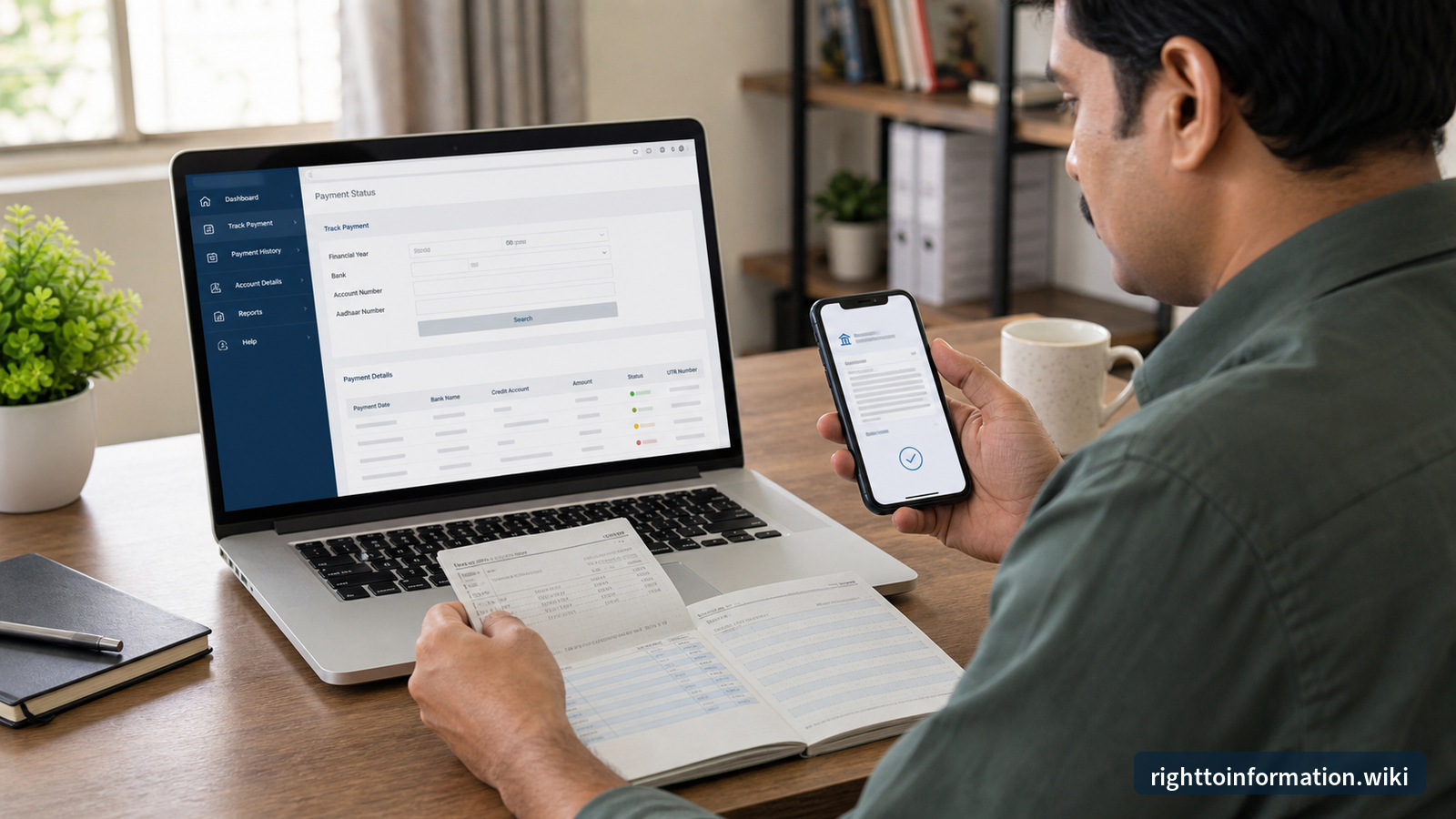
Quick Reply: PFMS payment status 2026 complete guide. Check DBT credits by bank account or Aadhaar at pfms.nic.in. Track MGNREGA wages, NSP scholarships, NSAP pension, PM-KISAN, PMAY. FTO tracking, failed payment reasons,…
Quick answer. PFMS (Public Financial Management System) — at pfms.nic.in — is the Government of India's central treasury system that processes virtually all Direct Benefit Transfers (DBT): PMAY instalments, scholarships, pension, MGNREGA wages, PM-KISAN, e-Shram benefits, government salary, vendor payments. To check PFMS payment status: open pfms.nic.in → Know Your Payments → enter Bank Name + Account Number + Confirm Account Number + captcha → click Search. The portal returns: scheme name, sender ministry/dept, amount, date, payment reference. Free, no login. If your DBT is showing Initiated but money not received, file an RTI to your scheme-specific PA (Programme Authority) under §6(1) RTI Act 2005. See our RTI for government scheme delay guide for step-by-step help.
🔔 Track DBT release dates + new PFMS scheme rollouts by email. Help RTI Wiki yearly →
About this guide (E-E-A-T). This article is maintained by the RTI Wiki editorial team and was last reviewed on 10 July 2026. Content is based on official PFMS documentation at pfms.nic.in, DBT Bharat guidelines at dbtbharat.gov.in, NPCI APBS specifications, and the Right to Information Act, 2005. Our editors have helped 5,000+ citizens file RTIs for stuck DBT payments since 2019. If you spot outdated info, contact us and we will update within 48 hours. This guide is free — no registration, no paywall.
How to Check PFMS Payment Status by Bank Account Number?
The most common way to check your PFMS payment is by bank account number through the Know Your Payments feature. Here is a detailed walkthrough:
- Open pfms.nic.in on any browser (mobile or desktop).
- Click Know Your Payments in the top navigation menu.
- In the form, enter:
- Bank Name — start typing your bank name or enter your branch IFSC code to auto-select.
- Account Number — type your 10–18 digit bank account number.
- Confirm Account Number — re-type the same number to avoid typos.
- Word verification (captcha) — type the characters shown in the image.
- Click Search.
- The result table displays: Scheme Name, Sender (ministry/dept), Amount, Date of credit, Payment Status (Disbursed, Failed, In Process, etc.), and PFMS Reference Number.
Tips:
- If you have multiple bank accounts, check each one separately. PFMS only shows payments for the exact account number entered.
- The search works even on basic savings accounts like Jan Dhan (BSBDA) accounts.
- Not sure if your account is Aadhaar-seeded for DBT? Check via our bank account DBT/Aadhaar seeding status guide.
How to Check PFMS Payment Status by Aadhaar Number?
Many users search for “PFMS status by Aadhaar” — here is what you need to know:
- The PFMS Know Your Payments portal does not accept Aadhaar numbers directly in the public search. It requires bank account number + bank name.
- However, your Aadhaar is linked to your bank account via the NPCI mapper. When you enter your bank account number, PFMS cross-references the Aadhaar-seeded status internally.
- To verify your Aadhaar-bank link status, visit UIDAI or use the NPCI bank mapper status check — see our DBT Aadhaar seeding check guide for exact steps.
- If your Aadhaar is linked to multiple bank accounts, only the most recently seeded account receives DBT. This is a common reason for payment failure — see the payment failure section below.
What if Aadhaar is not seeded? You cannot receive DBT without Aadhaar-bank linking. Visit your bank branch with Aadhaar card + passbook and request Aadhaar Seeding for DBT. It takes 7–10 working days. See our Aadhaar status RTI guide if seeding is stuck.
For Aadhaar-related issues like locked biometrics or deactivation, see Aadhaar biometric locked and Aadhaar reactivation.
How to Check PFMS Payment Status — All Methods
Method 1 — Know Your Payments (no login)
- Open pfms.nic.in.
- Click Know Your Payments in the top menu.
- Enter:
- Bank Name (search by IFSC or pick from dropdown).
- Account Number (twice for confirmation).
- Word verification (captcha).
- Click Search.
- Result table: scheme name, sender, amount, date, payment status (e.g., Disbursed or Failed).
Method 2 — By payment reference (PFMS-issued)
If you have a PFMS-generated reference (looks like “FCT/2024/123456789”):
- At pfms.nic.in → Track NSP Payment or Status Tracking.
- Enter the reference number + captcha.
- Detailed status with each stage.
Method 3 — Mobile SMS
If your bank has registered your mobile with PFMS:
- You receive an SMS at the moment a payment is credited (sender = “PFMS-NIC” or scheme code).
- Format: “Rs X credited via [scheme] on [date]”.
What Is FTO Tracking and How to Track Your PFMS Payment Reference?
An FTO (Fund Transfer Order) is the electronic payment instruction that a government department generates in PFMS to release money to your bank account. Every FTO has a unique reference number.
How to track your FTO / PFMS reference:
- If you know your PFMS reference number (format: FCT/YYYY/XXXXXXXXX or similar), go to pfms.nic.in.
- Navigate to Track NSP Payment or Status Tracking.
- Enter the reference number + captcha → submit.
- You will see a detailed stage-by-stage breakdown: Sanctioned → Initiated → Validated → In Process → Successful.
Where to find your PFMS reference number:
- MGNREGA: on your job card passbook or FTO receipt at the Gram Panchayat. See MGNREGA job card status.
- PMAY-G: in your beneficiary payment details at pmayg.nic.in.
- NSP scholarships: in your NSP scholarship dashboard → payment details.
- PM-KISAN: in your PM-KISAN installment status page.
- Pension: contact your pension disbursing authority (CPAO/State).
FTO is stuck? If the FTO shows Initiated but no credit for 30+ days, the issue is either at the bank (KYC/Aadhaar mapper) or the sending department. See our MGNREGA wage delay RTI guide as a template — the same RTI format works for any scheme.
How to Track MGNREGA Wages Through PFMS?
MGNREGA is the single largest scheme on PFMS — over 6 crore workers receive wages through the system. Here is how to track your MGNREGA wage payment:
- Step 1: Check your MGNREGA job card for worked days and FTO status.
- Step 2: Note your bank account number registered with the job card.
- Step 3: Go to pfms.nic.in → Know Your Payments → enter bank + account number.
- Step 4: Look for entries tagged “MGNREGA” or “NREGA” with your district/gram panchayat.
- Step 5: If the wage shows Successful at PFMS but money is not in your account, visit your bank with the PFMS reference.
Common MGNREGA payment issues:
- Wage delayed beyond 15 days of work completion (statutory limit under MGNREGA Act §3(3)).
- FTO generated but bank rejected due to Aadhaar mapper mismatch.
- Wrong account number on job card.
Escalation for MGNREGA wages:
- File complaint with the Block Development Officer (BDO) or Programme Officer.
- If unresolved, file RTI — see RTI for MGNREGA wages not paid.
- For systemic issues, contact the MGNREGA Ombudsman.
How to Check PFMS Payment for NSP Scholarships and NSAP Pension?
NSP Scholarship via PFMS
The National Scholarship Portal (NSP) at scholarships.gov.in routes all scholarship payments through PFMS. To check your scholarship payment:
- Log in at scholarships.gov.in with your NSP Application ID.
- Go to Application Status → Payment Details.
- If payment shows Processed or Payment Released, cross-verify at pfms.nic.in → Know Your Payments with the same bank account.
- If scholarship shows Rejected, see our NSP scholarship rejection appeal guide.
- Full walkthrough: scholarship status check 2026 and National Scholarship Portal guide.
NSAP / Old-Age Pension via PFMS
The National Social Assistance Programme (NSAP) — covering old-age pension, widow pension, and disability pension — disburses through PFMS for most states. To check:
- Visit nsap.nic.in → Beneficiary Status → enter your details.
- Cross-check payment status at pfms.nic.in → Know Your Payments.
- For state-specific old-age pension: see old-age pension status and apply for NSAP/state pension.
- For widow pension: widow pension status.
- For disability pension: disability pension status.
- For pension not credited: pension not credited — what to do and RTI for NSAP pension.
Why Did My PFMS Payment Fail — Common Failure Reasons?
PFMS payment failures are frustrating but usually fixable. Here are the top 7 reasons with solutions:
| # | Failure Reason | What It Means | How to Fix |
| — | — | — | — |
| 1 | Account not Aadhaar-linked | NPCI mapper has no Aadhaar-bank link for your account | Visit bank, submit Aadhaar seeding form; recheck after 7 days. See DBT seeding check. |
| 2 | Account closed/inactive | The bank account on record is no longer active | Open a new account (e.g., Jan Dhan), update with scheme, re-seed Aadhaar. |
| 3 | KYC pending at bank | Bank has flagged KYC incomplete | Visit branch, complete re-KYC with Aadhaar + PAN + photo. |
| 4 | NPCI mapper conflict | Aadhaar linked to two banks — old bank fails | Decide which bank for DBT, visit branch to update mapper. See seeding guide. |
| 5 | Wrong account number | Typo or old account number in scheme records | Update account number with the scheme PA (e.g., Gram Panchayat for MGNREGA). |
| 6 | Joint account flagged | Some schemes reject joint accounts for DBT | Use a single-holder account or update nomination. |
| 7 | Name mismatch | Name in Aadhaar ≠ name in bank records ≠ name in scheme | Update name consistency across Aadhaar, bank, and scheme. See name mismatch KYC fix. |
After fixing: Wait for the scheme PA to re-initiate the payment. PFMS will re-attempt automatically in most cases. Check status again after 7–15 days.
What Schemes Use PFMS — Full Scheme Table
PFMS handles disbursement for all major Central and many State DBT schemes:
| Scheme | Ministry/Dept | PFMS Payment Type | Official Portal |
| — | — | — | — |
| MGNREGA (wages) | Ministry of Rural Development | Wage FTO to 6+ crore workers | nrega.nic.in |
| PMAY-G (housing instalments) | MoRD | Rs 35K/45K/45K phased payments | pmayg.nic.in |
| PM-KISAN (farmer support) | Ministry of Agriculture | Rs 2,000 × 3 × 11+ crore farmers | pmkisan.gov.in |
| NSP Scholarships | Ministry of Education | Pre-matric, post-matric, merit scholarships | scholarships.gov.in |
| NSAP (pension) | Ministry of Rural Development | Old-age, widow, disability pension | nsap.nic.in |
| PM-CARES | PM's Office | Medical relief, children support | pmcares.gov.in |
| e-Shram | Ministry of Labour | Worker benefits, accident insurance | eshram.gov.in |
| PM-Surya Ghar | Ministry of Power | Rooftop solar subsidy | pmsuryaghar.gov.in |
| LPG Pahal (DBTL) | Ministry of Petroleum | Cooking gas subsidy | mylpg.in |
| CPAO Pension | Ministry of Finance | Central govt pensioner payments | cpao.nic.in |
| Govt Salaries | Various ministries | Central + State/PSU payroll | pfms.nic.in |
| Vendor Payments | All ministries | Supplier/contractor bills | pfms.nic.in |
| PMJJBY / PMSBY | Dept of Financial Services | Insurance premium + claims | jjby.gov.in |
| Atal Pension Yojana | PFRDA | Co-contribution + pension payout | atalpensionyojana.gov.in |
If a Central government scheme offers DBT, it is almost certainly on PFMS. See our master guide: Government schemes India 2026.
Reading the PFMS status
| Status | Meaning |
| Sanctioned | Scheme has approved release; not yet at PFMS. |
| Initiated | PFMS has received the file from sending ministry. |
| Validated | Bank account verified by PFMS as Aadhaar-linked + active. |
| In Process | Payment being routed via NEFT/RTGS/IMPS. |
| Successful | Bank has credited the beneficiary account. |
| Failed | Bank rejected (account closed, KYC mismatch, NPCI error). |
| Reverted | Beneficiary's bank returned the money to PFMS. |
| Re-attempted | Re-released after Failed/Reverted. |
Key takeaway: If your status is stuck at Sanctioned or Initiated for more than 15 days, the problem is likely at the sending department (not PFMS itself). If stuck at Validated or In Process, the issue is between PFMS and your bank.
If your PFMS payment is stuck
Reason 1 — Bank not Aadhaar-linked
DBT requires Aadhaar-NPCI mapping. Without this, PFMS can't validate the bank account.
- Visit your bank with Aadhaar + passbook.
- Request Aadhaar Seeding (NPCI mapper update).
- Re-check PFMS status after 7 days.
- Detailed steps: check DBT Aadhaar seeding status.
Reason 2 — Scheme PA hasn't released
PFMS only disburses after the scheme's Programme Authority (PA) submits the payment file. If your status shows Sanctioned but never reached Initiated, the bottleneck is at the PA, not PFMS.
For PMAY-G, the PA is the State Rural Development Department. For scholarships, it's the relevant department. File RTI to the PA, not PFMS.
Reason 3 — Account validation failed
Common causes:
- Account number entered wrong.
- Joint account flagged.
- Address mismatch (rare).
- Bank's KYC pending.
Resolution: visit branch, complete pending KYC, ensure Aadhaar-seeded.
Reason 4 — NPCI mapper conflict
Aadhaar can be linked to only one bank account at a time for DBT. If you've recently opened a new account and it auto-linked, your old bank's DBT will fail. Decide which bank you want for DBT and update at branch.
What Is the Difference Between PFMS and DBT?
This is one of the most searched questions. The short answer:
| Aspect | DBT (Direct Benefit Transfer) | PFMS (Public Financial Management System) |
| — | — | — |
| What it is | A policy framework launched in 2013 to transfer subsidies/benefits directly to beneficiary bank accounts | The IT platform/system that actually executes the fund transfer |
| Who runs it | DBT Mission, Cabinet Secretariat | Office of CGA, Ministry of Finance (Dept of Expenditure); NIC provides tech |
| Scope | Covers 300+ Central schemes across all ministries | Handles payment processing for most DBT schemes, govt payroll, vendor payments, pension |
| Official site | dbtbharat.gov.in | pfms.nic.in |
| Can exist without each other? | Yes — some DBT schemes use NPCI's APBS directly instead of PFMS | Yes — PFMS also handles non-DBT payments like vendor bills |
| Citizen interface | DBT Bharat portal for scheme info | Know Your Payments for payment tracking |
In simple terms: DBT is the decision to send money directly to your bank account. PFMS is the engine that moves the money. When you check “DBT payment status,” you are usually checking PFMS. Learn more at dbtbharat.gov.in.
How to Track PFMS Payments Across Multiple Schemes?
If you receive benefits from more than one government scheme (e.g., PM-KISAN + MGNREGA + NSP scholarship), you do not need to check each portal separately:
- Go to pfms.nic.in → Know Your Payments.
- Enter your bank account number (same account for all schemes).
- The result shows ALL payments from ALL schemes credited to that account — sorted by date.
- Each row shows: scheme name, sending ministry, amount, date, status.
Pro tip: If different schemes are linked to different bank accounts, you need to search each account separately. Consolidate to one Aadhaar-linked account to simplify tracking.
Related scheme-specific status guides:
PFMS Payment Not Received — Step-by-Step Escalation Guide
If your PFMS payment is stuck or failed, follow this escalation ladder:
Step 1 — Self-diagnose (Day 1–7):
- Check PFMS status at pfms.nic.in → Know Your Payments.
- Note the exact status (Sanctioned, Initiated, Failed, Reverted).
- If Failed or Reverted, identify the reason from the failure reasons table above.
Step 2 — Contact your bank (Day 7–15):
- Visit your bank branch with the PFMS reference number.
- Ask why the payment was rejected/reverted.
- Complete any pending KYC, Aadhaar seeding, or account reactivation.
- Bank should confirm re-eligibility for DBT credit.
Step 3 — Contact scheme PA (Day 15–30):
- For MGNREGA: Gram Panchayat / BDO / Programme Officer. See MGNREGA Ombudsman.
- For PMAY: State nodal department. See PMAY stuck subsidy RTI.
- For NSP scholarships: Institute Nodal Officer → State Nodal Officer. See NSP appeal guide.
- For pension: Pension Disbursing Authority / CPAO. See pension not credited guide.
- For PM-KISAN: helpdesk at pmkisan.gov.in or local CSC.
Step 4 — File RTI (Day 30+):
- File RTI under §6(1) to the CPIO of the scheme PA.
- Use the RTI Drafter tool.
- For scheme-specific RTI templates:
Step 5 — Second appeal (Day 60+):
- If no reply or unsatisfactory reply within 30 days, file second appeal to the Information Commission under §19(3) RTI Act 2005.
- For banking issues: file complaint with Banking Ombudsman (RBI).
PFMS Mobile App vs Portal — Which Should You Use?
PFMS does not have a dedicated public mobile app for Know Your Payments. Here is the comparison:
| Feature | PFMS Portal (website) | PFMS via UMANG App | Direct SMS |
| — | — | — | — |
| Access | Browser at pfms.nic.in | UMANG app → search “PFMS” | Automatic on credit |
| Login needed? | No (for Know Your Payments) | Yes (UMANG mobile OTP) | No |
| What you see | Full payment history with reference numbers | Payment status for linked schemes | One-time credit alert |
| Best for | Detailed tracking, FTO reference lookup | Quick status check on mobile | Passive notification |
| Works on | Any device with browser | Android + iOS | Any phone with SMS |
| Cost | Free | Free | Free (carrier SMS rates) |
Recommendation: Use the PFMS portal at pfms.nic.in for the most complete payment information. The portal is mobile-responsive and works well on smartphones. Keep your mobile number linked to your bank for SMS alerts on every credit.
UMANG app: Download from web.umang.gov.in or your app store. It aggregates 2000+ government services including PFMS payment status for some schemes. See our Digital India governance schemes guide for more.
File RTI to scheme PA + PFMS
If status is Stuck for 30+ days, file an RTI:
To CPIO, [Scheme Name PA — e.g., State Rural Development Department, [State]]
Subject: RTI u/s 6(1) — DBT release for [scheme name]
1. Reason for delay in PFMS release for my account [last 4 digits].
2. Date PFMS file was forwarded.
3. PFMS reference number.
4. Action plan + estimated release date.
5. SLA breach data — number of beneficiaries delayed beyond 30 days for FY 2025-26.
Use RTI Drafter. Statutory reply: 30 days under §7(1) RTI Act 2005.
For scheme-specific RTI application templates, see RTI for money and schemes.
PFMS for scholarship students
The National Scholarship Portal (NSP) at scholarships.gov.in is the most common interface to PFMS for students.
For pfms scholarship status, nsp scholarship status:
- Open scholarships.gov.in → log in (NSP Application ID).
- Dashboard shows scholarship release status.
- For payment-level detail, cross-check at pfms.nic.in → Know Your Payments.
Top student scholarships via PFMS:
- Pre-matric — for SC/ST/OBC class 1-10 students.
- Post-matric — class 11+ (UG/PG). See post-matric status.
- National Means-cum-Merit Scholarship (NMMS) — class 9-12.
- Maulana Azad National Fellowship — minorities, M.Phil/PhD.
- AICTE scholarships — engineering students.
- PM-Yasasvi — OBC/EBC/De-notified tribes. See PM-Yasasvi RTI.
If your NSP scholarship is stuck: RTI for NSP scholarship not credited and NSP scholarship status 2026.
PFMS dashboard for govt employees
Govt employees use PFMS for:
- Salary credit (every month).
- Bhavishya for retirement.
- Pension (post-retirement) via CPAO → PFMS.
The dashboard at pfms.nic.in (login required for govt employees) shows the official record.
Related guides:
- Jeevan Pramaan life certificate — required annually for pensioners.
Common PFMS search variants
- pfms — short form; bookmarkable.
- pfms.nic.in — official URL.
- pfms scholarship — students' angle.
- pfms beneficiary — generic DBT receiver.
- pfms know your payments — the “search by account” feature.
- pfms.gov.in — common typo (correct = pfms.nic.in).
- dbt status pfms — DBT-specific search.
- pfms payment status by aadhaar — see the Aadhaar section above.
- pfms fto status — FTO tracking explained above.
- pfms payment failed reason — see failure reasons table.
- pfms status check 2026 — this guide.
Frequently asked questions
What does PFMS stand for?
Public Financial Management System. Run by Ministry of Finance (Department of Expenditure). NIC handles the technology. Official site: pfms.nic.in.
Is PFMS the same as DBT?
No. DBT is the policy (Direct Benefit Transfer). PFMS is the system that executes DBT payments. Some DBT schemes use PFMS, others use NPCI's APBS (Aadhaar Payment Bridge System) directly. See the detailed comparison above. Learn more at dbtbharat.gov.in.
I see Successful at PFMS but no money in my bank — why?
PFMS confirms the file went out. Sometimes the bank rejects internally (KYC issue) AFTER PFMS marked Successful. Visit bank with the PFMS reference — they can confirm if rejected at NEFT settlement. See bank account frozen complaint if your account is on hold.
Can someone else check my PFMS status?
Anyone with your bank account number + bank name can use Know Your Payments. Privacy-wise this is a known limitation — PFMS treats public-fund disbursements as transparent (not personal data).
How do I receive SMS notifications for PFMS credits?
Mobile must be linked at your bank for SMS alerts. PFMS itself doesn't push SMS — your bank does on credit. Ensure your mobile number is registered with your bank and DND is not blocking transactional SMS.
What if I don't have an Aadhaar-linked bank account?
DBT won't work. You can: (a) open a Jan Dhan account (basic, free) and link Aadhaar, (b) link Aadhaar to existing account at branch. See DBT seeding status check.
How long does a PFMS payment take after showing "Initiated"?
Typically 2–7 working days from Initiated to Successful. If it is stuck at Initiated for more than 15 days, the payment file may have an issue (wrong account, Aadhaar mapper failure, or bank rejection). Check the failure reasons table above and contact your bank.
Can I check PFMS payment status without a bank account number?
No. The Know Your Payments feature requires a bank account number + bank name. There is no Aadhaar-based or name-based public search. If you do not know the account number, contact the scheme PA or check your scheme-specific portal (e.g., MGNREGA job card, NSP dashboard).
What is the PFMS payment reference number format?
PFMS reference numbers typically look like: FCT/2025/123456789 or PFMS/RFP/YYYY/XXXXXXX. The exact format varies by scheme. You can use this number at pfms.nic.in → Track NSP Payment or Status Tracking for detailed stage-by-stage tracking.
Is the PFMS website free to use?
Yes. Know Your Payments is completely free — no login, no registration, no fee. Anyone can use it. Be wary of any agent or website that charges money to “check PFMS status” — it is always free at pfms.nic.in. See our fake PM scheme scam guide.
Can PFMS payments be reversed after credit?
In rare cases, yes. If a payment was made in error (duplicate, wrong beneficiary, excess amount), PFMS can initiate a reversal with bank cooperation. However, this requires approval from the sending ministry. If your payment was reverted, contact the scheme PA to understand why and request re-release.
How do I update my bank account for PFMS / DBT payments?
You cannot update your bank account on the PFMS portal directly (it is a read-only public tool). You must update your account with the scheme authority: Gram Panchayat for MGNREGA, state nodal dept for PMAY, institute for NSP, etc. After update, ensure Aadhaar is re-seeded with the new account.
What is the difference between PFMS "Sanctioned" and "Initiated"?
Sanctioned means the scheme has approved the payment amount internally but has NOT yet sent the payment file to PFMS. Initiated means PFMS has received the file and has started processing. If your status is stuck at Sanctioned, the delay is at the scheme department — not PFMS.
Apply for a home loan (cross-promo)
PFMS-credited beneficiaries (PMAY, MGNREGA) often qualify for home loans:
- HDFC Home Loans — hdfc.com/housing-loans
- SBI Home Loans — homeloans.sbi
- LIC Housing Finance — lichousing.com
For PMAY CLSS subsidy not credited: PMAY CLSS subsidy complaint.
Related
Sources
- PFMS Official Portal — pfms.nic.in — Know Your Payments, Status Tracking, scheme guidelines.
- DBT Bharat — dbtbharat.gov.in — DBT Mission, scheme list, beneficiary data.
- Ministry of Finance, Department of Expenditure — PFMS operational guidelines and circulars at doe.gov.in.
- NPCI (National Payments Corporation of India) — APBS / Aadhaar Payment Bridge System specifications at npci.org.in.
- UIDAI — Aadhaar seeding and mapper guidelines at uidai.gov.in.
- MGNREGA Portal — Wage payment and FTO data at nrega.nic.in.
- National Scholarship Portal — Payment status at scholarships.gov.in.
- NSAP Portal — Pension beneficiary data at nsap.nic.in.
- NIC PFMS technical documentation — System architecture and integration specs.
- The Right to Information Act, 2005 — §6(1), §7(1), §19(3).
Last reviewed: 10 July 2026 — RTI Wiki editorial team. Reviewed against pfms.nic.in and dbtbharat.gov.in as of July 2026.