UPI MDR from 15 Oct 2026: who pays — citizen guide 2026
From 15 October 2026 a 0.4 percent Merchant Discount Rate applies to specified UPI shop payments above ₹2,000. You still pay the posted bill. The shop receives a little less. Person-to-person UPI stays free at any amount, and every shop payment up to ₹2,000 stays free.
If you are short on time, read the who-pays table, then the worked rupee examples, then the surcharge complaint path.
Quick answer: From 15 October 2026, you still pay the posted bill on UPI. Person-to-person transfers stay free at any amount. Shop payments up to ₹2,000 stay free. On specified shop payments above ₹2,000, the merchant pays a 0.4 percent Merchant Discount Rate, capped at ₹300. The fee is not a government tax.
Last reviewed: 17 September 2026 by Dr. Shrawan Kumar Pathak.
What a Merchant Discount Rate is, in 50 words
A Merchant Discount Rate is a merchant-side settlement fee. The customer pays the bill on the screen. The acquiring bank or payment provider keeps a small slice before crediting the shop. It is not a tax. The Ministry of Finance says it is not collected by the Government or by NPCI.
Who pays, and who does not
Read this table before any forward. The Ministry of Finance stated the same split on 15 September 2026 (PIB Release ID 2310586).
| Your payment | Who pays the MDR from 15 Oct 2026 | What you should see on the app |
|---|---|---|
| Person-to-person UPI, any amount | Nobody. Stays free. | The exact amount you typed |
| Shop / merchant UPI up to ₹2,000 | Nobody. Stays free. | The posted bill |
| Specified shop / merchant UPI above ₹2,000 | The merchant, at 0.4 percent, capped at ₹300 from ₹75,000 | The posted bill. No extra line on your side |
| Small merchant under the zero-MDR framework | Nobody. Stays free. | The posted bill |
| RuPay-powered debit card | Banks and system providers cannot charge the payer or the payee under S.O. 5067(E) | The posted amount |
The same PIB note says about 96 percent of person-to-merchant volume stays outside the MDR, and UPI transactions that make up 70 percent of total value stay outside it.
| Start date | You pay extra? | Shop UPI that stays free | Specified shop UPI above ₹2,000 | Cap |
|---|---|---|---|---|
| 15 October 2026 | No | Up to ₹2,000, plus P2P any amount | 0.4 percent, paid by the shop | ₹300 from ₹75,000 |
① Gazette S.O. 5067(E) on 14 September 2026 ② NPCI framework on 15 September 2026 ③ Rates live on 15 October 2026 ④ Settlement cut sits on the merchant ⑤ A surcharge printed on your bill is not the MDR
How the rupees add up for the shop (not for you)
These worked figures match the NPCI FAQ table dated 15 September 2026, as reproduced from that FAQ.
| Bill you pay | MDR the shop bears | What the shop should receive |
|---|---|---|
| ₹2,000 | ₹0 | ₹2,000 |
| ₹3,000 | ₹12 (0.4 percent) | ₹2,988 |
| ₹50,000 | ₹200 | ₹49,800 |
| ₹75,000 or more | ₹300 cap, not 0.4 percent of the full bill | Bill minus ₹300 |
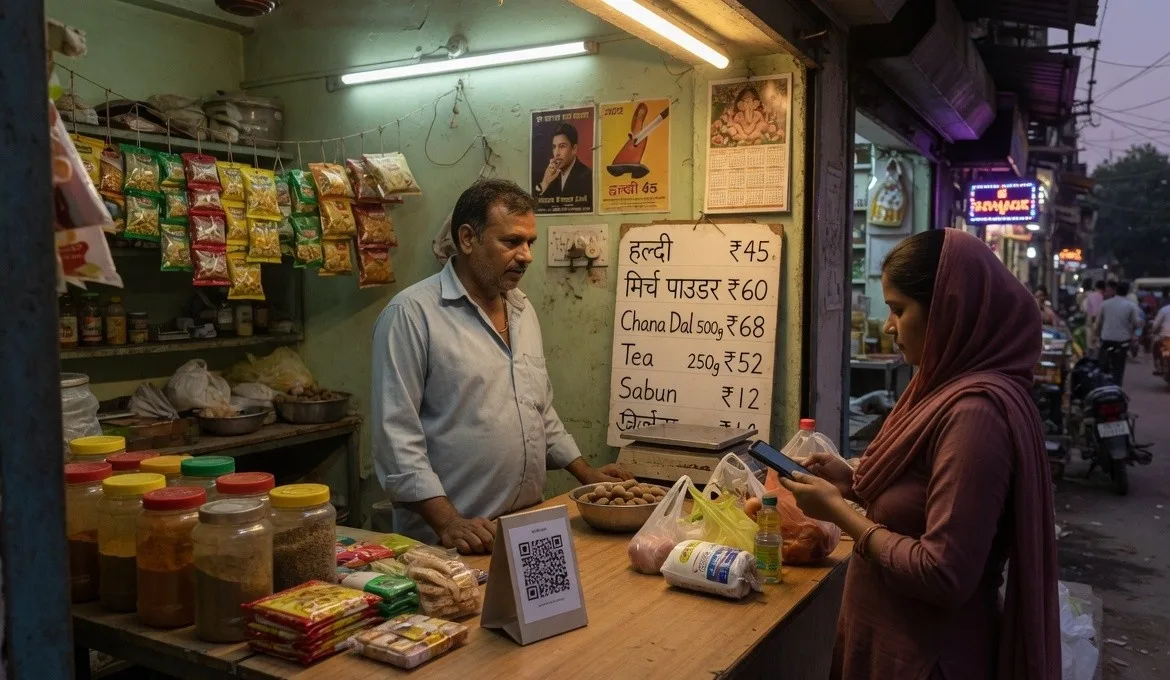
① You scan the QR and pay the posted amount. ② Your bank debit matches the bill. ③ The merchant's bank settles the credit. ④ On specified P2M above ₹2,000, the MDR is taken on the merchant side. ⑤ If the shop adds a “UPI charge” on your bill, that is a surcharge, not the MDR.
The two official papers, 14 and 15 September 2026
Two different instruments landed on two days. Mix them up and the forwards write themselves.
14 September 2026, the gazette. The Ministry of Finance, Department of Financial Services, issued S.O. 5067(E) under Section 10A of the Payment and Settlement Systems Act, 2007 (Act 51 of 2007). It specifies two electronic modes on which no bank or system provider may impose, directly or indirectly, any charge on a person making or receiving a payment:
- debit cards powered by RuPay
- Unified Payments Interface transactions up to ₹2,000
That is a statutory no-charge list. It protects both ends of the payment: the customer and the merchant, for those modes.
15 September 2026, the framework. After the UPI and Services Steering Committee headed by NPCI considered operational parameters, NPCI issued the Merchant Discount Rate framework for specified person-to-merchant UPI above ₹2,000. The Ministry of Finance published the citizen summary the same evening. The start date is 15 October 2026.
The standard rate in that framework is 0.4 percent on specified P2M above ₹2,000, with a ₹300 cap once the bill is ₹75,000 or more. A ₹1 lakh eligible merchant payment therefore costs the shop ₹300, not ₹400.
NPCI's FAQ of the same date, as reproduced from the FAQ text, also lists two concessional merchant classes:
- a flat ₹5 MDR on specified essential-sector P2M above ₹2,000, including railways, telecom, insurance and fuel
- 0.02 percent, still capped at ₹300, on specified capital-market P2M such as securities, mutual funds, stockbrokers and dealers
Confirm those two concessional rows on the live NPCI FAQ before you treat a named merchant as covered. The Ministry of Finance citizen note is the document to quote first: 0.4 percent, ₹2,000 threshold, ₹300 cap, P2P free, 96 percent of P2M volume free.
Finance Ministry note UPI stays free for P2P and 96 percent of merchant volume. pib.gov.in
August 2026 enabling note No charges for UPI users. The amendment was only an enabling power. pib.gov.in
This wiki does not host the government list. Use the official buttons.
Why the old "UPI is free by law" sentence had to change
From 1 November 2019, Section 10A of the Payment and Settlement Systems Act, 2007 barred a bank or system provider from charging a person making or receiving a payment through the electronic modes then prescribed under section 269SU of the Income-tax Act, 1961. In practice that list kept BHIM-UPI, UPI QR and RuPay debit free of a Merchant Discount Rate.
The Taxation and Other Laws (Amendment) Act, 2026 swapped that fixed tax-law cross reference for a notification power. The Central Government now names the protected modes in the gazette. That is what S.O. 5067(E) did on 14 September 2026. The older RTI Wiki page on the enabling law recorded the position as of 3 September 2026, when no rate and no start date existed. They exist now. Read that page for the statute history, then come back here for the live rates.
The 8 August 2026 Ministry of Finance note (PIB Release ID 2296594) had already said three things that still hold:
- consumers making payments will not face transaction charges
- all person-to-person transactions stay free
- any MDR would be merchant-side, threshold-based, and nominal compared with card MDRs
UPI's scale is why the fight is loud. NPCI's product statistics show 2,450.90 crore UPI transactions worth ₹29.82 lakh crore in August 2026, across 752 live banks. The Ministry of Finance earlier put FY 2025-26 at 24,161.69 crore transactions worth ₹314.23 lakh crore.
If the shop adds a UPI charge on your bill
The MDR is not supposed to appear as an extra line on the customer's UPI screen. The Ministry of Finance is explicit: customers will not be required to pay a charge when making the payment through UPI.
If a shop, petrol pump, clinic or website adds “UPI convenience”, “MDR 0.4 percent” or “digital fee” on top of the posted price, that is a surcharge on you, not the settlement MDR.
Do this the same day:
- Pay the posted price, or pay cash, or walk away. Do not accept a handwritten add-on as “government UPI tax”. It is not.
- Photograph the menu or MRP, the bill with the extra line, and the UPI success screen showing what you actually paid.
- Ask the shop in writing to reverse the extra. A WhatsApp to the printed number is enough if it shows the date.
- File on the National Consumer Helpline at consumerhelpline.gov.in or 1915, and on e-Jagriti if you want a consumer commission case.
- If a bank or UPI app itself added a platform fee on a protected payment, complain to the bank, then to the RBI Integrated Ombudsman at cms.rbi.org.in after 30 days or a rejection. Helpline 14448.
For a pasted fake QR, that is fraud, not MDR. Call 1930, file at cybercrime.gov.in, and use the QR sticker fraud guide.
Documents to keep for 90 days
- UPI success screenshot with UTR / RRN, payee name and amount
- The printed or PDF bill
- Photograph of the price board or in-app cart before you paid
- Shop GSTIN if printed (check it on gst.gov.in)
- Bank complaint number if you escalate
- Any WhatsApp or email in which the shop refused to reverse a surcharge
Common mistakes
- Treating the MDR as a tax. Section 10A and the PIB note both describe a charge inside the payment ecosystem, not a levy to the Consolidated Fund. Quote the 15 September PIB line, not a forward.
- Thinking person-to-person UPI above ₹2,000 is now charged. S.O. 5067(E) plus the PIB note keep P2P free at any amount.
- Paying a “UPI charge” added at the counter and assuming the government required it. The customer-facing payment stays at the posted amount.
- Using the 3 September 2026 “no rate exists” sentence after 15 October 2026. The rate and the date now exist.
- Filing an RTI to a private UPI app. Google Pay, PhonePe and Paytm are not public authorities. File to the Department of Financial Services or the Reserve Bank of India for the gazette, the circular and the monitoring record.
- Skipping first appeal. Silence after 30 days is deemed refusal under Section 7(2) of the RTI Act, 2005. File a first appeal under Section 19(1).
An illustrative situation, not a named person. A kirana in Nashik prints a new board on 16 October 2026: “UPI above ₹2,000: add 0.4 percent.” A customer buying rice for ₹2,400 is asked for ₹2,409.60. That extra ₹9.60 is not the official MDR. The official MDR, if this shop is a specified P2M merchant, is ₹9.60 borne by the shop on settlement, while the customer still owes ₹2,400. The customer should refuse the add-on, keep the photo of the board, and complain to 1915 if the shop will not sell at the posted price.
Sample RTI to the Department of Financial Services
File online at rtionline.gov.in against the Department of Financial Services, Ministry of Finance. Fee ₹10. BPL applicants pay nothing under Section 7(5). The PIO has 30 days under Section 7(1). If the request sits with RBI, the PIO must transfer it in 5 days under Section 6(3).
To
The Central Public Information Officer
Department of Financial Services
Ministry of Finance
Jeevan Deep Building, Parliament Street
New Delhi 110001

Subject: Request under Section 6(1) of the RTI Act, 2005, for the UPI MDR
         instruments dated 14 and 15 September 2026

1. Please supply a copy of gazette notification S.O. 5067(E) dated
   14 September 2026 issued under Section 10A of the Payment and
   Settlement Systems Act, 2007, including every annexure.

2. Please supply the note or office memorandum by which the
   Department recorded the NPCI Merchant Discount Rate framework
   for specified UPI person-to-merchant transactions, with the
   effective date of 15 October 2026.

3. Please state whether any later gazette, corrigendum or
   superseding notification has altered the Rs 2,000 threshold,
   the 0.4 percent rate, or the Rs 300 cap, and supply the copy.

4. Please supply the list of merchant categories, if any, that
   the Department has accepted as attracting a flat Rs 5 MDR or
   a 0.02 percent capital-market MDR, with the source circular.

5. Please state the name, designation and email of the officer
   currently holding the UPI MDR file, and the file number.

6. I am a citizen of India. I do not seek any third-party
   account data. If any part is exempt, apply Section 10 and
   release the rest.

Fee: Rs 10 paid on rtionline.gov.in / IPO.

Place:
Date:

Yours faithfully
[Name]
[Full postal address, PIN, mobile, email]
If there is no reply by day 31, file a first appeal under Section 19(1). Draft the application in the AI RTI Drafter and the appeal in the First Appeal Builder. Track the clock with the Timeline Tracker. For the wider method, use The RTI Playbook.
The Supreme Court in Reserve Bank of India v. Jayantilal N. Mistry, (2016) 3 SCC 525, held that the Reserve Bank is a statutory regulator, not a fiduciary of the banks it supervises, and cannot use a blanket Section 8(1)(e) shield to hide regulatory information. Payment-system directions and the gazette that names protected UPI modes sit in that public-interest space. Ask for the instrument, not for another customer's UPI log.
What to do in the next 30 minutes
- Screenshot this page's who-pays table and keep it on your phone until 15 October 2026.
- Open the 15 September PIB note from the official button above and save the PDF.
- If you run a shop, ask your acquiring bank in writing whether you are a specified P2M merchant, a zero-MDR small merchant, or an essential-sector merchant, and what credit you will see on a ₹3,000 UPI.
- If a shop has already added a UPI line on your bill, photograph it and file at 1915 tonight.
- If you only send money to family, you can stop reading. P2P stays free.
Frequently asked questions
Is UPI still free for me after 15 October 2026?
Yes, on the customer side. The Ministry of Finance says consumers making payments will not face transaction charges. Person-to-person UPI stays free at any amount. Shop UPI up to ₹2,000 stays free. On specified shop UPI above ₹2,000, you still pay the posted bill. The merchant bears the MDR.
Who actually pays the 0.4 percent?
The merchant, through the acquiring bank or payment provider, on specified person-to-merchant UPI above ₹2,000. It is taken on settlement. It should not appear as an extra debit on your UPI PIN screen.
What is the cap?
₹300 per transaction once the specified P2M bill is ₹75,000 or more. A ₹1 lakh eligible merchant payment therefore costs the shop ₹300, not ₹400.
Does the ₹2,000 line apply to money I send my family?
No. Person-to-person UPI stays free irrespective of the amount. The ₹2,000 line is for person-to-merchant payments and for the gazette's no-charge list.
Can the shop pass the MDR to me?
The official position is that customers are not to be charged for making the UPI payment. If a shop still adds a line, treat it as a surcharge, keep evidence, and use 1915 and the consumer commission. Do not confuse that add-on with the gazette.
Are AutoPay SIPs and insurance mandates charged?
NPCI's 15 September 2026 FAQ, as reproduced from the FAQ text, states that UPI AutoPay recurring mandates are not in the prescribed MDR list. One-time capital-market P2M is described separately at 0.02 percent. Confirm the live FAQ for your exact mandate class before you argue with a fund house.
Is this a tax?
No. The Ministry of Finance says MDR is neither a tax nor a charge collected by the Government or NPCI. It is distributed among payment-ecosystem participants, including banks and payment-application providers.
What if my UPI app starts showing a platform fee?
Complain to the bank that issued your UPI handle. If there is no reply in 30 days, or you reject the reply, file free at cms.rbi.org.in under the Reserve Bank - Integrated Ombudsman Scheme, 2026. See the RBI Ombudsman 2026 complaint guide.
Can I RTI NPCI itself?
File first to the Department of Financial Services and the Reserve Bank of India. They hold the gazette, the policy note and the regulatory file. Whether NPCI is a public authority in a given request is a separate, fact-specific question. Do not let that debate delay the DFS application.
Has a court stayed the 15 October start?
News reports of 16 September 2026 said a writ petition had been filed in the Supreme Court challenging the gazette and the MDR framework. A filing is not a stay. Until a court orders otherwise, S.O. 5067(E) and the 15 October start date are the live official position. Recheck the eGazette before you rely on a screenshot.
Sources
- S.O. 5067(E) dated 14 September 2026, Ministry of Finance, Department of Financial Services, under Section 10A of the Payment and Settlement Systems Act, 2007. Search on egazette.gov.in
- Payment and Settlement Systems Act, 2007 (Act 51 of 2007), Section 10A, on indiacode.nic.in
- NPCI UPI product statistics, August 2026, npci.org.in product statistics
- Department of Financial Services press-release index (links the 15 September note)
- Reserve Bank of India v. Jayantilal N. Mistry, (2016) 3 SCC 525
- Right to Information Act, 2005, Sections 6, 7, 10 and 19