RTI for an unresolved TAFCOP report - citizen guide 2026

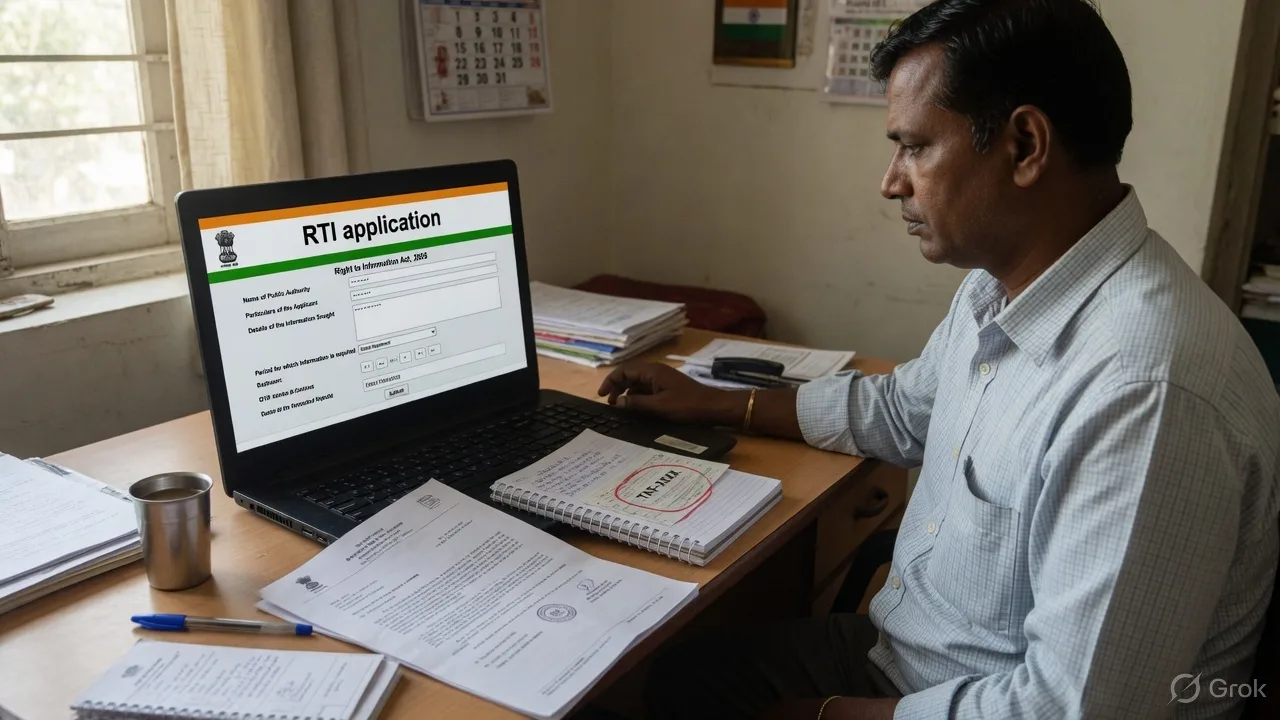
An RTI application asks a public authority for records it already holds, or can lawfully access. It is not a grievance, not an order to disconnect a SIM, and not a way to see another person's KYC. If your TAFCOP report looks stuck, file under section 6(1) of the Right to Information Act, 2005 with the Department of Telecommunications or the DoT office that holds the file. This page is independent citizen guidance.
Quick answer: File a section 6(1) RTI with DoT, or the DoT Licensed Service Area office if that office holds the file, asking for receipt date, recorded action, correspondence and current status of TAFCOP ticket [ID]. Fee is Rs 10 under the RTI Rules, 2012, unless you are eligible BPL. Reply is due in 30 days. Do not address the RTI to Airtel, Jio or Vi.
If you are short on time, copy the sample application below and file it at rtionline.gov.in.
2. TAFCOP login Know mobile connections in your name. tafcop.sancharsaathi.gov.in
This wiki does not host the government list.
What this page is, in 50 words
This is a records-and-application guide for a TAFCOP report that appears unresolved. It tells you which public authority is likely to hold the file, what you can ask, and what the Act will not give you. It is not another TAFCOP login tutorial and not an operator complaint letter.
For how to check and report connections, use the TAFCOP portal guide. For the operator letter, use SIM issued in my name: complaint letter.
RTI is not a grievance
Keep the two tracks separate.
| Track | What it does | What it cannot do |
|---|---|---|
| Operator complaint / TAFCOP report | Asks the provider or DoT system to re-verify or act | Does not create a statutory 30-day information reply |
| RTI application | Asks for existing records held by a public authority | Does not order disconnection, compensation, or an investigation you wish existed |
Section 2(f) of the RTI Act defines information as material in any form, including records, documents, emails, circulars and reports, and information relating to a private body which can be accessed by a public authority under any other law in force. Section 2(j) limits the right to information that is held by or under the control of a public authority.
You may therefore ask DoT for the notes it actually has on your ticket. You may not use RTI to invent a faster disconnection clock.
Open the RTI versus grievance infographic
Who is likely to hold the record
Start with the public authority that runs TAFCOP.
- Department of Telecommunications (DoT), Ministry of Communications. Sanchar Saathi and TAFCOP are DoT citizen services. File first with DoT through rtionline.gov.in. If you pick the wrong central office, section 6(3) requires transfer to the right public authority within five days, not rejection. - DoT Licensed Service Area (LSA) office of the circle where the connection is active. These field units, listed on dgtelecom.gov.in/rti, designate their own CPIOs. Use this extra filing only if you already know the circle office is handling the ticket, or if DoT HQ transfers the application there. - TRAI. Use TRAI for records about the complaint-redressal framework, published Appellate Authority particulars, or generic regulatory material. TRAI's own FAQ says it does not handle individual consumer complaints, so do not ask TRAI to disconnect the SIM.
Confirm the current public-authority name on the RTI Online drop-down at the time you file. Officer names change. Designations travel better than personal names.
Private telecom operators and the RTI Act
Airtel, Jio and Vi are private companies. They are not, as a general rule, “public authorities” under section 2(h). The Supreme Court in Thalappalam Service Cooperative Bank Ltd. v. State of Kerala, (2013) 16 SCC 82, held that the categories in section 2(h) exhaust themselves. Mere registration or regulatory supervision does not make a body a public authority. Control must be substantial, not only supervisory.
BSNL and MTNL are government companies. They are commonly treated as public authorities, but confirm the listing on RTI Online before you file, and still ask only for records, not for a service order.
Section 2(f) has a second door: information relating to a private body which the public authority can access under any other law. That is not a blank cheque. It covers what DoT or TRAI is already legally entitled to call for. It does not mean the PIO must fetch another subscriber's CAF or photograph because you asked. Third-party personal information may be withheld under section 8(1)(j). Section 10 allows the non-exempt part of a record to be released after severing exempt material. Section 11 requires a third-party process where the record relates to or has been supplied by a third party and is treated as confidential.
Do not write an RTI that says “send me the KYC of the person using number XXXXXXXXXX”.
Hypothetical example, not a real case
Hypothetical only. A reader reported one unknown number on TAFCOP, waited past the published 60-day outer limit, and still saw the same status. They filed a Rs 10 RTI with DoT asking only for the receipt date of ticket TAF-XXXX, copies of status notes DoT holds, and the date of any report received from the operator, with third-party personal details redacted under section 10. They did not ask DoT to disconnect the SIM. No person, district or outcome in this box is real.
Copy-ready RTI application
File this under section 6(1). Keep the text factual. Replace [placeholders]. Do not attach Aadhaar, OTP screenshots, or unmasked TAFCOP pages to a public upload. On RTI Online you may upload a masked ticket screenshot as a supporting PDF if you wish.
To
The Central Public Information Officer
Department of Telecommunications
Ministry of Communications
Sanchar Bhawan, 20 Ashoka Road
New Delhi 110001

(If filing on rtionline.gov.in, select the Department of Telecommunications
from the public-authority list. If you already have a named LSA CPIO,
address that office instead and say so in point 1.)

Date: [DD Month YYYY]

Subject: Application under section 6(1) of the Right to Information Act, 2005
for records on TAFCOP / Sanchar Saathi ticket [TICKET ID]

Sir / Madam,

1. I, [Full name], son / daughter of [parent name], resident of [postal
   address], am a citizen of India. I request the following information
   under section 6(1) of the Right to Information Act, 2005.

2. Subject matter: action recorded on TAFCOP / "Know mobile connections
   in your name" ticket [TICKET ID], reported on [date], concerning mobile
   connection ending [LAST FOUR DIGITS] shown in my name. I reported the
   connection as "This is not my number".

3. Information sought (existing records only):

   (i) Date of receipt of ticket [TICKET ID] in the Department, and the
       designation of the office that first recorded it.

   (ii) Current status recorded against the ticket as on the date of
        reply, with the date of last status change.

   (iii) Copy of correspondence, notes or electronic entries the Department
         holds on this ticket, including any reference sent to a telecom
         service provider and any action report received back. Personal
         information of any third party may be severed under section 10.

   (iv) Copy of the instructions, circulars or standard operating
        procedure, as held by the Department, that currently govern
        handling of a connection reported as not taken by the subscriber.

   (v)  If any part of this information is held by another public
        authority, please transfer that part under section 6(3) and
        inform me of the transfer.

4. I am not seeking another person's KYC form, photograph, biometric
   record, call detail record, or full mobile number of any third party.
   I am not seeking an opinion, an explanation of delay, or an order to
   disconnect the connection.

5. Period: from [date of TAFCOP report] to the date of your reply.

6. Fee: Rs 10 paid through the RTI Online portal / Indian Postal Order
   No. [number] payable to the Accounts Officer, Department of
   Telecommunications. If I am below poverty line, the BPL certificate
   is enclosed and no fee is payable under Rule 5 of the RTI Rules, 2012.

7. Please send the information to the postal / email address below
   within 30 days under section 7(1).

Yours faithfully,
[Signature]
[Full name]
[Postal address]
[Phone]
[Email]
Use AI RTI Drafter if you want the same facts formatted on screen. Use Timeline Tracker to mark day 30. For structure, see how to write an effective RTI application.
Fee, clock and first appeal
- Fee: Rule 3 of the Right to Information Rules, 2012 fixes Rs 10 for a section 6(1) application. Rule 5 exempts a below-poverty-line applicant who attaches the certificate. Rule 3 also says the application shall ordinarily not contain more than 500 words, excluding annexures, but it shall not be rejected only because it is longer. RTI Online currently allows about 3,000 characters in the form and a PDF attachment if you need more space. - How to pay: Online on rtionline.gov.in, or by IPO / demand draft / cash against receipt as in Rule 6. - Reply period: Section 7(1): 30 days from receipt. 48 hours if the information concerns the life or liberty of a person. Do not treat a stuck SIM as a life-or-liberty claim unless you can honestly justify that statutory test. - Deemed refusal: If no decision arrives in time, section 7(2) treats that as a refusal. - First appeal: Section 19(1), to the officer senior in rank to the CPIO in the same public authority, within 30 days of the decision or of the date the decision should have been received. No fee for the first appeal, as RTI Online's own FAQ also states. Section 19(6): the first appeal is to be disposed of within 30 days, extendable to 45 days with reasons recorded. - A first appeal under the RTI Act is not a telecom Appellate Authority appeal. Do not send this RTI first appeal to Airtel, Jio or Vi.
If the PIO's reply is evasive, run it through PIO Reply Checker and draft the first appeal with First Appeal Builder. The walkthrough is file a first appeal under section 19. The officer is the First Appellate Authority.
What you should not promise yourself
- RTI will not, by itself, disconnect the flagged SIM. - RTI will not force a private operator to open an investigation on your timetable. - RTI will not hand you another subscriber's KYC. - RTI will not obtain a document the authority does not hold and cannot lawfully access. - Filing RTI does not pause a cybercrime or bank clock. If money has moved, call 1930 first.
Common mistakes
- Addressing the RTI to a private operator. - Asking “why has nobody helped me” instead of asking for a dated record. - Combining a demand for disconnection with a records request in a way that lets the PIO treat the whole application as a grievance. - Attaching an unmasked TAFCOP screenshot or an Aadhaar image. - Filing on rtionline.gov.in against a state public authority. That portal returns such filings without refunding the fee. - Treating DoT silence as a telecom Appellate Authority order.
Application checklist
Print this section, or Print > Save as PDF after editorial approval. No PDF download exists on this page yet.
- I already have a TAFCOP ticket ID, or I have recorded why I do not. - I am filing with a public authority, not Airtel, Jio or Vi. - Every question asks for a record, date, copy or status note. - I have not asked for another person's KYC or CDR. - I have offered section 10 redaction. - I have mentioned section 6(3) transfer. - Rs 10 is paid, or a BPL certificate is attached. - I have saved the RTI registration number. - Day 30 is marked on my calendar. - Fraud, if any, is already on 1930 / cybercrime.gov.in, not waiting for this RTI.
What to do in the next 30 minutes
- Copy the sample, fill ticket ID and last four digits only. - File at rtionline.gov.in selecting Department of Telecommunications. - Save the registration number and payment proof. - Keep the operator complaint docket in the same folder. RTI does not replace it.
Frequently asked questions
Can I file this RTI before I use TAFCOP?
You can, but a ticket ID makes the request specific. Without it, ask only for the general instructions on handling a “not my number” report, which the Department may already publish. For the login itself, use the TAFCOP guide.
Which public authority do I pick on RTI Online?
Start with Department of Telecommunications. If the nodal officer transfers it to an LSA office, that is section 6(3) working as designed. Do not file a second paid application for the same questions unless the transfer notice tells you to.
Will DoT send me the operator's subscriber file?
Usually not in full. Third-party personal information may be exempt under section 8(1)(j). Ask for the Department's own status notes and for any action report it holds, with names and identity numbers severed under section 10.
Can I RTI TRAI to make the operator disconnect the SIM?
No. TRAI does not handle individual consumer complaints. An RTI to TRAI can ask for regulatory records TRAI holds. Disconnection follows the operator's re-verification process described on Sanchar Saathi, not an RTI order.
Is BSNL the same as Airtel for RTI?
No. BSNL is a government company and is commonly listed as a public authority. Airtel, Jio and Vi are not. Even with BSNL, RTI gets records, not a guaranteed restoration or disconnection.
What if the PIO says the record sits with the private operator?
That may be true for the CAF itself. Ask whether DoT holds an action report or a status feed on your ticket. If the PIO names another public authority, that is a section 6(3) transfer situation, not the end of the Act.
How long should I wait after the TAFCOP report before filing RTI?
There is no statutory waiting period for RTI. Sanchar Saathi's published outer limit for failed re-verification is 60 days, plus extra time in defined situations. Many readers wait until that window has passed so the request can ask for dates of action already due. Waiting is practical, not mandatory.
Is there a fee for the first appeal?
No. RTI Online's FAQ states that no fee is payable for a first appeal. File it in the same public authority.
Can this RTI reveal who took the SIM?
Do not expect a name and address. The Act protects personal information that does not involve a larger public interest. Your useful result is a dated official record of what DoT did with your ticket.
Should I attach my Aadhaar to prove I am the person on the ticket?
No. Name, address, ticket ID and a masked screenshot are enough to identify the file. Never upload Aadhaar, an OTP, or an identity-document scan to this wiki or to a public comment.
Sources
- Right to Information Act, 2005, sections 2(f), 2(h), 2(j), 6, 7, 8(1)(j), 10, 11, 19. - Right to Information Rules, 2012, Rules 3, 5 and 6, verified 17 September 2026. - RTI Online and RTI Online FAQ, verified 17 September 2026: central authorities only, Rs 10, no first-appeal fee, 3,000-character form. - Thalappalam Service Cooperative Bank Ltd. v. State of Kerala, (2013) 16 SCC 82, 7 October 2013: section 2(h) is exhaustive; regulatory supervision is not substantial control. - Sanchar Saathi FAQs, verified 17 September 2026: TAFCOP report options and re-verification timeline. - Director General Telecom RTI page, CPIO list for DGT HQ and LSAs. - TRAI complaint FAQ, verified 17 September 2026.
About this guide
Last reviewed on: 17 September 2026 | Reviewed by: Dr. Shrawan Kumar Pathak
Independent citizen guidance. Not a DoT, TRAI or operator page. RTI does not guarantee disconnection or disclosure.
Related on RTI Wiki
- Check SIM cards in your name on TAFCOP - How to write an effective RTI application - First appeal under section 19 - RTI Act, 2005 - The RTI Playbook - AI RTI Drafter - First Appeal Builder - Timeline Tracker - PIO Reply Checker - SIM issued in my name: complaint letter - How to file a TRAI / telecom complaint