How to file a TRAI / telecom complaint — complete 2026 guide
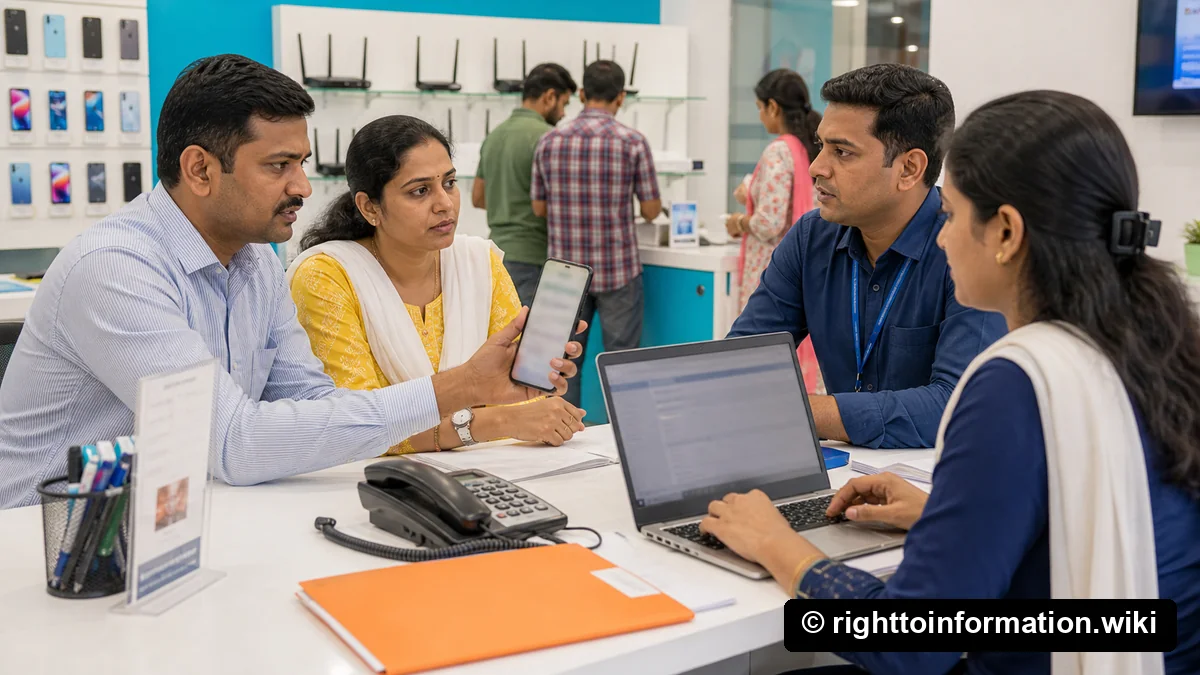
Quick Reply: TRAI does not handle individual consumer complaints. That is TRAI's own FAQ and the TRAI Act 1997 position. First, complain to the operator's complaint centre and get a docket — Airtel 121, Jio 198, Vi 198, BSNL 1800-345-1500. Second, if that fails, appeal to the operator's Appellate Authority — circle-wise names are on trai.gov.in appellate-authority. Look up contacts on tccms.trai.gov.in. Third, for spam, SIM fraud, unknown SIMs or a lost phone, use Sanchar Saathi at https://sancharsaathi.gov.in (DND 1909). Fourth, for a money order, file at the District Consumer Commission. Mail sent to TRAI is forwarded to the operator; TRAI does not follow it up.
Suresh's story — "₹3,200 reversed by Airtel after the appellate file"
Suresh Reddy, 38, runs a small printing business in Hyderabad. Postpaid Airtel Plan ₹999 for years. October 2024 bill: ₹4,837 — including ₹3,217 for “International Roaming Voice & Data” for 8-14 September 2024.
“I had not enabled IR. My phone was on my desk in Kukatpally that whole week — the SIM never left Hyderabad. I checked Airtel Thanks app — IR was 'Active' as of 5 September. I had not toggled it. The retailer who sold me the connection in 2019 was retired, no audit trail. I called Airtel 121 — the agent first said 'sir, you may have toggled it accidentally'. The ticket was raised, marked 'resolved' four days later with the note 'usage validated, payable'. I escalated to Airtel's Appellate Authority for Telangana — same response in 21 days, with one extra paragraph saying 'IR was activated through customer self-service on the app'. They could not show me an audit log. I sent the same file to Airtel's Appellate Authority for Telangana, cited TRAI Telecom Consumers Protection Regulations 2012 (only the undisputed portion is payable while a billing dispute is open), and copied consumer-affairs at TRAI knowing they only forward mail to the operator. Airtel wrote back on 22 November: '₹3,217 reversed as goodwill, plus ₹500 inconvenience credit'. They never produced the log. I never enabled IR. The appellate file is what moved the refund. TRAI does not adjudicate the bill.”
—Suresh, December 2024
TRAI's own FAQ states that individual consumer complaints are not handled by TRAI. The TRAI Act 1997 does not give the regulator a citizen-complaint desk. Mail that reaches TRAI is forwarded to the operator; TCCMS says no follow-up is taken on those individual files. Use tccms.trai.gov.in to find the complaint centre and Appellate Authority for your circle. Operators sometimes reverse a bill once the appellate file is complete and the regulation is cited in writing.
What this is — and which forum does what
After the Telecommunications Act 2023 came into force from late 2024 (replacing the Indian Telegraph Act 1885 and Indian Wireless Telegraphy Act 1933), the citizen-side architecture has settled into five doors. You need to know which door is yours.
- Operator's TGE (Tier-1): Mandatory first stop under the TRAI Telecom Consumers Protection Regulations 2012. Each operator runs a 24×7 helpline with a docket number and 30-day SLA. Airtel 121, Jio 198, Vi 198, BSNL 1800-345-1500 (or 1500 from BSNL phones), MTNL 1500.
- Operator's Appellate Authority (Tier-2): Separate office, named with email + postal address on the operator's website (“Customer Care” → “Grievance Redressal”). Hears appeals from TGE rulings within 3 months.
- TRAI does not take the individual file. Look up the operator complaint centre and Appellate Authority on tccms.trai.gov.in and the directory at trai.gov.in/consumer-info/cgr/appellate-authority. Consumer-affairs mail is daca[at]trai[dot]gov[dot]in — forwarded, not adjudicated. TRAI can still issue regulatory Directions to operators under §13 of the TRAI Act 1997; that is not a citizen complaint portal.
- Sancharsaathi (DoT): https://sancharsaathi.gov.in — DoT's citizen-side portal for spam (Chakshu), SIM-swap fraud, lost / stolen mobile (CEIR), KYC fraud (TAFCOP) — our TAFCOP check guide walks you through it — and report suspected fraud communications. DND helpline number is 1909.
- Consumer Forum (Tier-4): District / State / NCDRC under the Consumer Protection Act 2019 for monetary recovery and damages — telecom service is a “service” under §2(42) CPA 2019 (post-2014 the Supreme Court in *Vodafone Idea v Ajay Kumar Agarwal* (2022) 7 SCC 351 confirmed Consumer Forum jurisdiction over telecom).
The legal anchors: Telecom Regulatory Authority of India Act 1997, Telecommunications Act 2023 (citizen rights provisions notified in late 2024 — replacing Indian Telegraph Act 1885 and Indian Wireless Telegraphy Act 1933), TRAI Telecom Consumers Protection Regulations 2012, Telecom Commercial Communications Customer Preference Regulations 2018 (TCCCPR — anti-spam, with major amendments in 2024 mandating blockchain-based DLT registration for principal entities), TRAI Quality of Service Regulations (separate ones for cellular, broadband, TV).
Step-by-step process
Step 1 — Complain to the operator's TGE
- Call the operator's care number from the affected number (so the agent can pull your record without OTP friction).
- Airtel: 121 (postpaid) / 198 (prepaid)
- Jio: 198
- Vi (Vodafone Idea): 198
- BSNL: 1500 from BSNL phone, 1800-345-1500 from any phone
- MTNL: 1500
- Insist on a docket number — without it, the complaint doesn't legally exist. Note the date and time.
- Confirm in writing — most operators allow you to email the docket back at the operator's customer-care address. This is your evidence trail.
- SLA: 30 days for non-billing complaints, billing complaints addressed in next billing cycle.
Step 2 — Escalate to the Appellate Authority
If the TGE marked the docket “resolved” without actually resolving it, or didn't respond in 30 days, escalate.
- Open the operator's “Customer Care” or “Grievance Redressal” page — every operator publishes the Appellate Authority's name, postal address, email, and phone circle-wise (mandatory under TRAI Telecom Consumers Protection Regulations 2012 §17).
- Email a clear escalation: docket number, dates, what was promised, what actually happened.
- Appellate Authority disposes within 3 months.
Step 3 — After the Appellate Authority (TRAI will not decide the bill)
- TRAI's FAQ: individual consumer complaints are not handled by TRAI. There is no citizen “File Complaint” desk that issues a money order.
- Keep using tccms.trai.gov.in to confirm the Appellate Authority contacts for your circle.
- For a written trail to the department, file on CPGRAMS at https://pgportal.gov.in → Department of Telecommunications.
- Consumer-affairs contact published by TRAI is email daca[at]trai[dot]gov[dot]in. TCCMS says complaints received in TRAI are forwarded to the operator with no follow-up.
- For spam / SIM-swap / lost handset, go to Step 4 (Sanchar Saathi). For a refund or damages, go to Step 6 (Consumer Commission).
Step 4 — For spam / fraud / SIM-swap / lost handset, use Sancharsaathi (1909)
- DND for unsolicited calls / SMS: Send `START 0` to 1909 to register all-categories DND, or selective DND `START 1` (banking) `START 2` (real estate), etc. To stop a specific category, `STOP <category>`. To report a violation, `<header sender ID> <date> <time>` to 1909.
- Chakshu (suspected fraud SMS / WhatsApp): https://sancharsaathi.gov.in/sfc → upload screenshot. DoT investigates and disconnects fraudulent connections.
- TAFCOP (mobile connections in your name): https://sancharsaathi.gov.in/tafcop → enter your number → see all SIMs against your Aadhaar / ID. Report unknown ones for disconnection.
- CEIR (lost / stolen mobile): https://www.ceir.gov.in → enter IMEI → blocks the handset across networks.
- NCRP (cybercrime): if the spam led to financial loss, also file at https://cybercrime.gov.in or call 1930.
Step 5 — Escalate to DoT / CPGRAMS
- File on CPGRAMS at https://pgportal.gov.in → Department of Telecommunications.
- TRAI consumer-affairs email is daca[at]trai[dot]gov[dot]in. Do not expect TRAI to reverse a bill.
Step 6 — File at the Consumer Forum for monetary recovery
- District (DCDRC) for claims up to ₹50 lakh; State Commission ₹50 lakh – ₹2 crore; NCDRC above ₹2 crore.
- Limitation: 2 years from cause of action.
- Telecom service is “service” under CPA 2019 §2(42); jurisdiction confirmed in *Vodafone Idea v Ajay Kumar Agarwal* (2022).
- For wrong billing, you can ask for: refund + interest + compensation for harassment + cost of litigation.
Sample fee + SLA + limitation table
+-----------------------------------+--------------------------------------+
| Operator TGE                      | Free. Docket SLA: 30 days for non-   |
|                                   | billing; next billing cycle for bill |
|                                   | disputes (TRAI TCP Reg 2012)         |
+-----------------------------------+--------------------------------------+
| Operator Appellate Authority      | Free. SLA: 3 months                  |
+-----------------------------------+--------------------------------------+
| TRAI (regulator, not a desk)      | Does not handle individual files.    |
| tccms.trai.gov.in                 | Directory of complaint centre /      |
|                                   | Appellate Authority                  |
+-----------------------------------+--------------------------------------+
| Sancharsaathi (sancharsaathi.gov  | Free. Chakshu reports actioned in    |
| .in) - Chakshu / TAFCOP / CEIR    | 7-14 days; CEIR blocks IMEI within   |
|                                   | 24 hrs                               |
+-----------------------------------+--------------------------------------+
| 1909 DND helpline                 | Free. SMS-based registration         |
|                                   | (START 0). DND active in 7 days      |
+-----------------------------------+--------------------------------------+
| 1930 (cyber-financial fraud)      | Free. Connect to nearest cyber cell  |
+-----------------------------------+--------------------------------------+
| CPGRAMS → DoT                     | pgportal.gov.in                      |
+-----------------------------------+--------------------------------------+
| Limitation - Consumer Forum       | 2 years from cause of action         |
|                                   | (CPA 2019 § 69)                      |
+-----------------------------------+--------------------------------------+
| RTI to PIO TRAI / DoT             | ₹10 by IPO. BPL = free.              |
+-----------------------------------+--------------------------------------+
| Consumer Forum filing fee         | Below ₹5 lakh: NIL via e-Jagriti     |
| (DCDRC)                           | ₹5L–₹10L: ₹200; ₹10L–₹20L: ₹400      |
+-----------------------------------+--------------------------------------+
Common reasons your telecom complaint stalls
- Old events. There is no TRAI “complaint portal clock”. If the operator and Appellate Authority have closed the file, the money claim belongs in the Consumer Commission (2-year limitation under CPA 2019).
- “Complaint marked resolved” by the operator without contact. Common ploy — TGE auto-closes the docket after 24 hours of inaction. Always reopen the same docket number; don't accept “closed”.
- SIM ownership transfer dispute. If the SIM is in someone else's name (joint family, employer-issued), TRAI bounces the complaint — only the registered subscriber can file. Use TAFCOP first to verify ownership.
- Bill demand pending. Many operators insist you pay the disputed bill first, then claim refund. TRAI guidance is the opposite — under TCP Regulations 2012 §26, only the undisputed portion is payable while the dispute is being resolved. Quote this regulation in your complaint.
- “You consented during IVR.” Operators record your call and produce IVR consent for VAS (caller tunes, premium SMS packs) activated without your knowledge. Demand the audio recording — under §28 of the Telecommunications Act 2023, you have a right to it.
- MNP rejection citing “outstanding dues”. Even if you've paid, the operator's billing system may take 7-15 days to update. Demand a No-Dues Certificate before initiating port.
- Broadband disconnection without 15-day notice. TRAI's QoS Broadband Regulations require 15-day prior written notice. If you got cut off without it, that itself is a TRAI violation.
- Spam from “white-listed” sender. DLT-registered headers (banks, e-commerce, govt) cannot be blocked under category DND. You need to opt out of the sender's preference centre individually.
If stuck — the escalation ladder
Rung 1 — Operator TGE + Appellate Authority
- 30 days at TGE, 3 months at Appellate Authority. Mandatory first stops.
Rung 2 — TRAI will not take the individual file
- tccms.trai.gov.in for contacts. Consumer-affairs email is forwarded to the operator.
Rung 3 — Sancharsaathi (DoT)
- https://sancharsaathi.gov.in for spam / fraud / SIM-swap / IMEI. 1909 for DND. 1930 for cyber-financial fraud.
Rung 4 — CPGRAMS
- https://pgportal.gov.in → DoT (Department of Telecommunications) or TRAI. Higher visibility — gets a written reply within 30 days.
Rung 5 — Consumer Forum (parallel)
- District / State / NCDRC. The forum that gives you a money decree. Limitation 2 years.
Rung 6 — Right to Information (RTI)
Both TRAI (created by an Act of Parliament) and DoT (a government department) are public authorities under §2(h) of the RTI Act 2005. Private operators (Airtel, Jio, Vi) are not — RTI to them won't fly. But you can RTI the regulator about the operator.
RTI helps here when:
- You want the action taken on a complaint TRAI forwarded, or QoS / Direction records — file with PIO TRAI.
- You want to know how many TRAI Directions were issued to a particular operator in the last quarter — pattern evidence for your Consumer Forum case.
- You want TRAI's quality-of-service performance data for your operator in your circle (call drop %, network availability) — TRAI publishes these but RTI can pull granular cell-tower data.
- You want the DoT's policy file on a regulatory issue (spectrum allocation, MNP framework, broadband UCL conditions). RTI requests for exactly these DoT spectrum-allocation records are what fed the 2G spectrum case — still the best-known example of allocation papers reaching the public.
- You want to verify that the DLT-registration of a spam sender is real — file with TRAI under TCCCPR 2018.
RTI does NOT help here when:
- You want Airtel / Jio / Vi to refund you ₹3,200 — that requires the operator appellate file or a Consumer Commission order. RTI to TRAI gets you information about TRAI's enforcement, not money from the operator.
- You want internal billing records of a private operator — they are not public authority. The operator may have to disclose under TCP Regulations 2012 directly to you, but not under RTI.
- You want the personal contact details of an operator employee — exempt under §8(1)(j).
- You want call detail records (CDRs) of someone else — protected under the Telecommunications Act 2023 §29 and §30.
- You want an “expedite” of a service complaint — RTI runs in parallel; it does not speed up operator SLAs.
For MNP-specific procedure (porting your number to another operator, what to do when the request is rejected) see How to port your mobile number — MNP complete 2026 guide.
FAQs
Q. The operator says I activated a VAS through IVR. I never did. What now?
Demand the audio recording of the consent call under §28 of the Telecommunications Act 2023. If they can't produce it, put that in the Appellate Authority appeal and, for a refund, the Consumer Commission file. VAS auto-activation without verifiable consent has been the subject of multiple TRAI Directions to operators since 2014.
Q. I got an SMS from a 10-digit number selling loans. How do I report?
Forward the SMS to 1909 as `<sender's number> <date> <time>`. Also report on Sancharsaathi → Chakshu. Under TCCCPR 2018, all commercial SMS must come from a registered DLT header — a 10-digit number sending commercial content is a violation in itself.
Q. My MNP request was rejected with “code 17”. What does it mean?
TRAI's MNP rejection codes are public. Code 17 = “outstanding payment”. Demand a written breakup. If you've paid, you have right to a No-Dues Certificate; show it on retry. If the operator still rejects, appeal to the Appellate Authority citing TRAI Telecommunication Mobile Number Portability (Sixth Amendment) Regulations 2019, then the Consumer Commission if you want a money order.
Q. Broadband cut off without notice. What's my recourse?
TRAI's QoS Broadband Regulations require 15 days written notice before disconnection (except for non-payment after 60 days). Without notice, the disconnection is a QoS violation — raise it with the Appellate Authority and, for restoration plus compensation, the Consumer Commission.
Q. I'm getting calls from “Airtel KYC” asking for OTP — is it real?
No telecom operator asks for OTP over a call. This is a SIM-swap fraud attempt. Report to 1930 (cyber-financial fraud) immediately and on Chakshu at Sancharsaathi. Never share OTP.
Q. My number is in TAFCOP showing 4 connections — I only own 1. What now?
Click “Not my connection” against the unknown numbers; DoT initiates disconnection. Each request is auto-tracked. If a subsequently-found unknown SIM was used in a fraud, file an FIR under BNSS 2023 (which replaced CrPC from 1 July 2024) and quote the TAFCOP request as evidence you didn't authorise it.
Q. Can I claim damages for mental harassment due to wrong billing?
Yes — at the Consumer Commission, not at TRAI. *Vodafone Idea v Ajay Kumar Agarwal* (2022) 7 SCC 351 confirmed Consumer Commission jurisdiction over telecom disputes.
Q. Can I make TRAI reverse my bill?
No. TRAI does not handle individual consumer complaints. Non-compliance with a regulatory Direction under §13 of the TRAI Act 1997 is a separate enforcement track. Your refund still comes from the operator, the Appellate Authority, or a Consumer Commission order.
Related on RTI Wiki
Telecom regulations are amended frequently — verify the latest TCCCPR / QoS regulation on trai.gov.in.
New 2026 update on RTI Wiki: 1600-series insurance calls: how to spot a genuine call in 2026
Recently published: What CNAP verified caller name means for you
Related guides
Reader signal
Was this article useful?
Tap once if it helped you. These counters show other citizens which pages are worth reading.