Track an electricity complaint — citizen guide 2026
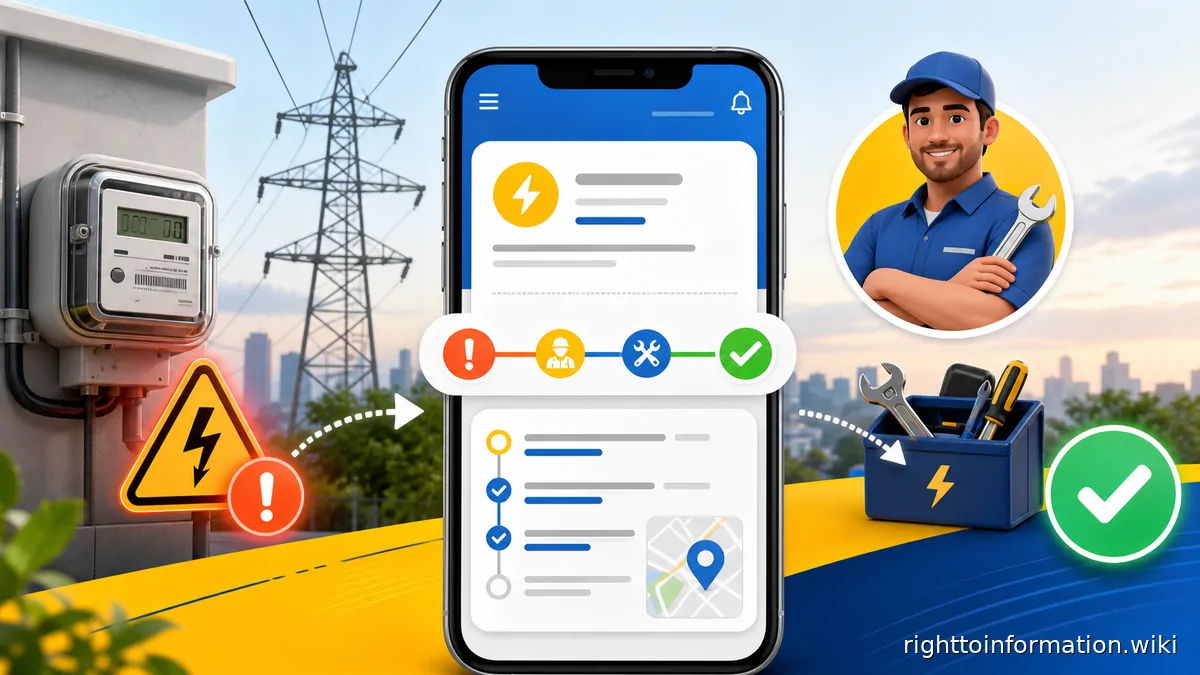
Last reviewed: 1 September 2026.
An electricity complaint is useful only if it has a registration number, recorded issue and traceable action. Start with the distribution licensee's official channel shown on your bill or website. If the complaint is closed without resolution or crosses the applicable standard, escalate through the statutory CGRF and Electricity Ombudsman route.
Quick answer: Register the fault or billing issue with your distribution licensee and save the complaint number, time and promised standard. Track it through the official portal, app, call centre or office. If unresolved, approach the Consumer Grievance Redressal Forum, then the Electricity Ombudsman. Timelines and compensation standards come from your State Commission's current regulations.
Complaint status — in 50 words
A status such as “assigned,” “under process” or “closed” is an internal workflow entry, not proof that supply, billing or metering was corrected. Match it against the actual problem and the standard of performance fixed by the State Electricity Regulatory Commission. Challenge an incorrect closure in writing with dated evidence.
Use the statutory ladder
Section 42(5) of the Electricity Act, 2003 requires each distribution licensee to establish a forum for consumer grievances in accordance with State Commission guidelines. Section 42(6) allows a consumer whose grievance is not redressed by the forum to make a representation to the Electricity Ombudsman. Ministry of Power replies in Parliament have described the same route: licensee mechanism, CGRF, then Ombudsman.
The Electricity (Rights of Consumers) Rules, 2020 require distribution licensees to provide grievance mechanisms and complaint monitoring. They also require forums at different levels and provide for Ombudsman representation. State commission regulations supply the local form, jurisdiction, documentary requirements and standards of performance.
Do not treat the Ministry's draft Electricity (Rights of Consumers) Amendment Rules, 2026 as law. A consultation draft is not an in-force entitlement. Check the final Gazette and current State Commission regulations before relying on a new time limit.
First capture a complete complaint
| Record | What to write down | Why it matters |
|---|---|---|
| Consumer account | Consumer/connection number, meter number and address | Identifies the correct service |
| Incident | Outage, voltage, billing, meter, connection or safety issue | Determines the correct category and standard |
| Registration | Complaint number, date, time and channel | Starts the traceable workflow |
| Evidence | Bill, meter photo, outage log, payment receipt, messages | Tests whether “resolved” is accurate |
| Status | Exact wording, timestamp and promised action | Supports escalation |
| Harm | Disconnection, equipment risk, business interruption or payment impact | Helps explain urgency without exaggeration |
For a live electrical danger—fallen wire, sparking equipment, fire risk or shock hazard—use the licensee's emergency channel printed on the bill or official website immediately. Do not wait for RTI, email or a normal billing queue.
How to track and challenge the status
- Use the official licensee channel. Start from the latest bill or the regulator's licensee directory. Utility helpline numbers and apps vary; do not trust a search-ad number.
- Quote both identifiers. Give the consumer number and complaint registration number, then confirm the category recorded by the agent.
- Save the live status. Take a screenshot or request an SMS/email acknowledgement showing the time and text.
- Compare with reality. If the portal says “resolved,” photograph the meter or continuing fault and write down the time.
- Seek reopening or written closure details. Ask for the field visit, action taken and reason for closure.
- Escalate to the appropriate CGRF level. Follow the current State Commission regulation and the forum details published by the licensee.
- Approach the Electricity Ombudsman if needed. Use the prescribed representation, limitation and prior-CGRF requirements in the local regulation.
- Seek records separately. RTI can expose logs held by a public authority but does not replace the CGRF/Ombudsman remedy.
| ① Register | ② Track | ③ Reopen | ④ CGRF | ⑤ Ombudsman |
|---|---|---|---|---|
| Get complaint number | Save every status | Challenge false closure | File documented grievance | Use prescribed representation |
Written escalation to the licensee
To: [Official grievance officer / office shown by the licensee]

Subject: Complaint no. [number] shown as [status] although issue continues

Consumer no.: [number]
Original complaint date/time: [date and time]
Issue: [precise description]

The official status showed [status] at [date/time]. However, [specific continuing
condition], as shown by the attached [bill/photo/meter reading/outage log]. Please
reopen or correct the complaint, provide the recorded action taken, and resolve
it under the applicable standard of performance. Please issue an acknowledgement.

Attachments: complaint acknowledgement, status screenshot, relevant bill,
payment proof and dated evidence.
Keep medical or safety details proportionate. Do not publish consumer numbers, meter images with addresses or bills containing phone numbers.
Filing with the CGRF
Use the forum and form identified by the distribution licensee and State Commission. A good grievance bundle contains:
- the original complaint and registration number;
- chronology of status changes;
- bills, receipts, meter readings and photographs relevant to the issue;
- the licensee's replies or incorrect closure;
- the rule, tariff order or standard you rely on; and
- a precise request—correction, reconnection, bill review, tested meter, reasoned order or applicable compensation.
The 2020 central rules originally state that a forum should normally decide a grievance within 30 days and not exceed 45 days from receipt. Use the current consolidated rules and the applicable State Commission regulation for your case; do not assume every internal call-centre complaint shares that forum timeline.
Read the CGRF order. If dissatisfied, use the Electricity Ombudsman representation procedure in the state regulation. An Ombudsman is part of the electricity-consumer framework; it is not the same as CPGRAMS or an RTI appellate authority.
When RTI helps
For a government-owned licensee or other body covered by the RTI Act, a focused application can seek existing records such as:
- the complete complaint history and status-change timestamps;
- field assignment, visit report and closure note;
- meter test report, inspection report or billing calculation sheet;
- the current standard-of-performance regulation or internal procedure;
- the designation responsible for the complaint category; and
- aggregate category-wise pendency, without consumer personal data.
If the licensee is not itself a public authority, consider whether the State Commission or another public authority holds or can access the particular regulatory record. Do not use RTI to direct reconnection, cancel a bill or award compensation. Seek those outcomes through the licensee, CGRF and Ombudsman.
Under section 6(1) of the RTI Act, please provide records concerning complaint
no. [number] for consumer no. [number]:

1. Complete status history with date and time of each change.
2. Copy of assignment, field-visit, inspection and closure records.
3. Copy of the recorded reason for marking the complaint [status].
4. Copy of the standard/procedure applied to this complaint category.
5. Name and designation of the office that approved closure.

Please redact third-party personal data and provide the severable record.
Common mistakes
- Calling an unofficial number. Use the bill or licensee/regulator website, especially for payments and remote-access requests.
- Accepting “closed” as proof. Save evidence of the continuing fault and seek the closure record.
- Skipping the CGRF. The Ombudsman route normally follows the forum process under the applicable regulations.
- Quoting one national deadline. Supply standards, compensation and local procedure are set through current central rules and State Commission regulations.
- Treating a draft amendment as law. Verify a final notified rule.
- Waiting for RTI during a hazard. Use the emergency fault channel immediately.
Worked example — illustrative, not a reported case
A consumer disputes a sudden bill after a meter change. The app marks the complaint “resolved,” but gives no reading calculation. She saves both bills, meter photographs and the status screen, asks the licensee for reopening, and files a CGRF grievance seeking a reasoned bill review. Her separate RTI seeks the meter-change report, reading history and closure note.
Frequently asked questions
Where can I find my electricity complaint number?
It should appear in the acknowledgement generated by the licensee's official portal, app, call centre, SMS or office receipt. If none was issued, ask the official channel to register the complaint and provide one.
Is 1912 available for every electricity complaint?
Do not assume universal availability or scope. Use the current contact printed on your bill or published by your distribution licensee and State Commission.
What if the complaint says closed but the fault remains?
Save the status and dated evidence, request reopening and the recorded action taken, then escalate through the applicable CGRF process if it remains unresolved.
What is a CGRF?
It is the Consumer Grievance Redressal Forum required for distribution licensees under section 42(5) of the Electricity Act, operating under State Commission guidelines and regulations.
When can I approach the Electricity Ombudsman?
Section 42(6) provides the route where the forum has not redressed the grievance. Follow the current state regulation's eligibility, form and time requirements.
Can CPGRAMS replace the CGRF?
No. CPGRAMS may route an administrative grievance where applicable, but it does not replace the statutory licensee-CGRF-Ombudsman path for electricity-consumer relief.
Can RTI cancel a wrong bill?
No. RTI can obtain the calculation, meter and complaint records. Seek correction or relief through the licensee and statutory grievance bodies.
Is the proposed 2026 amendment already binding?
Not merely because a draft was published for comments. Rely only on the final notified rule and current State Commission regulation.