Table of Contents
Ladki Bahin Yojana Status and Payment Check 2026 (Maharashtra)
Quick Reply: Cannot log in? Open ladakibahin.maharashtra.gov.in/sign-in. Enter your registered mobile number, your portal password and the captcha, then the four-digit one-time password sent to that phone. Told to do e-KYC? The public /ekyc page loaded an empty frame on 11 September 2026. A circular of 18 November 2025 set the deadline at 31 December 2025. E-KYC is also an annual duty. Money not arrived? The founding Government Resolution sets the due date at by the 15th of every month. The amount is ₹1,500 a month by Direct Benefit Transfer. Your application shows one of five labels: DRAFT, PENDING, APPROVED, REJECTED or RE-SUBMIT. This website cannot check your record.
The official host is spelled ladakibahin, with an extra a. Do not trust a lookalike address. If a site asks you to pay, or offers a searchable beneficiary list, it is not the government. Never share an Aadhaar one-time password.
If you cannot log in. The sign-in screen asks for your registered mobile number, your password and a captcha, then a four-digit one-time password. A mobile number alone will not open your record. Forgot Password and unlock your account are on the same page.
If you were told to do e-KYC. That is Aadhaar authentication, and it is how the department checks who is still eligible. The circular of 18 November 2025 extended the window to 31 December 2025. We could not retrieve a later extension. E-KYC is also an annual duty, due within two months from June each year. Do not plan your day around the public /ekyc link.
If the ₹1,500 has not arrived. The Government Resolution of 28 June 2024 sets the due date for later months at “by the 15th of every month”. Sign in, open Applications Made Earlier, and read the label. If it says APPROVED, the usual next check is Aadhaar seeding at your bank. If it does not say APPROVED, the label tells you what to fix.
Quick answer. To check your Ladki Bahin Yojana status 2026, open the official Maharashtra portal ladakibahin.maharashtra.gov.in and sign in as above. Open Applications Made Earlier to see the status label. The Mukhyamantri Majhi Ladki Bahin Yojana is run by the Women and Child Development Department and pays ₹1,500 per month by Direct Benefit Transfer to eligible women aged 21 to 65. Every scheme order we could retrieve, up to the funding order of 4 August 2025, sets ₹1,500, and we found no Government Resolution notifying ₹2,100. If the portal or the office gives you no clear written answer, ask under Section 6(1) of the Right to Information Act, 2005.
On this page: Visual guide · Check status · 1500 or 2100? · Verification drive · Payment details · Eligibility · Documents · Status meanings · Money not credited · Helpdesk · RTI angle · District-wise list · Status by mobile number · Installment schedule · Payment delayed or stopped · Bank account update · Comparison with other schemes · RTI for payment delay · FAQ
Ladki Bahin Yojana at a glance
- This is a Maharashtra Direct Benefit Transfer scheme for women, approved by Government Resolution dated 28 June 2024.
- The notified amount is ₹1,500 per month into the woman's own Aadhaar-linked bank account.
- The Women and Child Development Department, Government of Maharashtra, runs it.
- Eligible age is women who have completed 21 years and up to completion of 65 years.
- Annual family income must not be more than ₹2.50 lakh.
- The official portal is ladakibahin.maharashtra.gov.in.
- The portal footer displays 181 as the toll-free contact number.
- The portal states that no fee of any kind is charged. Never pay an agent.
- Portal counters on 11 September 2026 showed 11,270,261 applications received and 10,669,139 approved. A third counter reads zero, so treat it as not populated.
A late or missing payment is usually one of three things. Your e-KYC is not complete. Your Aadhaar is not seeded with your bank for Direct Benefit Transfer. Or your application is no longer marked approved. Since late 2025 the department has used Aadhaar authentication through e-KYC to verify who is still eligible, and it set a deadline for that check. Every scheme fact below comes from the official portal or from a Government Resolution we downloaded and read. For the wider picture, see our guide to government schemes in India 2026.
Visual guide: why the Rs 1500 payment stopped
Swipe left or right on a phone to view all six cards. This Hindi visual guide covers application and payment status, e-KYC, Aadhaar-bank DBT linking, removal reasons, grievance steps and RTI.
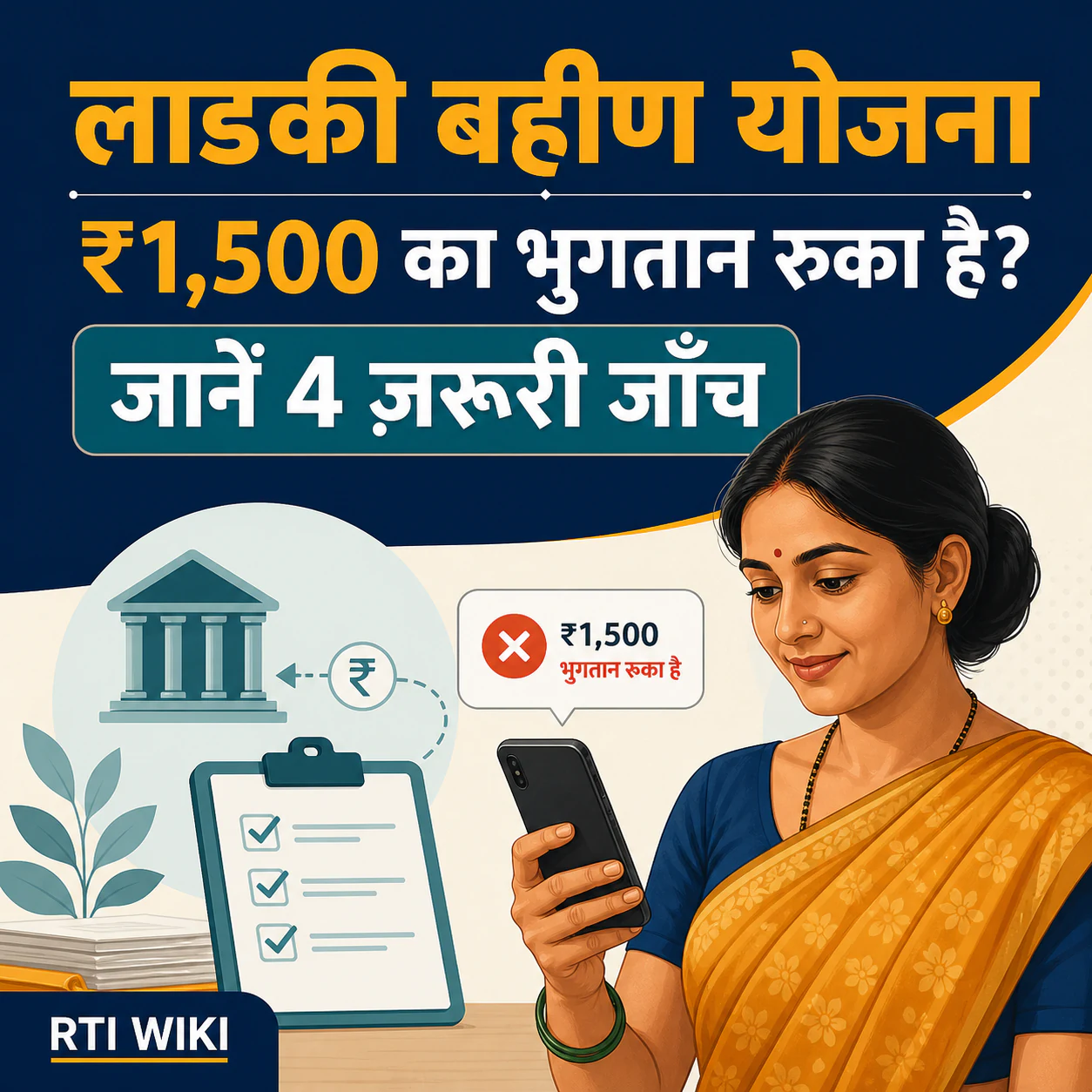
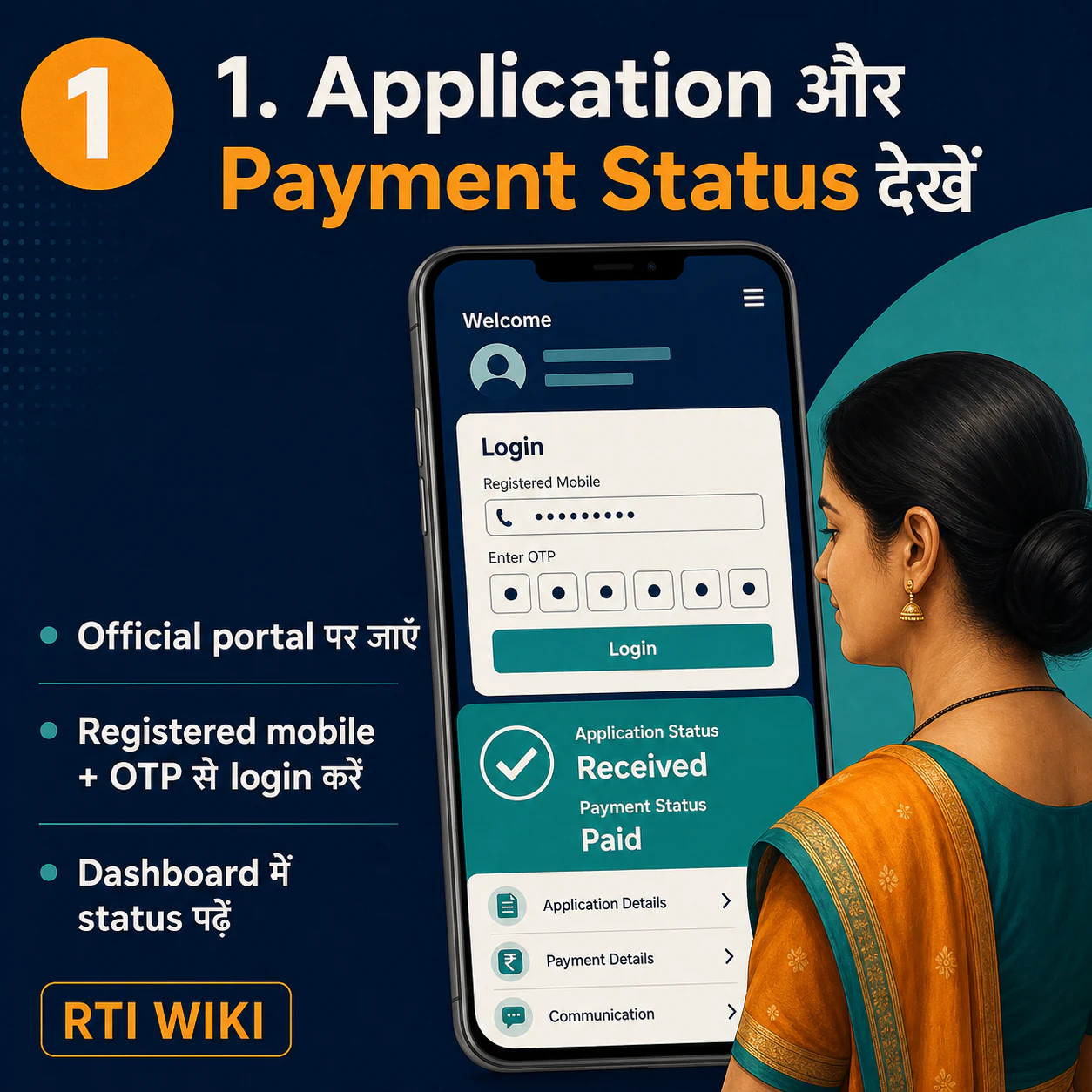
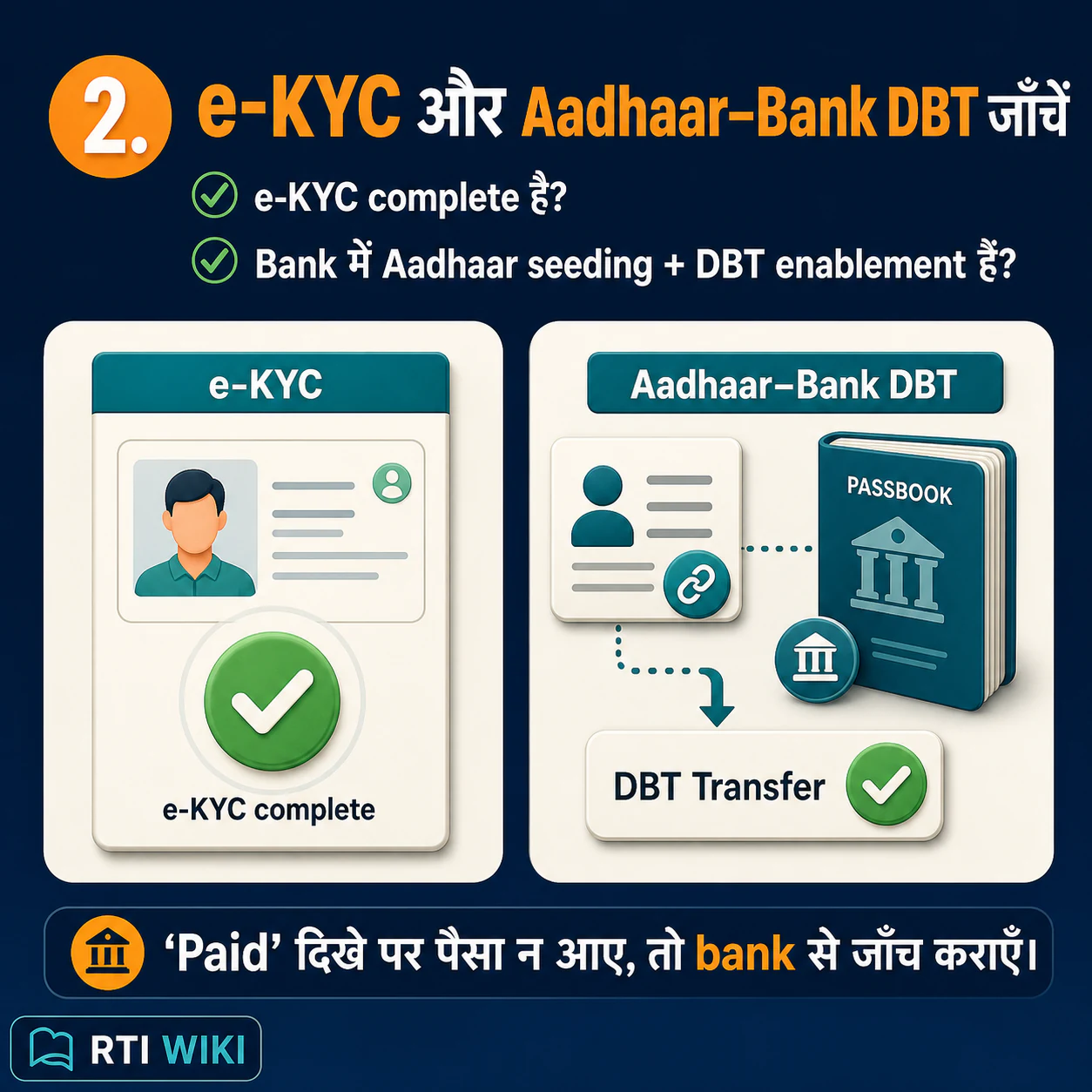
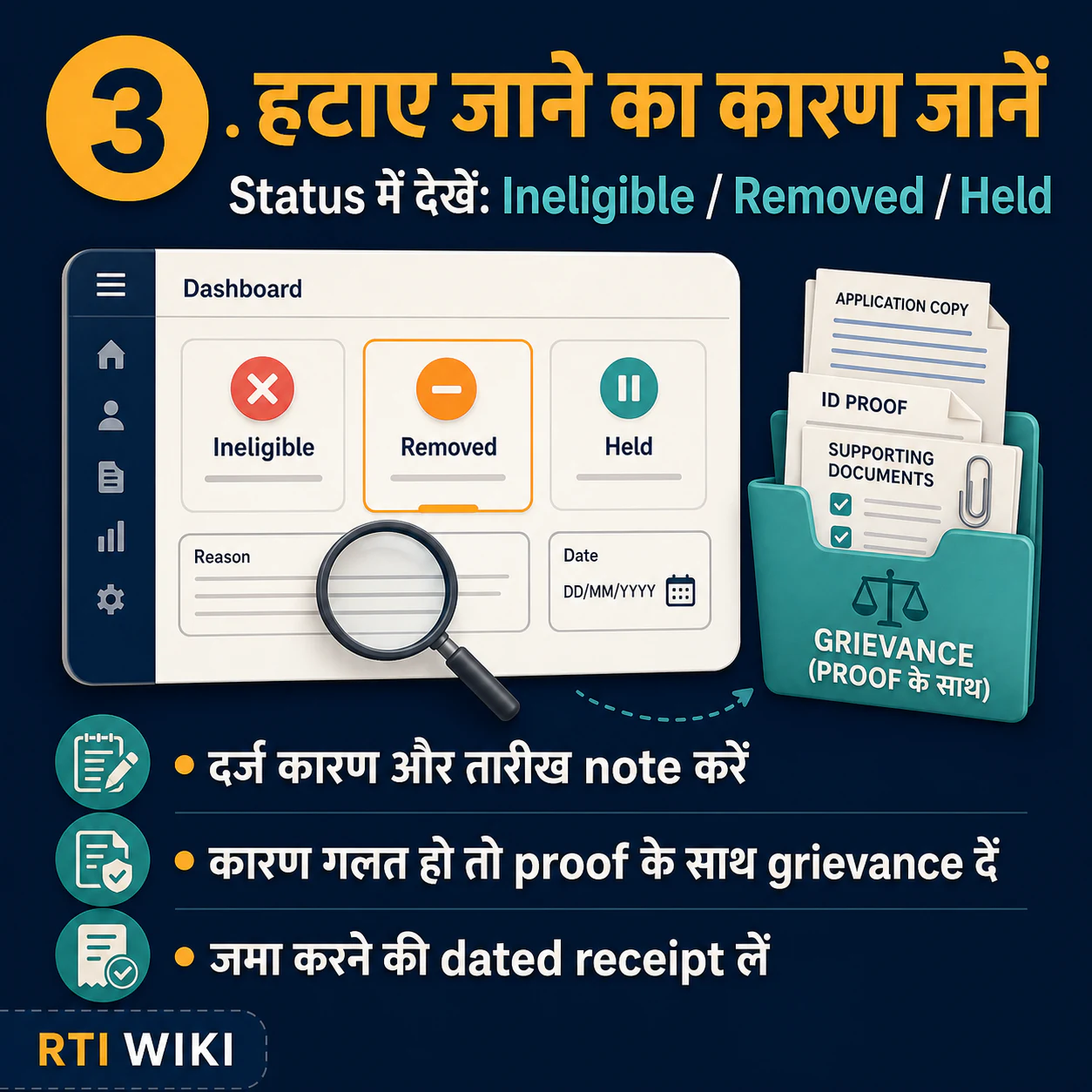
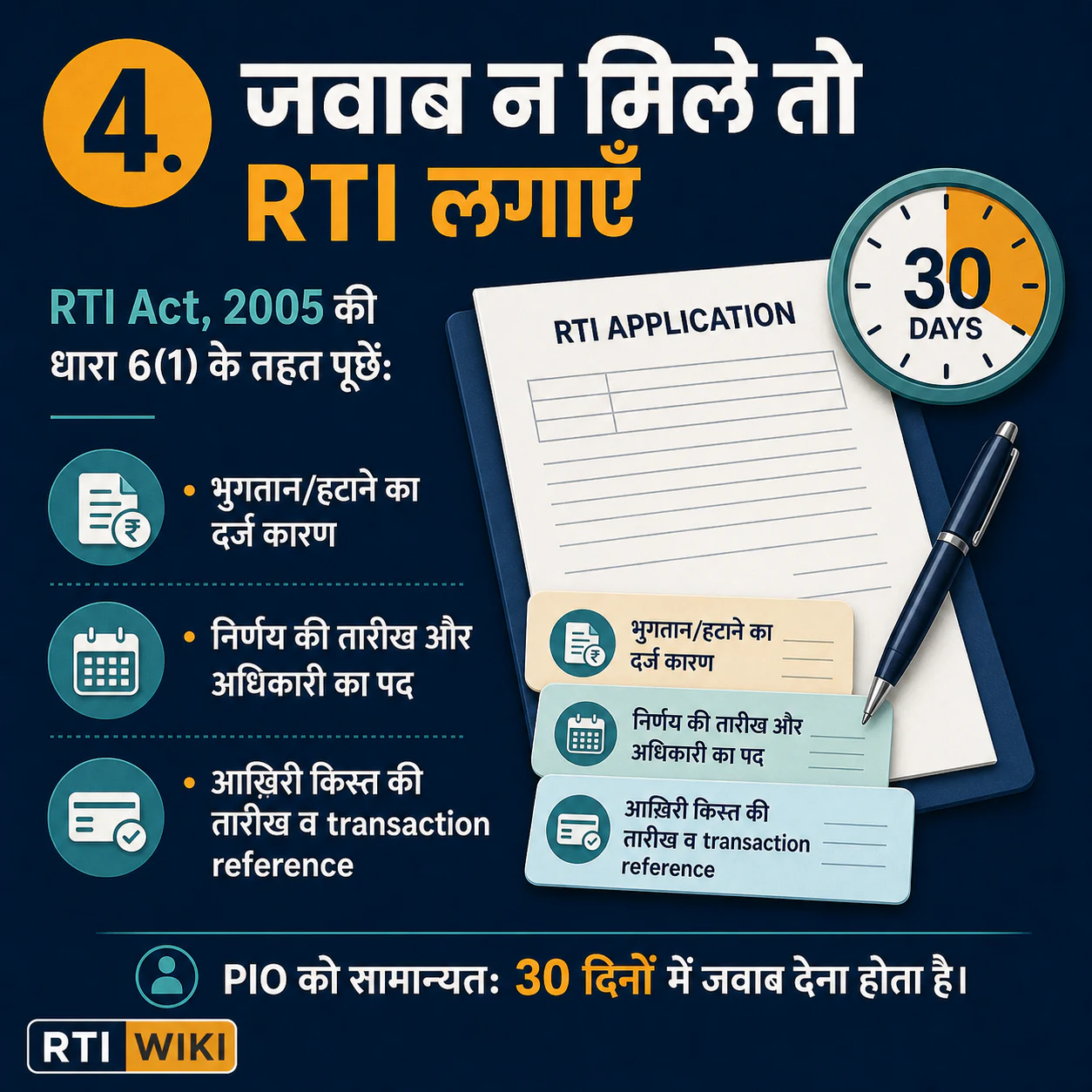
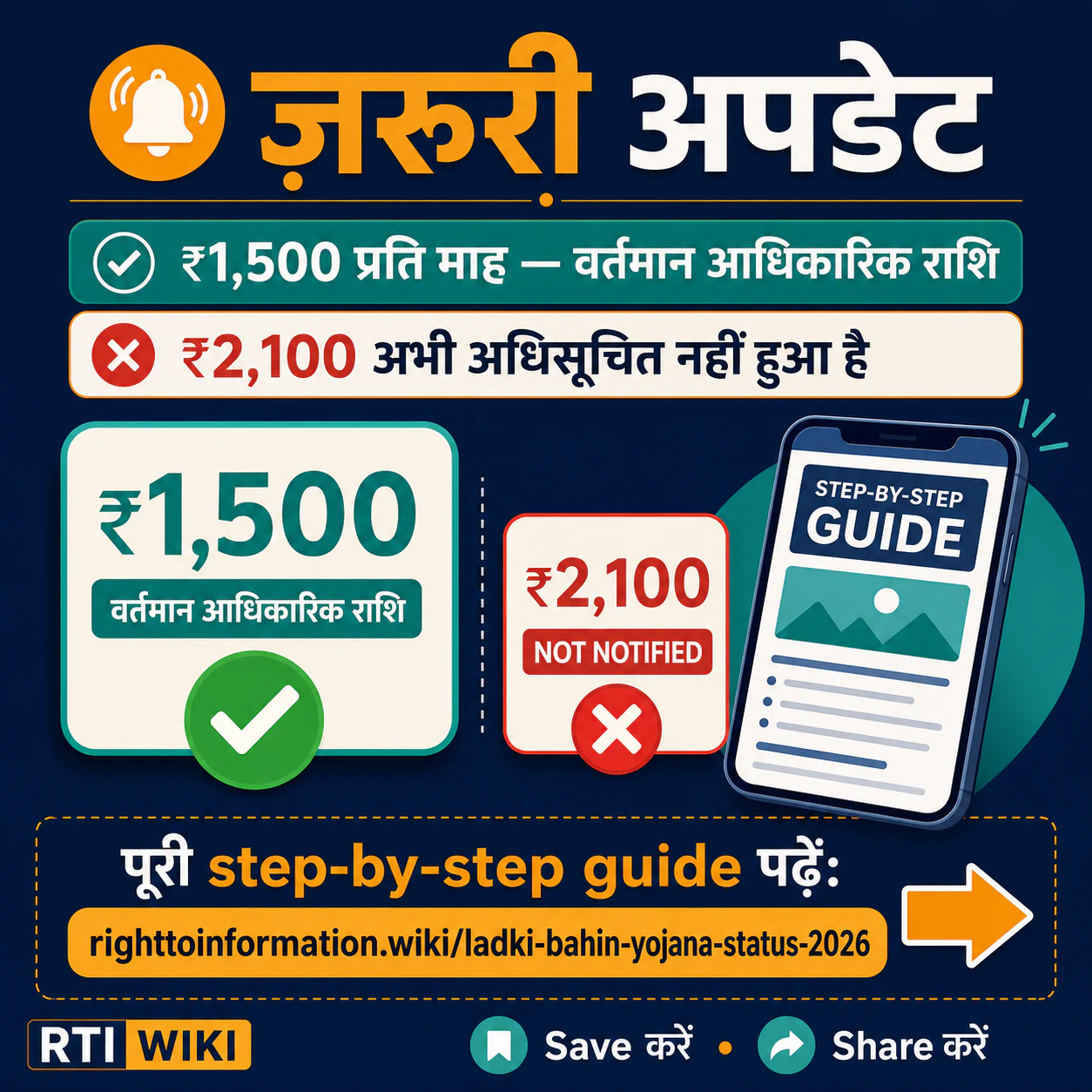
Quick visual summary only. For your own record, rely on the official Ladki Bahin portal, your bank and the implementing office. Never share an Aadhaar one-time password and never pay an agent.
How to check Ladki Bahin Yojana status 2026
- Go to the sign-in page at ladakibahin.maharashtra.gov.in/sign-in.
- Enter your registered mobile number, your password and the captcha on screen. The portal asks for all three. A mobile number alone will not open your record.
- Enter the one-time password sent to that mobile. The code is four digits and it expires, so keep the phone with you.
- On your dashboard, open Applications Made Earlier. It lists each application you have made with its status label.
- Open the application to read the full record. The portal also carries a transaction log screen and a grievance screen for the logged-in applicant.
- If you cannot get past the password, use Forgot Password. If the portal says the account is locked, use the unlock your account link on the same page.
Reminder. This website does not check status. Only ladakibahin.maharashtra.gov.in and your local office hold your record. The real spelling is ladakibahin, with an extra a. If a page or app asks you to pay to see your status, it is not the government.
About the e-KYC link you are probably looking for. The portal does have a route at ladakibahin.maharashtra.gov.in/ekyc. When we opened it on 11 September 2026 it loaded an empty embedded frame, because the page pulls its content from a third-party address that did not respond. The portal's public menu that day listed only Home, Scheme Information, Required Documents and Applicant Login, with no e-KYC item. So do not plan your day around that link. Aadhaar e-KYC for this scheme is done in person when the application is filled, through the logged-in portal flow, or at an Anganwadi centre or Setu Suvidha Kendra. Our companion page on the Ladki Bahin eKYC link online tracks it separately.
Is the monthly amount 1500 or 2100 in 2026?
Short answer: ₹1,500. You will see ₹2,100 in many headlines because it was promised in political speeches. It is not what the paperwork says.
The founding Government Resolution of 28 June 2024 fixes the benefit at ₹1,500 a month, and the funding order of 4 August 2025 for the 2025-26 financial year repeats that eligible women are paid ₹1,500 per month by Direct Benefit Transfer. Those are the most recent scheme orders we could retrieve from the Government Resolution portal, and we found none notifying ₹2,100.
A promise in a speech is not money in your account. If someone says ₹2,100 is already being paid, or asks for money to unlock it, that is a fraud. Read more about how to detect fake government scheme scams.
The 2026 e-KYC and verification drive: were you removed?
If your payments have stopped, start with whether your e-KYC is on record. The department verifies who is still eligible by Aadhaar authentication through e-KYC.
A Government Circular dated 18 November 2025, numbered MBAVIV 2025/Pra.Kra.167/Karya-2, records that the e-KYC window had run to 18 November 2025 and extends it to 31 December 2025. It gives the reasons plainly. Natural calamity had hit some districts, some beneficiaries could not get a one-time password on their Aadhaar because a husband or father had died, and many had simply not completed the process.
The same circular sets out a relief route:
- If your father is not alive, or your husband is not alive, or you are divorced, complete your own e-KYC first.
- Then give your Anganwadi Sevika an attested copy of the death certificate of the husband or father, or the divorce decree or court order.
- She checks it and recommends you for exemption from the husband's or father's e-KYC, through the Child Development Project Officer to the District Women and Child Development Officer.
That 31 December 2025 date is the last e-KYC deadline we could retrieve from the Government Resolution portal on 11 September 2026, and we found no later extension there. The Government Circular of 18 September 2025 that approved e-KYC also makes it an annual duty, due within two months from June each year, so expect a fresh round every year. Deadlines in this scheme have moved more than once, so confirm the current position with your Anganwadi Sevika or the District Women and Child Development Office rather than assuming the window is shut.
Once you know where you stand:
- Sign in and read your status label. Note the exact word on screen and the date.
- If your e-KYC is not done, get it done through the portal, your Anganwadi Sevika or a Setu Suvidha Kendra, then ask the office whether payment will resume.
- If you think the record is wrong, file a written grievance at the District Women and Child Development Office with your documents and ask for a dated acknowledgement.
- If nobody gives you a written reason, that is what the Right to Information Act is for. Ask for the reason on record, the date, and the designation of the officer who approved it.
Some genuine beneficiaries fall out only because of poor connectivity, a name mismatch between Aadhaar and the bank record, or a missed date. Do not assume it is final. Get the reason in writing first.
How to check beneficiary / payment details
Your money arrives by Direct Benefit Transfer. The payment itself lives with your Aadhaar-linked bank account. To confirm a credit, check your bank passbook, SMS alerts or net banking.
The Government Resolution of 28 June 2024 says the amount is credited through the District Women and Child Development Officer's office into the woman's own Aadhaar-linked, Direct Benefit Transfer enabled account. The order of 12 July 2024 confirms a post office account is acceptable.
On the portal, your application must show as approved and your e-KYC must be complete before a payment can land. If you applied through an Anganwadi, Gram Sevika, Aaple Sarkar Seva Kendra or Setu Suvidha Kendra, that operator can also help you open your record.
Who is eligible
These are the conditions as the official portal states them today. They come from the Government Resolution dated 28 June 2024 as amended by the Government Resolution dated 3 July 2024.
- You must be a resident of Maharashtra.
- The scheme covers married, widowed, divorced, deserted and destitute women, and only one unmarried woman from a family.
- You must have completed 21 years and not yet completed 65 years. The original order said 21 to 60. The amendment of 3 July 2024 raised the limit to 65 and added the unmarried woman.
- You must have your own bank account linked to Aadhaar.
- Your annual family income must not be more than ₹2.50 lakh.
Who is not eligible. The portal lists seven bars:
- Combined annual family income above ₹2.50 lakh.
- A family member is an income-tax payer.
- A family member is a regular or permanent employee of a government department, undertaking, board or local body of the Government of India or the state government, or draws a pension after retirement. The amendment of 3 July 2024 made one thing clear here. Outsourced staff, voluntary workers and contract employees with income up to ₹2.50 lakh do remain eligible.
- The woman already receives ₹1,500 or more a month from another financial scheme of a government department.
- A family member is a sitting or former Member of Parliament or Member of the Legislative Assembly.
- A family member is chairman, vice-chairman, director or member of a board, corporation or undertaking of the Government of India or the state government.
- A four-wheeled vehicle, tractors excluded, is registered in the name of a family member.
One bar that people still repeat has gone. The original order barred families holding more than five acres of farmland jointly. The Government Resolution of 3 July 2024 deletes that condition, and it is absent from the portal's current list.
Documents you need
A mismatch here is a common reason a payment fails later. This is the portal's own “required documents” list.
- Aadhaar card. Your name in the application must be written exactly as it appears on Aadhaar.
- Maharashtra domicile certificate. If you do not have one, any one of these will do: a ration card issued 15 years earlier, a voter identity card issued 15 years earlier, a birth certificate, or a school leaving certificate.
- If you were born outside Maharashtra, any one of your husband's documents will do: a 15-year-old ration card, a 15-year-old voter identity card, a birth certificate, a school leaving certificate, or a domicile certificate.
- Income proof. If you hold a yellow or orange ration card you do not need an income certificate at all. If you hold a white ration card or no ration card, you need a certificate showing annual income up to ₹2.50 lakh.
- For a newly married woman, if her name is not yet on the ration card, the husband's ration card with the marriage certificate is accepted as income proof.
- Bank account details, with the account linked to Aadhaar.
- The beneficiary's undertaking and photograph.
The portal also warns that your name, date of birth and address must match Aadhaar exactly, and that the bank details and mobile number must be correct.
What each status may mean
The portal shows one of five labels against each application. These are the labels the site itself renders, not our guesses.
| Label on the portal | What it means | What to do |
|---|---|---|
| DRAFT | The application was started but never submitted. | Open it, complete it and submit it. A draft is not an application. |
| PENDING | The application is with the office, waiting for approval. It covers two internal stages, one of which is a provisional approval. | Wait, and make sure your e-KYC is complete. |
| APPROVED | The application is accepted. | Watch your Aadhaar-linked bank account for the credit. |
| RE-SUBMIT | The office has sent the application back for correction. | Read the remarks, correct what is flagged and submit again. This is one of the few states in which you can still edit the form yourself. |
| REJECTED | The application was not accepted. | Get the reason, fix it if you can, or use the grievance route below. The portal has a grievance category for an appeal against a rejection. |
If your label says APPROVED but no money has arrived, the problem is almost always on the banking side. The next section covers that.
Money not credited? Check e-KYC and DBT first
If the ₹1,500 has not arrived, do these two checks before you queue at the office.
- Complete your e-KYC. Aadhaar authentication through e-KYC is how the department confirms you are still an eligible beneficiary. Until that is done, treat your record as unverified.
- Seed Aadhaar with your bank. For any Direct Benefit Transfer scheme, the commonest reason money does not arrive is an Aadhaar that is not mapped to the right account. Visit your bank with your Aadhaar and passbook and ask for Aadhaar seeding and Direct Benefit Transfer enablement. The national DBT Bharat portal points citizens to the UIDAI resident site to check that linking status.
You can check the link yourself. See our guide to check if your bank account is DBT-linked. Other common reasons are a frozen account, a closed account, a name mismatch between Aadhaar and the bank record, and an account that is not in your own name. The scheme requires the account to be the woman's own.
Check this before you complain. If the portal shows your application as approved and your passbook shows nothing, the usual cause is that the Aadhaar mapping points at an older account rather than the one you use. That is a branch-counter fix, not a grievance.
Complaint and helpdesk: official channels
Use only official channels. Do not pay any agent who promises faster approval or a ₹2,100 upgrade.
- The Ladki Bahin portal footer displays 181 as the helpline toll-free contact number.
- After you sign in, the portal has a Grievance screen. It asks for a grievance type and a category, and warns in its own words that the wrong choice will get the grievance rejected. The two types are My Application and Complaint Against Other Application. Categories include Appeal For Application Rejected, Bank Deducted Money, Dis-continue Scheme, Surrender Scheme Benefit, Not eligible applicant is getting benefit, Applicant has passed away, Fraud and Other. You can attach up to five documents of 1 MB each. Note the grievance number.
- Take it to your Anganwadi Sevika, Supervisor or Mukhya Sevika, or the District Women and Child Development Office.
- The order of 28 June 2024 sets up a grievance redressal committee chaired by the District Women and Child Development Officer to decide objections on the beneficiary list.
- The state department is the Women and Child Development Department, 3rd floor, New Administrative Building, Madam Cama Road, Hutatma Rajguru Chowk, Mumbai 400032. Website: womenchild.maharashtra.gov.in.
- The state publishes every order at gr.maharashtra.gov.in, and the Ladki Bahin portal keeps a scheme-information page with the orders as downloadable files.
RTI angle: when the portal gives no clear answer
If the office and the portal do not give you a clear, dated answer, you have a legal right to ask. File an application under Section 6(1) of the Right to Information Act, 2005 to the Public Information Officer of the implementing office, usually the District Women and Child Development Office. Since the verification exercise began, this route is especially useful for getting the reason on record in writing, because offices often give it verbally and nothing more. For Maharashtra filing steps, see our guide to file RTI in Maharashtra.
You can ask for facts the portal will not show, such as:
- The current status and recorded stage of your application.
- The reason recorded for any delay, rejection or change of status, and your e-KYC status on record.
- The date your payment was released, with the transaction reference.
- The number of applications pending or rejected in your district.
To the Public Information Officer, District Women and Child Development Office, [your district]
Subject: Information under Section 6(1) of the Right to Information Act, 2005, Mukhyamantri Majhi Ladki Bahin Yojana
1. The current status of my application (registered mobile: [number]).
2. The reason recorded for any delay, rejection, change of status or held payment, with the date and the designation of the approving officer.
3. The date and transaction reference of my last instalment, if released.
4. Whether my Aadhaar e-KYC is recorded as complete, and if not, what is pending.
The Public Information Officer must reply within 30 days under Section 7(1). If there is no reply, or the reply is evasive, file a first appeal within 30 days under Section 19(1), in minutes, with the First Appeal Builder. Draft the application itself with the RTI Drafter, track your deadlines with the Timeline Tracker, and read The RTI Playbook for the full path. See also file RTI for a delayed government scheme benefit, state-wise RTI fees, the second appeal before the Maharashtra State Information Commission, RTI for women's rights and RTI for money and government schemes.
Download: Ladki Bahin status check checklist 2026
Ladki Bahin status check checklist 2026
- Use ladakibahin.maharashtra.gov.in only. The real spelling has an extra a.
- Sign in with your registered mobile number, password, the captcha and the four-digit one-time password.
- Open Applications Made Earlier and note the exact label: DRAFT, PENDING, APPROVED, RE-SUBMIT or REJECTED.
- Confirm your Aadhaar e-KYC is complete. That is how the department verifies beneficiaries.
- If the label says APPROVED but no money arrived, check Aadhaar-bank seeding at your branch.
- If the record is wrong, use the portal Grievance screen and pick the correct type and category.
- Escalate to the District Women and Child Development Office if you are still stuck.
- Still no written answer? File under Section 6(1) of the Right to Information Act, 2005.
- The amount is ₹1,500. Anyone selling a ₹2,100 upgrade is a fraud. Never pay an agent and never share an Aadhaar one-time password.
Ladki Bahin Yojana district-wise beneficiary list Maharashtra
There is no public, name-by-name beneficiary list on the portal. Any site offering you one is not the government. What exists is a published list at the place where you applied, and the scheme orders describe it precisely.
- Provisional list. After applications are received, the provisional list of eligible applicants is published on the portal and the app, and a copy goes up on the notice board at the Anganwadi centre, the Gram Panchayat or the ward office.
- Objections. You can object through the portal or the app, or record a written objection with the Child Development Project Officer through the Anganwadi Sevika, the Mukhya Sevika or a Setu Suvidha Kendra. The order of 28 June 2024 gives five days from the date the list is published.
- Grievance redressal committee. A committee chaired by the District Women and Child Development Officer decides those objections.
- Final list. Separate final lists of eligible and ineligible applicants are then published at the Anganwadi centre, the Gram Panchayat, the ward level and the Setu Suvidha Kendra, and on the portal and the app.
- Village reading. The clarification order dated 12 July 2024 adds a step that is easy to use and rarely known. The village-level committee must read out the final beneficiary list at the gram chavdi every Saturday, and publish it at the Gram Panchayat and the Anganwadi centre.
- Who signs off. Taluka or ward committees select beneficiaries and publish the final list. Under the amendment of 3 July 2024 the district committee that supervises them is chaired by the district Guardian Minister, with the District Collector as member secretary.
For the state picture, the portal's front page carried 11,270,261 applications received and 10,669,139 applications approved when we checked on 11 September 2026. A third counter there showed zero, so it is not populated and we do not rely on it.
How to get numbers for your own district. District counts are not published on the portal. Ask the Public Information Officer at the District Women and Child Development Office, under the Right to Information Act, for the number of applications received, approved, rejected and pending in that district, taluka by taluka, for a stated period.
How to check Ladki Bahin payment status by mobile number
Your registered mobile number is the identity the portal uses, but it is not the only thing it asks for.
- Enter the mobile number you used during application.
- Enter your password and the captcha displayed on screen.
- Enter the one-time password sent by SMS to that number. Make sure the SIM is active and has signal.
- Open Applications Made Earlier to see the status label, and the transaction screen for what the portal records against your application.
- If the label says APPROVED but the money is not in your bank, the problem is usually Aadhaar-bank seeding. See our DBT seeding guide.
If you have forgotten the password. Use Forgot Password on the sign-in page and enter your mobile number to reset it. If the portal says the account is locked, use the unlock link on the same page.
If your registered mobile number is lost or changed. This is the harder case. The portal's Edit Profile screen lets you change your name, district, taluka, village, ward and photo. It does not offer a field to change the registered mobile number, and it has no bank fields either. So if you no longer hold that SIM, you cannot fix it online.
- Visit your Anganwadi Sevika, Gram Sevika or the District Women and Child Development Office with your Aadhaar and your application reference.
- Ask them to record a request to update the registered mobile number against your application, and take a dated acknowledgement.
Can you check by Aadhaar number alone? No. The portal has no public lookup by Aadhaar number. Sign-in is the only route online. If you cannot use the portal at all, take your Aadhaar card to the office where you applied. For related identity checks, see Aadhaar update status check 2026.
Ladki Bahin Yojana installment schedule 2026
The scheme pays ₹1,500 per month. The state does not publish a monthly payment calendar. The honest answer to “which date is the July or August instalment” is that no date is announced in advance. What the paperwork gives you is a due date.
The implementation timetable in the Government Resolution dated 28 June 2024 sets it out as a table. The first transfer was due on 14 August 2024, and for the months after that the order states the due date as “by the 15th of every month”. That is the standard the department set for itself, and it is the figure to quote in a grievance or a Right to Information application when a payment is late.
Two further dates are useful if you are checking arrears:
- The Government Resolution dated 3 July 2024 extended the application window to 31 August 2024 and said women who applied by then would be paid ₹1,500 a month with effect from 1 July 2024.
- The funding order dated 4 August 2025 released money for the 2025-26 financial year and confirms the benefit was still ₹1,500 a month.
How to count your own instalments. Match your bank passbook entries against the months you were eligible. Each credit of ₹1,500 is one instalment, and some batches cover more than one month together. If months are missing while your application was approved, ask for the arrears calculation in writing at the District Women and Child Development Office, and use the Right to Information route if you get no written answer.
What to do if Ladki Bahin payment is delayed or stopped
Work down this ladder. Move to the next step only when the previous one has not produced a written answer.
- Step 1. Check your status label. Sign in and open Applications Made Earlier. If it does not say APPROVED, the label tells you what to fix.
- Step 2. Check your Aadhaar e-KYC. If it is not complete, get it done through the portal, your Anganwadi Sevika or a Setu Suvidha Kendra.
- Step 3. Check Aadhaar-bank seeding. Visit your branch with Aadhaar and passbook and ask them to confirm Aadhaar seeding and Direct Benefit Transfer enablement. See our DBT seeding guide.
- Step 4. Raise a grievance on the portal. Use the Grievance screen, choose the right type and category, attach your proof and keep the grievance number.
- Step 5. File a written grievance at the District Women and Child Development Office. Attach your Aadhaar, application reference and passbook page, and ask for a dated acknowledgement.
- Step 6. File under the Right to Information Act. If the grievance produces nothing in writing, apply under Section 6(1). See our section below.
- Step 7. First appeal. If there is no reply within 30 days, or the reply is evasive, file a first appeal under Section 19(1) using the First Appeal Builder.
- Step 8. Second appeal. If that also fails, go to the State Information Commission. See our guide to filing a second appeal in Maharashtra.
Key takeaway. Do not wait indefinitely and do not rely on a verbal answer. The order says the benefit is due by the 15th of the month. Ask in writing, keep the acknowledgement, and start the Right to Information clock the moment the office stops answering.
How to update bank account for Ladki Bahin Yojana
If your application is already APPROVED, you cannot change the bank account on the portal. If the account is closed, frozen or not seeded with Aadhaar, the payment will not arrive even when the label says approved.
What you can change yourself. Bank details live in the scheme application form, not in your profile. The portal lets you edit that form only while the application is a DRAFT or has come back as RE-SUBMIT. Once it is pending approval, approved or rejected, the edit option is removed. The separate Edit Profile screen covers your name, district, taluka, village, ward and photo, and carries no bank fields at all.
So for an approved beneficiary, the change is an office job. Take these to your Anganwadi Sevika, Gram Sevika or the District Women and Child Development Office:
- Your Aadhaar card
- Your new bank passbook. The account must be in your own name and seeded with Aadhaar. The order of 12 July 2024 confirms a post office account is acceptable.
- Your application reference, if you have it
Ask for the correction to be recorded against your application and take a dated acknowledgement. Then check again after the next payment run rather than the same week.
Also confirm the Aadhaar mapping. Updating the account number at the office is only half the job. The account must also be Aadhaar-seeded and enabled for Direct Benefit Transfer at the bank end. Ask your branch to confirm both. See how to check if your bank account is DBT-linked.
If your account is frozen. The bank may have frozen it for pending know-your-customer or inactivity. Visit the branch, complete the bank's know-your-customer, and ask them to unfreeze it. Only then will credits resume. See also PM Jan Dhan Yojana if you need a zero-balance account in your own name.
Ladki Bahin vs other state women welfare schemes
Ladki Bahin is Maharashtra's women's Direct Benefit Transfer scheme. Several other states run their own programmes, and we keep a status guide for each. Amounts, age bands and income limits differ by state and change without much notice, so check each scheme on its own official portal rather than trusting a comparison table.
- Madhya Pradesh: check Ladli Behna Yojana status
- Jharkhand: check Maiya Samman Yojana status
- Odisha: check Subhadra Yojana status
- Tamil Nadu: check Pudhumai Penn Scheme status
- All India, self-help group based: check Lakhpati Didi Yojana status
For a fuller picture, see women's social welfare schemes in India and financial support schemes in India.
Two differences that matter for Ladki Bahin. You must be a resident of Maharashtra, so you cannot draw this benefit from another state. And you are barred if you already draw ₹1,500 or more a month from another government department's financial scheme, which is a rule about overlap rather than need. Most state schemes now run on Aadhaar-based verification, which is a national direction rather than a Maharashtra one. See Digital India governance schemes.
How to file RTI for Ladki Bahin Yojana payment delay
If your payment is delayed or stopped and the official channels have given you nothing in writing, the Right to Information Act is your strongest tool. Here is the sequence for Maharashtra.
Step 1. Identify the Public Information Officer. For Ladki Bahin the Public Information Officer sits at the District Women and Child Development Office. That office credits the money and chairs the grievance redressal committee, so it holds your record. Address the application to “The Public Information Officer, District Women and Child Development Office, [your district].”
Step 2. Draft the application. Keep it specific and ask for documents rather than opinions. Use our AI RTI Drafter for a ready-to-file draft. For the general method, see RTI for a delayed government scheme benefit and RTI for money and government schemes.
Step 3. Pay the fee. A small application fee is prescribed by the rules and is shown to you at the payment step. The Maharashtra online portal states that an applicant below the poverty line pays no fee on attaching the certificate, and that a first appeal on that portal costs ₹20. See state-wise RTI fees.
Step 4. Submit the application. You have two routes:
- Online: Maharashtra runs a Right to Information portal at rtionline.maharashtra.gov.in that accepts applications and first appeals to state departments and public authorities with online payment. Check that your district office is in its list first.
- Offline: by hand at the District Women and Child Development Office, or by registered post or speed post. Keep the receipt. This route always works.
Step 5. Wait 30 days. The Public Information Officer must reply within 30 days under Section 7(1).
Step 6. File a first appeal. If there is no reply, or the reply is evasive, file a first appeal within 30 days under Section 19(1) to the First Appellate Authority, the officer senior to the Public Information Officer. Draft it with the First Appeal Builder and track the dates with the Timeline Tracker.
Step 7. Second appeal. If the first appeal fails, go to the Maharashtra State Information Commission. See our guide to filing a second appeal in Maharashtra.
Sample questions for a Ladki Bahin payment delay:
1. The current status recorded against my application (registered mobile: [number]).
2. The reason recorded for any delay, hold, rejection or change of status in my application or payment, with the date.
3. The date and transaction reference of my last instalment, if released.
4. Whether my Aadhaar e-KYC is recorded as complete in the department's records, and if not, what is pending.
5. A copy of the entry for my application in the register or database kept by this office.
Frequently asked questions
How do I check Ladki Bahin Yojana payment status?
Open the official sign-in page and enter your registered mobile number, your password and the captcha, then the four-digit one-time password sent to that mobile. Open Applications Made Earlier to see the label on your application. For the money itself, check your Aadhaar-linked bank passbook or SMS alerts, because payment arrives by Direct Benefit Transfer.
How much does Ladki Bahin Yojana pay in 2026?
₹1,500 per month by Direct Benefit Transfer into the woman's own Aadhaar-linked bank account, for eligible women who have completed 21 years and not yet completed 65. The Government Resolution of 28 June 2024 fixes that amount and the funding order of 4 August 2025 repeats it. Those are the latest scheme orders we could retrieve.
When will the amount become Rs 2100?
No date is on record. We found no Government Resolution on the Maharashtra Government Resolution portal notifying ₹2,100, and every order we retrieved, up to 4 August 2025, sets ₹1,500. Until an order fixes a higher amount, the instalment stays ₹1,500. Ignore any message, video or agent claiming ₹2,100 has started.
What is the last date for Ladki Bahin e-KYC?
31 December 2025 is the last date we could retrieve. The circular dated 18 November 2025 extended Aadhaar e-KYC to that day. We found no later extension on the Government Resolution portal when we checked on 11 September 2026. This deadline has moved more than once, so confirm the current position with your Anganwadi Sevika or the District Women and Child Development Office.
Why was my name removed from the Ladki Bahin list?
Sign in and read the label and remarks on your own application. That record decides your case. The department verifies eligible beneficiaries by Aadhaar authentication through e-KYC, and the circular of 18 November 2025 extended that exercise to 31 December 2025. If the record is wrong, file a grievance with proof and use the Right to Information Act to get the reason in writing.
Why is my Ladki Bahin payment not credited?
The three common reasons are an incomplete Aadhaar e-KYC, an Aadhaar that is not seeded to the right account for Direct Benefit Transfer, and an application no longer marked APPROVED. Complete your e-KYC, ask your bank for Aadhaar seeding, and check the label on the portal. If it says APPROVED and no money came, ask the office for the transaction reference in writing.
Is there any fee to apply or check status?
No. The portal states in its own application-process note that no fee of any kind is charged for this application, and the Government Resolution of 28 June 2024 says the whole process is free. Do not pay any agent who promises faster approval or a guaranteed payment. Only official channels can change your record.
My application was rejected. Can I apply again?
Read the reason first. Common grounds are family income above ₹2.50 lakh, missing domicile proof, a name that does not match Aadhaar, or a family member in an excluded category. The portal grievance screen has a category called Appeal For Application Rejected, so use that with your documents. You can also ask for the recorded reason under the Right to Information Act.
What does the RE-SUBMIT status mean?
RE-SUBMIT means the office has sent your application back for correction rather than rejecting it. That is good news, because it is one of the few states in which the portal still lets you edit the form yourself. Open the application, read the remarks, correct what is flagged, attach anything missing and submit it again.
What if the office does not solve my problem?
Escalate in order. Use the portal grievance screen with the correct type and category, then the District Women and Child Development Office, then the state department in Mumbai. If nobody gives you a dated written answer, file under Section 6(1) of the Right to Information Act. Silence for 30 days sets up a first appeal under Section 19(1).
Can I check Ladki Bahin payment status without a mobile number?
Not online. The portal signs you in with your registered mobile number, password and a one-time password, and there is no public lookup by Aadhaar number. The Edit Profile screen has no field to change the registered mobile number either. If you have lost that SIM, take your Aadhaar to the District Women and Child Development Office or your Anganwadi Sevika.
What is the Ladki Bahin installment schedule for 2026?
There is no published monthly calendar. The implementation timetable in the Government Resolution of 28 June 2024 sets the due date for the months after August 2024 as by the 15th of every month. In practice, releases happen in batches. See our installment section for the dates on record and how to count your own credits.
Where is the Ladki Bahin beneficiary list published?
Not as a public name search on the portal. Under the scheme orders, the provisional list goes up on the portal and the app and on the notice board at the Anganwadi centre, the Gram Panchayat or the ward office, with five days to object. Separate final lists of eligible and ineligible applicants follow, and the village committee must read the final list out at the gram chavdi every Saturday.
Can I receive Ladki Bahin if I move to another state?
No. The scheme is for women resident in Maharashtra, and residence is the first eligibility condition on the portal. Each state runs its own women's welfare scheme. See our list of the sibling schemes and check each on its own official portal.
How do I update my bank account for Ladki Bahin payments?
Not online, once the application is approved. The portal lets you edit the application form only while it is a DRAFT or has come back as RE-SUBMIT. Once approved, the edit option is removed, and the Edit Profile screen carries no bank fields. Take your Aadhaar, your new passbook and your application reference to the District Women and Child Development Office and get a dated acknowledgement. Then confirm Aadhaar seeding at the bank.
Does a four-wheeler or farmland in the family make me ineligible?
A four-wheeled vehicle registered in the name of a family member is a bar, and tractors are excluded from that bar. Farmland is not a bar any more. The order of 28 June 2024 barred families holding more than five acres jointly, and the Government Resolution of 3 July 2024 deleted that condition. It does not appear in the portal's current list.
Can a married woman apply, and do contract workers qualify?
Yes to both, within the limits. The portal lists married, widowed, divorced, deserted and destitute women, and one unmarried woman from a family. A newly married woman whose name is not yet on the ration card can use her husband's ration card with the marriage certificate as income proof. The Government Resolution of 3 July 2024 also keeps outsourced, voluntary and contract workers earning up to ₹2.50 lakh eligible.
Related on RTI Wiki
Sources
- Official portal, Government of Maharashtra: ladakibahin.maharashtra.gov.in. Read on 11 September 2026 for eligibility, ineligibility, application process, required documents, the toll-free number 181, the counters, and the status labels and grievance categories the site renders.
- Official sign-in page: ladakibahin.maharashtra.gov.in/sign-in.
- Official e-KYC route: ladakibahin.maharashtra.gov.in/ekyc. Opened on 11 September 2026 and found to load an empty embedded frame.
- Government Resolution dated 28 June 2024, No. MBAVIV 2024/Pra.Kra.96/Karya-2, code 202406281814018230. Scheme launch, ₹1,500 a month, age 21 to 60, income ceiling ₹2.50 lakh, ineligibility grounds, documents, list publication and objections, and the due date “by the 15th of every month”: gr.maharashtra.gov.in.
- Government Resolution dated 3 July 2024, code 202407031335114330. Age raised to 65, one unmarried woman per family, contract and outsourced workers kept eligible, five-acre farmland bar deleted, ration card exemption from the income certificate: gr.maharashtra.gov.in.
- Government Resolution dated 12 July 2024, code 202407121401594230. Definition of family, post office account accepted, authorised form-fillers, and the weekly reading of the final list at the gram chavdi: gr.maharashtra.gov.in.
- Government Resolution dated 4 August 2025, No. MVIBA-2025/Pra.Kra.83/Karya-2, code 202508041302318130. Funds released for 2025-26 and confirmation that the benefit is ₹1,500 a month: gr.maharashtra.gov.in.
- Government Circular dated 18 September 2025, code 202509181610134730. Aadhaar e-KYC approved through the official portal, with the Appendix A flowchart, and made an annual duty due within two months from June: Government Circular of 18 September 2025.
- Government Circular dated 18 November 2025, No. MBAVIV 2025/Pra.Kra.167/Karya-2, code 202511181649338030. Aadhaar e-KYC extended to 31 December 2025, and the relief route for widows, women whose father has died, and divorced women: gr.maharashtra.gov.in.
- Scheme page, Nashik District, Government of Maharashtra: nashik.gov.in. Age 21 to 65, ₹1,500 by Direct Benefit Transfer, no application fee, and the offices that accept offline applications.
- Women and Child Development Department: womenchild.maharashtra.gov.in.
- Maharashtra Government Resolution portal: gr.maharashtra.gov.in.
- Maharashtra online Right to Information portal and its filing guidance, including the below-poverty-line fee exemption and the ₹20 first-appeal fee: rtionline.maharashtra.gov.in.
- The Right to Information Act, 2005, Sections 6(1), 7(1) and 19(1).
Editorial information
- Last reviewed on: 11 September 2026
- Written and reviewed by: Dr. Shrawan Kumar Pathak
- How this page was checked: every scheme fact here was taken from the official Ladki Bahin portal as it stood on 11 September 2026, or from a Government Resolution or Circular downloaded from the Maharashtra Government Resolution portal and read in full. Where we could not confirm something, we say so and date the check. We do not hold or access beneficiary data.
- Citizen guidance only. This page explains a public scheme and how to ask questions about it. It is not legal advice and it is not an official government page.