ITR for Senior Citizens 2026

Reviewed on 2026-06-20 by Dr. Shrawan Kumar Pathak.
Quick Reply: Take a breath, it is simpler than it looks. File your return on the income tax e-filing portal (incometax.gov.in) for income earned in FY 2025-26, the return due in 2026 (AY 2026-27). If you are 75 or older with only pension and bank interest from the same bank, you may not need to file at all.
Let us go slowly. Many seniors come to this page worried they have missed something or done it wrong. You almost certainly have not. The tax law gives you extra room, not less, and most of the rules on this page are there to help you keep more of your pension. Read one section at a time, and keep your PAN, bank statements and Form 16 or pension slip beside you.
First, are you a senior or a super senior?
The law sorts you into two friendly groups, and your age on any day during the financial year decides it.
- Senior citizen: a resident who is 60 years or more but below 80.
- Super senior citizen: a resident who is 80 years or more.
This matters because the older group gets an even higher tax-free limit. Keep your age band in mind as you read on, and do not worry about remembering rates, we will spell them out.
The one big choice: old regime or new regime
This is the only real decision you have to make, so let us make it gently. You can pick either tax regime each year, whichever leaves more money in your pocket.
The old regime, made for you
The old regime quietly rewards age. For income earned in FY 2025-26 the first slice is fully tax-free:
- A senior citizen (60 to 80) pays no tax up to Rs 3,00,000. Then 5 per cent up to Rs 5,00,000, 20 per cent up to Rs 10,00,000, and 30 per cent above that.
- A super senior citizen (80 plus) pays no tax up to Rs 5,00,000, then 20 per cent up to Rs 10,00,000, and 30 per cent above that.
On top of that you get a standard deduction of Rs 50,000 on pension, the Section 80TTB deduction we explain below, and a Section 87A rebate of up to Rs 12,500 if your taxable income stays within Rs 5,00,000.
The new regime, simpler but no age bonus
The new regime is the default. It has lower rates but treats everyone the same, so there is no special higher limit for your age. The first Rs 4,00,000 is tax-free for all ages, with a larger standard deduction of Rs 75,000 on pension and a Section 87A rebate of up to Rs 60,000 when taxable income does not exceed Rs 12,00,000.
The honest rule of thumb: if your savings and FD interest is large, the old regime plus 80TTB often wins. If your income is mostly pension and modest interest, the new regime is usually lighter and needs less paperwork. The portal shows both numbers as you fill the form, so you can compare before you submit.
Section 80TTB: a quiet Rs 50,000 gift
This one is only for seniors, and only in the old regime. Under Section 80TTB you can deduct up to Rs 50,000 of interest earned in the year from savings accounts, fixed deposits and recurring deposits in any bank, post office or co-operative bank. Younger taxpayers get a far smaller savings-only deduction, so this is a genuine age benefit. Add up every interest entry in your AIS, claim it here, and your taxable income drops straight away.
If you are 75 or older, you may skip filing entirely
Here is the relief most seniors have not heard about. Under Section 194P, you may not have to file a return at all if all of these are true:
- you are a resident aged 75 or more during the year, and
- your only income is pension plus interest, and
- that interest is earned in the same specified bank that pays your pension.
If you qualify, you simply submit Form 12BBA, a short declaration, to that bank. The bank then works out your tax after your Chapter VI-A deductions and the 87A rebate, deducts it, and you are done. No portal, no return. If your income is more mixed, this shortcut does not apply, and you file normally, which is still straightforward.
You do not pay advance tax (in most cases)
Another small kindness in the law. Under Section 207, a resident senior citizen with no income from business or profession is not required to pay advance tax through the year. You settle any tax at the time of filing instead. If you do run a business, the ordinary advance-tax rules apply, and our advance tax due dates guide walks you through them.
How to file, calmly, in seven steps
- Keep ready: PAN, Aadhaar, bank account, pension or Form 16, and interest certificates.
- Log in at incometax.gov.in. Check your prefilled data against Form 26AS and AIS so no interest is missed.
- Choose your ITR form. Most pensioners use ITR-1; if you have capital gains or more than one house, use ITR-2.
- Pick old or new regime and let the portal show both tax figures.
- Claim your deductions, including 80TTB and the standard deduction on pension.
- Submit, then complete e-verification of your ITR within 30 days, or the return is treated as not filed.
- Save the acknowledgement (ITR-V). That is your proof.
A gentle note on dates: for FY 2025-26 the usual filing date is 31 July 2026 for ordinary, non-audit cases, unless the CBDT extends it. Please check the current date on the portal before you assume, because it does sometimes move. And if reaching a screen is hard, a super senior citizen (80 plus) is allowed to file ITR-1 or ITR-4 on paper at the office. You are not forced online.
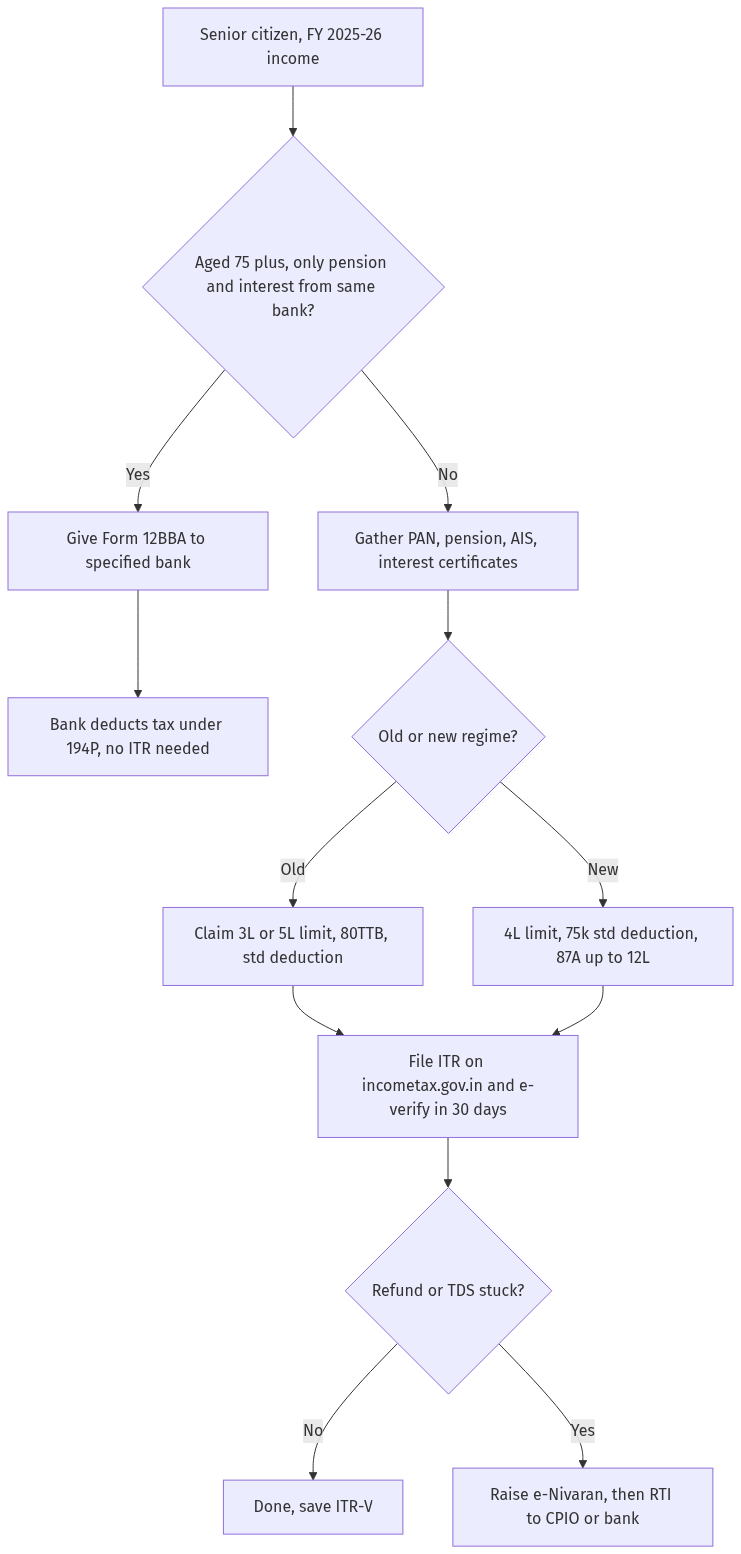
Figure: step-by-step flow. If a step stalls, use the grievance or RTI route shown.
If something goes wrong
If your refund is delayed, your TDS does not show, or the bank gets your Form 12BBA tax wrong, do not panic and do not pay an agent. Raise a free e-Nivaran grievance on the e-filing portal. If you still get no proper reply, file an RTI to the Central Public Information Officer of the relevant Income Tax office, or to your specified bank for a 12BBA or TDS issue, and ask for the file noting and the reason in writing. That usually moves things.
Frequently asked questions
Do senior citizens get a higher tax-free limit?
Yes, but only in the old regime. A senior citizen pays no tax up to Rs 3,00,000 and a super senior up to Rs 5,00,000. The new regime gives a Rs 4,00,000 limit to everyone regardless of age.
Which regime is better for a pensioner?
If you earn a lot of FD and savings interest, the old regime with the Rs 50,000 Section 80TTB deduction often wins. If your income is mainly pension, the new regime with its Rs 75,000 standard deduction is usually lighter. Compare both on the portal before submitting.
I am 76 with only pension and FD interest. Must I file?
Maybe not. Under Section 194P, if you are a resident 75 or older and your only income is pension plus interest from the same bank that pays your pension, you submit Form 12BBA to that bank and it handles your tax. No return is needed.
What is Form 12BBA?
It is a short declaration a senior aged 75 or more gives to their specified bank to use the Section 194P exemption. The bank then computes and deducts your tax, so you do not file an ITR yourself.
Do senior citizens have to pay advance tax?
Usually no. Under Section 207, a resident senior citizen with no business or professional income does not pay advance tax. You pay any balance tax at the time of filing instead.
What is the last date to file for 2026?
For FY 2025-26 the usual date for non-audit individuals is 31 July 2026, unless the CBDT extends it. Always confirm the live date on incometax.gov.in, as it has been extended in some recent years.
Can a very elderly person file on paper?
Yes. A super senior citizen aged 80 or more is allowed to file ITR-1 or ITR-4 in paper form. You do not have to do it online if that is difficult for you.
My refund or TDS is stuck. What can I do?
Raise a free e-Nivaran grievance on the e-filing portal first. If that fails, file an RTI to the CPIO of the relevant Income Tax office, or to your bank for a TDS or Form 12BBA problem, asking for the reason in writing.
Sources
You may also want to read how to file your ITR online step by step.
ITR for senior citizens: Tax filing guide for FY 2025-26 (2026)
ITR filing for senior citizens: Complete guide for AY 2026-27 (2026)
- What are the ITR rules for senior citizens in India? (a) Age categories: (i) Senior citizen: 60-80 years — as on 31 March of financial year, (ii) Super senior citizen: 80+ years, (b) Basic exemption limits — Old regime FY 2025-26: (i) Senior (60-80): Rs 3,00,000, (ii) Super senior (80+): Rs 5,00,000, © Basic exemption limits — New regime FY 2025-26: (i) All individuals: Rs 4,00,000 — (same for senior + non-senior), (ii) Section 87A rebate: up to Rs 12,000 — if income up to Rs 12,00,000, (d) Filing exemption: (i) Senior citizens 75+ — only pension + interest income — exempt from filing ITR — Section 87B, (ii) Condition: (1) Bank must deduct TDS — on pension + interest, (2) Senior citizen submits declaration to bank, (iii) Bank reports to income tax department.
- Which ITR form should senior citizens file? (a) ITR-1 (Sahaj): (i) For: pension + interest income — total income up to Rs 50 lakh, (ii) Most common — for senior citizens, (iii) Cannot file if: (1) Director in company, (2) Foreign assets, (3) Business income, (4) Capital gains above basic exemption, (b) ITR-2: (i) For: capital gains + multiple house property + foreign assets, (ii) If senior citizen sold property/shares — file ITR-2, © ITR-3: (i) For: business/profession income, (ii) If senior citizen has business income — file ITR-3, (d) ITR-4 (Sugam): (i) For: presumptive business — up to Rs 2 crore turnover, (ii) If senior citizen has small business — file ITR-4.
- Comparison table: Tax benefits for senior citizens FY 2025-26. (a) Basic exemption — Old regime: (i) Senior (60-80): Rs 3,00,000, (ii) Super senior (80+): Rs 5,00,000, (iii) Non-senior: Rs 2,50,000, (b) Basic exemption — New regime: (i) Senior: Rs 4,00,000, (ii) Super senior: Rs 4,00,000, (iii) Non-senior: Rs 4,00,000, © Section 80TTB: (i) Interest deduction: Rs 50,000 — for senior citizens — from savings + FD interest, (ii) Only for senior citizens — not non-seniors, (iii) Old regime only — not new regime, (d) Section 80D — health insurance: (i) Self + family: Rs 1,00,000 — for senior citizens (from FY 2025-26), (ii) Preventive health checkup: Rs 5,000 — included in Rs 1,00,000, (e) Filing exemption 75+: (i) Only pension + interest, (ii) Bank deducts TDS — no ITR needed. (Note: Super seniors have higher exemption in old regime. New regime is same for all.)
- How should senior citizens file ITR? (a) Step 1: Choose regime: (i) Old regime: higher exemption for super seniors + deductions (80TTB, 80D, 80C), (ii) New regime: lower rates + Rs 12 lakh rebate — but no deductions, (iii) Compare both — choose lower tax, (b) Step 2: Gather documents: (i) Form 16 — from pension provider, (ii) Form 16A — TDS on interest, (iii) Bank interest certificates — savings + FD, (iv) 80D proof — health insurance premium, (v) 80TTB: no proof needed — but interest details, © Step 3: File ITR: (i) Online: incometax.gov.in → e-File → File ITR, (ii) Or: through tax consultant / CA, (iii) Or: through bank — if 75+ with only pension + interest, (d) Step 4: Verify: (i) Aadhaar OTP — fastest, (ii) Or: net banking — EVC, (iii) Or: send ITR-V to CPC Bengaluru — within 30 days, (e) Step 5: Check refund: (i) Refund status — on incometax.gov.in → e-File → Refund Status, (ii) Refund usually 1-3 months — after processing.
- Practical tips. (a) Compare old vs new regime — choose lower tax, (b) Use 80TTB — Rs 50,000 interest deduction — old regime, © Senior 75+ with only pension+interest — no ITR needed — submit declaration to bank, (d) File before deadline — July 31 (non-audit) — avoid Rs 1,000-5,000 late fee, (e) Example: 72-year-old senior with pension Rs 6 lakh + FD interest Rs 2 lakh; old regime: exemption Rs 3L + 80TTB Rs 50K + 80D Rs 50K = taxable Rs 7L; new regime: exemption Rs 4L + rebate up to Rs 12L = zero tax; new regime better — filed ITR-1 — zero tax.
See ITR Senior Citizens and Section 80TTB and Section 87A Rebate.