Property Tax Name Change 2026

Reviewed on 2026-06-20 by Dr. Shrawan Kumar Pathak.
Quick Reply: Registering a sale deed does not move your name onto the municipal property tax bill. You must separately file an owner transfer or change of name application in your urban local body's property tax records, with the deed, the latest paid receipt and ID proof. Use your ULB's property tax portal; if it stalls, file an RTI.
The bill that still names the seller
Here is the gap nobody warns you about. You paid the full price. You paid stamp duty. The sub-registrar registered your sale deed and handed you a fat file of papers. By every measure that matters in a courtroom, the flat is yours.
And then the property tax bill arrives the next year, still printed in the seller's name.
This is not a clerical accident. The sub-registrar's office and your urban local body (ULB, meaning your municipal corporation, council or nagar panchayat) keep two separate ledgers that do not talk to each other automatically. Registration records the transfer of title. The property tax record, often called the assessment register, holding record or khata, decides who the civic body bills, who it holds liable for arrears, and whose name sits on the demand notice. Changing one does not change the other. You have to walk the second ledger over yourself.
This guide follows that second ledger: what the municipal name change actually is, what papers force it open, what it costs, and what to do when the file simply does not move.
What this change is, and what it is not
The municipal name change goes by different labels depending on where you live: owner transfer, change of name, e-change of name, or municipal mutation. In every case it does one narrow thing, it puts your name on the property tax record so future bills, receipts and civic correspondence come to you.
It is not the same as transfer of title (your registered deed already did that). It is not the same as revenue or land-records mutation, which the revenue department handles separately for land. And it does not, on its own, update your name on the electricity, water or gas connection, those are separate applications to each utility.
When you need it
You apply for a property tax name change after any event that changes who owns the property:
- Purchase, on a registered sale deed.
- Inheritance, where the owner has died, supported by the will or the legal heir or succession certificate plus the death certificate.
- Gift, on a registered gift deed.
- Partition, on a registered partition deed or family settlement.
- Marriage or a personal name change, supported by the marriage certificate or the gazette notification.
In each case the underlying document is what the municipal clerk checks the application against, so the papers differ by reason.
Papers that force the file open
Exact lists vary by ULB, but across the country the same core documents recur. Keep a self-attested set and the originals ready:
- The application form for owner transfer or change of name, from your ULB portal or office.
- The registered deed that triggered the change (sale, gift, partition), or the will, succession or legal heir certificate with the death certificate for inheritance.
- The latest property tax paid receipt, with no arrears outstanding.
- Identity and address proof of the new owner.
- A notarised affidavit or indemnity bond in many ULBs, declaring the change and indemnifying the civic body.
- A no-objection certificate where one is needed, for example from a housing society or a lessor on leasehold land.
A live tip the counter rarely volunteers: clear every rupee of pending tax before you apply. A name change request sitting on top of arrears is the easiest file in the office to set aside, and many portals will not even let you submit until dues are paid.
How to apply, step by step
Online, the usual route in 2026
Most municipal corporations now run a property tax portal. Open your own ULB's site (search your city's municipal corporation name with the words property tax), register or log in with the property identification number printed on your old bill, and look for owner transfer, mutation or change of name in the property tax menu. Fill the form, upload the deed, the paid receipt, ID and address proof, pay the fee online, and note the application or acknowledgement number. That number is your lever later.
As single-city illustrations only, Delhi residents use the property tax module on mcdonline.nic.in, and Bengaluru residents go through the BBMP khata route. Your city will differ, so do not copy another city's screen.
Offline, where the portal is thin
In smaller councils and nagar panchayats, you submit the same papers in person at the property tax or revenue branch, pay at the counter, and collect a dated receipt. Always insist on a stamped acknowledgement with a date, it is your proof that the clock has started.
Fee and timeline
There is no single national figure. Most ULBs charge either a small fixed transfer fee or a small percentage of the stamp duty already paid, and some add a modest processing or application charge. Processing commonly takes a few weeks, and longer where the field staff carry out a physical site verification or where someone files an objection. Both the fee and the timeline are set locally, so verify the current figure and the service charter timeline on your ULB portal before you pay anything.
When the application is approved, the civic body issues a change of name or mutation certificate, online or from the zonal office, and the next bill carries your name.
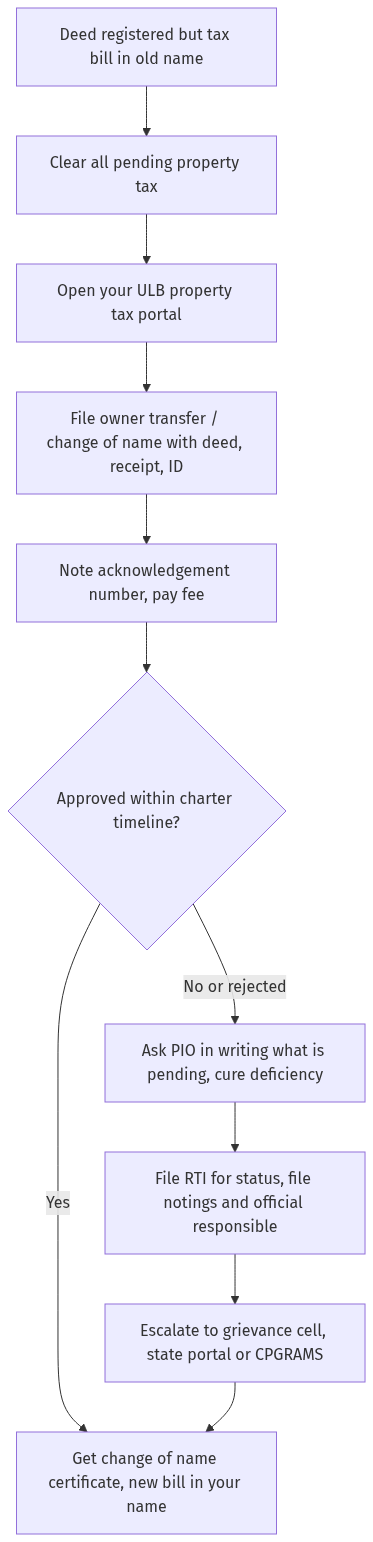
Figure: step-by-step flow. If a step stalls, use the grievance or RTI route shown.
When the file does not move
This is where most owners give up, and where a little pressure pays. Civic name changes stall for predictable reasons: a thin document set, unpaid arrears nobody flagged, a missing NOC, or simply a file that has gone to sleep on a desk.
First, fix the obvious. Call or visit, quote your acknowledgement number, and ask in writing what is pending. Cure any deficiency the same week.
If weeks pass with no movement, file an RTI to the municipal Public Information Officer. Ask four specific things: the current status of your owner transfer application, the documents still treated as pending, certified copies of the file notings and the file movement, and the name and designation of the official handling it with the reason for delay. The mechanism here is quiet but real, the moment a citizen demands certified copies of file notings, the dealing clerk has to physically pull the file, list every noting and have it attested, and a file that has to be opened is a file that tends to move.
If the RTI reply is evasive or the file still sits, escalate. Lodge the inaction with your ULB grievance cell, your state grievance portal, or the central CPGRAMS at pgportal.gov.in, attaching your application, the paid receipt and any deficiency letter. For a refused or wrongly rejected change of name, an internal review or appeal usually lies with a senior municipal officer named in the rejection order or the service charter.
For the routine billing and payment side of the same tax ledger, see our guide on how to pay holding or property tax locally. When an application is stuck and the grievance route is your best lever, walk through getting a municipal grievance fixed step by step. And once your name is on the tax record, do not forget to update it on your utilities, starting with your electricity connection.
Frequently asked questions
Does registering my sale deed automatically change the property tax name?
No. Registration and the municipal tax record are separate ledgers. The deed proves you own the property, but you must still file a separate owner transfer or change of name application with your urban local body to move your name onto the tax bill.
What is the difference between mutation and a property tax name change?
People use the words loosely. Revenue or land mutation updates land records held by the revenue department. The property tax name change updates the civic body's billing record. Many ULBs call their tax-side change mutation too, so check whether the office means the tax ledger or the land record.
Can I change the name without paying pending property tax?
Usually no. Most ULBs require a no-arrears position and the latest paid receipt before they accept a name change. Clear all dues first, otherwise the application is the easiest one in the office to keep aside.
How much does a property tax name change cost?
It varies by ULB. Some charge a small fixed fee, others a small percentage of the stamp duty already paid, sometimes with a modest processing charge. There is no single national rate, so verify the current figure on your own ULB portal before you pay.
How long does the name change take?
Commonly a few weeks, and longer if site verification or an objection is involved. Each civic body publishes its own service charter timeline. If the published timeline has passed with no result, that is your cue to ask for status in writing and then file an RTI.
The municipal office is sitting on my application. What can I do?
File an RTI to the Public Information Officer asking for the status, the pending documents, certified copies of the file notings and movement, and the official responsible. Demanding the file notings forces the file to be opened. If nothing moves, escalate to the ULB grievance cell, your state portal, or CPGRAMS.
I inherited the property. What papers do I need for the name change?
You typically need the death certificate plus proof of your right to inherit, such as a will, a legal heir certificate, or a succession certificate, along with the latest paid tax receipt and your ID proof. Some ULBs also ask for a notarised affidavit and a no-objection from other legal heirs.
Will the property tax name change update my electricity and water connections?
No. The municipal tax record is separate from your utility connections. After the tax record is updated, apply separately to each utility to change the name on the electricity, water and gas accounts.
Sources
How to change the owner name in property tax records?
Changing the owner name in property tax records (mutation of property tax records) is essential after purchasing a property. Here is how:
- Step 1: Gather documents. You will need: (a) registered sale deed (or gift deed/will/partition deed), (b) previous property tax receipts, © encumbrance certificate, (d) Aadhaar and PAN of the new owner, (e) application form from the municipality.
- Step 2: Submit the application. Visit the municipal office and submit the mutation application with all documents. Pay the prescribed fee.
- Step 3: Inspection. The municipal inspector may visit the property to verify the details.
- Step 4: Order for mutation. The municipal commissioner/assessment officer passes an order for mutation of the property tax records.
- Step 5: Updated property tax receipt. After mutation, the next property tax receipt will show the new owner's name.
- Step 6: File RTI for mutation delays. Ask the municipality for: (a) the status of your mutation application, (b) the reason for delay, © the inspection report, and (d) the timeline for mutation.
What if the previous owner's dues are pending?
- Previous owner's liability: The previous owner is liable for property tax dues up to the date of sale. However, the municipality can recover dues from the property itself, meaning the current owner may need to clear them.
- Negotiate with the seller: Before purchase, check for pending dues by asking the municipality for a no-dues certificate. If dues are pending, negotiate with the seller to clear them before sale.
- File RTI for dues history: Ask the municipality for the complete property tax payment history for the last 10 years.
How to file RTI for property tax name change?
- File RTI with the municipality: Ask for: (a) the status of your name change application, (b) the reason for delay, © the inspection report, (d) the mutation order, and (e) the updated property tax receipt.
Use AI RTI Drafter. See Property Tax Online Guide and Revenue Records and Title Guide.