New Electricity Connection 2026
Reviewed on 2026-06-20 by Dr. Shrawan Kumar Pathak.
Quick Reply: Apply on your state discom's online portal (not the National Power Portal), pick the domestic category, enter your load in kW and upload two documents. By law the discom must release a metered connection within 3 days in metro cities, 7 days in other municipal areas and 15 days in rural areas after a complete application.
This guide is a decision-tree. At each fork you answer one yes or no question, then follow the branch that fits your situation. Start at the top and stop the moment you reach an action that matches where you are stuck.
Fork 1: do you know your discom?
Electricity supply in India is run by a distribution company, called a discom or power utility, and each state or city has its own. Your bill names it: examples include the various state power corporations, BSES and Tata Power in Delhi, MSEDCL in Maharashtra and so on.
If yes, go to that discom's official website and find the “New Connection”, “New Service Connection” or “Apply Online” tab. If no, check any neighbour's electricity bill, or call the national electricity helpline 1912 from any mobile and ask which discom serves your address. Do not apply on the National Power Portal at npp.gov.in. That is a data dashboard, not a place to apply.
Fork 2: what is your connection category?
The category decides your tariff and your document list, so choose carefully before you pay.
Are you applying for a home?
If the supply is for a house or flat, choose the domestic category, often coded LT-1 or “Low Tension Domestic”. Enter the load you need in kilowatt (kW). A small flat with lights, fans, a fridge and a television usually needs around 2 to 5 kW; add more if you run an air conditioner or a water pump.
Is it a shop, workshop or farm?
A shop or office is a commercial connection, a workshop is industrial, and a borewell or farm pump is agricultural. These have different tariffs and may need extra clearances. If you also run a trade from the premises, sort your municipal trade licence first, because some discoms ask for it as ownership or use proof.
Fork 3: do you have the two documents?
Here is the relief most people do not know. Under the Electricity (Rights of Consumers) Rules, 2020, a connection up to a load of 10 kW needs only two documents: a proof of identity and a proof of ownership or lawful occupancy of the premises.
If you own the premises, use your sale deed, allotment letter, registered agreement, or the latest property tax receipt as ownership proof. If you rent, a registered rent agreement plus a no-objection note from the owner usually works. For identity, Aadhaar, voter ID, passport or driving licence are accepted. A passport-size photograph completes the set.
Do you owe demand charge estimates?
No. The same Rules say there is no estimation of demand charges for loads up to 150 kW, so the discom cannot stall a normal home or small-business connection on that ground. You will still pay an application fee, a refundable security deposit and any service-line or development charge, but those are quoted after your application is accepted.
Fork 4: how do you actually apply?
Follow these steps on the discom portal in order.
- Click “New User Registration”, enter your name, mobile number and email, and verify the OTP. You receive a User ID and password.
- Log in, select “New Service Connection” and choose your category and load in kW.
- Upload your two documents and photograph in the slots shown.
- Pay the application or processing fee online and note the application or request number. Keep the receipt.
- The discom inspects the site or checks feasibility, quotes the security deposit and service-line charge, and after you pay it, installs the meter and releases supply.
No connection is given without a meter, and by Rule the meter must be a smart prepayment or prepayment meter. If you also want a separate point for an electric vehicle charger, the 2024 amendment lets you apply for a separate EV connection.
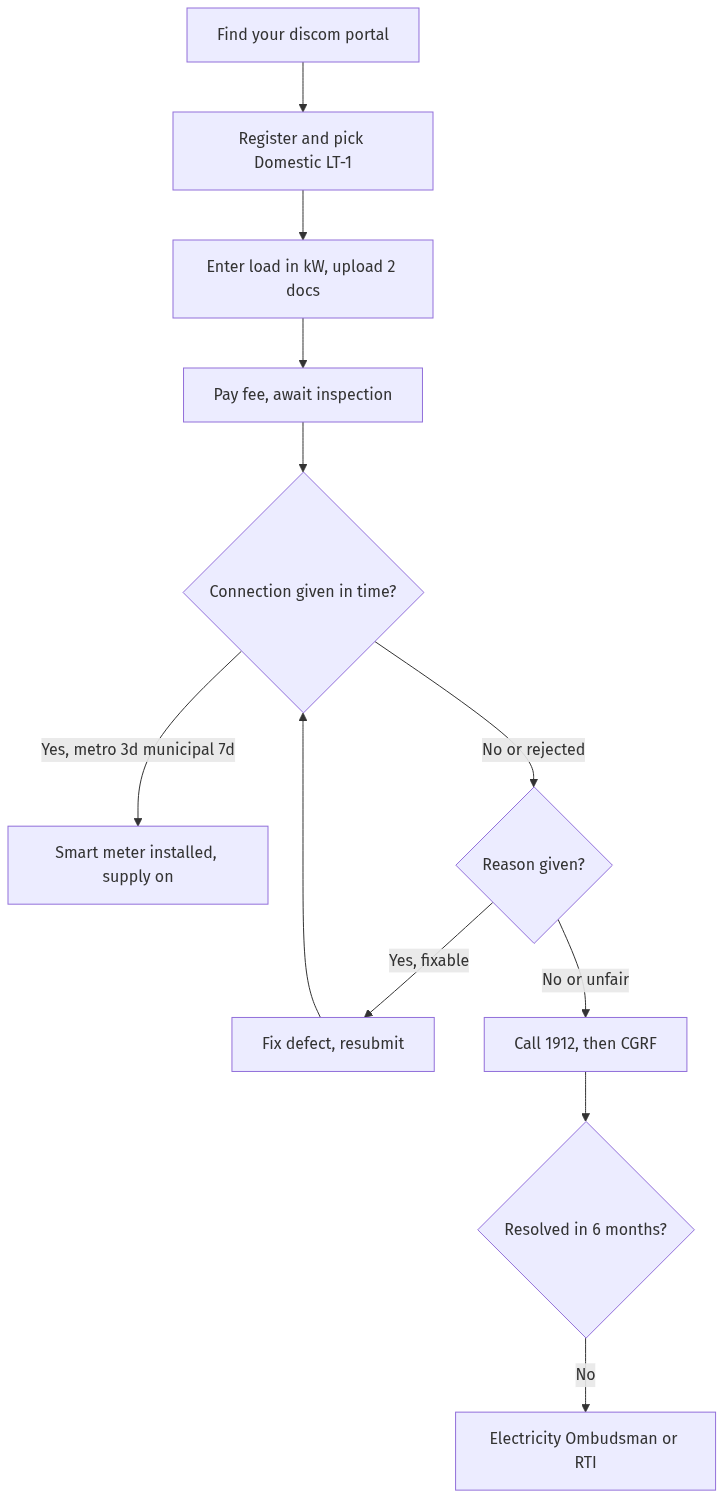
Figure: step-by-step flow. If a step stalls, use the grievance or RTI route shown.
Fork 5: has the deadline passed?
This is the fork that protects you. Count the days from when your application was complete, that is, fee paid and documents accepted.
- Metropolitan city: the discom must release the connection within 3 days.
- Other municipal area: within 7 days.
- Rural area: within 15 days, or 30 days in rural hilly terrain.
These limits come from the Electricity (Rights of Consumers) Amendment Rules, 2024, which took effect on 22 February 2024 and cut the older 7, 15 and 30 day limits. If the deadline has passed with no connection and no valid reason, you have moved from “applicant” to “aggrieved consumer”, and the next forks are your remedies.
Fork 6: stuck, delayed or rejected?
Were you given a reason?
If the reason is fixable, for example a missing document or a load mismatch, correct it and resubmit. If no reason was given, or the reason is unfair, do not keep re-applying. Escalate.
Does the line need road cutting?
Sometimes the delay is because the service cable must cross a public road or footpath. That is a separate municipal permission, not your job to chase, but it helps to know it exists. See road-cutting permission so you can ask the discom whether this is the hold-up. A genuine delay caused by a builder, as many flat owners face, is covered in our note on a builder delaying your utility connection.
Where do you complain?
- Call 1912 and log a ticket, or use the discom's online complaint form. Quote your application number.
- If that fails, file with the Consumer Grievance Redressal Forum (CGRF) of your discom, set up at sub-division or division level. It is free.
- If the CGRF order does not satisfy you, approach the Electricity Ombudsman appointed by your State Electricity Regulatory Commission. Grievances are meant to be settled within a maximum of six months.
- For a wider service failure, your municipal grievance route and an RTI to a state-owned discom can pull out the inspection report and the reason for delay.
Frequently asked questions
How long does a new electricity connection take in 2026?
After your application is complete, the discom must release it within 3 days in a metro city, 7 days in other municipal areas and 15 days in rural areas, or 30 days in rural hilly terrain. These are legal maximums set by the 2024 amendment to the Rights of Consumers Rules.
Which portal do I apply on?
Apply on your own state discom's website under “New Connection” or “New Service Connection”. There is no single all-India application site. The National Power Portal at npp.gov.in is only a data dashboard, so do not apply there.
How many documents do I need?
For a load up to 10 kW you need only two: a proof of identity and a proof of ownership or lawful occupancy, plus a photograph. Discoms cannot demand a long list for an ordinary home connection.
How much does a new connection cost?
There is an application fee, a refundable security deposit and a service-line or development charge. The exact rupee amounts differ by state, discom and your sanctioned load, so confirm the current figures on your own discom portal before you pay.
Can the discom refuse because of demand charges?
No. For loads up to 150 kW there is no estimation of demand charges, so a normal home or small-shop connection cannot be stalled on that ground. You still pay the security deposit and service-line charge after acceptance.
Will I get a smart meter?
Yes. By Rule no connection is given without a meter, and the meter must be a smart prepayment or prepayment meter. You can also apply for a separate connection just for an electric vehicle charger.
What if the discom misses the deadline?
Call 1912 and log a ticket, then file free with the Consumer Grievance Redressal Forum of your discom. If still unresolved, go to the Electricity Ombudsman of your state regulator, which should decide within six months. An RTI to a state-owned discom gets you the inspection report.
Can I get a connection if I rent the house?
Usually yes. A registered rent agreement with a no-objection note from the owner works as occupancy proof in most states. Confirm the exact list on your discom portal, since the accepted occupancy documents vary by state.
Sources
- https://powermin.gov.in (Ministry of Power, Electricity Rights of Consumers Rules, 2020)
- https://www.pib.gov.in (PIB PRID 2008289, Rights of Consumers Amendment Rules, 2024)
- https://npp.gov.in (National Power Portal and the 1912 electricity helpline)
Confirm your state discom's fees, category codes and exact document list on its own official portal before you apply, because these figures vary by state and by sanctioned load.
New electricity connection: Municipal procedure and timeline (2026)
How to apply for new electricity connection: Complete guide (2026)
- What is the process for a new electricity connection? (a) Application: (i) Apply to local DISCOM (distribution company) — online or offline, (ii) Documents: (1) Identity proof — Aadhaar/PAN, (2) Address proof — property document / sale deed / rent agreement, (3) Property tax receipt — latest, (4) NOC — from property owner — if tenant, (5) Wiring completion certificate — from licensed electrician, (6) Photograph — of premises, (iii) Fee: (1) Single phase: Rs 500-2,000 — depending on load + state, (2) Three phase: Rs 2,000-10,000 — depending on load + state, (iv) Load: (1) Domestic: up to 5 kW — single phase, (2) Commercial/industrial: 5 kW+ — three phase, (b) Timeline: (i) Urban: 7-30 days — from application, (ii) Rural: 15-60 days, (iii) If pole/transformer extension needed: 30-90 days, © Online application: (i) State DISCOM website — or national single window, (ii) Upload documents + pay fee online, (iii) Track status — online.
- Why do electricity connections get delayed? (a) Common delay reasons: (i) Incomplete application — missing documents, (ii) Site inspection pending — JE (Junior Engineer) not visited, (iii) Pole/transformer extension — needed — but not sanctioned, (iv) ROW (Right of Way) issue — neighbour objection for laying cable, (v) Wiring not complete — or not as per code, (vi) Fee not paid — or incorrect amount, (vii) Load sanction — pending from higher authority — for high load, (b) How to resolve delays: (i) Contact JE / AEE — of your area — follow up, (ii) File grievance — on DISCOM website / app, (iii) Contact consumer grievance forum — if DISCOM doesn't respond, (iv) File RTI — for status + delay reason.
- Comparison table: Electricity complaint channels. (a) DISCOM grievance: (i) Purpose: complaint — for connection delay, (ii) Authority: DISCOM — website/app/helpline, (iii) Timeline: 7-30 days, (iv) Cost: free, (v) Best for: direct complaint — to DISCOM, (b) Consumer Forum: (i) Purpose: compensation — for delay + deficiency, (ii) Authority: District Consumer Forum, (iii) Timeline: 3-6 months, (iv) Cost: nominal fee, (v) Best for: compensation for delay, © RTI: (i) Purpose: get information — status + delay reason, (ii) Authority: CPIO — DISCOM / Electricity Department, (iii) Timeline: 30 days, (iv) Cost: Rs 10, (v) Best for: identifying delay reason + officer. (Note: File grievance first → RTI if no response → Consumer Forum for compensation.)
- Step-by-step: How to apply for new connection. (a) Step 1: Visit DISCOM website: (i) Find your DISCOM — by state/area, (ii) Example: BSES (Delhi), TSSPDCL (Telangana), MSEDCL (Maharashtra), (b) Step 2: Register + apply: (i) Create account — with mobile + email, (ii) Fill application — load required + premises details, (iii) Upload documents — ID + address + property tax + wiring certificate, © Step 3: Pay fee: (i) Online payment — connection + security deposit, (ii) Security deposit: based on load — refundable, (d) Step 4: Site inspection: (i) JE visits — inspects premises + wiring, (ii) Approves — or asks for corrections, (e) Step 5: Connection: (i) Meter installed — and connection energized, (ii) Timeline: 7-30 days — after inspection approval, (f) Step 6: If delayed: (i) File RTI — ask: (1) Status of application — reference [XXX], (2) Reason for delay, (3) Date of site inspection — conducted or pending, (4) Expected date — of connection.
- Practical tips. (a) Apply online — faster + trackable, (b) Keep all documents ready — before applying, © Hire licensed electrician — for wiring — as per code, (d) Follow up with JE — if delayed beyond 30 days, (e) Example: Applicant applied for domestic connection — paid Rs 1,500; no response for 45 days; filed RTI; reply revealed — site inspection not scheduled; JE contacted after RTI reply; inspection in 3 days; connection in 7 days.