Road-Cutting / Excavation Permission 2026

Reviewed on 2026-06-20 by Dr. Shrawan Kumar Pathak.
Quick Reply: If you need to dig open a public road for a water pipe, sewer, electricity or telecom cable, you must get road-cutting permission from the municipal corporation or local body that owns the road. You apply online, pay a road-restoration charge, then cut only after the permit is issued. Cutting without it invites a fine and an FIR.
A road-cut looks small from the kerb. One trench for a new water line, one channel for a fibre cable. But the road belongs to the public, and the body that maintains it has the final say on who opens it and who pays to close it back up. This guide walks you through it as a set of plain “if this, then that” rules, so you can see exactly which path is yours before you spend a rupee.
If you want to dig a public road, then you need permission first
The simple rule: you cannot break open any public road, footpath or kerb on your own. The road is owned and maintained by an agency, and only that agency can let you cut it. Whose road it is decides whose permission you need.
If the road is a city or town street, then go to your municipal body
If the stretch is an ordinary municipal road, an interior lane or a footpath inside a city or town, the municipal corporation, municipal council or nagar panchayat is your authority. They issue the road-cutting or road-cut permission and collect the restoration charge. Most corporations now take the application on their own portal, the same one you use to pay your holding or property tax.
If the road is a highway or a PWD road, then a different agency decides
If the road is a state highway, a National Highway or a road built and held by the Public Works Department, the municipal body is not the owner. You apply to that road-owning agency instead. The same goes for roads inside a private layout or a gated society, where the developer or association controls the surface. When in doubt, ask your ward office whose road it is before you fill any form.
If you are ready to apply, then keep these documents handy
Exact papers differ by state and by local body, but most road-cut applications ask for the same core set. Greater Chennai Corporation, for example, lists these on its road-cut portal.
- Name of the road, plus its zone and division
- Type of road: bus-route road, interior road, footpath or concrete (CC) road
- Length, width and depth of the cut you need
- Nature of the cut: a one-off service connection or a larger project
- A sketch showing exactly where the cut will be made
- Building permission and completion certificate, if the cut serves a new building
- Your latest property tax receipt
- A statement from the divisional engineer on any court case or lock-and-seal notice
If your cut is to bring in a connection for a brand-new house, the same office that handled your building plan approval usually holds these records, so collect them together.
If you are a utility or contractor, then expect a higher charge
If you apply as an individual for a single house connection, your restoration charge is calculated on the small patch you open. If you apply as a telecom, optical-fibre or pipeline company laying a long run, the charge is higher and often doubled, because you damage a longer stretch and the road must be relaid wider. Plan for that before you quote a customer.
How road-restoration charges work
You do not pay a flat fee to cut a road. You pay the cost of putting it back. The local body inspects the spot, measures the cut, and prepares an estimate using its Schedule of Rates for that year. You pay that estimate up front, and the body restores the road, or supervises the restoration, after your work is done.
Because the charge is built from local rates, road type and the exact size of your cut, there is no single all-India figure. A short cut on a mud lane costs far less than a wide trench across a freshly laid bus-route road. Many corporations now show the amount through an online calculator or a payment advice once your application is scrutinised. Get that written estimate before you pay, and verify the current rate on your own municipal portal.
If the road was recently relaid, then expect to pay more
Most bodies protect new roads. If the road was laid only a few months ago, the restoration charge is steeper, sometimes doubled, to discourage cutting fresh tar. If you can wait or reroute, you may save a large sum. Ask the engineer how the road is classified before you commit.
Step by step: from application to permit
The flow below follows the published Greater Chennai Corporation procedure. Your own body's portal will mirror most of it, with its own timelines.
- Apply online on the municipal portal with the road details, the cut dimensions and the documents above.
- Site inspection. The zonal or division engineer visits, measures the cut and prepares the restoration estimate as per the current Schedule of Rates.
- Payment advice. You receive the charge. In Chennai this advice must be issued within 10 days of the application.
- Pay the charge. Pay by the route shown, usually RTGS or demand draft. In Chennai you must pay within 30 days or the application is rejected.
- Permit issued. Once payment is received, the permission order is issued. In Chennai this is within 7 days of payment.
- Cut within the validity window. The permit runs for a fixed period, one month in Chennai. Finish the work inside it, or the permission lapses and you must get it revalidated.
- Close out. Inform the body within 24 hours of finishing, refill and compact the trench properly, and upload completion photos and the certificate on the portal.
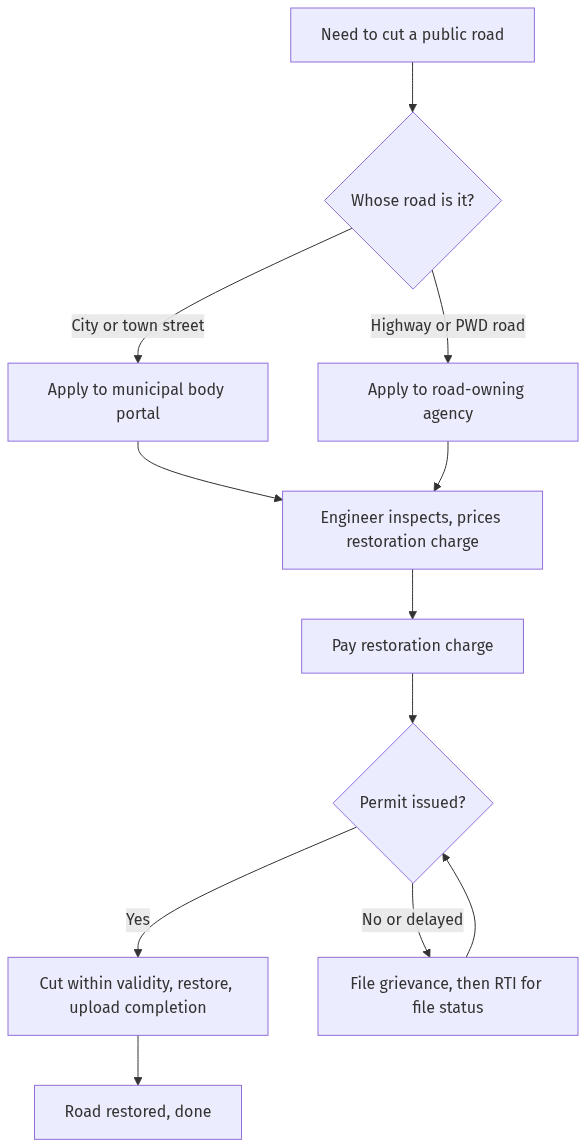
Figure: step-by-step flow. If a step stalls, use the grievance or RTI route shown.
If you cut the road without permission, then the penalty is harsh
This is the rule worth remembering. If you break open a road with no permit, the local body can confiscate your tools, remove anything you laid, lodge an FIR against the contractor, and recover a fine. Under the Chennai procedure that fine is fixed at three times the cost of restoring the road. A permit is far cheaper than the penalty.
If your permit is stuck or your road is left broken, then escalate
Two things go wrong most often: the office sits on your application, or someone cut the road, took your money, and left a sunken patch that never healed.
If the office delays your permission, then push it in writing
First, log a formal complaint on your municipal grievance portal and keep the ticket number. A written, tracked complaint moves faster than a counter visit. Our guide on how to make a municipal grievance stick shows the exact route and follow-up. If the silence continues, file a Right to Information request to the road-owning department asking for the status of your file, the officer holding it, and the reason for delay. An RTI puts a clock on the file.
If a cut was left unrestored, then demand the record
If a utility or contractor dug near your home and left the road broken, you have a right to know who permitted it and who was paid to restore it. File an RTI to the local body for the road-cutting permission, the restoration charge receipt and the completion certificate for that stretch. If the completion record is missing or the charge was collected but no repair done, that paper is your lever, with the grievance cell or in a consumer or public forum. The same approach helps when a water connection is delayed because of a road-cut dispute.
Frequently asked questions
Who gives road-cutting permission in India?
The agency that owns the road. For city and town streets, footpaths and interior lanes, it is your municipal corporation, council or nagar panchayat. For highways and PWD roads it is that road-owning department. There is no single national portal, so start at your local body.
How much does road-cutting permission cost?
You pay a road-restoration charge, not a flat fee. The body measures your cut and prices it from its Schedule of Rates, so the amount depends on road type, the cut size and local rates. Get the written estimate first and verify the current rate on your municipal portal.
How long does it take to get road-cut permission?
It varies by body. Under the published Greater Chennai Corporation procedure, the payment advice comes within 10 days, you pay within 30 days, and the permit is issued within 7 days of payment. Check your own body's stated timeline.
How long is a road-cutting permit valid?
For a fixed window set by the body, one month in Chennai. You must finish the cut inside it. If you do not, the permission lapses and you have to apply for revalidation before you restart the work.
What happens if I cut a road without permission?
The body can seize your equipment, remove what you laid, file an FIR against the contractor, and recover a fine. Under the Chennai procedure that fine is three times the cost of restoring the road. Always get the permit first.
Can an individual apply, or only a contractor?
An individual can apply, for example to bring a water or electricity line to a new house. Utilities, telecom and fibre companies also apply, usually at a higher, sometimes doubled, charge because they cut longer stretches.
A contractor cut the road and never repaired it. What can I do?
Log a complaint on your municipal grievance portal with the location and a photo. If nothing moves, file an RTI for the road-cutting permission, the restoration charge receipt and the completion certificate. A collected charge with no repair is strong proof to force the fix.
Sources
For related municipal steps, see paying holding or property tax, your building plan approval, a delayed water connection and your local municipal grievance route.