Building Plan Approval 2026

Reviewed on 2026-06-20 by Dr. Shrawan Kumar Pathak.
Quick Reply: To build legally in India in 2026 you need a sanctioned building plan from your local municipal or development authority. Apply online on your state OBPAS (Online Building Plan Approval System) portal: upload an architect-signed plan, clear the automated scrutiny, pay the fees, and collect the sanction before you start work.
You cannot lawfully start construction until your building plan is sanctioned. Build first and you risk a stop-work notice, penalty, or even demolition of the unauthorised portion. This guide walks you through the full approval journey in order, so you know what comes next at every stage and how long each step should take.
The approval journey, stage by stage
Think of building plan approval as a single online file that moves through fixed checkpoints. Most states now run this on an OBPAS portal, so the whole journey happens from your computer or phone.
Stage 1: appoint an architect and prepare drawings
Your plan must be drawn and signed by a registered architect or a licensed technical person empanelled with your authority. Get the working drawings as a CAD or Pre-DCR file in the layer format your portal specifies, because the automated scrutiny engine reads those layers directly. Keep your title document, latest property tax or holding tax receipt, approved layout or plot allotment, and identity proof ready before you log in.
Stage 2: register and submit on the OBPAS portal
Find your state or city OBPAS portal (search for “OBPAS” plus your state, or check your municipal corporation or development authority website). Your architect usually submits on your behalf using their professional login, while you provide and verify the owner details. Upload the CAD plan, site plan, ownership papers and the required declarations or affidavits, then submit the application.
Stage 3: automated scrutiny of your plan
Before any official sees the file, the portal's scrutiny engine checks your drawing against the building bye-laws: setbacks on all sides, the floor area ratio or FAR, ground coverage and the permitted height for your plot. If the drawing breaks any rule, it is returned for correction. This is the most common reason a fresh application stalls, so confirm with your architect that the plan obeys your local bye-laws before you submit.
Stage 4: risk category and self-certification
Many states have moved to a risk-based system under their 2025 model or uniform building bye-laws. Plots are classified as low, moderate or high risk by size and height. Low and moderate risk buildings, such as a small residential plot, can often be approved through self-certification by your architect, while high-risk or tall buildings still go for full departmental scrutiny. Check which category your plot falls in, because it decides how fast you get the sanction.
Stage 5: pay the fees and clear any NOCs
Once the plan passes scrutiny the portal calculates the charges. These usually include a scrutiny fee, development or betterment charges, labour cess and a security deposit, and you pay them online. The exact amounts vary by state and by your built-up area, so verify the current figures on your ULB or OBPAS portal before you pay. Depending on where your plot is, you may also need clearances such as a Fire NOC, an Airports Authority height NOC, or an environment or heritage clearance. The portal will tell you which apply.
Stage 6: sanction, then commencement
After fees and NOCs are in, the competent authority issues the sanctioned plan with a unique permit number. The sanction carries a validity period, so start construction within the stated time or you may have to renew it. Keep the digital sanction letter safe; you will need it for the water and electricity connection and later for the sale or loan on the property.
Stage 7: completion and occupancy certificate
Approval to build is not the end. After construction you apply on the same portal for a completion certificate and an occupancy certificate, certifying that you built as per the sanctioned plan. You should obtain the occupancy certificate before you legally occupy the building; many utilities and banks now ask for it.
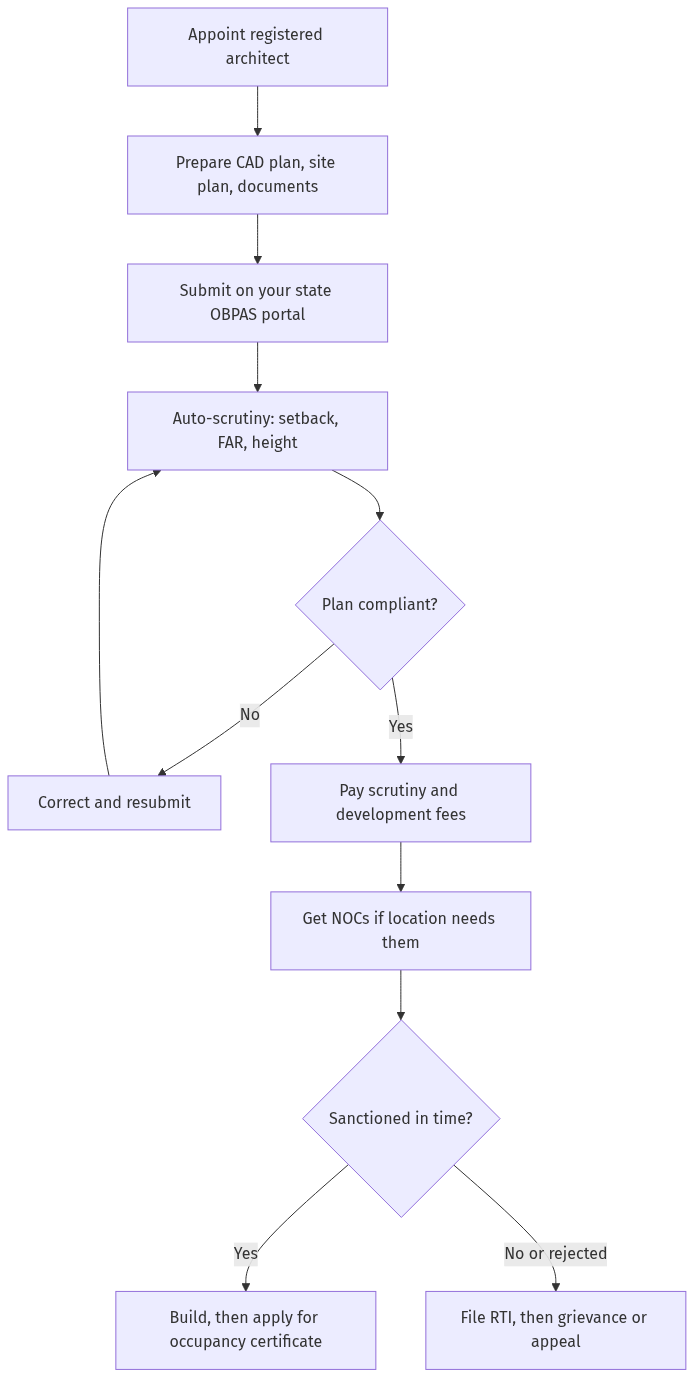
Figure: step-by-step flow. If a step stalls, use the grievance or RTI route shown.
How long should it take?
Several states now offer deemed or auto approval to push authorities to decide quickly. The rule is broadly the same everywhere: if the authority raises no objection within the set time limit, a low-risk or self-certified plan is treated as approved. The exact number of days differs from state to state, so do not assume one national figure. Confirm the legal timeline on your own state's OBPAS portal or service-guarantee notification, and note the date you submitted so you can prove any delay later.
If your plan is rejected or stuck
If the scrutiny engine rejects the plan, read the objection list, fix the exact points with your architect, and resubmit. If the file is simply not moving after you have paid, do not rely only on phone calls. File an RTI application asking for the current status, the file movement and the name of the dealing officer, then use that dated reply to appeal under your state's service-guarantee law. Our companion guide on a building plan delayed after fees are paid sets out that remedy week by week, and you can escalate through the municipal grievance system.
Frequently asked questions
Can I start building before the plan is sanctioned?
No. Construction without a sanctioned plan is unauthorised and can attract a stop-work notice, penalty or demolition. Wait for the sanction letter with its permit number before you begin any work on site.
Do I have to apply online through OBPAS?
In most states and large cities the building plan approval is now fully online through an OBPAS portal. Check your municipal corporation or development authority website for the link. A few smaller bodies may still accept offline files, so confirm locally.
How much does building plan approval cost in 2026?
There is no single national fee. You typically pay a scrutiny fee, development or betterment charges, labour cess and a refundable security deposit, all calculated by built-up area. Verify the current rates on your state's OBPAS or municipal portal before you pay.
Which NOCs do I need for my building?
It depends on your plot. Common ones are a Fire NOC for taller or commercial buildings, an Airports Authority height NOC near airports, and environment or heritage clearances in protected zones. The OBPAS portal usually flags which clearances your application needs.
What is deemed approval and can I rely on it?
Deemed or auto approval means the plan is treated as sanctioned if the authority does not object within the legal time limit. The number of days varies by state. Treat it as a backstop, not a shortcut: still get the written sanction or proof of deemed approval before you build.
Who can sign my building plan?
A registered architect or a licensed technical person empanelled with your local authority must prepare and sign the drawings. You cannot self-draw and submit a plan on most OBPAS portals.
Is the occupancy certificate the same as plan approval?
No. Plan approval lets you start building; the completion and occupancy certificate is issued after construction to confirm you built as sanctioned. You need the occupancy certificate before you legally occupy the building.
What should I do if the authority ignores my application?
File an RTI to get the file status and the officer's name in writing, then appeal under your state service-guarantee act using that dated reply. Read our delay-remedy guide and use the municipal grievance route to escalate.
Sources
For related municipal procedures see our guides on road cutting permission and updating holding tax records after construction.