Closed vs settled vs written-off on CIBIL
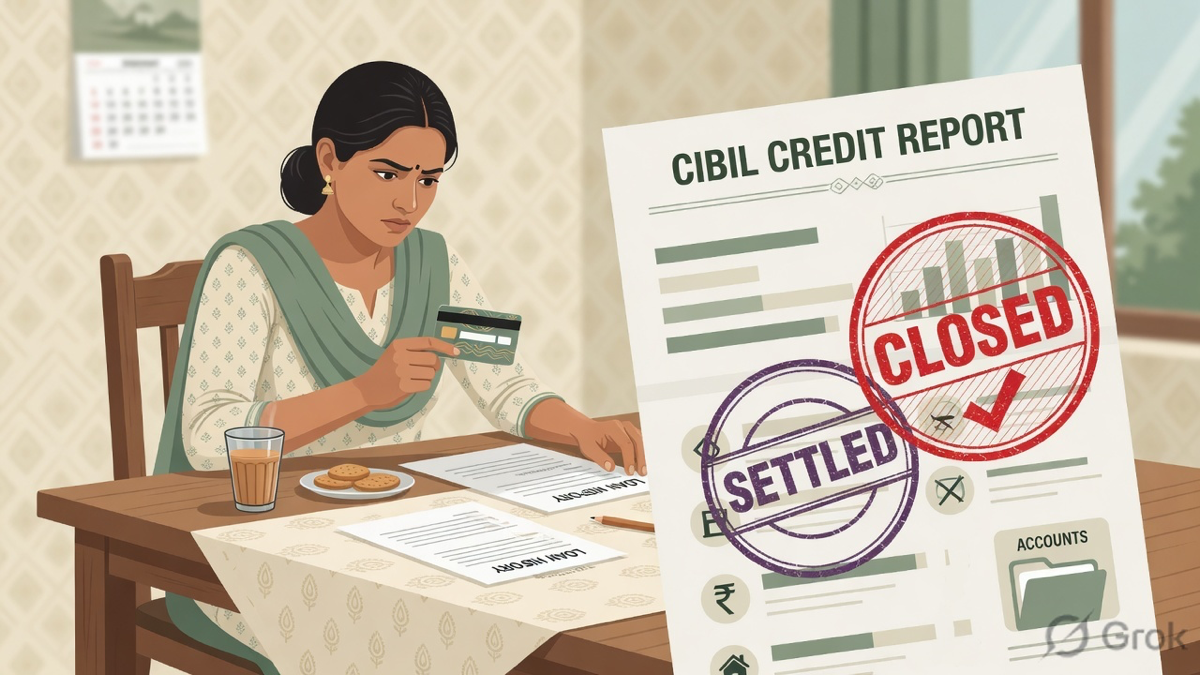
Closed, settled and written-off are three different CIBIL remarks. A credit card settlement ends the recovery fight, but later lenders still read it as unpaid dues.
Do not treat “settled” as a synonym of “closed”. CIBIL's own explainer is clear. If you had paid the entire amount, the account would be reported as closed. A settled status means the bank accepted less than the full due. Future lenders may treat you as risky. If you later pay the remaining balance, get a No Dues Certificate and ask the bank and CIBIL to update the status.
Closed vs settled vs written-off on CIBIL
| Remark | What actually happened | How later lenders read it | Typical next step |
|---|---|---|---|
| Closed | You paid the full due and the card account ended | Cleanest of the three. Shows the account was paid in full | Keep the NOC. Check the report after the bank reports the update |
| Settled | Bank accepted a lower amount than the total due | Worse than closed. Signals unpaid remainder | Pay leftover if you can. Get NOC. Dispute the remark with proof |
| Written-off | Lender booked the unpaid amount as a loss. You may still owe it | Usually the harshest of the three | Ask the bank what is still legally due. Do not assume the debt vanished |
CIBIL does not publish a fixed point drop for settlement. Ignore blogs that quote “50 to 100 points” as if that were a bureau rule. The damage is qualitative: settled is worse than closed-in-good-standing, and written-off is usually worse still.
Illustrative scenario. A cardholder cannot pay a large overdue bill. The bank offers a one-time settlement. The person pays and feels free. A year later a home-loan officer points to one word on the credit report: settled. In credit-report language that word can mean “not fully paid”.
Credit card settlement: what you sign up for
Settlement means the bank agrees to accept a lower amount than the total due. It can stop calls and close the recovery fight. It can still leave a mark on your credit report.
Ask the bank these questions in writing before you pay:
- What is the full outstanding amount?
- What is the settlement amount?
- Will the account be reported as settled, closed, written-off, or something else?
- Will all recovery calls stop after payment?
- Will the bank issue a No Dues Certificate?
- What date will the bank report the update to credit bureaus?
If the bank refuses to answer, do not pay cash to any agent. Pay only through official bank channels.
Subject: Credit card settlement status and credit bureau reporting confirmation

Credit card number ending:
Name:
Mobile:

The bank has offered settlement of Rs [amount] against total dues of Rs [amount].
Before I make payment, please confirm in writing:

1. Final settlement amount and last payment date.
2. Whether the card will be reported as Settled, Closed, Written Off, or Paid.
3. Whether a No Dues Certificate will be issued.
4. Date by which the update will be sent to all credit information companies.
5. Confirmation that no recovery agent will contact me after the settlement payment.

Please treat this as a formal grievance if the above is not clarified.
CIBIL score after settlement: how to correct the remark
CIBIL says paying the remaining amount and raising a dispute can help update status. Get bank confirmation first. Do not guess a point gain.
Remark-correction flow
① Download the latest CIBIL report → ② Ask the bank what unpaid balance remains → ③ Pay only through official bank channels if you can → ④ Collect NOC or closure letter → ⑤ Dispute with CIBIL and write to the bank nodal officer → ⑥ If still wrong after 30 days, use RBI CMS
RBI Ombudsman as of 1 July 2026: Bank, certain NBFC, prepaid-instrument and credit-information complaints go under the Reserve Bank - Integrated Ombudsman Scheme, 2026, which replaced RB-IOS 2021 from 1 July 2026. First complain to the entity. If there is no reply in 30 days (or the longer NPCI/card-network window, if it applies) or you reject the reply, file free at cms.rbi.org.in within 90 days. The Ombudsman can award up to Rs 30 lakh for consequential loss and up to Rs 3 lakh for time, expenses and harassment. Complaints received before 1 July 2026 stay under the 2021 scheme. Source: RBI FAQ, updated 1 July 2026 and the RB-IOS 2026 FAQ PDF dated 1 July 2026.
Verb-led steps
- Download your latest CIBIL report and save a PDF.
- Ask the bank, in writing, how much unpaid balance remains after settlement.
- Pay that balance only to the bank through official channels. Not to an agent in cash.
- Collect a No Dues Certificate or closure letter.
- Raise a dispute on the CIBIL site and attach the NOC and payment proof.
- Email the bank nodal officer asking them to update all credit information companies.
- Wait the RBI 30-calendar-day correction window. Credit institutions and credit bureaus together get 30 days to resolve a dispute.
- Escalate if the remark stays wrong.
If the report is wrong, fight the data error. If the report is true but painful, plan a clean-up with the bank. Settlement is useful in a crisis. It is not a magic credit-score repair tool. If you want a later home loan, car loan or education loan, closed is safer than settled.
Documents required
- Latest CIBIL report PDF
- Settlement letter or email from the bank, not a phone promise
- Payment receipts, UPI reference, or bank statement
- No Dues Certificate or closure letter
- Written grievance number and nodal-officer email
- Call recordings or screenshots if a recovery agent abused the process
Recovery-agent limits
RBI says banks are responsible for their recovery agents. The agent should carry bank authorisation and identity proof. The bank should have a grievance route for recovery complaints. The process should not use abusive or unlawful methods.
If an agent threatens you, calls relatives, abuses you or asks for cash, write to the bank nodal officer with recordings, screenshots and phone numbers. If threats are serious, file a police complaint also.
Practical rules:
- Do not pay settlement money in cash.
- Do not hand over the card, a blank cheque or signed blank paper.
- If you pay through UPI, pay only to official bank account details.
- Save SMS, email, statement, receipt and NOC in one folder.
- Check all four credit bureaus, not only one report.
- If you cannot pay full dues, still ask for a written settlement letter.
RBI Integrated Ombudsman Scheme, 2026
Complain to the card issuer first. If the bank rejects the complaint or does not resolve it in 30 days, file on cms.rbi.org.in under the RBI Integrated Ombudsman Scheme, 2026.
Use CMS for:
- Wrong CIBIL reporting after you paid
- Recovery-agent abuse
- Bank silence on a written settlement or NOC request
- Failure to update credit information within the RBI correction window
Do not jump to RBI without a bank complaint number, unless the bank has already rejected you in writing.
For delayed credit-information correction, RBI has a compensation framework. Credit institutions and credit information companies together get 30 calendar days to resolve a dispute. If they miss that window, compensation can apply under the RBI framework. Quote your dispute date, not a blog's point-drop chart.
When stuck: RTI path
CIBIL is not a public authority under the RTI Act. A private bank is usually not either. RTI works when the lender is a public sector bank, or when you need a public record from RBI.
Ask a public-sector-bank PIO, under RTI Act 2005 section 6(1):
- Copy of the settlement terms and the CIBIL reporting instruction on record
- Date on which the bank reported closed, settled or written-off to credit information companies
- Date and copy of any later correction sent after full payment
- Whether a No Dues Certificate was issued, and on which date
The PIO has 30 days under section 7(1). If there is no reply or a refusal, file first appeal under section 19(1). Draft with the AI RTI Drafter. Appeal with the First Appeal Builder.
For a private bank, use written grievance, then cms.rbi.org.in.
Common mistakes
- Paying cash to a recovery agent against a phone promise
- Assuming settled means closed
- Trusting a blog that quotes a fixed CIBIL point drop
- Skipping the written settlement letter
- Not collecting a No Dues Certificate
- Checking only one credit bureau
- Filing RTI against CIBIL or a private bank
- Waiting years without a dispute after you paid the leftover balance
Related on RTI Wiki
Official sources
- RTI Act 2005 sections 6(1), 7(1), 19(1)
FAQ
What is the difference between CIBIL settled vs closed?
Closed means the account ended after full payment. Settled means the bank accepted less than the full due. Later lenders treat settled as riskier than closed.
Does credit card settlement always ruin a CIBIL score?
No honest source publishes a fixed point drop. CIBIL says settled can hurt later credit. Closed in good standing is safer if you can still pay in full.
How does CIBIL score after settlement improve?
There is no guaranteed jump. If you pay the leftover balance, get an NOC, and the bank reports closed, later lenders see a cleaner remark. Time and clean new credit also matter.
Can I change settled to closed after paying the balance?
Often yes, if the bank agrees the account is now fully paid. Get the NOC, dispute with CIBIL, and write to the nodal officer. CIBIL's own note describes this path.
How do I complain under the RBI Integrated Ombudsman Scheme, 2026?
Complain to the bank first. If there is no resolution in 30 days, or a written rejection, file on cms.rbi.org.in. Attach the bank complaint number, settlement letter, receipts and NOC.
Will a public sector bank answer an RTI on CIBIL reporting?
You can ask a public-sector-bank PIO for the reporting instruction and NOC record. CIBIL itself is not a public authority. Private banks go through grievance and RBI CMS, not RTI.
Can a recovery agent force a cash settlement?
No. Pay only through official bank channels. Ask for a written offer. Report abuse to the bank nodal officer. Use cms.rbi.org.in if the bank ignores you.
Is written-off worse than settled on CIBIL?
Usually yes. Written-off means the lender booked a loss. Settled means a partial payment was accepted. Closed after full payment is the cleanest of the three.
Reviewed for RTI Wiki by Dr. Shrawan Kumar Pathak.
Reader signal
Was this article useful?
Tap once if it helped you. These counters show other citizens which pages are worth reading.