Right to Information Wiki Blog

Quick Reply: RTI Wiki blog — analysis, case-law summaries, and citizen guides on Right to Information Act 2005.
Latest RTI decision notes
- National Statistics Day 2026: How Government Data Affects Your Ration, Pension, Salary, Hospital, School and RTI Rights – citizen guide to administrative data, daily public services, RTI questions and the difference from UN World Statistics Day.
- Right to Be Forgotten: erase old court cases from Google after Delhi HC's 2026 ruling - what the Laksh Vir Singh Yadav judgment (2026:DHC:4891) means, the three remedies (de-indexing, delinking, masking), who is eligible vs barred, and how to apply.
- Gold Rate Today in India: 24K, 22K, 18K Price and Buyer Checklist — SEO-focused gold price guide with current-rate snapshot, city buying checklist, jewellery bill calculation, hallmark checks and a light RTI route for complaint records.
- PAN Aadhaar name mismatch? Fix KYC rejections without running office to office — high-search digital identity repair map covering PAN-Aadhaar, DigiLocker, mutual fund KYC, passport holds, bank onboarding and when RTI can actually help.
- Monday Morning RTI Checklist: Fix Pending Government Work This Week — Monday action plan for pending passport, pension, ration card, FIR, PMAY, electricity, scholarship, mutation and public-service files.
- PMAY status stuck or subsidy delayed? Use RTI after this checklist — high-interest PMAY 2026 guide covering stuck beneficiary status, missing names, delayed instalments, subsidy confusion, grievance steps and record-based RTI drafting.
- BCCI outside RTI: CIC decision in Geeta Rani case explained — legal analysis of CIC/MOYAS/A/2018/123236 after the Madras High Court remand, including Section 2(h), government control, substantial financing, tax concessions and practical RTI routes.
How to Write an RTI Application
Quick Reply: After 25 years of training PIOs and activists, here is the single lesson that fixes most rejections: ask for records, not answers. The rewrite takes two minutes.
Practice this in 30 seconds. Use our free RTI Assistant — AI-driven drafting, First Appeal, Second Appeal in one place.
In one line. If you want to know how to write an RTI application that works, write it to request records that exist — not answers, not explanations, not “why.” This single shift fixes most rejections. The rest of this piece shows you how, from someone who has read thousands of replies.
RTI: No Right to Insist on Original Documents
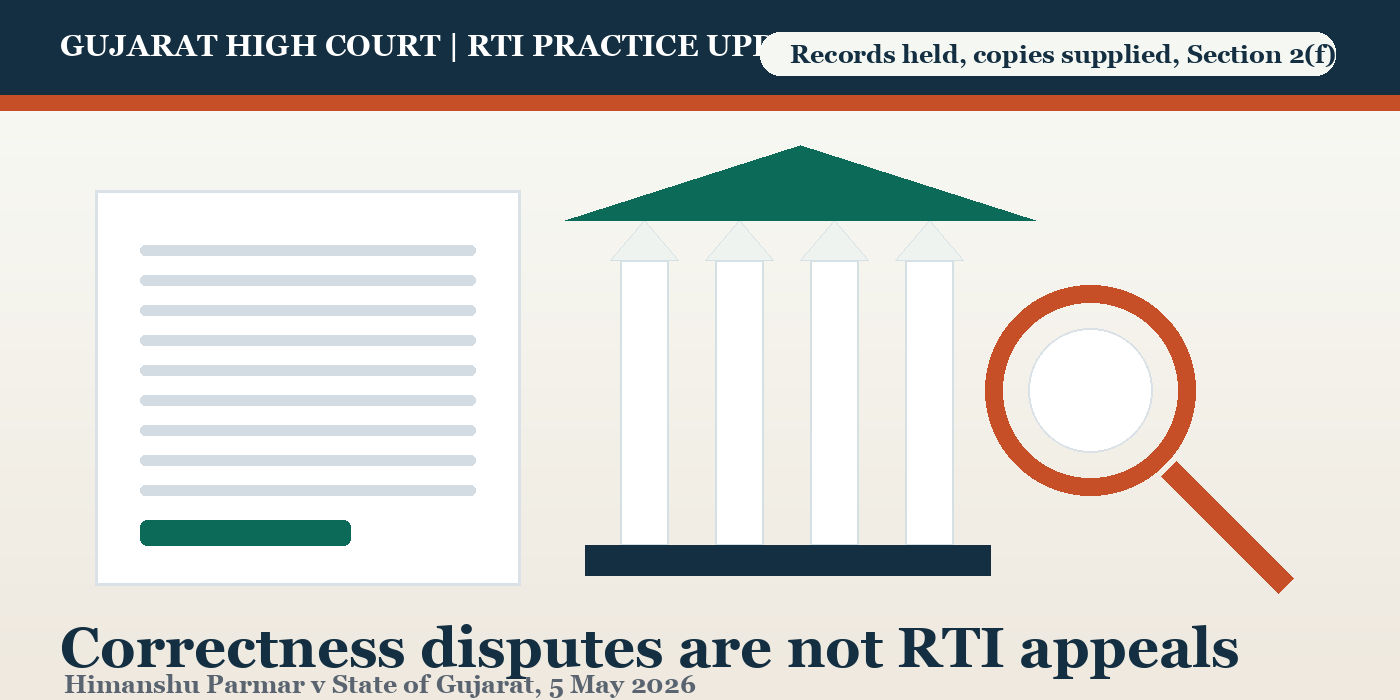
Quick Reply: Gujarat High Court held that once accessible RTI records and copies are supplied, an applicant cannot insist on original documents through the CPIO. Evaluatory analysis of Himanshu Parmar v State…
A practitioner evaluation of the Gujarat High Court's order dated 5 May 2026 in Himanshu Parsottambhai Parmar v. State of Gujarat & Ors., R/Special Civil Application No. 15120 of 2025. The first takeaway is direct: RTI gives access to records, inspection and copies. It does not give the applicant custody of original government or university documents once accessible records have been supplied. The second takeaway is procedural: the Information Commission is not a court for deciding whether the supplied information proves a recruitment or reservation-law violation.
Privacy and RTI: Filing Smart in the DPDP Era (2026 Guide)
Quick Reply: File RTI after DPDP 2026: 5 proven strategies beating the wave of Section 8 1 j rejections. RTI Wiki — India's independent Right to Information reference, 2026.
Practice this in 30 seconds. Use our free RTI Assistant — AI-driven drafting, First Appeal, Second Appeal in one place.

Did you know? A well-drafted “aggregate” RTI wins almost every time, even after the 14 November 2025 amendment. The Digital Personal Data Protection Rules, 2025 did not touch Section 8(2), the public-interest override. That clause is still your lifeline.
In one line. The Digital Personal Data Protection Rules, 2025, notified on 14 November 2025, substituted the text of Section 8(1)(j) of the RTI Act. A steep share of Q1 2026 RTIs have been refused on the strength of that substitution. This guide shows how to draft an application the Public Information Officer cannot refuse by reflex.
What that means in practice.
- Names trigger rejections. Naming an officer or a citizen in the question is the fastest route to a Section 8(1)(j) refusal.
- Aggregates and functions win. Ask about the department's spending, the scheme's cost, the tender's award criteria, not about who drew what.
- Section 8(2) is intact. The public-interest override survives the amendment and must be read into every refusal.
File RTI after DPDP 2026: 5 proven strategies beating the wave of Section 8(1)(j) rejections. India's independent Right to Information reference, updated 2026.
Updated: 20 April 2026. Rejection rates reported above 40 per cent in the first quarter of 2026.