₹1,000 for Your Answer Sheet? RTI Fees - citizen guide 2026
Asked to pay ₹1,000 for your own answer sheet under RTI? You can challenge a fee that does not match the RTI rules. Save the fee notice. Check which rules apply. Then use the first appeal draft below to ask for the right fee and your copy.

Representative illustration. It does not show the student in the case.
The short answer: When you ask for a copy under RTI, the fee must follow the RTI rules that apply to that public body. A university cannot simply use its own higher copy fee. This does not cancel fees under its separate exam scheme. See the Supreme Court ruling below.
Last reviewed: 8 September 2026. This guide is about your own answer sheet held by a public university or exam body. New to the process? Start with how to get your answer-sheet copy under RTI.
One student challenged the ₹1,000 demand
Ahmed Shakir sought his own answer script from Assam University. He filed his RTI on 21 November 2025. The reply on 1 December asked for ₹1,000. He filed a first appeal on 4 December. The first appeal order on 17 December upheld the fee.
He then appealed to the Central Information Commission, or CIC. On 6 July 2026, the CIC set aside the fee decision. It directed the university to give him his script free, within two weeks of receiving the order.
Case: Ahmed Shakir v. CPIO, Assam University, file CIC/ASUVR/A/2025/657621. Read the full CIC order, pages 1, 2, 5 and 6.
The order proves what the CIC directed. It does not prove that the student later received the copy. The free-copy direction was relief in this case. It is not a rule that every answer sheet is free.
First, check which route you used
An RTI copy request asks a public body for a record it holds. Here, the record is your marked answer sheet. The RTI fee rules govern that request. A university's own exam scheme is a separate route. Its fee may differ. Check your receipt to see which route you chose.
| Your receipt or form says | What to check |
|---|---|
| RTI application | The RTI fee rules for that public body |
| Exam copy, scrutiny or revaluation scheme | That scheme's current fee and deadline |
| It is not clear | Ask the exam office or RTI office to confirm the route in writing |
In ICSI v. Paras Jain, Civil Appeal 5665/2014, 11 April 2019, the Supreme Court said the two routes can exist together. If a candidate chooses RTI, the RTI fee rules apply. The Court did not wipe out the institute's separate fee scheme. Read the Supreme Court order, paragraphs 11 to 13, on the government ISTM website.
Section 22 of the RTI Act, 2005 gives the Act priority where another law or rule conflicts with it. This is the rule the CIC applied to the ₹1,000 demand.
What should a central-body RTI copy cost?
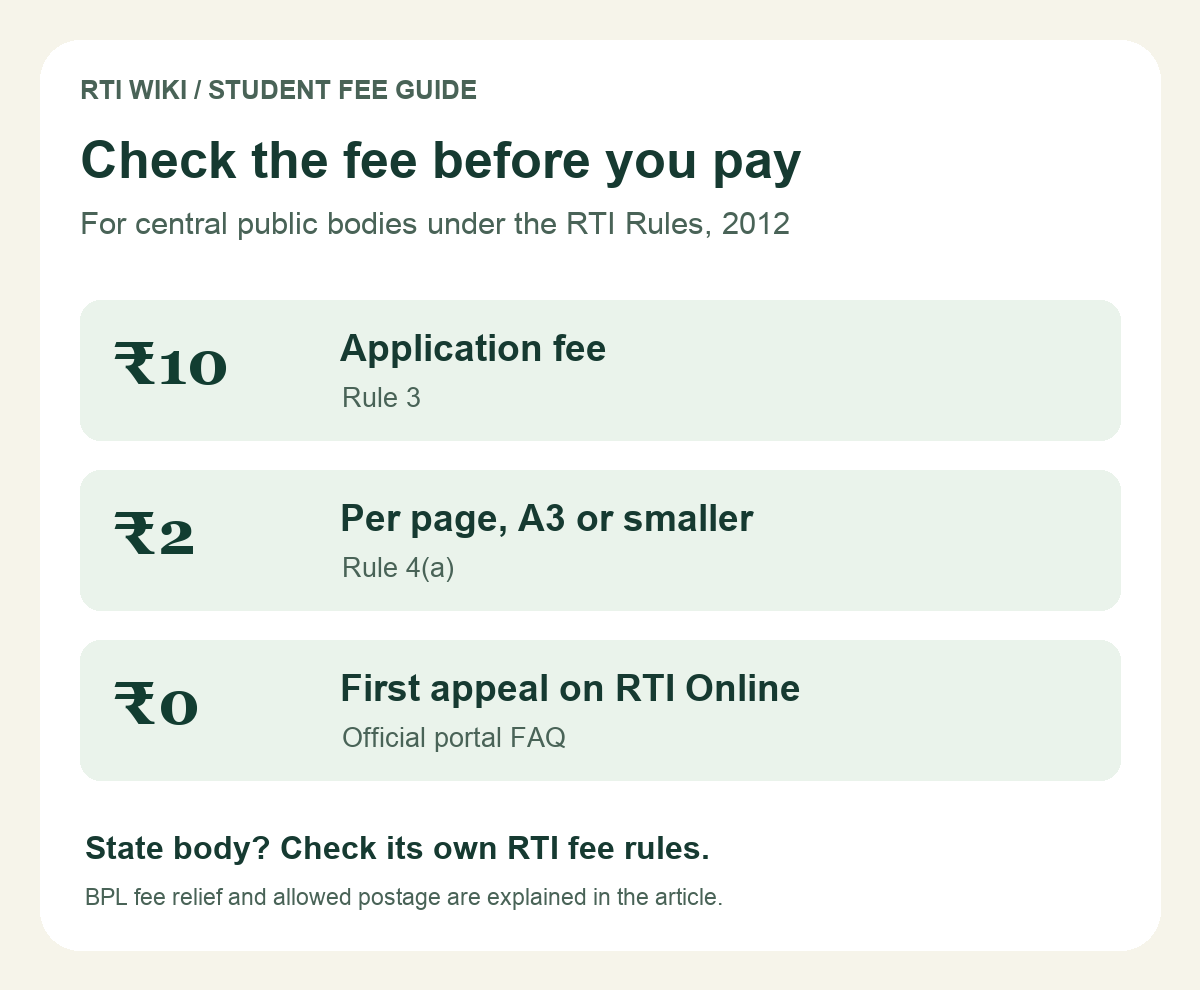
These are the central rates. Do not assume they apply to each state university.
| Item | Central RTI rule |
|---|---|
| Application | ₹10 under Rule 3 |
| Paper copy, A3 or smaller | ₹2 per page under Rule 4(a) |
| Postage | Only the part above ₹50, under Rule 4(g) |
| Applicant below the poverty line | No Rule 3 or Rule 4 fee, with the required government certificate, under Rule 5 |
Source: Right to Information Rules, 2012, page 2. The official RTI Online FAQ also states that its first appeal is free.
A simple cost example: A 20-page A4 copy costs ₹40 in copy charges. With the ₹10 application fee, that is ₹50 before any allowed postage. This is a worked example, not the cost paid in Shakir's case.
For a state body, use state-wise RTI fees and check the linked official rules. A university being in Assam does not, by itself, make the Assam state fee rules apply.
Got a fee notice? Take these four steps
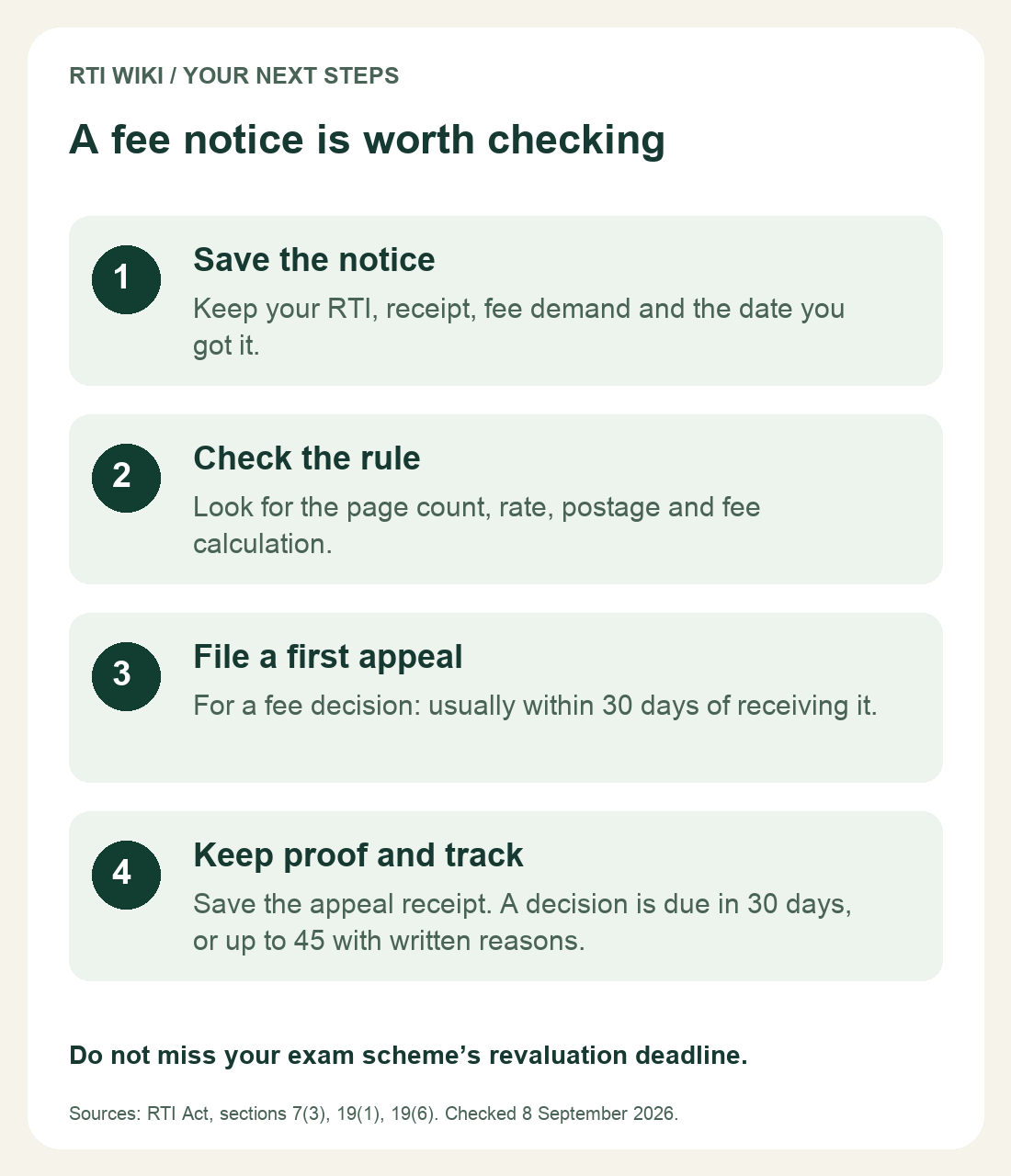
- Save the proof. Keep your RTI, receipt, fee notice and the date you received it. Save the exam name, session, paper code and your roll number in your own file.
- Check the fee calculation. Look for the page count, rate and any postage. Under Section 7(3), a fee notice must give the calculation and explain how to seek a review. The PIO Reply Checker can help you review the reply. PIO means Public Information Officer.
- File a first appeal. Send it to the First Appellate Authority, the senior officer who reviews the PIO's decision. For a fee decision, the usual filing limit is 30 days from receipt under Section 19(1). If you are late, explain the cause and ask the officer to accept it. Do not wait for an informal email reply and miss this limit.
- Keep proof and track the reply. Save the appeal receipt. Section 19(6) gives the officer 30 days, or up to 45 days with written reasons, to decide. Use the RTI Timeline Tracker with your actual dates.
Source for the fee notice and appeal rules: RTI Act, Sections 7(3), 19(1) and 19(6).
If you filed on RTI Online, use Submit First Appeal for that request. The central portal covers the central public bodies listed in its form. A state body needs its own route. Check the official portal FAQ before filing.
Keep this beside you: Download the free fee-check and first-appeal checklist. It has a blank evidence list and a draft you can fill in. The First Appeal Builder is another way to prepare your draft. Check all details before you send it.
Copy this first appeal and fill in your facts
This draft suits a central public body. For a state body, replace the fee-rule line with the correct state rule. Delete any point that does not fit your case. Send the appeal to the authority, not to RTI Wiki.
To: The First Appellate Authority
[Public university or exam body]
[Official address or portal]

Subject: First appeal under Section 19(1), RTI Act, 2005

RTI reference: [number and date]
Fee notice: [date]
Date I received the notice: [date]

I asked under RTI for a copy of my own evaluated answer
sheet for [exam, session, subject, paper code, roll number].
The PIO asked for ₹[amount], citing [rule or notice].
I challenge this fee decision for these reasons:

1. I used the RTI route. Rule 4(a) of the central RTI
Rules, 2012 sets ₹2 per page for A3 or smaller paper.
[For a state body, replace this with its applicable rule.]

2. [Use only if true] The notice does not show how the
fee was calculated, as required by Section 7(3).

3. I rely on Section 22 and ICSI v. Paras Jain,
Civil Appeal 5665/2014, decided on 11 April 2019.
RTI requests must use the applicable RTI fee rules.

Please review the charge, issue a correct fee notice
if a fee is due, and provide the answer-sheet copy.
I am willing to pay the fee lawfully due under RTI.

Attachments: RTI application, filing receipt, fee notice,
proof of receipt, and the rule or judgment relied on.

[Name and contact address]
[Date and signature, if filed on paper]
If the first appeal does not solve it
A second appeal goes to the CIC for a central body, or the State Information Commission for a state body. Under Section 19(3), file within 90 days from when the first appeal decision was due or was received. A late appeal may be accepted for sufficient cause. See the Act, Section 19(3).
For the CIC, if no first appeal order arrives, Rule 10(2)-(3) requires the first appeal route to be used and 45 days to have passed. Do not send a second appeal straight after the fee notice. Read the central appeal rules, pages 2 and 3.
Questions students ask
Can the university charge ₹1,000 if its own rules say so?
For an RTI request, it must apply the relevant RTI fee rules. Its own copy scheme is a separate route. Keep your RTI receipt so you can show which route you used. ICSI v. Paras Jain explains this distinction.
Does every student now get an answer sheet free?
No. The CIC gave free-copy relief in Shakir's case. Other requests follow the applicable rules. Section 7(6) also provides free information when the public body misses the legal time limit. Check the dates before you make that claim.
Does a fee notice stop the 30-day reply clock?
Section 7(3)(a) excludes the time from dispatch of a further-fee notice to payment when counting the reply period. Do not assume every fee demand is valid. If the amount is wrong, challenge it promptly and keep all dates.
Will getting my copy change my marks?
The copy lets you see what was marked. It does not itself change your marks. Check your exam body's rules for rechecking or revaluation. Do not assume an RTI or appeal extends the exam scheme's deadline. Keep that deadline in view.
Can I use this for a private college?
First check who holds the answer sheet and whether it is a public authority under Section 2(h). If a public university holds it, apply to that university. A college's link to a public university does not by itself settle every RTI coverage question.
Is this a new September 2026 decision?
No. The CIC order is dated 6 July 2026. It was reported in September. Use the order date and case number in your appeal. The news date is not the date the Commission decided the case.
Sources and useful next links
Primary sources checked:
- CIC order: Ahmed Shakir v. CPIO, Assam University, 6 July 2026. Full order hosted by LiveLaw.
- Central RTI Rules, 2012. Rules 3, 4, 5, 8 and 10.
- RTI Act, 2005. Sections 2(h), 7(3), 7(6), 19 and 22.
- Supreme Court order in ICSI v. Paras Jain. Civil Appeal 5665/2014, 11 April 2019. Government ISTM copy.
- RTI Online FAQ. Portal scope, fee notice and first appeal route.
Use the guide that fits your next task:
Your next step: Put your RTI receipt and fee notice side by side. Check the rule. If the fee does not fit, fill in the appeal draft and file it on time.