Right to Information Wiki Blog

Quick Reply: RTI Wiki blog — analysis, case-law summaries, and citizen guides on Right to Information Act 2005.
Latest RTI decision notes
- National Statistics Day 2026: How Government Data Affects Your Ration, Pension, Salary, Hospital, School and RTI Rights – citizen guide to administrative data, daily public services, RTI questions and the difference from UN World Statistics Day.
- Right to Be Forgotten: erase old court cases from Google after Delhi HC's 2026 ruling - what the Laksh Vir Singh Yadav judgment (2026:DHC:4891) means, the three remedies (de-indexing, delinking, masking), who is eligible vs barred, and how to apply.
- Gold Rate Today in India: 24K, 22K, 18K Price and Buyer Checklist — SEO-focused gold price guide with current-rate snapshot, city buying checklist, jewellery bill calculation, hallmark checks and a light RTI route for complaint records.
- PAN Aadhaar name mismatch? Fix KYC rejections without running office to office — high-search digital identity repair map covering PAN-Aadhaar, DigiLocker, mutual fund KYC, passport holds, bank onboarding and when RTI can actually help.
- Monday Morning RTI Checklist: Fix Pending Government Work This Week — Monday action plan for pending passport, pension, ration card, FIR, PMAY, electricity, scholarship, mutation and public-service files.
- PMAY status stuck or subsidy delayed? Use RTI after this checklist — high-interest PMAY 2026 guide covering stuck beneficiary status, missing names, delayed instalments, subsidy confusion, grievance steps and record-based RTI drafting.
- BCCI outside RTI: CIC decision in Geeta Rani case explained — legal analysis of CIC/MOYAS/A/2018/123236 after the Madras High Court remand, including Section 2(h), government control, substantial financing, tax concessions and practical RTI routes.
Why Customer Care Never Calls You Back

You call customer care after a failed delivery, wrong bill, refund delay, or broken service. The IVR asks you to press 1, then 2, then 5. A bot says your issue is important. A ticket number comes by SMS. Then nothing happens.
You call again on Saturday. A new agent says the old ticket is closed. You explain everything from the start. They say, “We will get back to you.” Nobody calls.
Quick Reply: If customer care keeps delaying, stop only calling. Start documenting every call, ticket, email, chat, and payment proof. Send one clear escalation email to the company nodal officer or grievance officer. If the issue remains unresolved, use the National Consumer Helpline or the proper regulator for that sector.
If you are short on time, go to what to do in the next 30 minutes.
CIC Refuses Disclosure of the Ashok Lavasa Dissent Note
Quick Reply: In this context, a reference can be made to the decision of the Hon’ble Supreme Court in the matter of Central Board of Secondary Education and Anr. v.
Practice this in 30 seconds. Use our free RTI Assistant — AI-driven drafting, First Appeal, Second Appeal in one place.
In this context, a reference can be made to the decision of the Hon’ble Supreme Court in the matter of Central Board of Secondary Education and Anr. v.
Dated: 24.03.2020
The Appellant vide his RTI application sought information regarding the certified copy of the dissent expressed by Mr Ashok Lavasa (Election Commissioner) over the clean chits given to four speeches of Hon’ble Prime Minister of India and one speech of Mr. Amit Shah in lieu of the complaints received by the ECI during the Lok Sabha Election campaign in 2019.
The CPIO, vide its letter dated 23.07.2019 denied disclosure of information u/s 8 (1) (g) of the RTI Act, 2005. Dissatisfied by the response, the Appellant approached the FAA. The FAA, vide its order dated 06.09.2019 stated that handling MCC violations involved obtaining reports and input from field level officers. Notings prior to taking decision would contain references to reports and comments from field level officers. In similar cases, regarding reports submitted to the Commission by observers on conduct of election, the Commission vide order no CIC/WB/A/000212 dated 15.04.2010 upheld the view that such information would be protected from disclosure u/s 8 (1) (g) of the RTI Act, 2005.
Keeping in view the facts of the case and the submissions made by both the parties and in the light of the aforesaid decisions, no further intervention of the Commission is required in the matter. The Appeal stands disposed accordingly.
The Commission referred to the following:
In this context, a reference can be made to the decision of the Hon’ble Supreme Court in the matter of Central Board of Secondary Education and Anr. v. Aditya Bandopadhyay and Ors (Civil Appeal No. 6454 of 2011) wherein it was held as under:
“28………the information as to the names or particulars of the examiners/coordinators/scrutinisers/head examiners are therefore exempted from disclosure under Section 8 (1)(g) of RTI Act, on the ground that if such information is disclosed, it may endanger their physical safety. Therefore, if the examinees are to be given access to evaluated answer-books either by permitting inspection or by granting certified copies, such access will have to be given only to that part of the answer-book which does not contain any information or signature of the examiners/co-ordinators/scrutinisers/head examiners, exempted from disclosure under Section 8 (1)(g) of RTI Act.”
Last reviewed on: 20 April 2026
~~LINKBACK~~
Blood Group Compatibility: Who Can Donate to Whom
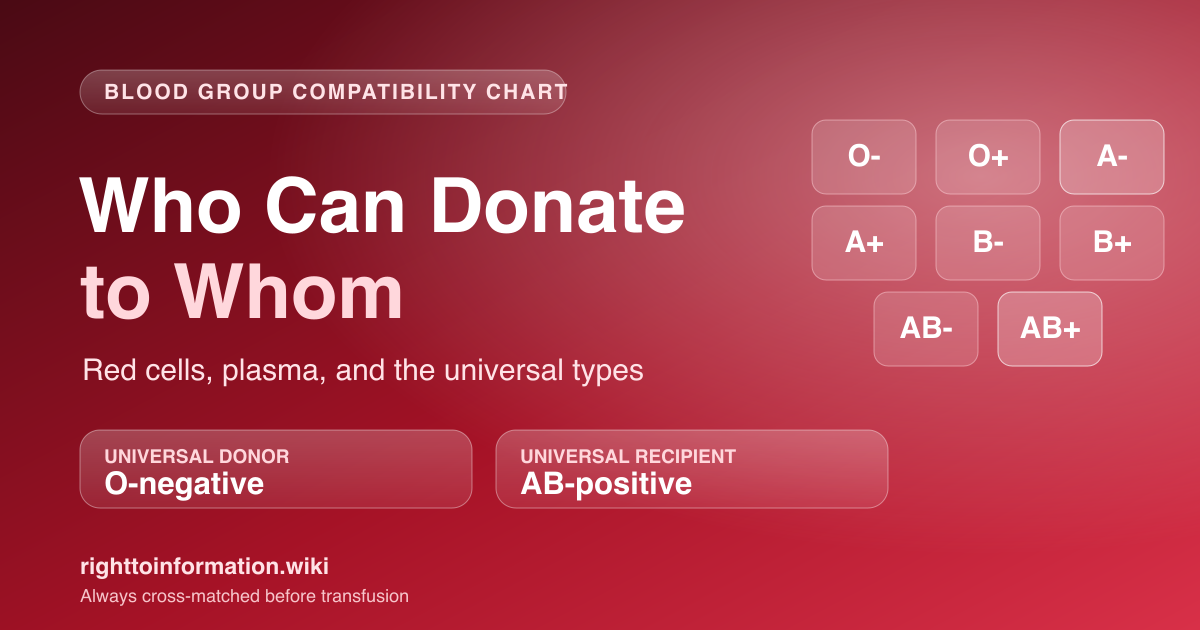
Quick Reply: O-negative is the universal donor and AB-positive the universal recipient. See the full blood group compatibility chart for who gives and receives red cells.
Your blood group decides who you can give blood to and who you can receive it from. The short version: O-negative is the universal donor (its red cells suit every patient), and AB-positive is the universal recipient (it can receive from everyone). The full chart below shows every combination for red cells, the reverse rule for plasma, and why O-negative and AB matter so much in an emergency.