PMAY status stuck: checklist then RTI
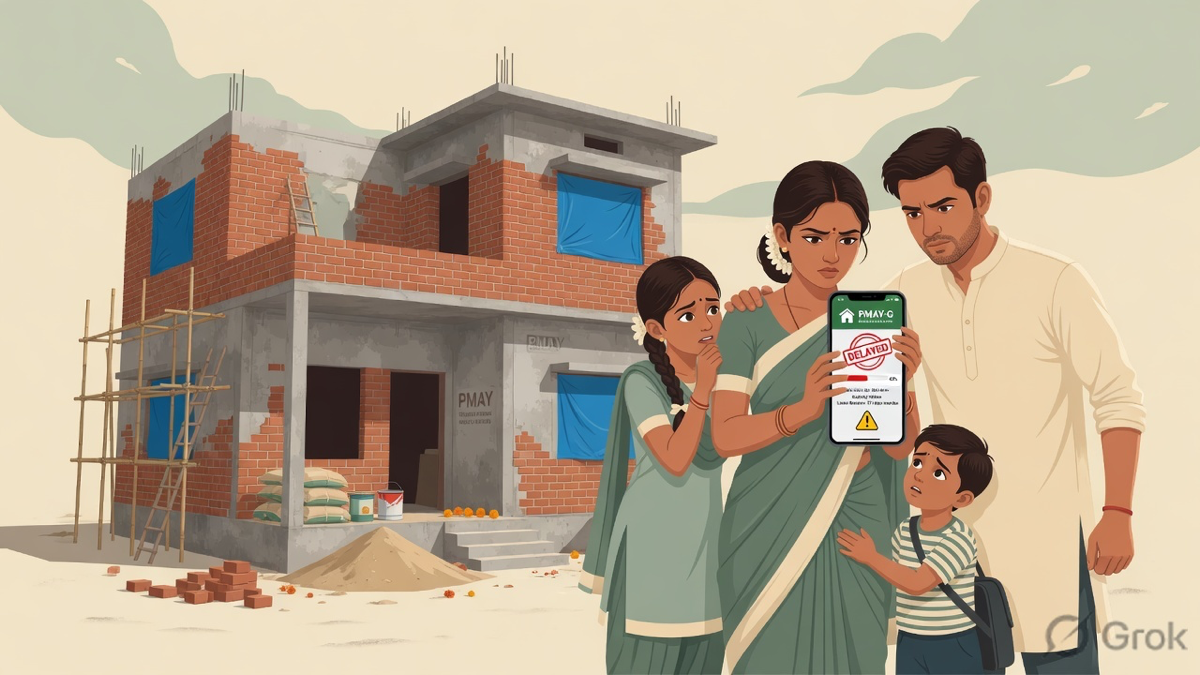
If PMAYMIS or AwaasSoft status is stuck, do not jump to RTI on day one. Save the portal result, write to the ULB or block, then demand the file movement record.
People are not only asking how to apply. They are asking where the instalment, subsidy, or name on the list went. Most PMAY pages tell you where to check status. They do not tell you what to do when the portal is silent. That is where a written grievance, then RTI for records, helps.
PMAY-Gramin and PMAY-Urban do not share a database. Rural names are never on pmaymis.gov.in. Urban 2.0 names are never on AwaasSoft. Pick the scheme first.
PMAY status stuck: checklist before RTI
RTI is powerful, but it is not a complaint portal. It gives you records. A cleaner sequence is:
- Check the official PMAY-G or PMAY-U route and save the page result.
- Note registration number, beneficiary ID, application number, loan account, bank branch, ULB, block, gram panchayat, district and state.
- File a short written grievance with the office that should process the file.
- Wait for a reasonable reply or written status.
- File RTI for records if the status remains unclear, contradictory or silent.
Do not ask, “Why did you not give me a house?” Ask for the file noting, sanction status, instalment release record, inspection report, rejection note, waiting-list position and the officer currently holding the file.
Stuck-status flow
① Save portal status and IDs → ② Confirm PMAY-G vs PMAY-U → ③ Write to ULB, block or bank → ④ File a grievance with the number on record → ⑤ RTI for file movement, sanction, FTO or rejection note
First decide: PMAY-G or PMAY-U?
| If your case is… | You are probably dealing with… | First place to check |
|---|---|---|
| Rural house assistance, village list, instalment, house photo or geotag | PMAY-G / old IAY records | pmayg.dord.gov.in and AwaasSoft beneficiary search |
| Urban EWS/LIG/MIG house, city ULB application, BLC/AHP/ARH/ISS | PMAY-U 2.0 | pmaymis.gov.in and your ULB or lending bank |
| Home loan interest subsidy through a bank | PMAY-U 2.0 Interest Subsidy Scheme | Bank or Primary Lending Institution, and the PMAY-U channel |
| Old IAY beneficiary record | Legacy IAY migrated into PMAY-G systems | PMAY-G / AwaasSoft search |
The old bookmark pmayg.nic.in does not resolve. Use pmayg.dord.gov.in. For rural search, try AwaasSoft beneficiary with the registration number, or the panchayat report on report.pmayg.dord.gov.in.
For PMAY-U 2.0, log in on the PMAY-U 2.0 MIS. Old 2015-22 CLSS or BLC files sit on the earlier pmaymis.gov.in search. CLSS as a live window is closed. Do not assume an old assessment ID moves into 2.0 on its own. Confirm at the ULB.
Subsidy is not guaranteed. Income slabs and credit-linked benefits change. Confirm current eligibility on the official MIS. Do not trust a third-party site that quotes a rupee figure.
PMAYMIS status and PMAY-G AwaasSoft
| What you see | Usual meaning | What to do next |
|---|---|---|
| Registered / surveyed | In Awaas+ or MIS, not yet sanctioned | Ask the panchayat or ULB where the selection file is |
| Sanctioned | Order issued. Wait for first FTO or instalment | Track FTO. Confirm the bank account is seeded |
| FTO / instalment paid | DBT sent | Confirm in the passbook. If missing, ask for the return reason |
| Geo-tag pending | Photo of that construction stage is not uploaded | Ask who is assigned for the site visit |
| Rejected / not eligible | A reason should exist on file | Collect the note. Then RTI if it is missing |
| Name not in list | Wrong panchayat, spelling, or never selected | Check family-member name and old IAY record |
PMAY-G in four clicks
- Registration number on AwaasSoft beneficiary search.
- No number: reports site, Social Audit Reports, beneficiary details for verification.
- Aadhaar path: Stakeholders, IAY/PMAYG Beneficiary, Advanced Search.
- Not sanctioned yet: Awaas+ on pmayg.dord.gov.in/infoapp.html.
PMAY-U 2.0
- New file: applicant login on the 2.0 MIS.
- Old CLSS/BLC: pmaymis.gov.in, Search Beneficiary.
- Bank ISS file: ask the PLI for the claim status in writing, then the ULB.
Five PMAY problems and the RTI record to ask for
| Problem | First non-RTI action | RTI records to request |
|---|---|---|
| Name not found in beneficiary list | Check spelling, panchayat or ULB, family member name and old IAY record | Selection list, waiting-list position, survey reference, exclusion note |
| PMAY-G instalment not received | Check AwaasSoft instalment details and bank account status | Sanction order, FTO or payment order, PFMS/DBT status, bank return reason, officer note |
| PMAY-U subsidy not credited | Ask bank or PLI for written subsidy status | Date of forwarding, eligibility note, pending objection, release or rejection record |
| Geotag or inspection pending | Ask panchayat, block or ULB when the site visit is scheduled | Inspection report, geotag photo status, officer assignment, date-wise action |
| Application rejected or marked ineligible | Collect the rejection message or letter | Copy of rejection order, guideline clause applied, documents relied upon, review route |
PMAY subsidy delay: grievance then RTI
File a written grievance before RTI. Use the ULB housing cell, the block development office, the bank PMAY desk if a loan subsidy is involved, or pgportal.gov.in for a central-ministry grievance. Keep the grievance number.
Common non-RTI blocks, without inventing a rupee cap:
- Bank has not forwarded the subsidy claim
- ULB or block verification is still open
- Aadhaar or bank account is not seeded to the beneficiary name
- Geo-tag of the previous construction stage is missing
- Name, income or land record does not match the survey
There is no single all-India day-count on the portal for “how long after sanction”. Track the FTO on the same record. If the previous geo-tag is missing, the next FTO often waits.
Draft RTI format for PMAY status
Use this only after replacing the bracketed details. Keep it factual.
To,
The Public Information Officer,
[Block Development Office / ULB / Housing Department / public-sector bank]
[Address]

Subject: Request for information under RTI Act regarding PMAY application / beneficiary status

Sir/Madam,

Please provide the following information under the Right to Information Act, 2005:

Applicant / beneficiary name: [Name]
Registration / application / beneficiary ID: [Number]
Village / Ward / ULB / Block / District: [Details]
Scheme: [PMAY-G / PMAY-U 2.0 / ISS / old IAY record]

1. Current status sheet / file status of the above application.
2. Sanction order, approval note, rejection note, or pending-objection note, if any.
3. Date-wise action taken from submission or survey date till today.
4. Name and designation of the office where the file is presently pending.
5. Inspection report, geotag status, house photo upload status, or field verification note.
6. Instalment release order / FTO / payment advice / PFMS transaction status, if any amount was sanctioned.
7. If payment or subsidy was returned, failed or withheld, the record showing the reason and date.
8. Rule, guideline clause or office instruction relied upon for pending or rejecting the file.
9. Appellate or grievance authority for this PMAY matter, as available on record.

I request information in electronic form where available.

Yours faithfully,
[Name]
[Address]
[Mobile/email]
[Date]
File under RTI Act 2005 section 6(1). The PIO has 30 days under section 7(1). If there is no reply or a refusal, file first appeal under section 19(1). Draft with the AI RTI Drafter. Appeal with the First Appeal Builder.
Where to send the RTI
Send RTI to the office that is most likely to hold the record:
- PMAY-G village or block issue: Block Development Office, District Rural Development Agency, Panchayat Raj or Rural Development department, or the state PMAY-G nodal office.
- PMAY-U city issue: ULB or municipality, state urban development or housing department, State Level Nodal Agency, or implementing agency.
- Bank subsidy issue: If it is a public sector bank, file RTI with the bank CPIO for records the bank holds. If it is a private bank, use written grievance first. Ask the public PMAY office for records on the government side.
- Central policy issue: Ministry of Rural Development for PMAY-G, or Ministry of Housing and Urban Affairs for PMAY-U.
If you do not know the exact office, file the first RTI to the district or state PMAY nodal office and ask them to transfer it under section 6(3) to the record-holding public authority. This is slower than choosing the correct office. It is better than a vague RTI to the wrong ministry.
Documents required
- Portal screenshot with date
- Registration, application or beneficiary ID
- Aadhaar last four digits only, if needed to identify the record
- Bank passbook page for the seeded account
- Written grievance number
- Rejection SMS or letter, if any
- Loan account number for ISS files
Do not expose full Aadhaar in the RTI. Use application number, beneficiary ID, registration number and masked Aadhaar only if needed.
Common mistakes
- Searching the urban MIS for a rural name, or AwaasSoft for an urban 2.0 file
- Using the dead pmayg.nic.in bookmark
- Asking RTI “why no house” instead of asking for records
- Filing only with the central ministry for a block-level geotag delay
- Skipping the written grievance, so you have no trail
- Trusting a third-party site that quotes a subsidy rupee figure
- Putting full Aadhaar on a paper RTI
- Waiting for the portal to explain a rejection that exists only in a paper file
Official sources
- RTI Act 2005 sections 6(1), 6(3), 7(1), 19(1)
FAQ
Why is my PMAY subsidy delayed even after sanction?
Sanction is not the same as payment. The next block is often geo-tag, bank seeding, FTO, or a bank claim that was never forwarded. Ask for that record in writing. Then RTI if the office stays silent.
What does pmaymis status mean if it never moves?
The urban MIS can sit on verification, geotag or bank action without a useful sentence. Save the screen. Write to the ULB. If the status is still blank, RTI the file movement and the officer holding it.
What if my PMAY application is rejected?
Collect the rejection message or letter. Then RTI for the rejection order, the guideline clause applied, and the documents relied upon. RTI cannot order a house. It can produce the note you need for grievance or appeal.
Can RTI force PMAY officials to release my instalment?
No. RTI cannot directly order payment. It can obtain the payment record, pending note, rejection reason, FTO or PFMS status and responsible office. Those records support a grievance, appeal, complaint or later legal action.
Should I file RTI with the central ministry for every PMAY problem?
Usually no. Local approval, inspection, beneficiary list and instalment records are often at block, district, ULB, state nodal agency or bank level. Use the central ministry for policy, central release and guideline issues.
Do PMAY-G and PMAY-U use the same portal?
No. Rural: pmayg.dord.gov.in and AwaasSoft. Urban 2.0: pmaymis.gov.in. The two schemes do not share a database.
Is Aadhaar mandatory to mention in RTI?
Do not expose full Aadhaar unnecessarily. Use application number, beneficiary ID, registration number and masked Aadhaar only if needed to identify the record.
Where do I file a PMAY grievance before RTI?
ULB housing cell for urban files, BDO or panchayat for rural files, the bank PMAY desk for a loan-subsidy file, and pgportal.gov.in if you need a central grievance number.
Reviewed for RTI Wiki by Dr. Shrawan Kumar Pathak.