Sell on eNAM: Farmer Guide 2026

Reviewed on 2026-06-20 by Dr. Shrawan Kumar Pathak.
Quick Reply: Think of eNAM as one giant online auction hall that connects mandis across India. Register free as a Farmer on enam.gov.in, get your APMC to approve your KYC, then bring produce to the mandi gate for assaying and online bidding. Payment lands in your bank by RTGS, NEFT or UPI.
Picture a national auction hall, not just your local mandi
For generations a farmer's market was one yard: the buyers who happened to stand there that morning set the price. eNAM, the National Agriculture Market, turns that single yard into a stall inside a country-wide auction hall. The walls between mandis come down, more buyers can bid on your lot, and the price reflects what your crop is actually worth rather than who showed up.
This guide walks you from a fresh registration to money in your bank account, in the order you will actually do it. Everywhere a charge or a limit is set locally, your own APMC and State Agriculture Marketing Board hold the rulebook, so check those for exact figures.
Step 1: Register as a Farmer, free
Registration is the entry ticket to the hall, and the ticket is free. Open the registration page on enam.gov.in and choose registration type Farmer, then pick the APMC mandi you want to trade through.
What you keep ready
- A working email address. Your login details are emailed to you, so a wrong email means no entry.
- Photo identity proof: Aadhaar, PAN or passport, plus a passport-size photograph.
- Bank details: a passbook copy or a cancelled cheque, because this is where your sale money will arrive.
Submit the form and the system emails you a temporary Login ID and password. Treat this like a visitor's pass: it lets you in the door, but you are not yet cleared to trade.
Step 2: Get your APMC to clear your KYC
A visitor's pass becomes a member's badge only when the gatekeeper signs off. Log in with the temporary details, look for the flashing Click here to register with APMC message on your dashboard, and complete the KYC details it asks for.
Your application then travels to the APMC you chose. You can watch its status move through Submitted, In progress, and finally Approved or Rejected. Once approved, eNAM emails you a permanent Farmer Login ID (a code that looks like HR866F00001) and password. That permanent ID is your member's badge for every future trade.
If the status sits unmoved for days, or comes back Rejected, do not start over blindly. See the stuck-or-rejected section below.
Step 3: Bring produce to the gate and let it be graded
On sale day you take your produce to the mandi, just as before, but now each consignment is logged like a numbered lot at an auction house. Staff record your arrival and the system assigns a unique lot ID that follows your produce all the way to payment.
Why assaying matters
Before bidding, a sample is assayed, that is, tested for quality such as moisture, foreign matter or grade. In the old single-yard market, good grain and average grain often fetched a similar rate because nobody measured the difference. Assaying is the auctioneer holding your lot up to the light, so buyers bid a price commensurate with the actual quality of what you grew.
Assaying charges, mandi commission and market fees are set by your State Agriculture Marketing Board and APMC, so they differ from state to state. Ask your mandi office for the exact charges before you sell, and verify the current figures on enam.gov.in or your state board portal.
Step 4: The online auction and getting paid
This is the moment the hall fills with bidders. Buyers registered across the integrated mandi network place competitive online bids on your lot. You see the bids and decide whether to accept the best one. Because more buyers can reach your lot than could ever crowd a single yard, transparent price discovery works in your favour.
Once you accept a bid, payment is made electronically through RTGS, NEFT or BHIM UPI, straight to the bank account you registered. Some states also allow a part of the value as cash at the gate with the balance to your bank, but that partial-payment limit varies by state, so confirm it with your mandi.
Knowing the going rate before you sell helps you judge a bid. You can compare against today's mandi prices and time your sale.
If approval is stuck, rejected, or you get no response
An auction hall has a complaints desk, and so does eNAM. If your APMC approval is delayed, your KYC keeps bouncing, or a payment does not reach your account:
- Fix and re-submit. A blurred ID scan or a mismatched bank name is the commonest reason for rejection. Correct it and submit again.
- Call the helpline. The eNAM portal lists a toll-free number, 1800 270 0224. Confirm the current number on enam.gov.in before you call.
- Escalate on CPGRAMS. File a public-grievance complaint at the central grievance portal pgportal.gov.in against the concerned APMC or department.
- File an RTI. Ask your State Agriculture Marketing Board or the Department of Agriculture in writing why your registration or payment is pending, and by when it will be resolved. An RTI puts a dated, answerable question on the record.
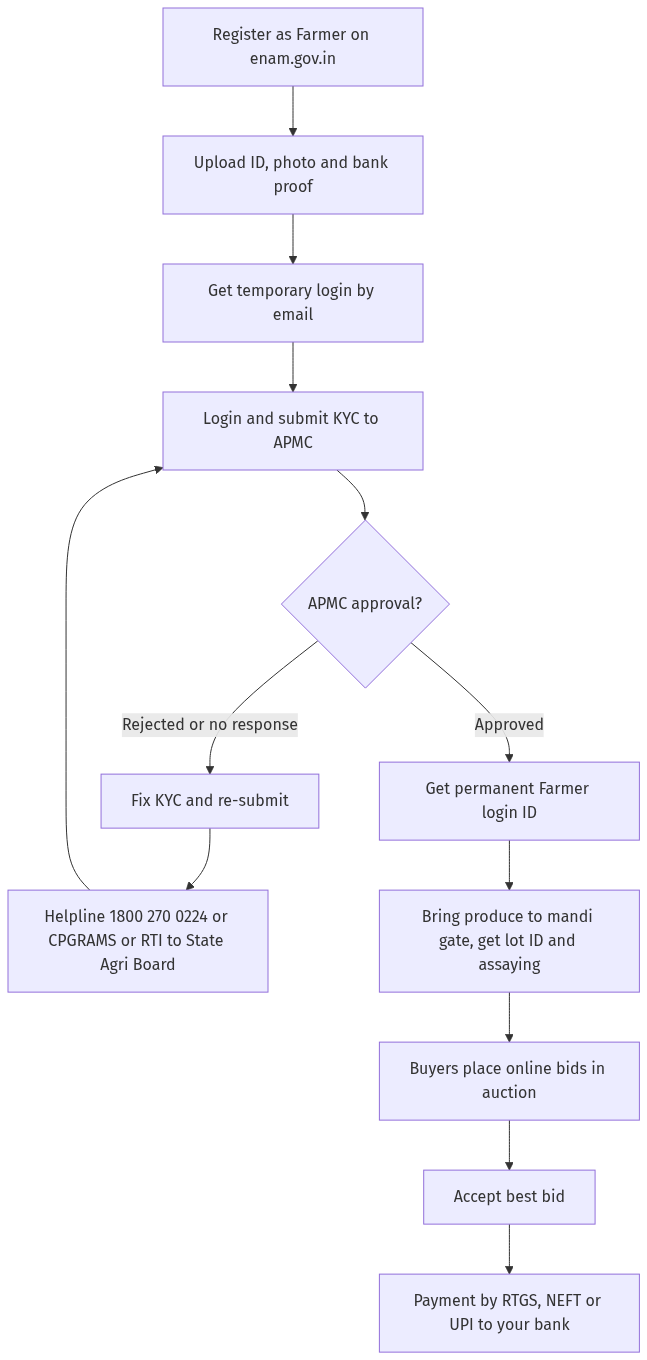
Figure: step-by-step flow. If a step stalls, use the grievance or RTI route shown.
A new eNAM seller often also needs a digital farmer identity and credit. Set up your Farmer ID on Agristack so your land and crop records link cleanly, and if you fund the season on borrowed money, read how crop loan interest subvention lowers your cost. To grade your land before you grow, use your soil health card.
Frequently asked questions
Is there any fee to register as a farmer on eNAM?
No. Registering as a Farmer on eNAM is free. You only deal with the usual mandi charges, such as commission, market fee and assaying, and those are set by your state APMC, not by the eNAM portal.
Do I have to sell only at my own mandi after registering?
That is the whole point of the auction-hall idea. Your produce is listed for buyers across the integrated mandi network, not just the few standing in your local yard, which widens competition for your lot.
How long does APMC approval take?
It depends on the mandi and how quickly your KYC clears. You can track the status as Submitted, In progress, Approved or Rejected on your dashboard. If it stalls, call the eNAM helpline or escalate on the grievance portal.
When and how do I get my sale money?
After you accept a bid, payment is made electronically by RTGS, NEFT or BHIM UPI to the bank account you registered. Some states permit a part-cash payment at the gate, but that limit varies by state, so confirm it locally.
What is assaying and why should I care?
Assaying is a quality test of your produce sample before bidding. It lets buyers offer a price matched to your grade instead of a flat rate, so better-quality crops can earn more. Charges for it vary by state.
My registration was rejected. What now?
Most rejections come from a poor document scan or a bank-name mismatch. Correct the detail and re-submit. If it keeps failing, call the eNAM helpline, escalate on CPGRAMS, or file an RTI with your State Agriculture Marketing Board.
Can a Farmer Producer Organisation register too?
Yes. eNAM has a dedicated module for FPOs, which can trade from their own collection centres declared as deemed markets. The FPO registration asks for organisation and registration-certificate details in addition to the usual KYC.
Sources
Reader signal
Was this article useful?
Tap once if it helped you. These counters show other citizens which pages are worth reading.