Animal Husbandry KCC 2026
RBI Ombudsman as of 1 July 2026: Bank, certain NBFC, prepaid-instrument and credit-information complaints go under the Reserve Bank - Integrated Ombudsman Scheme, 2026, which replaced RB-IOS 2021 from 1 July 2026. First complain to the entity. If there is no reply in 30 days (or the longer NPCI/card-network window, if it applies) or you reject the reply, file free at cms.rbi.org.in within 90 days. The Ombudsman can award up to Rs 30 lakh for consequential loss and up to Rs 3 lakh for time, expenses and harassment. Complaints received before 1 July 2026 stay under the 2021 scheme. Source: RBI FAQ, updated 1 July 2026 and the RB-IOS 2026 FAQ PDF dated 1 July 2026.

Reviewed on 2026-06-20 by Dr. Shrawan Kumar Pathak.
Quick Reply: If you keep dairy cattle, poultry, goats or run a fish or aqua unit, you can get a Kisan Credit Card for working capital. Apply at your bank, the Kisan Rin Portal (fasalrin.gov.in) or Jan Samarth. Loans up to Rs 2 lakh need no collateral, and timely repayment brings the rate down to roughly 4 percent.
The Kisan Credit Card, or KCC, started as a crop-loan card. Since 2018-19 it also covers your animals and your fish pond. This guide is built as a set of simple “if this, then that” rules so you can see exactly where you stand before you walk into a bank.
If you raise animals or fish, then KCC is for you
KCC for animal husbandry and fisheries is a working-capital loan. It pays for the running costs of your unit: feed, fodder, medicines, chicks, fingerlings, labour and small repairs. It is not meant for buying land or building a large shed.
If you do any of these, then you are eligible
You can apply if you are engaged in dairy, poultry, sheep or goat rearing, piggery, inland or marine fisheries, or aquaculture. The card is open to:
- owner-farmers, on their own or jointly
- tenant farmers, sharecroppers and oral lessees
- Self-Help Groups (SHGs) and Joint Liability Groups (JLGs)
So if you do not own land but rent a pond or rear someone else's cattle on a share basis, you are still inside the scheme. If you are already a PM-KISAN beneficiary, the form is even shorter.
If you wonder how much you can borrow, then look at the scale of finance
You do not pick the loan amount yourself. The District Level Technical Committee (DLTC) fixes a “scale of finance” for each activity, usually per animal or per unit. Your bank multiplies that rate by your herd size or pond area to set your limit. So ten milch cows or a one-acre fish pond each carry a standard per-unit figure that the district has already approved.
If your loan is small, then you skip the collateral
This is the rule most people get wrong, so read it carefully.
If your KCC is up to Rs 2 lakh, then no collateral is needed
The collateral-free limit was raised from Rs 1.60 lakh to Rs 2 lakh per borrower with effect from 1 January 2025. Below this line, the bank cannot ask you to mortgage land or pledge gold. Verify the current figure on rbi.org.in before you sign.
If your KCC is above Rs 2 lakh, then the bank may ask for security
Once your limit crosses Rs 2 lakh, the bank can take a charge on your land or other security. If you only run a small backyard unit, you will rarely cross this line, so most animal-husbandry borrowers stay fully collateral-free.
If you repay on time, then your interest drops to about 4 percent
Under the Modified Interest Subvention Scheme (MISS), short-term loans carry a concessional rate of 7 percent a year. The government pays the bank a 1.5 percent subvention, and if you repay on time you get a further 3 percent Prompt Repayment Incentive. That brings your effective cost down to roughly 4 percent. Note the ceiling: the overall MISS limit per farmer is Rs 3 lakh, but crop loans take priority within it, and for a borrower whose KCC is exclusively for animal husbandry or fisheries the subvention and prompt-repayment benefit apply only up to Rs 2 lakh. Verify the current limits on rbi.org.in.
If you want the full step-by-step of how this 7 to 4 percent maths works, read our companion guide on crop loan and interest subvention. The same rate mechanism applies to your dairy or fisheries KCC, but remember the subvented amount for an allied-activity-only borrower is capped at Rs 2 lakh, not the full crop-loan ceiling.
If you heard about a Rs 5 lakh limit, then check what is actually live
The Union Budget 2025-26, presented on 1 February 2025, announced raising the MISS loan limit from Rs 3 lakh to Rs 5 lakh. As things stand in 2026, that higher ceiling has been announced but not yet made operational, so the subsidised rate still applies up to Rs 3 lakh. Do not assume the Rs 5 lakh cushion until your bank confirms it is in force. Verify the current ceiling on rbi.org.in or with your branch.
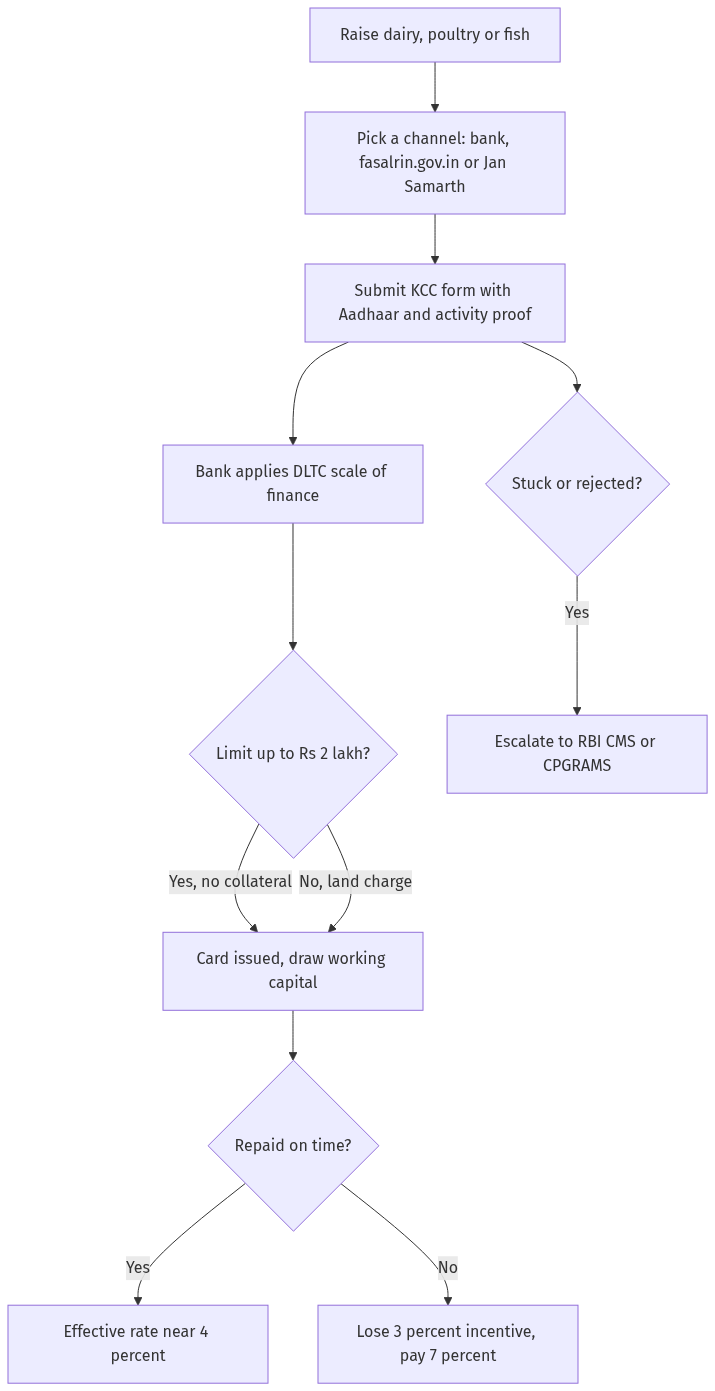
Figure: step-by-step flow. If a step stalls, use the grievance or RTI route shown.
If you are ready, then here is how to apply
Step 1: Pick a channel
You can start at any of these:
- your nearest bank branch (the simplest route for a first card)
- the Kisan Rin Portal at fasalrin.gov.in
- the Jan Samarth Portal at jansamarth.in
- your State or UT Fisheries or Animal Husbandry department
- the PM-KISAN portal at pmkisan.gov.in if you already get PM-KISAN money
Step 2: Keep your papers ready
Carry your Aadhaar and PAN, a passport photo, proof of your activity such as a dairy society membership, a fisheries or aquaculture licence or a poultry record, and proof that you cultivate or lease the land or pond. Knowing your herd or pond size in advance helps the bank fix your limit quickly.
Step 3: Submit and track
Fill the single-page KCC form, attach your documents and submit. Note the application or reference number. The bank verifies your details, applies the district scale of finance and issues your card and limit. Keeping a Farmer ID helps your records stay linked, which our guide on Farmer ID and the Agristack registry explains.
Step 4: Use it like a revolving limit
Your KCC works like an overdraft. Draw what you need for feed or fingerlings, repay within the cycle, and the limit refreshes. Pair it with your soil health card if you also grow fodder, so input costs stay low.
If your application is stuck or rejected, then escalate
If the bank sits on your file, refuses a collateral-free card below the limit, or rejects you without a written reason, do not give up. First, ask for the rejection in writing from the branch manager. Next, lodge a complaint with the bank's grievance cell. If there is still no fair response within a reasonable period, raise it with the Banking Ombudsman through the RBI complaint portal (cms.rbi.org.in). For scheme or department lapses, file on CPGRAMS (pgportal.gov.in) against the Department of Animal Husbandry and Dairying or your State department.
Frequently asked questions
Can I get a KCC if I only keep goats or poultry in my backyard?
Yes. The card covers dairy, poultry, goats, sheep, piggery and fisheries. A small backyard unit usually needs a limit well under Rs 2 lakh, so you stay collateral-free. The district scale of finance decides the exact amount per animal or per unit.
Do I need to own land to get an animal husbandry KCC?
No. Tenant farmers, sharecroppers, oral lessees and members of Self-Help Groups or Joint Liability Groups can all apply. You show proof of the activity, such as a dairy society or fisheries record, rather than a land title.
Is the loan really collateral-free?
For a KCC up to Rs 2 lakh per borrower, yes, the bank cannot demand land or gold as security. That limit was raised from Rs 1.60 lakh with effect from 1 January 2025. Above Rs 2 lakh, the bank may take a charge on your land. Verify the current figure on rbi.org.in.
What interest will I actually pay?
The headline rate is 7 percent under MISS. With the government subvention and a 3 percent prompt-repayment incentive for paying on time, your effective cost falls to roughly 4 percent. The overall MISS limit per farmer is Rs 3 lakh with crop loans taking priority, but if your KCC is exclusively for animal husbandry or fisheries the subvention applies only up to Rs 2 lakh. Miss the repayment dates and you lose the incentive.
Is the Rs 5 lakh KCC limit available now?
It was announced in Budget 2025-26 but, as of 2026, it has not yet been made operational. The subsidised interest still applies up to Rs 3 lakh. Confirm the live ceiling with your bank or on rbi.org.in before you plan around the higher figure.
Where can I apply online?
Use the Kisan Rin Portal at fasalrin.gov.in or the Jan Samarth Portal at jansamarth.in. PM-KISAN beneficiaries can use the short KCC form on pmkisan.gov.in. You can also walk into any bank branch that offers KCC for allied activities.
What if the bank refuses without a reason?
Ask for the refusal in writing, complain to the bank's grievance cell, then escalate to the Banking Ombudsman on cms.rbi.org.in. For scheme-level issues, file a grievance on CPGRAMS at pgportal.gov.in against the relevant department.
Sources
Animal Husbandry KCC (Kisan Credit Card): How to apply and check status?
The Animal Husbandry Kisan Credit Card (KCC) provides credit for livestock farmers. Here is the complete guide:
- Step 1: What is Animal Husbandry KCC? An extension of the Kisan Credit Card scheme for farmers engaged in animal husbandry (dairy, poultry, sheep, goat, piggery, etc.). It provides working capital for feed, medicines, and livestock maintenance.
- Step 2: Eligibility. (a) individual farmers, self-help groups (SHGs), joint liability groups (JLGs), (b) must own or lease livestock (cattle, buffalo, poultry, sheep, goats, pigs, etc.), © no land ownership required (unlike regular KCC), (d) the farmer must be engaged in animal husbandry as a primary or secondary activity.
- Step 3: Credit limit. (a) the credit limit is based on the number of animals: typically Rs 40,000-60,000 per milch animal, Rs 5,000-10,000 per poultry bird, (b) for sheep/goat: Rs 500-1,000 per animal, © the limit includes: recurring expenses (feed, medicines, vaccination) + investment component (purchase of animals, infrastructure), (d) the limit is sanctioned for 5 years, reviewed annually.
- Step 4: Interest subvention. (a) interest rate: 7% per annum (subsidized), (b) interest subvention of 1.5% — effective rate 5.5%, © incentive of Rs 10,000 for prompt repayment — effective rate as low as 4% (varies by scheme year), (d) the subvention is available for loans up to Rs 3 lakh.
- Step 5: How to apply. (a) visit the nearest bank branch (commercial bank, RRB, cooperative bank), (b) submit: KCC application form, land records (if available), livestock details (number, type, breed), identity proof (Aadhaar, PAN), bank account details, © the bank sanctions the KCC within 30 days, (d) the KCC card is issued for withdrawing from ATM/branch.
- Step 6: Check status. (a) check with the bank branch where applied, (b) some banks offer online tracking on their portal, © file RTI with the bank / NABARD asking for the status.
- Step 7: File RTI. File RTI with the Department of Animal Husbandry / NABARD asking for: (a) the number of Animal Husbandry KCC issued, (b) the total credit disbursed, © the number of applications pending, (d) the status of your application.
See KCC Status and PM Kisan Samman.
Reader signal
Was this article useful?
Tap once if it helped you. These counters show other citizens which pages are worth reading.