India’s Cultural Heritage Mapping: What the Data Shows and What India Must Do Next
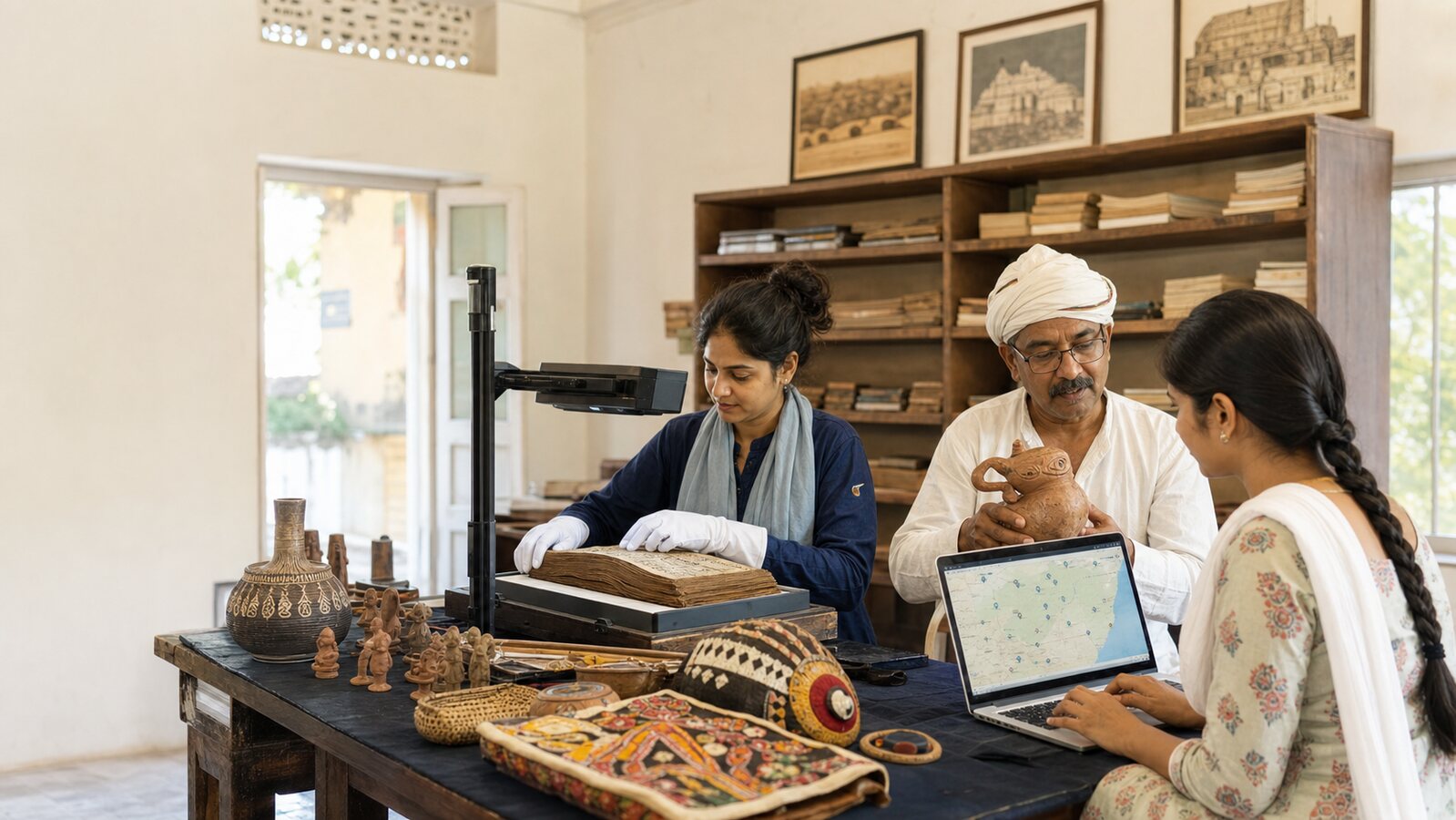
India has begun one of the world’s largest exercises in cultural documentation: manuscripts, village traditions, local artists, oral histories, festivals, craft clusters and endangered knowledge systems. The question now is not whether India has enough heritage. The question is whether India can organise it, protect it, verify it and turn it into living opportunity.
India’s cultural heritage is not a museum category. It is a living system: manuscripts in private collections, temple records, village songs, textile practices, folk theatre, local festivals, oral genealogies, regional dialects, ritual objects, craft families, performance lineages and community memory.
For decades, much of this survived because families, gurus, village communities, libraries, mutts, temples, local historians and artists carried it forward without much institutional support. The national effort now is to bring this scattered wealth into a mapped, searchable and usable public framework.
That is a major shift. It can become a turning point if handled well. It can also become just another database if the next steps are not taken seriously.
The scale is historic
India is dealing with cultural material at a scale few countries face.
The manuscript universe alone is estimated in crores of folios and nearly one crore manuscript titles. A large part of this material is scattered across public institutions, private homes, traditional repositories and regional collections. Many records are fragile, uncatalogued or known only to local custodians.
On the cultural mapping side, the ambition is even wider: to document the cultural profile of more than six lakh villages. This includes art forms, artists, festivals, food traditions, local stories, historical places, dress, ornaments, customs, beliefs and living practices.
This kind of exercise is not only about preservation. It is about national self-knowledge.
If done properly, India will know:
- where its manuscript wealth lies;
- which villages carry which traditions;
- which art forms are thriving and which are disappearing;
- where artisan clusters need support;
- where cultural tourism can be responsibly developed;
- which languages and oral traditions need emergency documentation;
- how cultural work contributes to livelihoods and the economy.
That is the real promise of cultural mapping.
The first challenge: data quality
A national cultural database is only as good as its verification.
Village culture cannot be captured like a census form. A local tradition may have several names. A craft may be seasonal. A ritual may be known only to a caste group, tribe, women’s collective, temple committee or elder. A dialect may not be written. A folk performance may be active only during a festival. A village may have heritage that is not visible to an outside data collector.
This means the first generation of data will naturally have gaps.
Possible problems include:
- generic entries copied from district descriptions;
- wrong or repeated images;
- missing local names;
- under-reporting of women artists and informal practitioners;
- over-reporting of famous art forms while smaller traditions disappear;
- weak verification at village level;
- no clear way for communities to correct errors.
The solution is not to abandon large-scale mapping. The solution is to treat mapping as a living process, not a one-time upload.
India needs cultural data that can be corrected, enriched, audited and locally owned.
Panchayats should become cultural data custodians
The most practical unit for cultural verification is not Delhi. It is the gram panchayat.
Every village profile should be placed before the local community for correction. Panchayat officials, school teachers, local artists, elders, self-help groups, youth volunteers and district cultural officers should be able to validate and update entries.
A strong model would include:
- a village cultural register maintained at panchayat level;
- an annual gram sabha review of the village heritage profile;
- local-language correction forms;
- photo and video evidence for key entries;
- district-level cultural nodal officers;
- public change logs showing what was updated and when;
- a simple appeal/correction mechanism when a community says its heritage has been wrongly represented.
This will make the database more trustworthy. It will also give communities a sense of ownership.
Manuscript digitisation must move from storage to access
Digitising manuscripts is essential, but digitisation alone is not enough.
A manuscript scanned and stored in a closed repository is safer than before, but it is not yet alive for scholars, students, translators, publishers, researchers or the public. India needs a clear access framework that balances preservation, private ownership, copyright, community sensitivity and scholarly use.
The next phase should focus on:
- a national digital manuscript library with clear search tools;
- owner-consent models for privately held manuscripts;
- revenue-sharing where commercial use is permitted;
- free or low-cost access for research and education;
- high-quality metadata in Indian languages;
- AI-assisted transcription where technically possible;
- training of young scholars in scripts, cataloguing and conservation;
- regional manuscript centres that can work with local custodians.
India should not merely scan manuscripts. It should create a manuscript knowledge ecosystem.
The artisan question: preservation without income will fail
The biggest mistake in cultural policy is to treat artists only as carriers of tradition.
Artists are workers. Artisans are entrepreneurs. Performers need bookings. Craft families need buyers. Young learners need a reason to continue. If a tradition cannot support dignity and income, the next generation will leave it.
So the cultural mapping project must connect to a cultural economy project.
That means:
- verified artist profiles;
- direct payment systems;
- fair revenue-sharing on digital platforms;
- buyer-seller meets;
- craft trails and cultural tourism circuits;
- design support without destroying authenticity;
- export training for artisan groups;
- access to e-commerce;
- public galleries that sell, not only display;
- yearly income tracking for supported artists.
The goal should be simple: every mapped art form should have a preservation plan, and every active artist should have a market access pathway.
Tourism must be careful, local and respectful
Cultural tourism can bring income, but it can also flatten living traditions into performances for outsiders.
India should build heritage circuits around communities, not over them. A village craft trail should benefit local artisans. A festival calendar should not disturb the ritual meaning of the festival. A homestay programme should be community-led. A museum or interpretation centre should credit the people whose knowledge is being displayed.
The best model is not mass tourism everywhere. It is layered tourism:
- national-level circuits for major heritage clusters;
- district-level trails for crafts, food, festivals and local history;
- small guided experiences for sensitive traditions;
- school and university heritage visits;
- digital tourism for fragile sites or private collections;
- strict consent rules for recording and commercial use.
Culture should create livelihood without becoming spectacle.
Endangered languages and traditions need emergency response
Some heritage cannot wait for a five-year scheme cycle.
If a language has only a few speakers left, if one family holds a dying craft technique, if an oral epic survives only in a small region, or if a ritual specialist is the last practitioner, the response must be immediate.
India should create a Heritage Emergency Response mechanism.
Its job should be to:
- identify critically endangered languages, dialects, art forms and oral traditions;
- send trained documentation teams quickly;
- record audio, video, vocabulary, process, context and community history;
- train local youth to continue documentation;
- archive material safely;
- return copies to the community;
- create revival plans where revival is possible.
This is cultural triage. Without it, the most fragile traditions may vanish while larger databases are still being cleaned.
A national cultural data stack
India should think of cultural heritage as a data stack with five layers.
- Discovery: identify manuscripts, artists, art forms, rituals, sites, languages and village traditions.
- Verification: validate through communities, panchayats, experts and district institutions.
- Access: make appropriate material searchable and usable through public platforms.
- Livelihood: connect artists and custodians to markets, grants, tourism, galleries and digital revenue.
- Protection: preserve sensitive knowledge, respect consent, share benefits and prevent misappropriation.
Without all five layers, the system remains incomplete.
A database without verification is unreliable. A digital archive without access is invisible. A cultural listing without income is tokenism. Promotion without consent can become exploitation. Preservation without community benefit is not sustainable.
What India should do next
India now needs a clear national roadmap for cultural heritage. The roadmap should be practical, measurable and public-facing.
The core actions should be:
- complete village cultural profiles, but treat them as living records;
- make panchayats and districts responsible for annual verification;
- create a public dashboard showing data status, verification status and gaps;
- build a national digital manuscript library with clear access rules;
- use AI carefully for transcription, translation, duplicate detection and metadata enrichment;
- publish district-wise lists of endangered traditions requiring urgent support;
- link mapped artists to real income opportunities;
- create a national artisan market access programme;
- integrate culture with tourism, textiles, MSME, education, rural development and digital platforms;
- develop cultural satellite accounts to measure the contribution of arts and heritage to GDP and employment;
- ensure communities receive credit, copies, consent rights and benefit-sharing.
The ambition should not be limited to preservation. India should aim to become the world’s most serious cultural knowledge economy.
The larger picture
India’s cultural heritage is not a soft subject. It is knowledge infrastructure.
It can support research, publishing, language revival, education, tourism, creative industries, artisan livelihoods, local pride, district economies and international cultural influence.
But this will happen only if the country moves from scattered schemes to an integrated mission:
- preservation plus access;
- documentation plus verification;
- tradition plus livelihood;
- technology plus community consent;
- national scale plus local ownership.
India has the raw cultural depth. It now needs institutional depth.
The next decade should not be remembered only for how much India scanned, uploaded or mapped. It should be remembered for how many traditions were revived, how many artisans earned better incomes, how many manuscripts became accessible, how many languages were documented in time, and how many villages saw their own culture recorded with dignity.
That is the grand task: not just saving heritage, but making it live.
Last reviewed on: 23 May 2026.
Reader signal
Was this article useful?
Tap once if it helped you. These counters show other citizens which pages are worth reading.
