Table of Contents
Kisan Credit Card (KCC): crop loan up to Rs 3 lakh at about 4 percent, explained for a farm family (2026)
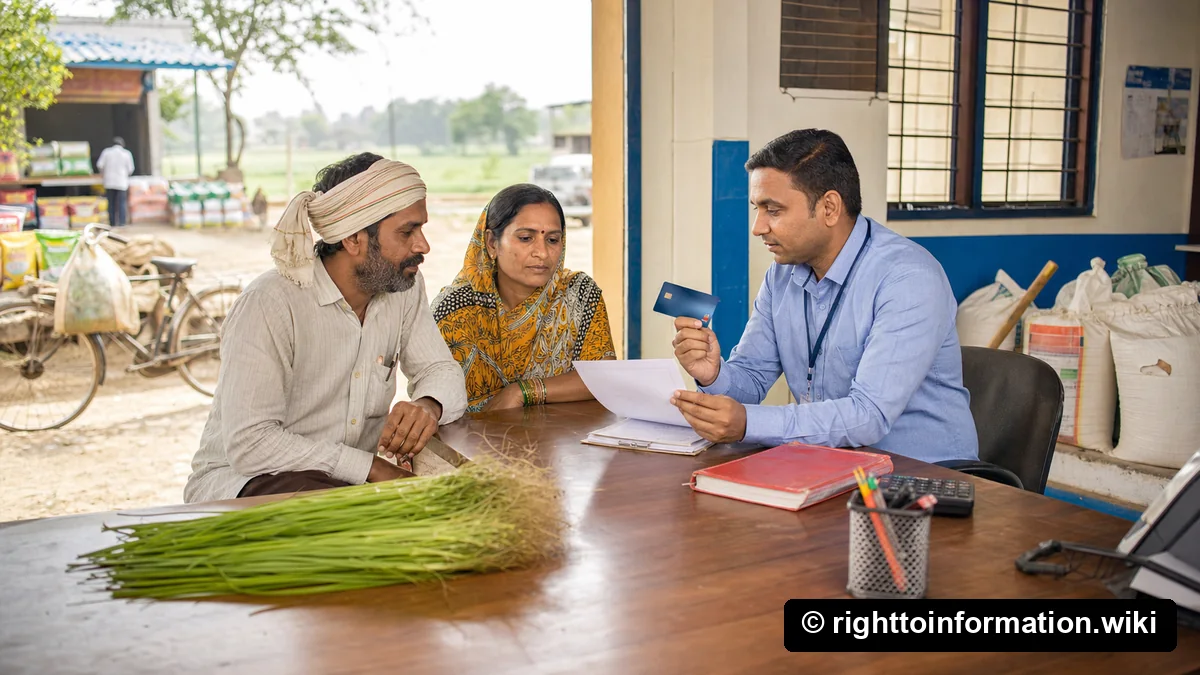
Quick Reply: Kisan Credit Card gives crop loans up to Rs 3 lakh at about 4 percent after prompt repayment, covers animal husbandry and fishery. Apply, eligibility, RTI help.
Start with one official number. The government has told Parliament that operative Kisan Credit Cards now carry more than Rs 10 lakh crore of farm credit, and that close to 7.72 crore farmers hold a live card. That is not a small pilot. It is one of the largest crop-credit systems anywhere, and it exists so that a farmer does not have to walk to a moneylender the week before sowing.
Now bring that number down to one household. Picture a family that farms three acres in a small village. Every June, before the kharif sowing, they need money for seed, fertiliser, diesel and a little labour. The shortfall is around Rs 60,000. Without a card, that gap used to be filled by a local lender charging 3 to 5 percent a month, which quietly ate the whole season's profit. With a Kisan Credit Card, the same family draws the Rs 60,000 from its own sanctioned limit, pays about 4 percent for the year if it repays on time, and keeps the harvest income for the home. The Kisan Credit Card is built to close exactly that gap, and this guide explains how a family gets one and what to do when a bank drags its feet.
The Kisan Credit Card gives short-term crop credit at a concessional 7 percent, which falls to about 4 percent when you repay on time. Loans up to Rs 2 lakh are collateral free. Animal husbandry and fishery are covered too.
Scheme began: 1998 · Administered by: NABARD with all banks under the Ministry of Agriculture and Farmers Welfare
What the card gives you
The Kisan Credit Card is a running credit limit for farming, not a one-time loan. Once a bank sanctions your limit, you can draw and repay through the season like an overdraft, and you pay interest only on what you use.
- Concessional interest of 7 percent. Under the Modified Interest Subvention Scheme the government pays part of the interest to the bank, so short-term crop credit through a KCC is priced at 7 percent a year for the farmer.
- About 4 percent if you repay on time. On top of the 7 percent rate, a farmer who repays promptly gets a Prompt Repayment Incentive of 3 percent. That brings the effective cost down to around 4 percent a year. Miss the repayment window and you lose this incentive, so timely repayment is the single most valuable habit with a KCC.
- Collateral free up to Rs 2 lakh. The Reserve Bank raised the collateral free and margin free farm loan limit from Rs 1.6 lakh to Rs 2 lakh per borrower with effect from 1 January 2025. Up to that limit the bank cannot demand security beyond the crop itself.
- Allied activities are included. The card is no longer only for crops. Working capital for animal husbandry, dairy, poultry, beekeeping and fisheries is covered, so a family that keeps buffaloes or runs a small fish pond can use the same card.
- A RuPay KCC card in hand. Most banks issue a RuPay KCC debit card so you can withdraw at an ATM or pay at a point of sale, instead of visiting the branch for every drawal.
A word on the higher ceiling you may have read about. In the Union Budget for 2025 to 2026, the government announced raising the loan limit that carries interest subvention from Rs 3 lakh to Rs 5 lakh for KCC borrowers. The rollout of that higher subvented ceiling has been phased, so before you plan around a Rs 5 lakh subsidised loan, confirm the current limit for your season with your own bank or on the official portal. The safe, confirmed figure to work with today is subvention on crop credit up to Rs 3 lakh, with the allied-activity interest benefit applying up to Rs 2 lakh within that.
Who is eligible
The card is meant for anyone whose livelihood is the land or allied farm activity, not only for those who own big holdings.
- Owner cultivators. Any farmer, on his or her own or jointly, who cultivates land can apply.
- Tenant farmers, oral lessees and sharecroppers. You do not need to own the land. A tenant or sharecropper is eligible, and the local revenue official or the bank can record the cultivation arrangement.
- Self help groups and joint liability groups. Groups of farmers, including tenant farmers, can take a KCC as a group.
- Allied activity farmers. Those engaged in animal husbandry, dairy, poultry, beekeeping or fisheries can get a KCC for working capital in that activity.
You will normally need an Aadhaar, a bank account and a record of the land you cultivate or the activity you run. There is no upper income bar that blocks a genuine cultivator, and small and marginal farmers are the core group the scheme is designed for.
How to apply, step by step
- Pick your bank. Any commercial bank, regional rural bank or cooperative bank can issue a KCC. If you already have a savings account somewhere, that branch is the easiest place to start.
- Fill the KCC application. Banks use a common one-page form. You can also begin the process online on the PM Kisan portal, which links to the KCC application.
- Attach your land and identity papers. Give the land record, your Aadhaar and a passport photo. For a tenancy or sharecropping arrangement, carry the document or the revenue certificate that shows you cultivate the land.
- Let the bank fix your limit. The bank works out your credit limit from the scale of finance for your crops set by the district committee, multiplied by your cropped area, and adds an allowance for allied needs.
- Collect your card and passbook. Once sanctioned, you get the KCC account and, in most cases, a RuPay KCC card to draw money.
- Draw, use and repay in the cycle. Use the limit for inputs through the season and repay before the due date to hold on to the 4 percent effective rate.
Documents you need
| Document | Why it is needed |
|---|---|
| Aadhaar | Identity and to link the account |
| Land record such as khasra, khatauni or the 7 by 12 extract | To prove you cultivate the land |
| Tenancy or sharecropping proof if you do not own the land | So a tenant farmer can still qualify |
| Bank account details | The KCC runs through a bank account |
| Passport size photograph | For the card and the file |
If you farm as a tenant and the paperwork is thin, ask the village revenue officer for a cultivation certificate. Many rejected KCC files fail on this one point and clear once the tenancy is recorded.
Interest, repayment and keeping the low rate
The 4 percent effective rate is not automatic. It is a reward for repaying on time, so it helps to understand how it is built.
The bank lends at 7 percent because the government meets part of the cost through interest subvention paid to the bank. The farmer then earns a further 3 percent Prompt Repayment Incentive by clearing the dues within the period the bank allows, which is usually up to twelve months for a crop loan or by the due date the bank sets. Repay in that window and your real cost is about 4 percent. Slip past it and the rate reverts to the full card rate and you also lose the incentive for that cycle. For a Rs 1 lakh drawal, the difference between 4 percent and the higher rate is thousands of rupees a year, so a farmer who plans repayment around the harvest sale protects real money.
A before and after picture
Before the card, the family that farms three acres borrowed its Rs 60,000 sowing money from a village lender. At roughly 4 percent a month, the interest alone could cross Rs 20,000 over the season, and one weak harvest could roll the debt into the next year. The pressure to sell the crop the day it was ready, at whatever price, was constant.
After the card, the same Rs 60,000 comes from the family's own sanctioned KCC limit. If they repay after selling the harvest, the yearly interest at about 4 percent is close to Rs 2,400 rather than tens of thousands. Because the drawal sits inside a running limit, they can dip in again for the next season without a fresh loan application. The card does not raise the harvest, but it changes who keeps the profit from it.
Common problems and how to fix them
- The bank sits on your file. A KCC application should be decided in a set number of days. If it is stuck well past that, ask in writing for the status, then use the RTI route below through the lead bank of your district.
- The sanctioned limit looks too low. The limit follows the official scale of finance for your crops and your cropped area. If it seems low, ask the branch to show the working, and correct the crop pattern or area on record.
- The bank asks for security below Rs 2 lakh. For a farm loan up to Rs 2 lakh the collateral free rule applies. Point the branch to the current Reserve Bank limit and escalate to the lead district manager if it persists.
- You lost the 4 percent rate. The prompt repayment incentive applies only within the repayment window. If you repaid on time but were still charged the higher rate, ask the bank in writing to correct the interest and refund the difference.
- A tenant farmer is refused for want of land papers. Get the revenue officer to certify your cultivation, or apply as part of a joint liability group of tenant farmers.
Benefit delayed or refused? File an RTI
When a branch will not move your file or explain a refusal, a short Right to Information request to the public authority, such as the lead bank of your district or the agriculture department, often gets a written answer within the statutory time. Ask plainly for the status of your application, the officer handling it and the reason for any delay. Draft it in minutes with the AI RTI Drafter, and if you need the full filing and appeal steps, follow The RTI Playbook.
Where this scheme came from
The Kisan Credit Card began in 1998 as a way to give farmers timely and low-cost crop credit in place of the moneylender. The Union government led by Prime Minister Narendra Modi has since widened it to cover animal husbandry and fisheries, brought it under the interest subvention and prompt repayment structure that gives the 4 percent effective rate, and raised the collateral free limit to Rs 2 lakh. You can see it next to every other central and state welfare scheme on the All Modi-era Sarkari Yojana index 2014 to 2026.
Frequently asked questions
Can a tenant farmer or sharecropper get a KCC?
Yes. You do not need to own the land. A tenant, oral lessee or sharecropper is eligible, and the revenue official or the bank can record the cultivation arrangement so the file goes through.
What is the real interest rate on a KCC?
Short-term crop credit is priced at a concessional 7 percent. If you repay on time you earn a 3 percent prompt repayment incentive, so the effective rate is about 4 percent a year. Miss the repayment window and you pay the higher card rate.
Is a KCC loan collateral free?
Farm loans up to Rs 2 lakh per borrower are collateral free and margin free after the Reserve Bank raised the limit from Rs 1.6 lakh with effect from 1 January 2025. Above that, the bank may take security.
Does the card cover animal husbandry and fisheries?
Yes. Working capital for animal husbandry, dairy, poultry, beekeeping and fisheries is covered by the KCC, with the interest benefit for allied activities applying up to Rs 2 lakh.
Is the loan limit now Rs 5 lakh?
The 2025 to 2026 Budget announced raising the subvented loan limit from Rs 3 lakh to Rs 5 lakh, and the rollout has been phased. Confirm the current limit for your season with your bank or the official portal before you plan around it.
How long is a KCC valid?
A KCC is normally valid for five years and is reviewed each year. As long as you use and repay it properly, the limit continues and can rise with your cropping needs.
Summary and next step
Bottom line: The Kisan Credit Card gives running crop credit at a concessional 7 percent, about 4 percent when you repay on time, collateral free up to Rs 2 lakh, and it covers animal husbandry and fishery. Apply at any bank branch or through the PM Kisan portal. If a bank delays or refuses without reason, an RTI usually clears it.
- Apply through a bank or the portal: pmkisan.gov.in
- If delayed, draft an RTI: AI RTI Drafter
- All government schemes: Sarkari Yojana index
Related schemes
Sources
- Ministry of Agriculture and Farmers Welfare and PIB, operative KCC credit and farmer numbers: pib.gov.in
- Reserve Bank of India, collateral free farm loan limit raised to Rs 2 lakh from 1 January 2025: rbi.org.in
- PIB, Modified Interest Subvention Scheme for 2025 to 2026, 7 percent rate with 3 percent prompt repayment incentive: pib.gov.in
- PM Kisan portal, KCC application: pmkisan.gov.in
Last reviewed: 1 July 2026.