Table of Contents
Khata and Patta Transfer 2026

Reviewed on 2026-06-20 by Dr. Shrawan Kumar Pathak.
Quick Reply: Khata and patta are the names some states give to the land or tax record you must update after buying or inheriting property. If your state says khata, use the state revenue or municipal portal; if it says patta, use the state land records portal. Updating the record does not by itself make you the owner.
Start here: which word does your state use?
The same task has different names across India, and the name tells you which office and which portal to use. Match your state first, then follow the matching branch below.
If your state says khata
You are in Karnataka or a neighbouring system. For a flat or house inside a city, khata is a municipal record tied to property tax, and you transfer it through the urban body. For Bengaluru this now runs through the e-Aasthi or e-Khata system at bbmpeaasthi.karnataka.gov.in, which has been the required route for city transactions since late 2024. For farm or village land, the equivalent record is the RTC, updated through the Bhoomi system at landrecords.karnataka.gov.in or your Village Accountant.
If your state says patta
You are in Tamil Nadu, Andhra Pradesh or Telangana. Patta is the land record naming the holder. In Tamil Nadu you apply for patta transfer through eservices.tn.gov.in, and you can file at any Common Service Centre. The Tahsildar or revenue officer checks your registered deed and passes the change.
If your state says something else
In Maharashtra the rural record is the 7/12 extract and the urban one is the Property Card, both reachable through the Mahabhumi land records portal. In Punjab, Haryana and much of north India the same step is called intkal or dakhil kharij, handled by the revenue Patwari. The principle is identical everywhere: you are changing whose name sits against the property in a government register.
The one rule that protects you
Read this before you spend a rupee on the transfer. The Supreme Court has repeatedly held that a mutation entry, whether khata or patta, does not by itself create or extinguish ownership. The record exists so the right person pays the tax and revenue. Your title comes from the registered sale deed, gift deed, Will or court decree, not from the khata or patta line. So if a seller waves only an old khata at you, that is not proof of clean title. Treat the transfer as the finishing step after a proper registered transfer, never as a substitute for one. For the difference between a deed that transfers title and one that only promises to, see our note on sale deed versus agreement to sell.
Now branch by how you got the property
If you bought it
Register the sale deed at the Sub-Registrar first, then apply for the khata or patta transfer. Carry the registered sale deed, the encumbrance certificate, the latest tax receipts and the previous owner's khata or patta copy. In several states the registration system and the record system are now linked, so the transfer may be triggered or pre-filled when you register. Pay your stamp duty and registration charges correctly, because the transfer office often checks the value you declared.
If you inherited it without a Will
You cannot simply ask for your name on the record. Get a legal heir certificate or succession certificate that lists every heir, then apply for a joint transfer in the names of all heirs unless they have legally given up their share. Skipping a co-heir creates a defect that can freeze a future sale.
If you got it by gift or under a Will
Register the gift deed, or get the Will probated where your state requires it. If any other relative disputes the gift or the Will, the office will usually wait. The court has been clear: where title is contested, a civil court must crystallise the rights first, and only then can the revenue or municipal officer make the entry. If you are an heir facing a contest, our guide on ancestral property partition explains that route.
Fees and timelines: verify your own state
There is no single national fee, and you should not trust a random figure online. As a pattern, urban khata transfer is often charged as a small percentage of the guidance value or stamp duty with a minimum amount, plus small fees for the application and the new certificate. Rural patta or RTC changes are usually a nominal application fee. Timelines also vary: many states aim to complete a clean file in a few weeks, and some set an outer limit. Apply soon after registration, because some states expect it within about ninety days. Always confirm the current fee and the time limit on your own state or local body portal before you pay. While you are on the portal, you can also handle your property tax online, since the updated record feeds the tax bill.
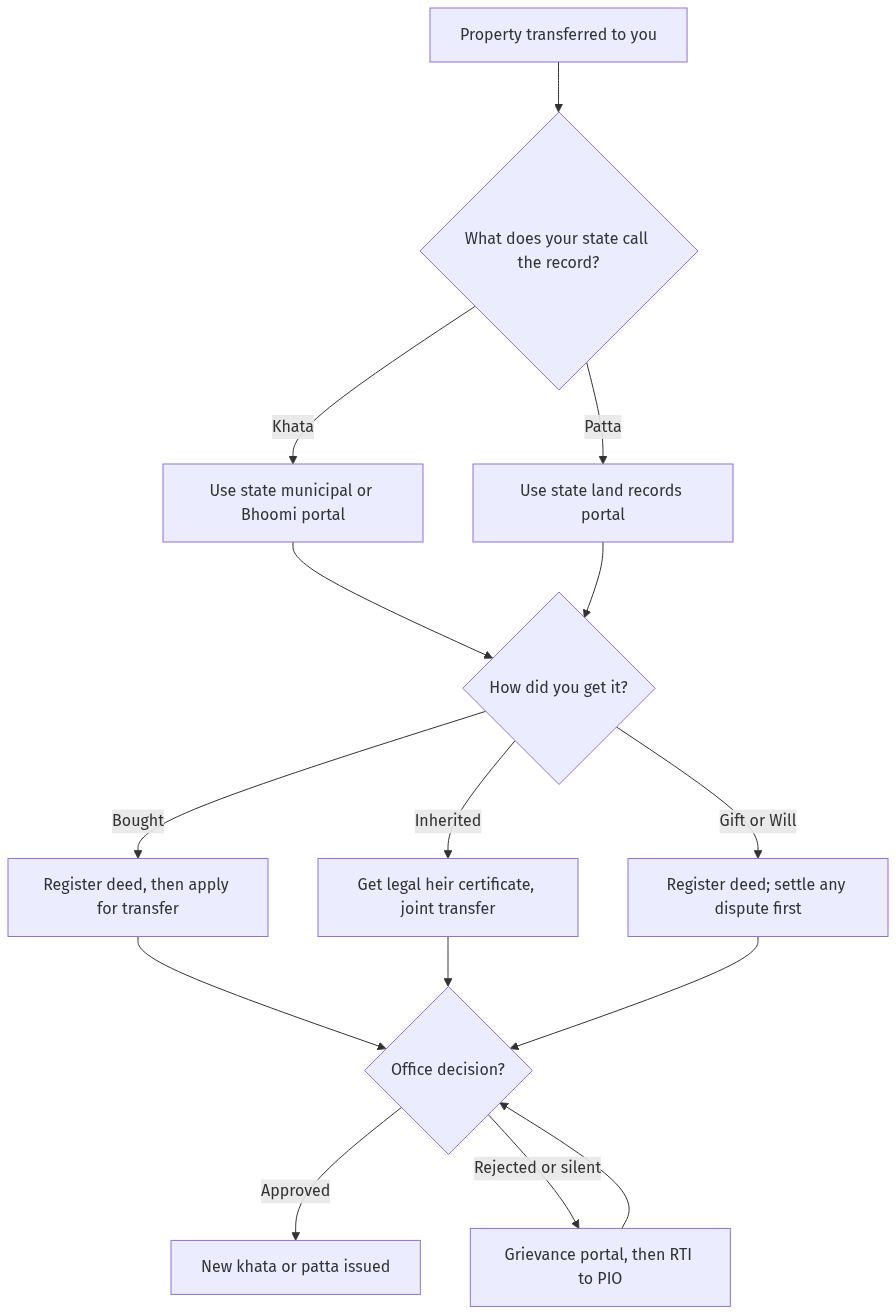
Figure: step-by-step flow. If a step stalls, use the grievance or RTI route shown.
If it is rejected or goes silent
If the office returns your file, read the rejection note. The usual reasons are a mismatch between your deed and the old record, a missing co-heir, unpaid dues on the property, or a dispute marked against it. Fix the named gap and re-file. If the application simply sits past the time your state allows with no decision, escalate through the state public grievance portal or the local body grievance window, quoting your application number. If that still draws no response, file an RTI with the revenue department or municipal Public Information Officer asking for the status of your application and the reason for delay. A dated RTI usually moves a stuck file faster than repeat visits. If the property itself was never properly registered, sort that out first using our guide on a stalled property registration.
Frequently asked questions
Is khata the same as patta?
They do the same job under different names. Khata is the term in Karnataka and is often a municipal tax record, while patta is the term in Tamil Nadu, Andhra Pradesh and Telangana and is a land record. Both identify the holder and let the right person pay tax. Other states use 7/12, property card, intkal or dakhil kharij for the same step.
Does a khata or patta in my name prove I own the property?
No. It only shows who the revenue or municipal office bills for tax. Ownership comes from your registered deed, Will or court decree. The Supreme Court has held that a mutation entry confers no title on its own, so never buy on the strength of a khata or patta alone.
I bought a flat but the seller has no khata. Is that a problem?
It is a red flag in cities where khata is mandatory for transactions, such as Bengaluru, because you may struggle to register, pay tax or get a home loan. Ask why it is missing and insist the record is regularised before you complete the purchase.
How long should khata or patta transfer take?
A clean file is often cleared within a few weeks, though it varies by state and can stretch if documents clash. Check the published time limit on your state portal and start the clock from the day you submitted, not the day you first walked in.
What does khata or patta transfer cost?
There is no fixed all-India fee. Urban khata transfer is commonly a small percentage of the guidance value plus minor charges, while rural patta or RTC changes are nominal. Verify the current figure on your state or local body portal rather than relying on any quoted amount.
Can I transfer the record online?
In many states, yes. Karnataka runs urban khata through the e-Aasthi or e-Khata system and rural records through Bhoomi, and Tamil Nadu offers patta transfer through eservices.tn.gov.in. If your state has no online route, the revenue or municipal office still accepts a paper application.
The office is not responding. What can I do?
Escalate through your state public grievance portal with the application number, then file an RTI with the revenue or municipal Public Information Officer asking for the status and the reason for delay. This creates a record and a deadline they must answer.
Sources
Khata/Patta transfer after property purchase: Complete guide (2026)
- Step 1: What is Khata/Patta transfer and why is it needed? (a) Khata: (i) property record entry with municipal corporation — Karnataka term, (ii) Patta: land revenue record — Tamil Nadu/other states, (iii) transfer needed after property purchase — new owner name in records, (b) why needed: (i) property tax assessment, (ii) municipal services — water, electricity, (iii) resale proof, (iv) loan/mortgage, © authority: municipal corporation + revenue department, (d) law: state municipal laws + revenue codes.
- Step 2: Comparison table — Khata/Patta transfer scenarios. (a) Khata transfer after sale: (i) issue: new owner needs Khata in name, (ii) remedy: apply to municipal corp with sale deed + encumbrance certificate, (iii) timeline: 30-45 days, (iv) fee: 2% of stamp duty value, (v) example: buyer applied; Khata transferred in 30 days, (b) Patta transfer after purchase: (i) issue: new owner needs Patta, (ii) remedy: apply to Tahsildar with sale deed + tax receipts, (iii) timeline: 30-60 days, (iv) fee: nominal, (v) example: applied; Patta transferred in 45 days, © Khata for inherited property: (i) issue: Khata needs transfer to legal heirs, (ii) remedy: apply with death cert + legal heir cert + Will, (iii) timeline: 45-60 days, (iv) fee: nominal, (v) example: heirs applied; Khata transferred in 50 days, (d) Khata transfer rejected: (i) issue: municipal corp rejects, (ii) remedy: appeal to Commissioner + RTI, (iii) timeline: 30 days appeal, (iv) escalation: KAT/court, (v) example: rejected; RTI filed; approved in 15 days, (e) Patta for agricultural land: (i) issue: Patta needs transfer for farmland, (ii) remedy: apply to Tahsildar with sale deed + mutation order, (iii) timeline: 30-60 days, (iv) fee: nominal, (v) example: applied; Patta transferred in 40 days. (Note: Khata/Patta transfer is mandatory after property purchase — apply within 30 days.)
- Step 3: How to transfer Khata/Patta. (a) Step 1: Obtain sale deed + encumbrance certificate + tax receipts, (b) Step 2: Apply to municipal corp (Khata) or Tahsildar (Patta), © Step 3: Submit documents + pay fee, (d) Step 4: Verification by revenue officer, (e) Step 5: Khata/Patta transferred — collect certificate, (f) Step 6: If rejected — appeal + RTI.
- Step 5: Practical tips. (a) apply within 30 days of registration, (b) keep all documents ready — sale deed, EC, tax receipts, © RTI is effective if delayed, (d) check online status — Kaveri (Karnataka), (e) Example: A buyer's Khata transfer was delayed 3 months; filed RTI; transferred in 15 days.
- Step 6: Key provisions. (a) Karnataka Municipal Act: Khata, (b) Tamil Nadu Land Revenue Act: Patta, © State municipal laws, (d) RTI: file with municipal corp/revenue dept, (e) Appeal: Commissioner/Tahsildar.
See Khata Patta Transfer and Home Loan Documents and Ancestral Property and How to File RTI.