Table of Contents
PM Surya Ghar 2026: subsidy, eligibility, status, deadline
PM Surya Ghar: Muft Bijli Yojana runs until 31 March 2027. It pays ₹30,000 per kW for the first 2 kW of rooftop solar and ₹18,000 for the third kW, capped at ₹78,000. The portal was still taking new applications on 15 September 2026, so the real race is to finish installation, inspection and subsidy redemption before the scheme ends.

Short version. Already applied? Log in, find your stage, and chase whoever owns it: you, your vendor or your DISCOM. Make sure the name on your bank account matches your electricity bill exactly, or the subsidy will not be processed. Not applied yet? You still can, but choose a vendor who can install in weeks, not months. Every rule below comes from Ministry of New and Renewable Energy (MNRE) guidelines, 2026 notices and the national portal, checked on 15 September 2026.
Short on time? Go straight to find your stage.
PM Surya Ghar in 50 words
PM Surya Ghar: Muft Bijli Yojana is a central scheme of MNRE, launched on 13 February 2024 with an outlay of ₹75,021 crore. It subsidises rooftop solar for 1 crore homes. The aim is free or low-cost electricity of up to 300 units a month from your own panels, with surplus power going to your DISCOM.
Scheme status on 15 September 2026
| What people ask | What the official portal shows |
|---|---|
| Last date | The scheme closes on 31 March 2027 |
| New applications | Open. The Apply For Rooftop Solar form is live |
| Applications so far | 82,94,833 (as on 14 September 2026) |
| Rooftop systems installed | 47,89,902 (as on 14 September 2026) |
| Households benefitted | 56,97,760 (as on 14 September 2026) |
| Subsidy for 2026-27 | Disbursement has started |
The guidelines cap the scheme at 1 crore active applications, and the portal count is still below that. No notice on the portal says what will happen to applications that are unfinished on 31 March 2027. Do not plan around an extension.
Already applied? Find your stage before 31 March 2027
Log in, open your application and match the stage name with this table. The second column tells you whom to chase.
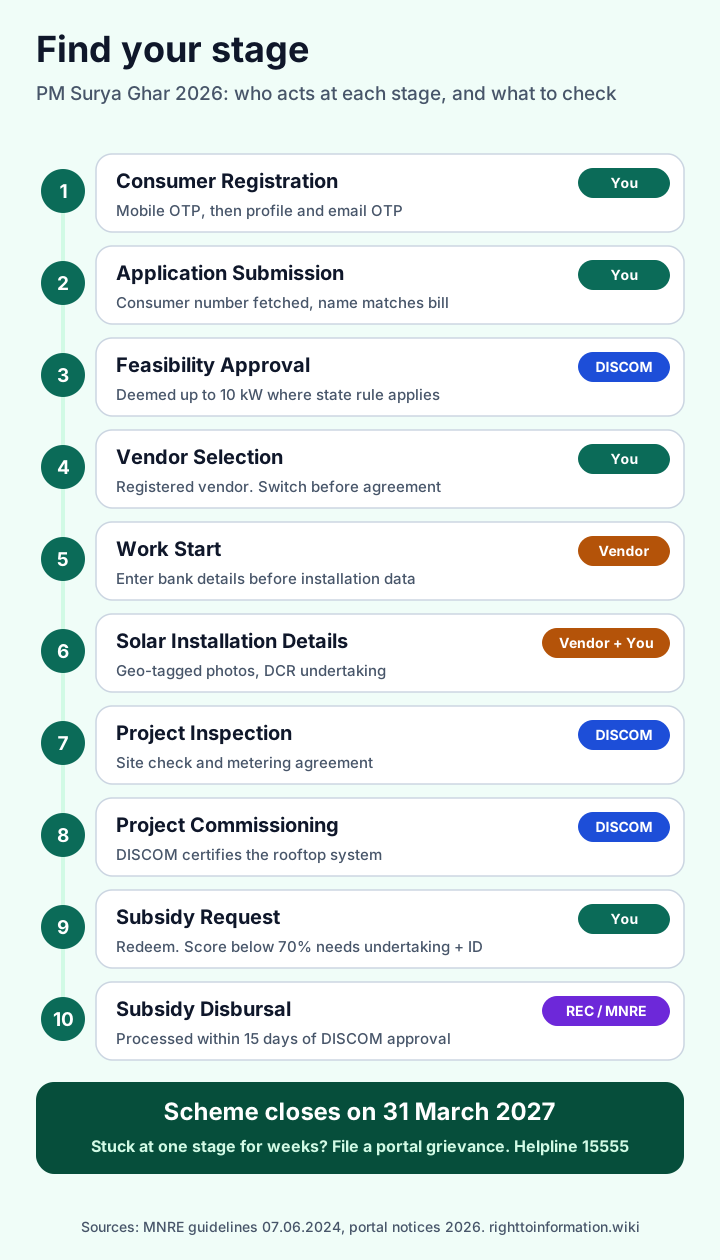
| Stage on the portal | Who acts | What to check in 2026 |
|---|---|---|
| Application Submission | You | Your consumer number was fetched correctly and your name matches the electricity bill. |
| Feasibility Approval | DISCOM | For systems up to 10 kW, feasibility is deemed accepted once your state has put that rule in place. Otherwise the DISCOM approves it. |
| Vendor Selection | You | The vendor is registered on the national portal. You can switch freely until the work agreement is uploaded. |
| Work Start | Vendor | The agreement is uploaded. Enter your bank details now, before installation is submitted. |
| Solar Installation Details | Vendor, then you | Geo-tagged photos and the DCR undertaking are uploaded. The vendor sends the data to you. You check it and submit it to the DISCOM, or send it back. |
| Project Inspection | DISCOM | Physical inspection and the metering agreement. The DISCOM can send the file back for corrections. |
| Project Commissioning | DISCOM | The DISCOM certifies your rooftop system. |
| Subsidy Request | You | Redeem the subsidy in your login. If your confidence score is below 70%, upload the signed undertaking and a name proof. |
| Subsidy Disbursal | REC Limited for MNRE | The subsidy is processed within 15 days of DISCOM approval. Loan cases go to the loan account. |
REC Limited is the national implementing agency that runs the portal. Separately, third-party agencies engaged by REC make random inspections of installed systems. Their field engineers carry inspection permits, and the portal asks consumers to cooperate.
How much subsidy you get in 2026
The central subsidy is called Central Financial Assistance (CFA). It is a fixed amount per kW of solar panels.
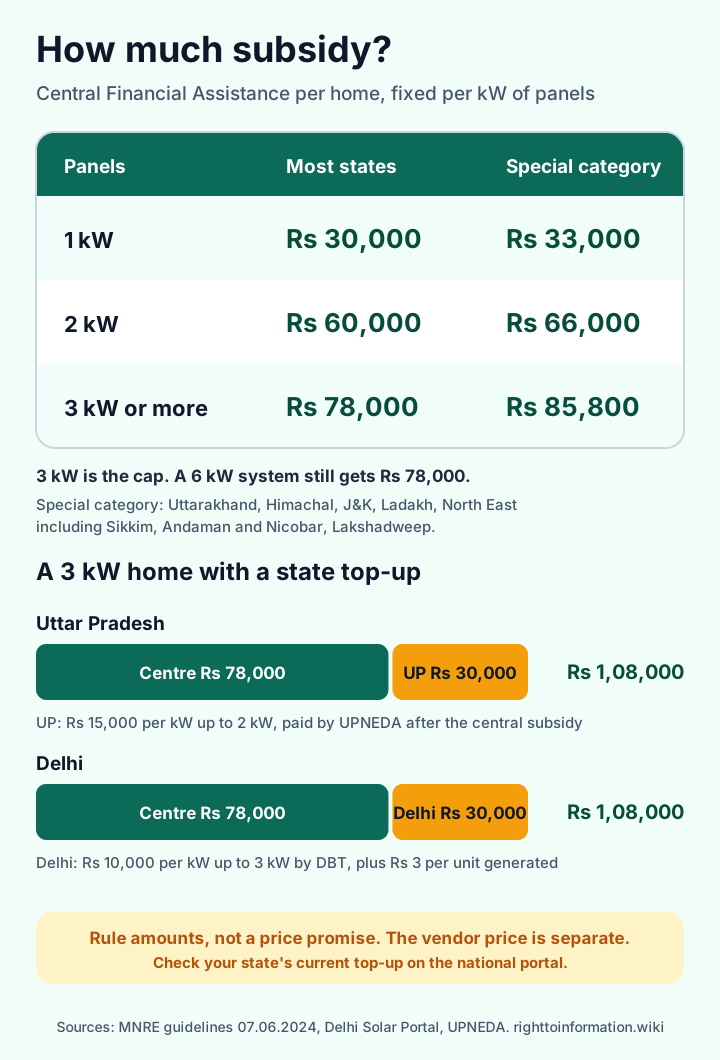
| Panel capacity | Most states | Special category states and UTs |
|---|---|---|
| 1 kW | ₹30,000 | ₹33,000 |
| 2 kW | ₹60,000 | ₹66,000 |
| 3 kW or more | ₹78,000 (cap) | ₹85,800 (cap) |
Special category means Uttarakhand, Himachal Pradesh, Jammu and Kashmir, Ladakh, the North Eastern states including Sikkim, Andaman and Nicobar Islands, and Lakshadweep.
Part kilowatts count too. The guidelines give three examples: 1.5 kW gets ₹45,000, 2.5 kW gets ₹69,000, and 6 kW still gets ₹78,000.
- The subsidy is worked out on the capacity of the solar panels, not on the size of the inverter.
- Batteries and hybrid inverters are allowed, but they do not add to the subsidy.
- Housing societies and RWAs get ₹18,000 per kW for common facilities, up to 500 kW at 3 kW per house. See the RWA and housing society subsidy guide.
Not sure what size to buy? The portal suggests 1 to 2 kW if your home uses up to 150 units a month. For 150 to 300 units it suggests 2 to 3 kW, and above 300 units, more than 3 kW.
State top-ups: Delhi and Uttar Pradesh
States may add their own subsidy on top of the central amount. MNRE's July 2025 amendment says these state subsidies should be updated on the national portal. Two large ones:
| State | Extra state subsidy for homes | How it reaches you |
|---|---|---|
| Delhi | ₹10,000 per kW, up to ₹30,000 for 3 kW, as notified in July 2025. There is also a monthly generation-based incentive of ₹3 per unit for systems up to 3 kW, and ₹2 per unit for systems above 3 kW and up to 10 kW. | By DBT, using the data from your PM Surya Ghar application. |
| Uttar Pradesh | ₹15,000 per kW up to 2 kW, so ₹30,000 at 2 kW or more. | UPNEDA releases it after your central subsidy is paid. |
Delhi's Second Amendment, September 2026. A notice now on the Delhi Solar Portal says the Delhi Government has made a Second Amendment to the Delhi Solar Energy Policy, 2023. According to the notice:
- Delhi's solar subsidy is increased to ₹78,000. This is in addition to the central PM Surya Ghar subsidy of up to ₹78,000.
- Homes whose average use is less than 400 units a month can get a solar plant installed free of cost by the Delhi Government.
- Group housing societies can benefit too.
- The Delhi Government is going to empanel vendors to install plants of up to 3 kW under a Utility-Led Aggregation (ULA) or DISCOM Trusteeship model. A selected vendor will visit your home if you give consent.
What is not settled yet. On 15 September 2026, neither the Delhi Solar Portal nor the website of Delhi's Energy Efficiency and Renewable Energy Management Centre had the notified text. The portal's own state subsidy page still showed the older ₹10,000 per kW rate. The notice does not say when the new terms start, or how they apply to applications already in progress.
If you live in Delhi and have not paid a vendor yet, read the Delhi notice first. Then check solar.delhi.gov.in, whose home page has a Consumer Consent for RTS Installation option.
Worked example: a 3 kW rooftop in Lucknow, Delhi and Shimla
| Home | Central subsidy | State subsidy | Total from government |
|---|---|---|---|
| Lucknow, Uttar Pradesh | ₹78,000 | ₹30,000 | ₹1,08,000 |
| Delhi | ₹78,000 | ₹30,000, plus ₹3 per unit generated | ₹1,08,000, plus the incentive |
| Shimla, Himachal Pradesh | ₹85,800 | Check the portal | ₹85,800 or more |
These are the rule amounts. The price you agree with the vendor is separate, and the subsidy does not rise if the vendor charges more.
The Delhi row uses the ₹30,000 rate still shown on the Delhi Solar Portal's subsidy page. Delhi's September 2026 notice announces ₹78,000, and free installation for homes using less than 400 units a month, so your Delhi figure may be higher. See the Delhi note above.
Who is eligible
- A residential electricity connection. Only residential consumers and RWAs can apply. Commercial, industrial and government connections get no subsidy.
- A consumer number. You apply with the consumer account number printed on your DISCOM bill.
- A grid-connected system. Panels can go on a roof, terrace, balcony or elevated structure, and ground-mounted elevated structures are allowed. Off-grid systems are not.
- A registered vendor. The vendor must be registered on the national portal for your DISCOM area. Under this scheme there is no DISCOM tender or empanelment, and you agree the price with the vendor.
- Made-in-India panels. Solar modules must be made in India from Indian-made cells. This is the Domestic Content Requirement (DCR). Modules must also be on MNRE's Approved List of Models and Manufacturers (ALMM).
- One subsidy per system. If your home already got an MNRE rooftop subsidy, you can claim only the balance up to 3 kW. A system shifted to a new place gets nothing.
- Matching names. The name on your bank account must exactly match the consumer name on your electricity bill.
The guidelines set no income limit.
Renting, or the connection is in someone else's name?
The guidelines do not set out a separate process for tenants. What they do fix is the name. The subsidy follows the consumer name on the electricity bill, and the bank account must match it. In practice, the person named on the bill is the one who can receive the subsidy. If the panels will sit on a roof you do not own, get the owner's written agreement before any work starts.
How to apply on pmsuryaghar.gov.in
Registration is open. These steps match the consumer login page as it stood on 15 September 2026.
- Open the portal. Go to pmsuryaghar.gov.in and choose Apply Now, or open the Login menu and choose Consumer Login.
- Verify your mobile number. Enter it with the captcha, tick the box saying you have read the guidelines, press Verify and enter the SMS OTP.
- Fill your profile. Add your name, state, district and email. Verify the email with an OTP and save.
- Decide who fills the form. A popup asks whether your vendor should fill the application for you. Choose No to do it yourself.
- Apply for Solar Rooftop. Select your state, district and DISCOM. Enter your consumer number, press Fetch Details, then Next, and submit.
- Wait for feasibility. The DISCOM clears it. For systems up to 10 kW, the guidelines treat it as deemed approved wherever your state has put the Electricity (Rights of Consumers) Rules provision in place.
- Choose a registered vendor. Compare vendors on the portal and agree the system, price and payment terms in writing. Registered vendors must maintain and repair the system free for 5 years from commissioning. Check the vendor's bank details shown on the portal before you pay anything.
- Enter your bank details. Do this before installation is submitted, and upload a cancelled cheque or passbook copy. Only these bank documents are mandatory at the application stage.
- Check the installation data. Your vendor uploads geo-tagged photos and the DCR certificate details, then sends the data to you. Check the panel count and capacity, then submit it to the DISCOM or send it back with remarks.
- Inspection, commissioning and redemption. The DISCOM inspects the system, signs the metering agreement and certifies the installation. You redeem the subsidy in your login, and it is processed within 15 days of DISCOM approval.
If you need a loan
Apply from inside your portal login. The portal passes the request to JanSamarth, and the loan is for residential consumers only. The standard product listed on the portal for loans up to ₹2 lakh looks like this:
- Interest linked to the RBI repo rate plus 0.50%. The portal table showed 6.00% a year.
- At least 10% of the project cost from you. No PAN needed.
- CIBIL score of 680 or more, or no credit history at all.
- Up to 120 months, a 6-month moratorium, no processing fee and no prepayment charge.
- The loan money goes to the vendor in two instalments.
Loans above ₹2 lakh go up to ₹6 lakh. For those, PAN is mandatory, your share rises to 20% and you need a net annual income of at least ₹3 lakh.
How to check your PM Surya Ghar status
- Open consumer.pmsuryaghar.gov.in, or use Login and then Consumer Login on the main portal.
- Enter your registered mobile number and the captcha, tick the guidelines box, press Verify and enter the OTP.
- Open your application. Note the stage name and any remark. Take a dated screenshot.
- Match the stage with the stage table above and chase the owner of that stage.
- If nothing moves, use the Grievance option on the portal. You get a tracking ID, and the guidelines say grievances are to be resolved within 30 days. You can also call the helpline on 15555.
If your vendor is the problem, the grievance reaches the vendor through the portal. Under MNRE's procedure of 22 June 2026, the vendor gets 8 days to explain and then a reminder. If there is still no reply, a show-cause notice follows. A vendor that does not answer that notice properly within 15 days can be deactivated for a month.
Why applications get stuck or rejected in 2026
Know the rule behind each one before you act.
- Panels without verifiable DCR. Using non-DCR modules anywhere in the system makes it ineligible for the subsidy. Since 18 December 2024, modules whose DCR cannot be verified on the NISE portal are not accepted. Ask your vendor for the 16-digit DCR certificate number for your panels.
- Panels or cells not on ALMM. Modules must be ALMM-listed. Net-metering systems commissioned on or after 1 June 2026 also need cells from ALMM List-II. Write this into your vendor agreement.
- Name mismatch. If the bank account name does not exactly match the electricity bill, the subsidy application is not processed. Correct the name with your DISCOM or your bank.
- Confidence score below 70%. From 3 September 2026, such applications cannot be redeemed directly. Download the undertaking from the portal, sign it and upload it with a Government ID such as Aadhaar or Voter ID.
- Repeated serial numbers. For applications submitted after 26 May 2026, repeated module or inverter serial numbers can no longer be pushed through on a vendor undertaking. The serial numbers uploaded must be the ones on your roof.
- Panel capacity slightly above what you applied for. In a 25 March 2026 advisory, MNRE asked DISCOMs to allow up to 10% tolerance between the panel capacity applied for and the panels installed. The inverter must still stay within the allowed limit. If your file is returned over a small gap, point the DISCOM to that advisory.
- Missing photos or documents. Geo-tagged photos and the DCR undertaking are mandatory. You do not have to appear in the photos.
- Wrong kind of connection or system. There is no subsidy for commercial connections, off-grid systems, shifted systems or a second claim on the same system.
- A vendor sitting on your file. In August 2026 the portal deactivated 66 vendors for a month for holding more applications than they could install. If installation details are not submitted within 60 days of uploading the agreement, you can switch vendor. This option is for applications without a loan.
- A DISCOM return or rejection. The DISCOM can send a file back for corrections or reject it with reasons. Read the remark word for word before you fix anything.
Why this matters now
- The deadline is fixed. The portal counts down to 31 March 2027. The portal's own August 2026 notice to vendors speaks of less than 9 months remaining in the scheme.
- Unfinished files carry the risk. No notice says what happens to applications still open on the last date. Every stage in the table above takes time, so start chasing now.
- The money comes by DBT. The central subsidy goes to your bank account, or to your loan account if you took the scheme loan.
- Some states add more. Uttar Pradesh adds up to ₹30,000 for a 3 kW home. Delhi's notified rate is also up to ₹30,000, and a September 2026 notice on its solar portal announces ₹78,000, with free installation for homes using less than 400 units a month.
- Your bill. If your monthly bill keeps rising, every unit your panels make is a unit you do not buy from the DISCOM. Surplus units are credited or bought back under the metering rules your state regulator has approved.
Stuck for weeks? Ask MNRE in writing under RTI
Use the portal grievance first. If nothing moves, a Right to Information request makes the office put its reasons on record. MNRE runs the scheme, and REC Limited runs the portal for it. File online at rtionline.gov.in and choose the Ministry of New and Renewable Energy. If the delay is at inspection with a government-owned DISCOM, file with that DISCOM's Public Information Officer under your state's RTI rules.
To
The Central Public Information Officer
Ministry of New and Renewable Energy
Atal Akshay Urja Bhawan, Lodhi Road
New Delhi 110003

Subject: Information under Section 6(1) of the RTI Act, 2005
about my PM Surya Ghar: Muft Bijli Yojana application

Please provide the following information about my application
on the National Portal for PM Surya Ghar: Muft Bijli Yojana.

Application ID: ______________
Electricity consumer number: ______________
DISCOM: ______________

1. The present stage of my application and the date on which
   it reached that stage.
2. Copies of any remarks recorded when my application was
   returned, held or rejected, with dates.
3. If redemption of my subsidy is on hold, the recorded reason,
   including any name-match or confidence score check.
4. The date on which the DISCOM approved my installation, and
   the date on which my subsidy was sent for release.

This information concerns my own application. Please reply
within 30 days as required by Section 7(1). If I receive no
reply, I will file a first appeal under Section 19(1).

I enclose the application fee of Rs 10.

Name:
Address:
Mobile:
Date:
- Draft and personalise this in minutes with the AI RTI Drafter.
- Got a vague reply? Grade it with the PIO Reply Checker, then use the First Appeal Builder.
- For the full RTI process, from fee to second appeal, read The RTI Playbook.
FAQ
Has PM Surya Ghar registration closed in 2026?
No. On 15 September 2026 the consumer login page still showed the Apply For Rooftop Solar form, and the main portal shows the scheme closing on 31 March 2027. The June 2026 notices on the portal deal with vendors, government buildings and ALMM rules, not with closing registrations. The guidelines cap the scheme at 1 crore active applications, and the portal showed 82,94,833 applications on 14 September 2026.
What is the last date for PM Surya Ghar?
31 March 2027, when the scheme's implementation period ends. Aim to finish installation, inspection and subsidy redemption well before that, because no notice yet says what happens to files left incomplete.
What does a confidence score below 70% mean?
Since 3 September 2026, such applications cannot be redeemed directly. The notice does not define the score. It asks for a signed undertaking and a Government of India name proof such as Aadhaar or Voter ID. So check that your name reads the same on your electricity bill, bank account and ID.
Can I change my vendor after uploading the agreement?
Before the agreement is uploaded, yes. After that, you can switch only if the vendor has not submitted installation details within 60 days of the upload, and only for applications without a loan.
Will my subsidy go to my loan account?
Yes, if you took the scheme loan and you redeem on or after 14 August 2026. If JanSamarth does not send your loan details within 15 days of inspection approval, the portal lets you give your savings account details instead.
Do I get 300 units free every month?
Not as a gift. The scheme subsidises the panels, and the electricity comes from your own roof. The PIB release on the Cabinet approval, dated 29 February 2024, says a 3 kW system generates more than 300 units a month on average. Your real output depends on your roof and sunlight.
I applied under the old rooftop solar Phase II programme. What now?
If your Phase II application was already installed, inspected or redeemed, the subsidy claim is admissible if it is received by 30 November 2026. Phase II applications that were submitted but not installed on 1 April 2025 were deleted, and those households can apply again under PM Surya Ghar.
Can I install panels without a DCR certificate?
Only if you choose the Give It Up option and forgo the subsidy. Give It Up net-metering consumers who apply through the national portal are also exempt from the ALMM List-II cell rule until 31 March 2027.
What to do in the next 30 minutes
- Log in and write down your application stage and today's date.
- Compare the name on your electricity bill and your bank passbook, letter by letter.
- If your stage has not moved for weeks, file a grievance and save the tracking ID.
- Ask your vendor for the DCR certificate number and the ALMM model name of your panels.
- Save the helpline 15555. In Uttar Pradesh, also save UPNEDA's 1800 1800 005.
Official links only
- National portal: pmsuryaghar.gov.in. Scheme guidelines (in the Knowledge Centre) and FAQs are under the More menu.
- Consumer login, status and grievance: consumer.pmsuryaghar.gov.in
- Cabinet approval: PIB release, 29 February 2024
- Delhi state subsidy: Delhi Solar Portal and its Second Amendment notice
- Uttar Pradesh: UPNEDA rooftop solar page
- RTI online: rtionline.gov.in
- National helpline: 15555
Sources
- Ministry of New and Renewable Energy, OM No. 318/17/2024-Grid Connected Rooftop dated 7 June 2024, Operational Guidelines for the component CFA to Residential Consumers, paras 2(d), 3, 5, 6, 7, 8©, 11 and 13, and Annexure 3.
- MNRE amendments to those guidelines dated 7 July 2025 and 31 August 2026, and clarifications dated 20 September 2024 and 13 February 2025.
- MNRE advisories and OMs dated 25 March 2026 (capacity tolerance), 30 March 2026 (Give It Up without DCR), 11 May 2026 (repeated serial numbers), 21 May 2026 (ALMM List-II and timely commissioning), 8 June 2026 (ALMM List-II exemption for Give It Up) and 22 June 2026 (vendor complaint procedure).
- National Portal notice to registered vendors dated 24 August 2026.
- National Portal home page, FAQs, consumer application journey, standard loan product, consumer login page and announcements, read on 14 and 15 September 2026.
- Press Information Bureau, release ID 2010133, 29 February 2024.
- Department of Power, Government of NCT of Delhi, Delhi Solar Portal: About Delhi Solar Energy Policy, 2023, read on 15 September 2026.
- Delhi Solar Portal: Overview of Delhi Solar Scheme, the notice on the Second Amendment to the Delhi Solar Energy Policy, 2023, read on 15 September 2026.
- Department of Power, Government of NCT of Delhi, notification dated 10 July 2025, Delhi Solar Energy Policy 2023 (First Amendment), Delhi Gazette Extraordinary, Part IV, No. 200.
- UPNEDA, PM Surya Ghar Urja flyer and How to Avail State Subsidy note.
- Right to Information Act, 2005, sections 6(1), 7(1) and 19(1), and the RTI Rules, 2012.