Table of Contents
PM Vishwakarma: toolkit, stipend and artisan loans 2026
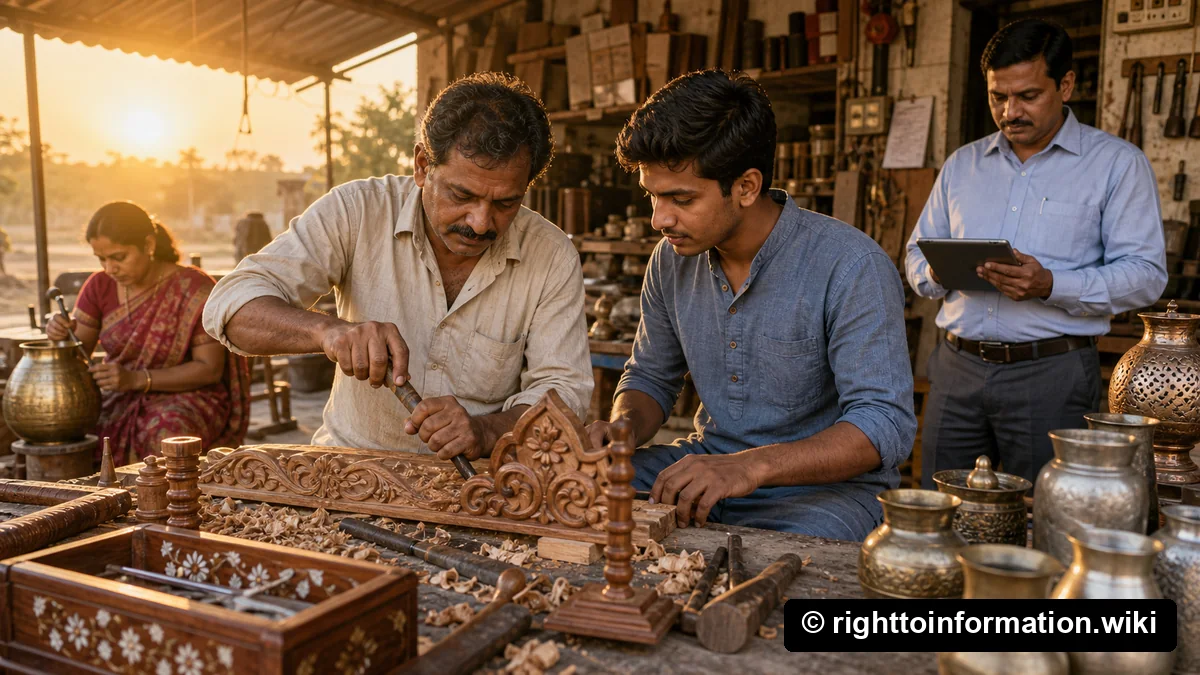
Quick Reply: PM Vishwakarma gives 18 artisan trades a Rs 15,000 toolkit voucher, Rs 500 a day training stipend and collateral-free loans up to Rs 3 lakh at 5 percent.
A free certificate and ID card, a Rs 15,000 toolkit e-voucher, training with a Rs 500 a day stipend, and collateral-free loans of Rs 1 lakh then Rs 2 lakh at 5 percent. For artisans in 18 traditional trades.
Launched: 17 September 2023 · Issued by: Ministry of MSME, Government of India
A village potter wakes before dawn. He digs his own clay, shapes pots on a wheel his grandfather used, and fires them in a mud kiln. He has the skill, the hands, and the orders. What he does not have is a little money to buy a better wheel, or a bank that will lend to him without land papers. For generations, that gap is where so many artisan families stayed stuck. PM Vishwakarma was built to close that gap, and the rest of this guide walks you through it the way you would explain it to a neighbour.
The old way and the new way, side by side
The fastest way to understand this scheme is to look at the same potter twice. Once in the world before the scheme, and once on the scheme route now.
| The artisan's struggle | The old way, before the scheme | The PM Vishwakarma route now |
|---|---|---|
| Proof of skill | No paper to show. A buyer or bank only had his word. | A government certificate and an ID card that name him as a Vishwakarma. |
| Better tools | Saved for years or borrowed from a moneylender to buy one tool. | A Rs 15,000 e-voucher to buy a modern toolkit. |
| Learning new methods | Learned only what the family passed down. No stipend to spare a working day. | Basic and advanced training with a Rs 500 a day stipend so a training day is not a hungry day. |
| Working capital | Lenders asked for land or gold as security. Many got nothing. | A collateral-free loan of Rs 1 lakh, then Rs 2 lakh, at 5 percent. |
| Selling wider | Sold at the local haat at whatever price the trader set. | Help with branding, quality marking, trade fairs and online listing. |
| Going cashless | Cash only, no record, no credit history. | A small incentive for every digital payment he takes. |
Neither column is a promise about one person's income. The point is the route. Before, an artisan carried the whole weight alone. Now there is a marked path with a certificate, a toolkit, training, credit and market help joined together.
What you get in hand
The scheme bundles six kinds of help. Here is what each one means in plain terms.
- Recognition. A PM Vishwakarma certificate and a digital ID card. This is the part many people skip past, but it is the foundation. The card is your official proof that the government recognises you as a skilled artisan, and every other benefit flows from it.
- Skill training. A basic course of 5 to 7 days, which is about 40 hours, on your own trade and on running a small enterprise. If you want to go further, there is advanced training of 15 days or more. You earn a stipend of Rs 500 for each day of training.
- Toolkit incentive. Rs 15,000 as an e-voucher at the start of your basic training. You use it to buy modern tools for your trade. It comes as a voucher, not loose cash, so it has to be spent on the toolkit.
- Credit support. A collateral-free enterprise loan. The first tranche is up to Rs 1 lakh, repayable over 18 months. After you repay that well and meet the conditions, a second tranche of up to Rs 2 lakh follows, repayable over 30 months. The interest you pay is held at 5 percent, with the government covering a subvention of 8 percent on top.
- Digital reward. A small incentive of one rupee for each digital transaction you make or receive, up to 100 transactions a month. It is meant to nudge artisans towards digital payments and build a money trail that helps with future credit.
- Marketing support. A national committee helps with quality certification, branding, putting your craft on e-commerce sites, advertising and a place at trade fairs, so your work reaches buyers beyond your own town.
The two loan tranches, made clear
The credit part confuses people most, so look at it on its own.
| Loan stage | Amount | Repayment tenure | Interest you pay | Security needed |
|---|---|---|---|---|
| First tranche | Up to Rs 1 lakh | 18 months | 5 percent | None, collateral-free |
| Second tranche | Up to Rs 2 lakh | 30 months | 5 percent | None, collateral-free |
You do not get all Rs 3 lakh at once. You start with the first tranche. The second tranche opens up only after you have a standing loan account, have repaid the first one on track, and have adopted digital transactions or finished advanced training. The government also covers the credit guarantee fee, so the bank is protected and does not ask you for land or gold.
Who is eligible
- You are a self-employed artisan or craftsperson who works with your hands and tools in one of the 18 listed trades, in the unorganised sector.
- You are 18 years or older on the date you register.
- You are engaged in the trade on the date of registration, not someone planning to start later.
- One member per family can take the benefits. Family here means you, your spouse and unmarried children.
- You and your family members are not in a government job. People in government service, and their families, are kept out.
- You have not taken a similar credit-based loan under schemes like PM SVANidhi, PMEGP or Mudra for the same purpose in recent years. Check the current rule on the portal before you register.
The 18 trades covered
If your craft is not on this list, the scheme does not apply, so read it carefully. The 18 trades are carpenter, boat maker, armourer, blacksmith, hammer and tool kit maker, locksmith, goldsmith, potter, sculptor or stone carver and stone breaker, cobbler or footwear artisan, mason, basket or mat or broom maker and coir weaver, traditional doll and toy maker, barber, garland maker, washerman, tailor, and fishing net maker.
Notice that ordinary handloom weavers are not on this list. They are looked after under separate handloom schemes. If your work is close to a listed trade but named differently in your area, the verifying committee decides whether it fits.
How to apply, step by step
You cannot self-register from home. Enrolment is done through a Common Service Centre, which keeps the process honest and free.
- Visit a CSC with your Aadhaar. Go to your nearest Common Service Centre. The operator opens the PM Vishwakarma portal and starts your application. There is no fee for enrolment.
- Complete Aadhaar e-KYC. Your identity is verified with an Aadhaar-based OTP or biometric. Your Aadhaar should be linked to a working mobile number for the OTP.
- Give your trade and bank details. Tell the operator your trade, your work address and your bank account. A photo of you with your work or tools may be added.
- Wait for three-tier verification. Your application is not approved on the spot. It moves through three checks. First the Gram Panchayat in a village, or the Urban Local Body in a town, looks at it. Then the District Implementation Committee reviews it. Finally a Screening Committee clears it.
- Collect your certificate and ID card. Once approved, you download your PM Vishwakarma certificate and digital ID card. This card is your key to the benefits.
- Do the training and claim the toolkit. Join the basic training. The Rs 15,000 toolkit e-voucher reaches you at the start of training, and the Rs 500 a day stipend covers your training days.
- Apply for the loan at the bank. With training done, approach a participating bank for the first tranche of up to Rs 1 lakh. The second tranche follows later.
Documents you need
| Document | Why it is needed |
|---|---|
| Aadhaar card | For e-KYC and identity match |
| Aadhaar-linked mobile number | For the OTP during verification |
| Bank account details | For the stipend, toolkit voucher and loan |
| Ration card | To confirm family members, where asked |
| Proof or photo of your trade | To support the trade you have declared |
Common problems and how to fix them
- Verification was rejected. A rejection at the Panchayat, ULB or district stage is the most common setback. Find out the exact reason. It is often a mismatch in your name or trade, or a missing trade proof. Correct the detail and ask for a re-verification, or appeal to the next-level officer with extra evidence of your craft.
- Toolkit voucher has not arrived. The Rs 15,000 e-voucher is tied to the start of basic training and to your e-KYC and bank seeding. If you have done the training but no voucher shows, check that your bank account is linked to your Aadhaar and active, then raise it with the training centre or the helpline.
- My trade is not on the list. Only the 18 listed trades qualify. If yours is close to a listed one but named differently, explain it to the verifying committee. If it is truly outside the list, look at other schemes like Mudra or PM SVANidhi instead.
- The loan is delayed at the bank. Not every branch is geared for the scheme. Ask whether the branch handles PM Vishwakarma loans, keep your certificate and training record ready, and if the file sits without a reason, the RTI route below is built for exactly this.
Benefit delayed or rejected? File an RTI
If the helpline and the centre lead nowhere, a written Right to Information request often gets the file moving, because the public authority then has to answer in writing or explain why it has not. For the full filing steps, draft your application with the AI RTI Drafter and read The RTI Playbook to know your appeal rights.
Where this scheme came from
PM Vishwakarma was launched on 17 September 2023 by the Union government led by Prime Minister Narendra Modi, with an outlay of Rs 13,000 crore for the five years from FY 2023-24 to FY 2027-28. It is run by the Ministry of Micro, Small and Medium Enterprises and aims to reach about 30 lakh artisan families. You can see it next to every other central scheme on the All Modi-era Sarkari Yojana index 2014 to 2026.
Frequently asked questions
What are the 18 trades?
Carpenter, boat maker, armourer, blacksmith, hammer and tool kit maker, locksmith, goldsmith, potter, sculptor or stone carver and stone breaker, cobbler or footwear artisan, mason, basket or mat or broom maker and coir weaver, traditional doll and toy maker, barber, garland maker, washerman, tailor, and fishing net maker.
Is the loan truly at 5 percent?
You pay interest at 5 percent. The government adds a subvention of 8 percent on top, so the bank earns a normal rate while your cost stays low. The first tranche is up to Rs 1 lakh and the second up to Rs 2 lakh.
Can more than one person from my family join?
No. Only one member per family can take the benefits. Family is counted as you, your spouse and unmarried children.
Do I have to repay the Rs 15,000 toolkit money?
No. The toolkit incentive is a grant given as an e-voucher, not a loan. Only the credit tranches are loans you repay.
I have a government job. Am I eligible?
No. People in government service, and members of their family, are kept out of the scheme.
How long is the scheme open?
The scheme runs from FY 2023-24 to FY 2027-28. Registration is open during this period through Common Service Centres.
Summary and next step
Bottom line: A free certificate and ID card, a Rs 15,000 toolkit voucher, training with a Rs 500 a day stipend, and collateral-free loans of Rs 1 lakh then Rs 2 lakh at 5 percent, for artisans in 18 traditional trades. Enrol free at a Common Service Centre. If a benefit is stuck, an RTI usually clears it.
- Official portal: pmvishwakarma.gov.in
- Helpline: 1800-267-7777 or 17923
- If delayed, draft an RTI: AI RTI Drafter
- All government schemes: Sarkari Yojana index
Related schemes
Sources
- Official portal: pmvishwakarma.gov.in
- Ministry of MSME, PM Vishwakarma scheme guidelines
- PIB, Cabinet approval and launch of PM Vishwakarma, September 2023, Rs 13,000 crore outlay for FY 2023-24 to FY 2027-28
- Helpline: 1800-267-7777 and 17923
Reviewed and written by Dr. Shrawan Kumar Pathak.
Last reviewed: 30 June 2026.