Table of Contents
Transfer Vehicle RC Ownership 2026

Reviewed on 2026-06-20 by Dr. Shrawan Kumar Pathak.
Quick Reply: To transfer a vehicle Registration Certificate, apply on vahan.parivahan.gov.in under RC Related Services, Transfer of Ownership. After a sale in the same state, the buyer must apply within 14 days using Form 29 and Form 30, pay the RTO fee, and a fresh RC is issued in the new owner's name.
Start here: which transfer is yours?
RC transfer is not one process. The forms, the deadline and the extra paperwork all change with your situation. So before you log in anywhere, answer one question: why is the RC changing hands? Pick the branch below that fits you, and follow only that branch. The four common branches are a sale inside your state, a sale to another state, a transfer after the owner has died, and any of these where a loan is still showing on the RC.
Branch 1: You sold or bought within the same state
This is the simplest path. The seller files Form 29 (the seller's report that the vehicle has been handed over). The buyer files Form 30 (the buyer's application to be recorded as the new owner). Form 30 is signed by both parties. The buyer must apply within 14 days of the sale. Keep the original RC, a valid insurance certificate, a valid pollution under control (PUC) certificate, and PAN or Form 60 ready, because these are the core documents the registering authority asks for under the Central Motor Vehicles Rules, 1989.
Branch 2: The buyer is in another state
If the vehicle is moving to a different state, you cannot simply file Form 30. First the seller obtains a No Objection Certificate (NOC) from the registering authority where the vehicle is currently registered. Only then can the buyer re-register and transfer in the new state. The deadline here is longer: apply within 45 days of the transfer. Our step-by-step on the NOC route is here: how to get an RTO NOC.
Branch 3: The registered owner has died
When the owner passes away, the legal heir or the person in possession applies in Form 31, not Form 29 or 30. You attach the death certificate and proof that you are entitled to the vehicle, such as a succession or legal-heir document. This application must be made within three months of the owner's death to the registering authority. Until the RC is in your name, do not sell the vehicle onward, because the chain of ownership will break.
Branch 4: A loan is still showing on the RC (any of the above)
Look at the RC. If a bank or finance company is named on it, the vehicle is hypothecated and the RTO will reject a plain transfer. You must close the loan first, then file Form 35 to remove the hypothecation entry. Form 35 is signed by both you and the financier, and you attach the lender's clearance letter (the NOC confirming all dues are paid). Once the RC shows no lender, return to your branch above and continue the transfer.
How to actually file it on Parivahan
Whichever branch you are on, the online steps are the same shape.
- Go to vahan.parivahan.gov.in and choose your State and RTO.
- Open RC Related Services, then Transfer of Ownership, and select your case (sale, death, or auction).
- Enter the registration number and the last five digits of the chassis, and verify with the OTP sent to the owner's mobile.
- Fill the relevant form (29 and 30 for a sale, 31 for death) and upload the documents.
- Pay the fee online. The fee and the road tax due are set under Rule 81 of the Central Motor Vehicles Rules and vary by State and vehicle class, so check the exact amount on your RTO's schedule on the portal before paying. Do not rely on a figure quoted by a dealer; verify the current figure on vahan.parivahan.gov.in.
- Book the document-verification or inspection slot if your State asks for one. Faceless States complete this online with Aadhaar e-KYC; others need a short RTO visit.
After approval, a fresh smart-card RC is printed and dispatched in the new owner's name. Processing typically takes a few weeks, depending on your RTO.
Before you transfer: three things people forget
Clear pending challans. An unpaid e-challan on the vehicle can stall the transfer. Check and settle them first: check and pay your eChallan.
Move the insurance. A motor policy follows the vehicle, but the insurer must record the new owner, or a future claim can be disputed. Sort this alongside the RC: vehicle insurance claim guide.
Update FASTag. The old owner's FASTag is linked to their account and bank. On a change of ownership it must be deactivated and a fresh one issued: FASTag KYC and disputes. If the physical RC is lost before you transfer, get a duplicate RC first.
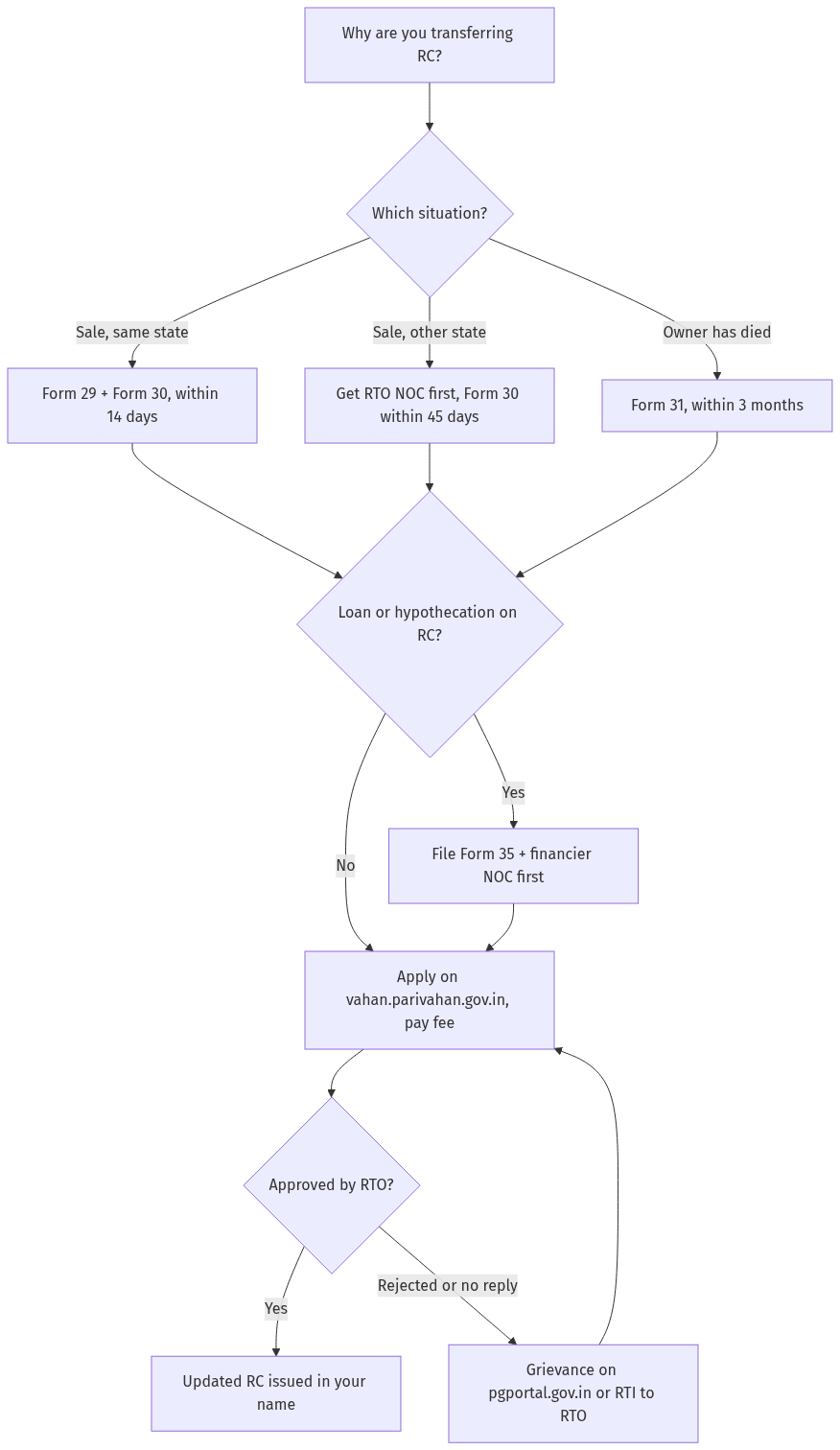
Figure: step-by-step flow. If a step stalls, use the grievance or RTI route shown.
If the transfer is stuck or rejected
If the RTO sits on your application past its service-charter time, or rejects it without a clear reason, do not start again from zero. First read the rejection remark on the Vahan application status. If it asks for a missing document, supply it. If the delay is unexplained, lodge a grievance on the central public grievance portal at pgportal.gov.in, quoting your application number, and track it with the registration ID. You can also file an RTI with your State Transport Department asking for the status of your application and the reason for delay. Both are free and create a paper trail that usually unlocks a stalled file.
Frequently asked questions
Who pays for the RC transfer, the buyer or the seller?
The buyer pays the transfer fee and applies in Form 30 to be recorded as the new owner. The seller's job is to file Form 29 and hand over the original RC, insurance and PUC. In practice both sign the forms, but the legal duty to apply within the deadline sits with the new owner.
What is the deadline to transfer the RC after a sale?
For a sale within the same State, apply within 14 days of the transfer. For a sale where the vehicle moves to another State, apply within 45 days. When the owner has died, the heir applies in Form 31 within three months. Missing the window can attract a penalty, so do not delay.
The vehicle still has a loan on the RC. Can I transfer it?
Not until the hypothecation is removed. Close the loan, collect the lender's clearance letter, and file Form 35 signed by you and the financier to delete the lender's entry from the RC. Once the RC is clean, the ownership transfer can proceed normally.
Can I transfer RC fully online without visiting the RTO?
In States that offer faceless services, yes, the whole flow runs on vahan.parivahan.gov.in with Aadhaar e-KYC. In other States you complete the application and payment online but still attend a short document-verification or vehicle-inspection step at the RTO.
What documents do I need for an ownership transfer?
The core set is the original registration certificate, a valid insurance certificate, a valid PUC certificate, and PAN or Form 60. Death and interstate cases need extras, a death certificate and heir proof for Form 31, and an RTO NOC for an interstate sale. Your RTO may ask for address proof too.
How much does RC transfer cost in 2026?
The fee and any road tax due are fixed under Rule 81 of the Central Motor Vehicles Rules and differ by State and vehicle type, so there is no single all-India amount. Check the exact fee shown for your RTO on the Vahan portal before you pay, and verify the current figure on vahan.parivahan.gov.in.
The RTO has not processed my transfer. What can I do?
Check the rejection or pending remark on your Vahan application status and fix any document gap. If the delay is unexplained, raise a grievance on pgportal.gov.in with your application number, and file an RTI for vehicle ownership with the State Transport Department asking for the status and reason for delay.