Table of Contents
SIM Re-Verification SMS: Keep Your Number Active
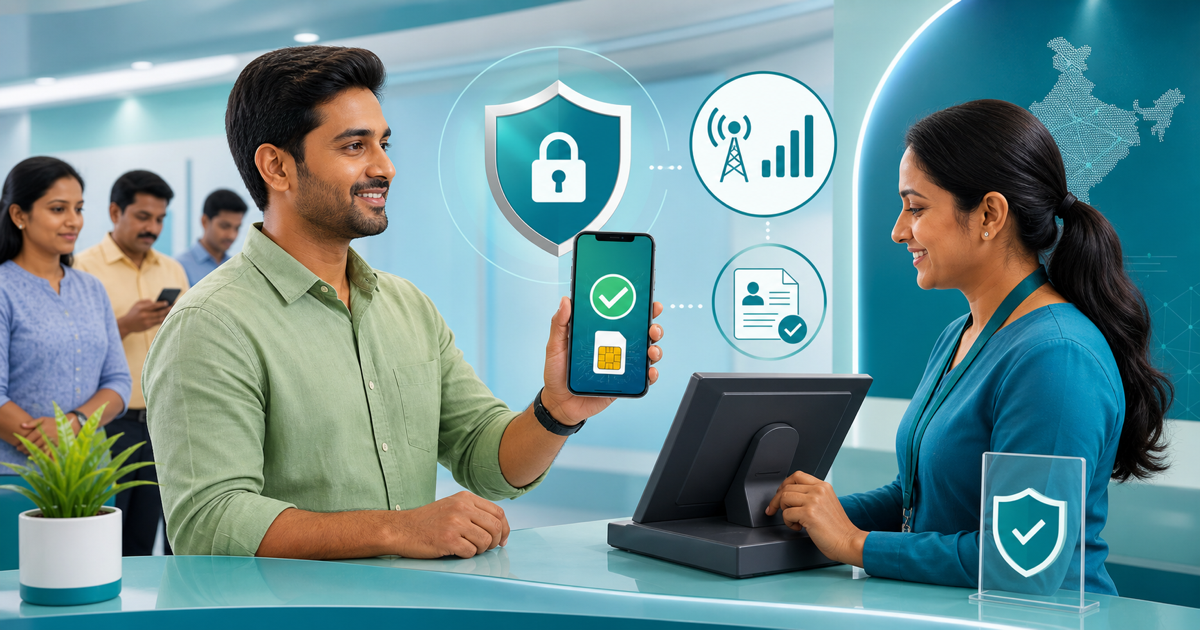
Quick answer: Do not click a link or share an OTP after a SIM re-verification message. Open your telecom operator's official app, call its published customer-care number, or visit a company-owned store. If the request is genuine, complete e-KYC or D-KYC and keep the complaint docket. Appeal immediately if your genuine number is wrongly restricted.
A SIM re-verification warning can be real, but a caller claiming to be TRAI and threatening instant disconnection is not. The safest response is to verify the notice through your own operator, complete identity checking only on its official channel, and record every docket number. This guide is independent citizen guidance, not a government or telecom-operator page.
First decide: genuine notice or scam?
| What you received | Safest reading | What to do now |
|---|---|---|
| A message visible inside your operator's official app, or confirmed by its published customer care | It may be a genuine re-verification request | Ask the operator why the number was flagged and which official e-KYC or D-KYC route applies |
| A call or recorded message claiming to be TRAI and threatening disconnection | Treat it as suspected fraud | End the call. Do not share identity data or an OTP. Preserve the communication, use Chakshu on Sanchar Saathi, and follow the fraud-call, SMS or WhatsApp reporting steps |
| A message with a shortened link, APK file, screen-sharing request, payment demand, or request to read out an OTP | Unsafe, even if the sender uses government words or logos | Do not open it. Verify separately with your operator and preserve a screenshot |
| Your genuine SIM has already lost service | It may be a KYC restriction, a technical fault, a port, or a SIM-swap attack | Use another phone to contact the operator. If any bank debit is visible, call 1930 and report at cybercrime.gov.in |
TRAI states that it does not contact customers about mobile-number disconnection. Billing, KYC, or misuse-related disconnection is done by the telecom service provider. A threat made in TRAI's name should therefore be treated as suspected fraud and checked with the operator through a number you find independently.
What SIM re-verification means in 50 words
SIM re-verification is an identity check by your telecom operator. It compares your current personal details with the operator's subscriber records. Under the Telecommunications (User Identification) Rules, 2025, re-verification may use e-KYC or D-KYC and can arise during SIM replacement, mobile-number portability, or a Central Government direction.
Why this is in the news now
Official current-affairs record, 30 June 2026: The DoT Tamil Nadu Licensed Service Area reported analysis of 1,559 mobile-number portability cases involving numbers flagged for re-verification. It also reported that, since April 2026, nearly 1.2 lakh connections were disconnected after proof-of-identity or proof-of-address mismatches. These are enforcement figures in an official PIB release, not a prediction that your genuine number will be disconnected.
The same release said re-verification was also used for numbers linked to financial fraud, spam, harassment, and subscribers holding more than the prescribed connection limit. This is why a real subscriber should respond carefully instead of ignoring a verified operator notice.
The legal position in India
The Telecommunications Act, 2023 is the parent law. The Telecommunications (User Identification) Rules, 2025, made under that framework, define the current user-identification process.
Rule 9 says an authorised telecom entity must re-verify a user's identity through e-KYC or D-KYC, as applicable, when:
- the user replaces or upgrades a subscribed service, including a SIM replacement;
- the user ports the number through Mobile Number Portability; or
- the Central Government directs re-verification.
The Rules define re-verification as comparing the user's current demographic details with the details in the Subscriber Data Record or Biometric Identity Verification System. Rule 7 says D-KYC can use documents specified as proof of identity and proof of address. Rule 12 also requires a user to notify the operator when user information changes.
There is important legal history. In Lokniti Foundation v. Union of India, (2017) 7 SCC 155, the Supreme Court accepted the need for an effective mobile-subscriber identity-verification process. Later, in K.S. Puttaswamy (Aadhaar-5J.) v. Union of India, (2019) 1 SCC 1, the Court quashed the 23 March 2017 DoT circular that had made Aadhaar-mobile linking compulsory because that circular was not backed by law. Do not read the old Aadhaar-only drive as the present rule. The 2025 Rules now expressly provide e-KYC and D-KYC routes.
No outcome guarantee: Completing valid re-verification promptly gives the operator the evidence needed to correct its record. It does not guarantee same-day restoration or stop a lawful investigation. Keep written proof and use the complaint and appeal route if service remains restricted.
Keep the number active: the safe seven-step route
- Verify the sender without using the message link. Open the operator's official app or website yourself. You may also call its published customer-care number from another phone.
- Ask for the exact recorded reason. Request the flag category, the date it was placed, and whether it came from a KYC mismatch, MNP request, SIM replacement, government direction, or another operator record. Note the answer word for word.
- Choose only the operator's official verification route. If e-KYC is offered, complete it within the operator's official app or store process. If D-KYC applies, use the identity and address documents the operator specifies under the current rules.
- Match the record before submitting. Check your name, date of birth, address, photograph, and ownership details. If the number is recorded in a relative's or former employer's name, do not falsely declare that the old record is yours. Ask for the proper ownership-change process.
- Collect proof. Save the operator docket number, store receipt, submission date, and any confirmation message. Do not publish your full mobile number, identity document, barcode, or OTP online.
- Check the result through an independent channel. Reopen the official app or call customer care. Ask whether the re-verification is accepted and whether any outgoing, incoming, SMS, or data restriction remains.
- Escalate a wrong restriction in writing. First use the operator's Complaint Centre. If the complaint is not resolved, appeal to that operator's Appellate Authority using the original docket number.
What to carry or save
- The phone and SIM concerned.
- An original identity and address document accepted by the operator for the applicable e-KYC or D-KYC route.
- The re-verification message or screenshot, with private details masked in any copy shared outside the operator.
- The latest bill, recharge receipt, or account page showing your long use of the number. These are supporting records, not a substitute for KYC.
- The operator complaint docket, store acknowledgement, and verification receipt.
- A short timeline of the notice, visit, restriction, complaint, and replies.
If the operator still blocks your genuine SIM
TRAI requires telecom service providers to run a two-tier complaint system. Start with the operator's Complaint Centre and obtain a unique docket number. Where no separate time is prescribed, TRAI's current complaint FAQ says complaints and service requests should be addressed within no more than three days.
If the response is missing or unsatisfactory, appeal to the Appellate Authority of the same operator. TRAI publishes the service-area-wise Appellate Authority directory. The appeal is normally filed within 30 days after the complaint time limit expires, and TRAI says disposal takes about 39 days. TRAI itself does not decide individual telecom complaints.
Use these official routes:
- CPGRAMS for a grievance about a DoT office or government handling after the operator route has been used
If the loss of service coincides with an unauthorised bank debit, unexpected porting message, or a duplicate-SIM warning, treat it as a possible SIM-swap emergency. Use another phone, tell the operator to secure the number, notify the bank, and call 1930. Read SIM stopped: swap, KYC, and recovery for the emergency path.
Use RTI for records, not instant reactivation
RTI can obtain records held by a public authority. It is not a complaint remedy and cannot itself order a private telecom company to restore a SIM. For Jio, Airtel, or Vi service restoration, use the operator's Complaint Centre and Appellate Authority first. You may file an RTI with DoT for records held by DoT about a government-directed flag or the processing of your Sanchar Saathi reference.
Ask for recorded facts, not explanations or accusations. Personal data belonging to another subscriber may be withheld under section 8(1)(j) of the RTI Act. Section 10 allows exempt personal details to be redacted while the rest of a record is supplied.
To: The Central Public Information Officer
Department of Telecommunications

Subject: Information under section 6(1) of the RTI Act, 2005 about mobile-number re-verification

Please provide the following records concerning Sanchar Saathi or DoT reference [REFERENCE ID] for mobile number ending [LAST FOUR DIGITS]:

1. Date on which the reference was received by DoT and date on which it was sent to the telecom service provider.
2. Current status recorded against the reference and copies of status notes available with DoT.
3. Copy of the direction or rule category under which re-verification was requested, with personal information of third parties redacted under section 10 where required.
4. Date and substance of any action report received by DoT from the telecom service provider.
5. Name and designation of the DoT office responsible for monitoring the reference.

If another public authority holds any requested record, please transfer that part under section 6(3) and inform me.
For a central public authority, the ordinary RTI application fee is ₹10, subject to the RTI Rules and the exemption for eligible below-poverty-line applicants. The normal response period is 30 days under section 7(1). Use AI RTI Drafter to format the request, Timeline Tracker to count the response date, and First Appeal Builder if the public authority does not answer properly.
Common mistakes that can cost your number
- Trusting a caller because they say “TRAI”. TRAI's official warning says it does not contact customers about disconnection. Cross-check with the operator.
- Opening the wrong app. Sanchar Saathi can check connections and report fraud, but operator re-verification must use the operator's official process. See what the official Sanchar Saathi app can and cannot do.
- Reading out an OTP or installing a remote-access app. Neither Rule 9 re-verification nor a genuine complaint requires giving an OTP to a caller.
- Ignoring a notice already confirmed by the operator. Rule 9 permits re-verification in defined situations. Use the official route and keep proof.
- Using Aadhaar-only advice copied from old articles. The 2017 compulsory-linking circular was quashed in Puttaswamy. Current Rule 9 provides e-KYC or D-KYC, as applicable.
- Appealing without the first docket. TRAI's two-tier system starts with the operator's Complaint Centre. Preserve that number for the Appellate Authority.
- Filing RTI as a demand to restore service. Section 6(1) is for existing records. Ask DoT for dates, notes, directions, and action reports while pursuing service relief through the operator.
Printable re-verification checklist
Copy this list into your phone notes, or use your browser's Print > Save as PDF option to download a clean checklist.
- I did not click the message link.
- I confirmed the request through the operator's official app, website, call centre, or company-owned store.
- I wrote down the exact reason and date of the flag.
- I used only the official e-KYC or D-KYC process.
- I checked the name, address, date of birth, photograph, and ownership record before submission.
- I saved the complaint docket and verification receipt.
- I checked whether calls, SMS, data, and banking OTPs work after verification.
- I appealed to the operator's Appellate Authority if the first complaint was not resolved.
- I called 1930 only if money moved or a cyber-fraud incident occurred.
- I masked my mobile number and identity documents before sharing evidence outside official channels.
Frequently asked questions
Is every SIM re-verification SMS a scam?
No. A telecom operator may request re-verification in situations allowed by the 2025 Rules, including SIM replacement, Mobile Number Portability, or a Central Government direction. Verify the request independently through the operator. A threat made in TRAI's name is different: TRAI says it does not contact customers about mobile-number disconnection.
Must I give Aadhaar to keep my SIM active?
Do not rely on old claims that every mobile number must be linked to Aadhaar. The Supreme Court quashed the 2017 compulsory Aadhaar-mobile circular. The 2025 Rules now recognise e-KYC and D-KYC routes, as applicable. Ask your operator which lawful route and documents apply to your case.
What if another person marked my real number as “Not My Number”?
Contact your operator as soon as you learn that the number is under re-verification. Prove your identity through the official process and ask for the recorded ownership details to be corrected. Keep a docket and receipt. If the operator restricts service despite accepted verification, use its Appellate Authority.
Can TRAI restore my mobile number?
TRAI does not handle individual consumer complaints. It requires each telecom operator to maintain a Complaint Centre and an Appellate Authority. Use the operator's two-tier system. TRAI's website supplies the current escalation directory and rules.
Should I call 1930 for a KYC dispute?
Use 1930 when money has been lost or a cyber-fraud transaction is occurring. A normal KYC or service dispute belongs with the telecom operator. If a suspicious caller asked for an OTP or sent a malicious link but no money moved, report the communication through Chakshu.
Can RTI give me another subscriber's KYC documents?
Usually not in full. Third-party personal information may be exempt under section 8(1)(j). Ask DoT for the reference status, dates, directions, and action records it holds. Section 10 permits redaction of exempt details while non-exempt parts are released.
How do I prove that I completed re-verification?
Keep the operator's docket number, store receipt or digital acknowledgement, submission date, and confirmation message. Ask the Complaint Centre to state in writing whether verification was accepted and what restriction remains. Do not post an unmasked KYC document or full mobile number on social media.
Official sources
Related on RTI Wiki
Editorial verification: Every procedural, legal, date, and numerical claim in this guide was checked against the official sources listed above on 11 August 2026. No result, restoration time, ranking, or compensation is guaranteed.