Table of Contents
Sale Deed vs Agreement to Sell 2026

Reviewed on 2026-06-20 by Dr. Shrawan Kumar Pathak.
Quick Reply: A sale deed transfers ownership; an agreement to sell only promises a future transfer. You become the legal owner only when a sale deed is signed and registered at the Sub-Registrar office, within four months of signing under the Registration Act, 1908. An agreement to sell alone never makes you the owner.
Buyers lose money every year because they treat a signed agreement as proof of ownership. It is not. The two documents look similar and use similar words, but they sit at opposite ends of a property purchase. This guide puts them side by side, row by row, so you can see exactly what each one does before you pay.
The two documents at a glance
Think of buying a flat as a journey with two stops. The agreement to sell is the booking; the sale deed is the handover. Here is the full comparison in one table.
| What you are comparing | Agreement to sell | Sale deed |
|---|---|---|
| Does it transfer ownership? | No. It only promises a future sale | Yes. Title passes to the buyer |
| Governing law | Section 54, Transfer of Property Act, 1882 | Section 54, Transfer of Property Act, 1882 |
| Nature | A contract for a future transfer | The actual conveyance |
| Registration compulsory? | Generally no, but some states require it. Check your state | Yes, under Section 17 of the Registration Act, 1908 |
| What you hold afterwards | A right to demand the sale (specific performance) | Full legal ownership and possession |
| Risk if the other side backs out | You sue for specific performance or refund | Title is already yours; very low risk |
| When it is usually signed | Before payment, while loan or papers are arranged | At final payment, to complete the purchase |
| Stamp duty | Lower or nominal in most states | Full stamp duty on the property value |
Read the ownership row first. Under Section 54 of the Transfer of Property Act, an agreement to sell does not, by itself, create any interest in or charge on the property. The Supreme Court said the same in the Suraj Lamp case and reaffirmed it in 2025: title in immovable property passes only through a registered sale deed, never through an agreement, a power of attorney or a will.
Why the agreement to sell still matters
An agreement to sell is not a weak document. It locks in the price, the payment schedule, the date for completing the sale and what happens if either side defaults. It is the paper your home loan bank reads before it sanctions money, and the one that protects your token amount. You just must not mistake it for the finish line.
If you want a clean paper trail, gather the title chain and approvals before you sign it. Our home loan documents checklist lists what your lender and your own lawyer should see, and for an under-construction flat you should run the RERA project check first.
Why the sale deed is the document that counts
The sale deed is the conveyance. Once it is executed, stamped and registered, you are the owner on record. Sale of immovable property worth Rs 100 or more can be made only by a registered instrument, and Section 17 of the Registration Act, 1908 makes registering that deed compulsory. Skip registration and Section 49 says the document cannot affect the property or be used as full proof of the sale.
The buying journey, step by step
Step 1: Sign the agreement to sell
Agree on price, advance, balance and a clear date for completing the sale. Get the seller's title documents, encumbrance certificate and approvals checked. Keep the agreement on the correct stamp paper for your state.
Step 2: Arrange money and clear dues
Complete your loan, clear any pending property tax or society dues and fix the registration appointment. If the sale value or stamp duty value is Rs 50 lakh or more, the buyer must deduct 1 percent TDS under Section 194-IA of the Income Tax Act and deposit it using Form 26QB within 30 days from the end of the month of deduction.
Step 3: Execute and register the sale deed
Pay the balance, sign the sale deed and present it at the Sub-Registrar office within four months of execution, as Section 23 of the Registration Act, 1908 requires. Both parties and two witnesses attend with identity proof. Stamp duty and the registration fee are set by your state, so confirm the current rates on your State Stamp and Registration or IGR portal before you go. Our stamp duty and registration charges guide explains how the slab is worked out.
Step 4: Update the records in your name
After registration, apply for mutation so the municipal and land records show you as owner. Only now is the purchase truly complete.
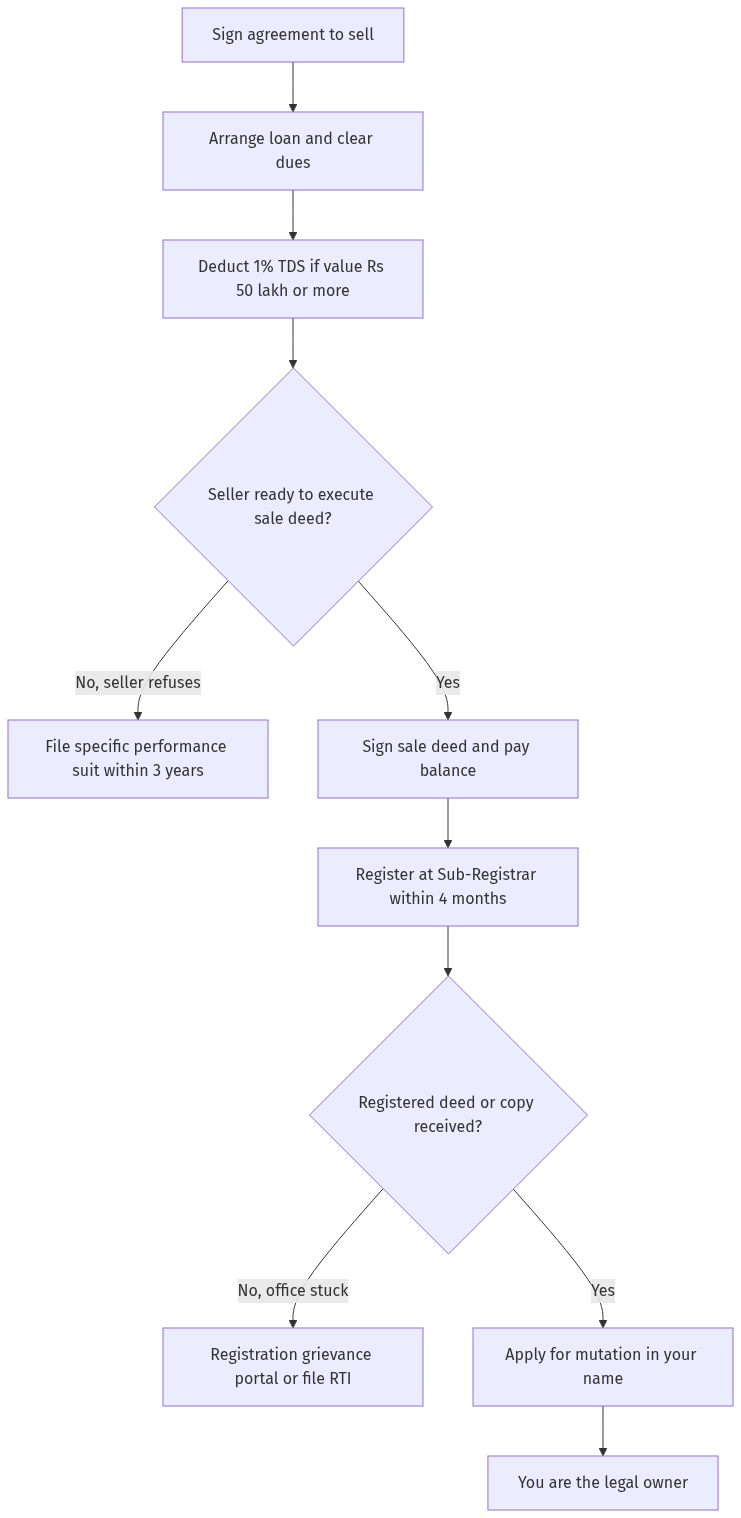
Figure: step-by-step flow. If a step stalls, use the grievance or RTI route shown.
If the seller backs out or registration is stuck
If the seller refuses to execute the sale deed after taking your advance, your agreement to sell becomes your weapon. You can file a civil suit for specific performance to force the sale, and you have three years to do so under Article 54 of the Limitation Act, 1963, counted from the date fixed for completing the sale or from when you learn the seller has refused. Do not wait; courts frown on buyers who sit on a breach.
If the problem is at the Sub-Registrar office, say your registered deed or certified copy is delayed, first use the office complaint or grievance channel, then your State Registration department portal. Where a public office holds your record and will not release it, a Right to Information request often unlocks the file faster than a reminder letter. For a deeper title dispute, see how an ancestral property partition suit is fought, and if a builder is sitting on your flat, read our builder delay and RERA complaint guide.
Frequently asked questions
Does an agreement to sell make me the owner?
No. An agreement to sell is only a promise to transfer the property in future. Under Section 54 of the Transfer of Property Act, it creates no ownership and no interest in the property. You become the owner only when a sale deed is executed and registered in your name.
Is an agreement to sell legally valid if it is not registered?
Yes, an unregistered agreement to sell is generally valid as a contract and can support a suit for specific performance. But some states require the agreement itself to be registered, so confirm the rule on your State Registration portal before you rely on an unregistered copy.
Within how many days must a sale deed be registered?
Present the sale deed at the Sub-Registrar office within four months of signing it, under Section 23 of the Registration Act, 1908. A delay of up to four more months can be condoned by the Registrar on payment of a fine, so do not let the deadline slip.
Do I pay full stamp duty on the agreement to sell or the sale deed?
Full stamp duty is charged on the sale deed, which is the actual transfer. The agreement to sell usually attracts a lower or nominal stamp duty. Rates are fixed by each state, so check the current figure on your State Stamp and Registration portal.
What if the seller refuses to sign the sale deed after taking my advance?
Use your agreement to sell to file a civil suit for specific performance and ask the court to compel the sale, or to order a refund with damages. You have three years from the date fixed for completion, or from the date of refusal, under Article 54 of the Limitation Act, 1963.
Do I need to deduct TDS when I buy property?
Yes, if the sale consideration or stamp duty value is Rs 50 lakh or more, you must deduct 1 percent TDS under Section 194-IA of the Income Tax Act and deposit it through Form 26QB within 30 days from the end of the month in which you deduct it.
Can I sell using only a power of attorney instead of a sale deed?
No. The Supreme Court has held that a power of attorney, an agreement to sell or a will cannot transfer ownership of immovable property. Only a registered sale deed conveys title. Treat any seller who offers a power of attorney sale as a red flag.
Sources
Sale deed vs agreement to sell: Key legal differences (2026)
Sale deed vs agreement to sell: Complete legal guide (2026)
- What is a sale deed and what is an agreement to sell? (a) Sale deed: (i) Sale deed — registered document transferring ownership, (ii) Conveys absolute title — from seller to buyer, (iii) Must be registered — under Registration Act 1908, (iv) Stamp duty paid — as per state law, (v) Title transfers — on registration, (vi) Also called: conveyance deed, (b) Agreement to sell (ATS): (i) Agreement to sell — promise to sell in future, (ii) Does NOT transfer title — only creates right to buy, (iii) Can be registered or unregistered — depending on state, (iv) Stamp duty: lower than sale deed — in most states, (v) Title does NOT transfer — only on execution of sale deed, (vi) Also called: bayana, earnest money agreement, © Key difference: Sale deed = title transfers NOW; ATS = title will transfer LATER.
- Comparison table: Sale deed vs agreement to sell. (a) Nature: (i) Sale deed: transfers title, (ii) ATS: promise to transfer, (b) Registration: (i) Sale deed: mandatory under Registration Act, (ii) ATS: optional (but recommended), © Stamp duty: (i) Sale deed: full rate — 4-9% depending on state, (ii) ATS: lower rate — varies by state, (d) Title: (i) Sale deed: title transfers on registration, (ii) ATS: title does NOT transfer, (e) Possession: (i) Sale deed: usually with registration, (ii) ATS: may or may not include possession, (f) Remedies: (i) Sale deed: eviction if buyer doesn't pay, (ii) ATS: specific performance if seller doesn't execute sale deed, (g) Risk: (i) Sale deed: low — title transferred, (ii) ATS: high — seller may not execute sale deed, (h) Tax: (i) Sale deed: capital gains on transfer, (ii) ATS: no capital gains until sale deed executed. (Note: ATS gives right to sue for specific performance — not ownership.)
- What rights does an agreement to sell give the buyer? (a) Rights under ATS: (i) Right to specific performance — sue seller to execute sale deed, (ii) Right to possession — if ATS includes possession clause, (iii) Right to refund — if seller refuses to sell, with interest, (iv) Right to damages — if seller breaches, (v) Right to injunction — prevent seller from selling to third party, (b) Limitations: (i) Buyer does NOT get title — until sale deed registered, (ii) Buyer cannot sell property — based on ATS alone, (iii) Buyer cannot mortgage property — based on ATS, (iv) Buyer's name NOT in revenue records — until sale deed, © Protection: (i) Register ATS — creates public record, (ii) Pay earnest money — with proof, (iii) Include timeline — for sale deed execution, (iv) Include penalty clause — for seller's default.
- Step-by-step: From agreement to sell to sale deed. (a) Step 1: Sign ATS — with earnest money (10-20% of sale price), (b) Step 2: Register ATS — at sub-registrar office (recommended), © Step 3: Pay stamp duty — for ATS (lower rate), (d) Step 4: Due diligence — title search, encumbrance certificate, (e) Step 5: Obtain loan — if needed, bank approves based on ATS, (f) Step 6: Pay balance amount — at time of sale deed, (g) Step 7: Draft sale deed — with full details, (h) Step 8: Pay stamp duty — full rate for sale deed, (i) Step 9: Register sale deed — at sub-registrar, (j) Step 10: Mutation — update revenue records in buyer's name.
- What to do if seller refuses to execute sale deed after ATS? (a) Remedies: (i) Specific performance suit — Section 10 Specific Relief Act 1963, (ii) Suit for possession — if ATS includes possession, (iii) Suit for refund + damages — if buyer wants exit, (iv) Injunction — prevent sale to third party, (b) Specific performance: (i) File in civil court — within 3 years of ATS breach, (ii) Buyer must prove: readiness + willingness to pay, (iii) Court orders seller — to execute sale deed, (iv) If seller still refuses — court executes sale deed itself, © Defences seller may use: (i) Buyer didn't pay — on time, (ii) Buyer not ready — to perform, (iii) ATS was conditional — condition not fulfilled, (iv) ATS not registered — for agreements requiring registration, (d) Key evidence: (i) Registered ATS, (ii) Payment proofs — earnest money + balance, (iii) Communications — demand for sale deed, (iv) Readiness proof — bank loan approval, funds ready.
- Common pitfalls with agreement to sell. (a) Pitfall 1: Not registering ATS — hard to prove terms, (b) Pitfall 2: No timeline — for sale deed execution, © Pitfall 3: No penalty clause — for seller's default, (d) Pitfall 4: Paying full amount — without sale deed, (e) Pitfall 5: No title search — before ATS, (f) Pitfall 6: No encumbrance certificate — property may have liens, (g) Pitfall 7: ATS on stamp paper only — not registered, (h) Pitfall 8: No possession clause — if buyer wants possession before sale deed.
- Practical tips. (a) Register ATS — not just stamp paper, (b) Include timeline + penalty clause, © Do title search before ATS, (d) Pay earnest money with proof, (e) Execute sale deed ASAP — don't delay, (f) Example: Buyer signed ATS, paid 20% earnest; seller refused sale deed; buyer filed specific performance; court ordered sale deed; buyer got property.
See Sale Deed vs Agreement and Specific Performance and How to File RTI.