Table of Contents
How to Claim Gratuity 2026

Reviewed on 2026-06-20 by Dr. Shrawan Kumar Pathak.
Quick Reply: Once you complete 5 years with an employer, gratuity equals your last Basic plus DA, times 15, times years served, divided by 26, capped at Rs 20 lakh. Send Form I to your employer within 30 days. The employer must pay within 30 days or owe you 10 percent simple interest.
Think of gratuity as a final-settlement number you can compute yourself before anyone hands you a figure. This guide walks you through the sum first, then the paperwork that turns that sum into money in your account.
First, run the numbers
The Payment of Gratuity Act, 1972 uses one formula. Put your own figures into it.
- Gratuity = (last drawn Basic + Dearness Allowance) x 15 x completed years / 26
The 15 is fifteen days of wages for every completed year. The 26 treats a month as 26 working days. Use only Basic plus DA, not your gross or your in-hand pay. House rent allowance, bonus and incentives do not enter the sum.
Round the final year
Count whole years served. If your last part-year crosses six months, round it up to a full year. Six months or less is dropped. So 10 years and 7 months counts as 11 years; 10 years and 5 months counts as 10.
Three worked sums
- Basic plus DA of Rs 30,000, 8 years served: 30000 x 15 x 8 / 26 = Rs 1,38,462.
- Basic plus DA of Rs 50,000, 10 years 7 months (rounds to 11): 50000 x 15 x 11 / 26 = Rs 3,17,308.
- Basic plus DA of Rs 80,000, 25 years: 80000 x 15 x 25 / 26 = Rs 11,53,846.
The ceiling and the tax line
The most an employer must pay under the Act is Rs 20 lakh. That cap was set by notification S.O. 1420(E) on 29 March 2018 under section 4(3). Anything an employer pays above it is voluntary ex-gratia. For tax, gratuity is exempt under section 10(10) of the Income-tax Act up to the same Rs 20 lakh ceiling for covered employees; any excess is taxable salary. Check your slab on the income tax portal before you spend it.
Are you eligible?
You qualify once you finish 5 years of continuous service with the same employer and then retire, resign or are superannuated. The 5-year bar is waived in two cases: if the employee dies, or is disabled by accident or disease. In a death case the gratuity goes to the nominee or, failing nomination, to the legal heirs, and no minimum service is needed. If you ever named a nominee, it was on Form F, filed during service. Trace it now so the right person claims later, the same way a family pension after a death turns on whose name is on record.
Claim it: the four-form path
Gratuity does not arrive automatically. You start the clock.
Step 1: send Form I
Apply to your employer in Form I ordinarily within 30 days of the date your gratuity becomes payable, which is your last working day. A nominee uses Form J; a legal heir uses Form K (a legal heir may apply within one year). Send it by registered post or email so you hold a dated proof. A late form does not kill your claim, but a dated one protects it.
Step 2: read the employer's reply
Within 15 days the employer should respond. If the claim is in order, you get Form L, which states the amount and fixes a payment date no later than the 30th day. If the employer rejects it, you get Form M with reasons. Keep whichever notice you receive; it is your evidence later.
Step 3: get paid on time
The employer must pay within 30 days of the gratuity becoming payable, under section 7(3). If they miss that window, section 7(3A) makes them pay simple interest at 10 percent per annum from the due date to the date they actually pay. You do not have to ask twice for the interest; it is your statutory right. Keep your final payslip and the bank credit advice.
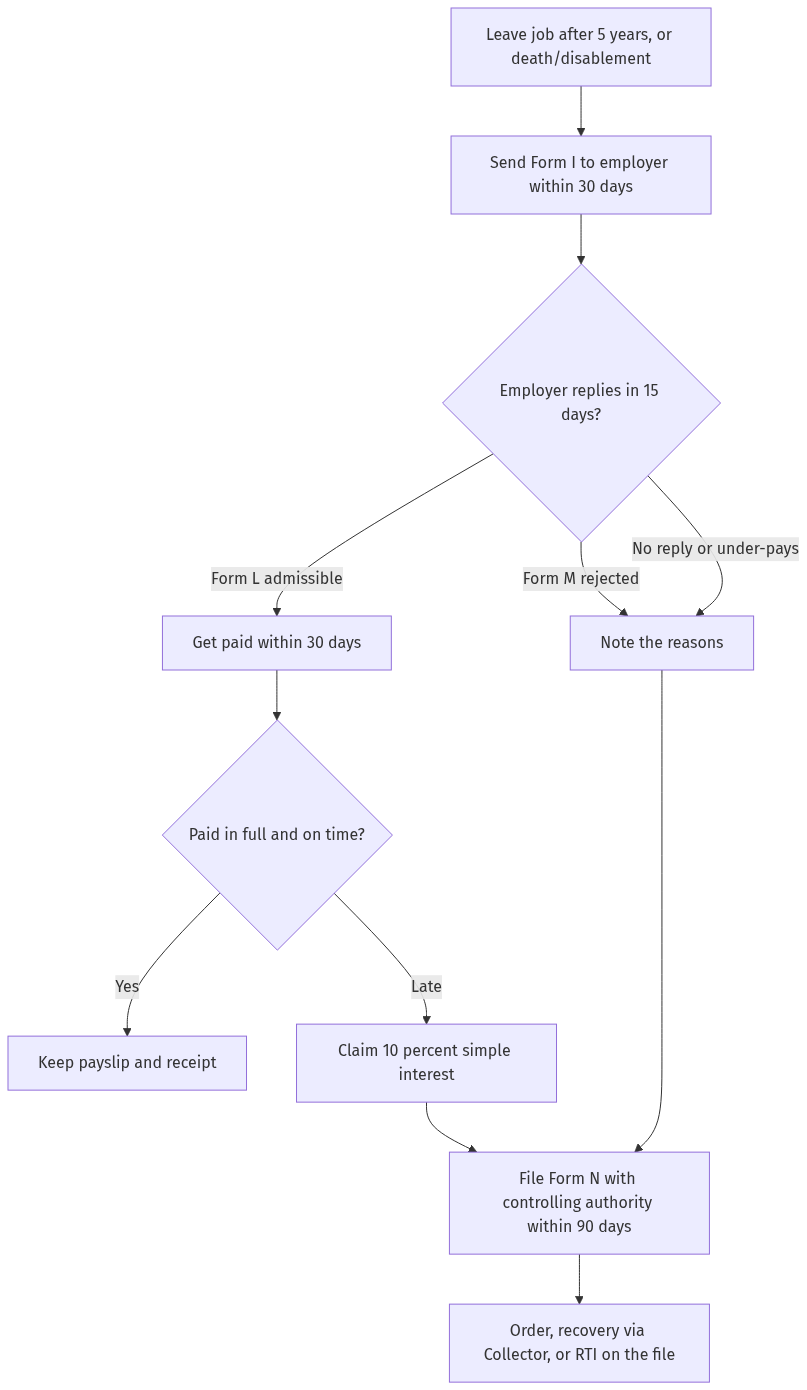
Figure: step-by-step flow. If a step stalls, use the grievance or RTI route shown.
If the employer stalls or refuses
A rejection or silence does not end the matter. The Act gives you a public officer who can order payment.
File Form N with the controlling authority
Apply in Form N to the controlling authority, the labour officer notified for your area, within 90 days of the employer's refusal, short payment or failure to reply. The controlling authority hears both sides and can direct the employer to pay the gratuity with interest. If the employer still does not comply, section 8 lets the authority issue a certificate to the District Collector to recover the amount as arrears of land revenue. If either side disagrees with the order, an appeal lies to the appellate authority, usually within 60 days under section 7(7). Find your controlling authority through your state labour department portal, since each state notifies its own officer.
When the file just sits there
If a government or public-sector employer keeps your gratuity file pending, or the controlling authority does not move, file an RTI asking for the current status, the officer holding the file, and the expected date of payment. The same pressure works when an employer refuses to release documents you need. Gratuity is run by the labour department, not EPFO, so do not file it with the wrong office.
Keep gratuity separate from PF and pension
These three settlements travel together but follow different rules. Your provident fund is claimed online; see how to withdraw PF online. Your monthly pension under EPS needs a separate EPS Form 10D. And before any of this, make sure you can log in by checking how to activate your UAN. Gratuity is the one paid by the employer directly, so chase the employer, not EPFO, for it.
Frequently asked questions
Can I get gratuity before 5 years?
Only in two situations. If you die or become disabled, the 5-year rule does not apply and the amount is paid to you or your nominee. In an ordinary resignation or retirement you need 5 years of continuous service. Some courts have read 4 years and 240-plus days in the fifth year as enough, but employers vary, so confirm with your controlling authority.
What counts as salary in the gratuity sum?
Only your last drawn Basic pay plus Dearness Allowance. Leave out HRA, conveyance, bonus, overtime and incentives. Use the figure from your final payslip, not your gross CTC, or your number will come out too high.
How long does the employer have to pay?
Thirty days from the date the gratuity becomes payable, which is normally your last working day. Miss that and the employer owes simple interest at 10 percent a year on the unpaid amount until it is settled.
Is my gratuity taxable?
Gratuity is exempt under section 10(10) of the Income-tax Act up to the Rs 20 lakh limit for employees covered by the Act. Anything above the exempt limit is added to your taxable salary. Verify the current exemption figure on incometax.gov.in.
My employer rejected my claim. What now?
Take the Form M rejection and apply in Form N to the controlling authority for your area within 90 days. The officer can direct payment with interest and, if needed, recover it through the Collector. Find the officer on your state labour department website.
Does a contract or fixed-term worker get gratuity?
Yes, if you have completed the qualifying continuous service with the same principal employer or establishment. The status of your contract does not by itself remove the entitlement; what matters is the length and continuity of service.
I worked through a staffing agency. Who pays?
Usually the establishment where you actually worked, or the agency that employed you, depending on your contract and who exercised control. If they pass the buck, name both before the controlling authority in Form N and let the officer fix liability.