Table of Contents
Send a Legal Notice (Format) 2026

Reviewed on 2026-06-20 by Dr. Shrawan Kumar Pathak.
Quick Reply: A legal notice is a formal letter, usually on an advocate's letterhead, stating your facts, your demand and a deadline to comply before you go to court. There is no all-India notice fee or single deadline. Send it by Registered Post Acknowledgement Due and keep the proof.
Think of a legal notice as the last polite letter before a lawsuit. It is not a court filing and there is no government portal for it. It is a letter, so this guide is built like one. Below you walk through each block of the notice in the order it is written, then you serve it correctly and watch the clock.
When a legal notice helps you
You send a legal notice when someone owes you money, has broken a contract, sold you a defective product, refuses to vacate, or has harmed you and you want them to fix it before you sue. The notice gives the other side a last clear chance to settle. Many disputes end right here, which saves you the cost and years of a court case.
Before you draft, gather your proof: the agreement, invoices, cheque return memo, photographs, messages and dates. The notice is only as strong as the facts you can later show a judge.
The legal notice format, block by block
A clean notice reads top to bottom in this order. Treat each block as a numbered step.
1. Letterhead and date
If an advocate drafts it, the notice goes on the advocate's professional letterhead with the chamber address and the date. If you write it yourself, put your own name and full address at the top. The date matters, because some deadlines run from it.
2. Recipient and the opening line
Write the full name and complete postal address of the person or company you are noticing. The opening line names the sender, for example “Under instructions from and on behalf of my client, Mr A, resident of …, I serve you with the following notice.” This is also where you may add “WITHOUT PREJUDICE” if you want to keep settlement talks separate from court admissions.
3. The facts, in order
Set out what happened as short numbered paragraphs in date order. Stick to facts you can prove. Mention the contract, the amount, the cheque number, the date of breach, and any earlier reminders. A judge later reads this to understand the dispute, so keep it plain and honest.
4. The legal grievance
State clearly how the other side wronged you: the unpaid sum, the broken clause, the deficient service. You do not need to quote sections, but naming the right law sharpens the notice (see the deadline table below for the common ones).
5. The demand and the deadline
This is the heart of the notice. State exactly what you want done: pay this amount, vacate by this date, replace the goods, or correct the record. Then give a clear compliance period, commonly 15 days, after which you will go to court. Where a statute fixes the period, use that period.
6. The consequence and the signature
Warn that if the demand is not met within the period, you will initiate civil or criminal proceedings at the recipient's risk as to cost and consequences. The advocate signs (and often the client too). Keep a signed copy for yourself.
The deadlines that actually apply
There is no single deadline for every legal notice. A few situations have a statutory clock, and these are exceptions, not the general rule.
- Cheque bounce, Section 138 Negotiable Instruments Act, 1881. You must send the demand notice within 30 days of receiving the bank's dishonour memo, and the drawer then gets 15 days from receiving it to pay. Miss the 30 day window and your complaint can fail.
- Suing the Government or a public officer, Section 80 Code of Civil Procedure, 1908. You must serve a written notice and wait 2 months before filing the suit. This is mandatory.
- Consumer complaints, Consumer Protection Act, 2019. A legal notice is not compulsory before filing; you can approach the consumer commission directly. A notice is still useful because it often settles the matter.
For every other dispute there is no fixed notice period, so you set a reasonable deadline yourself. Advocate fees for drafting vary widely, so ask your lawyer for a quote; there is no official fee schedule. If you cannot afford one, you can get free legal aid, explained below.
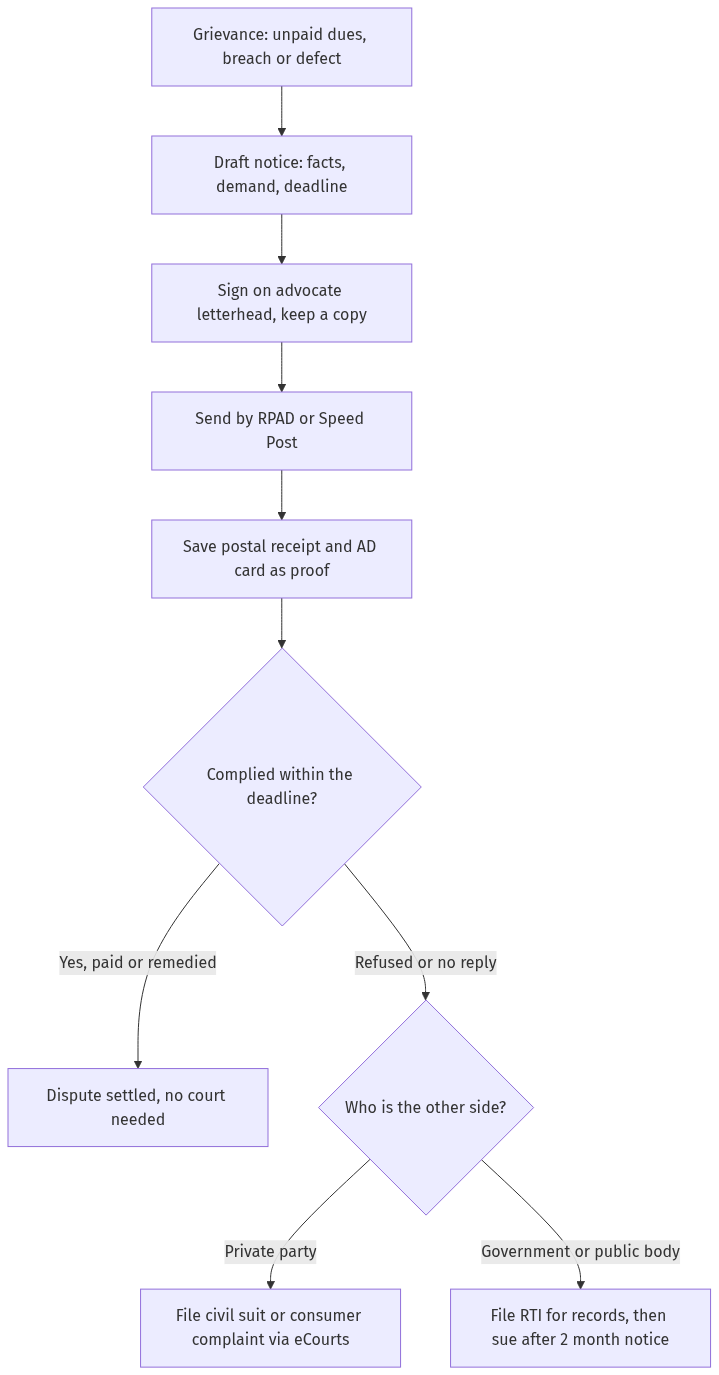
Figure: step-by-step flow. If a step stalls, use the grievance or RTI route shown.
How to serve it so it counts
Service is where weak notices die. Always send by Registered Post Acknowledgement Due (RPAD) or Speed Post through India Post, never plain post. The green Acknowledgement Due card comes back signed by the recipient and is your proof of delivery. You may also email or hand a copy, but the postal proof is what a court trusts.
Keep three things together for the file: the signed notice, the postal receipt with its tracking number, and the returned AD card. If the recipient dodges the postman and the cover comes back “refused” or “not claimed”, the law generally treats that as good service, so do not panic if it bounces back.
If there is no reply or a flat refusal
When the deadline passes with no payment and no meaningful reply, the notice has done its job: it has put the other side on record. Now you escalate based on who they are.
- A private party: file the appropriate case. For money or contract disputes you file a civil suit; track it later through the eCourts case status portal. For a defective product or service you file a consumer complaint. For a bounced cheque you file a Section 138 complaint before the Magistrate within one month of the cause of action. Before fighting, consider settling through a Lok Adalat, which is quick and free.
- A government body or public authority: complete the Section 80 CPC notice period first. You can also file an RTI to obtain the file notings, correspondence and records that prove your case, which often makes the department settle.
If the dispute is really a maintenance or family matter, the notice route differs; see maintenance under Section 125 CrPC. If the wrong done to you is a crime, a notice is not the tool; you instead register an FIR. And if you cannot afford an advocate to draft or fight, apply for free legal aid through NALSA, which is your right.
Frequently asked questions
Do I need a lawyer to send a legal notice?
No. Any person can send one in their own name. Most people use an advocate because a lawyer on letterhead frames the facts and demand in a way that holds up later in court, but it is not legally compulsory.
Is there a government portal to file a legal notice?
No. A legal notice is a private letter sent by post, not a form filed on any .gov.in site. The portals come later, for the court case, such as eCourts. Be wary of any website claiming to “file” your notice with the government.
How long should I give the other side to comply?
For ordinary disputes you set a reasonable period yourself, commonly 15 days. Where a statute fixes the clock you must follow it, such as the 30 day notice window for a bounced cheque or the 2 month wait before suing the Government.
What if the recipient refuses to accept the post?
Refusal or “not claimed” is generally treated by courts as valid service, provided you sent it to the correct address by Registered Post Acknowledgement Due. Keep the returned cover unopened with the postal endorsement as your proof.
Does sending a notice mean I have to go to court?
No. The notice often ends the dispute by itself when the other side pays or corrects the problem within the deadline. You only move to court if they refuse or ignore it.
Is a legal notice mandatory before a consumer complaint?
No. Under the Consumer Protection Act, 2019 you can approach the consumer commission directly. A notice is still worth sending first because it gives a fast, no cost chance to settle.
How much does a legal notice cost?
There is no official fee. The only fixed cost is postage for Registered Post Acknowledgement Due. Advocate drafting charges vary, so ask your lawyer for a quote, and check whether you qualify for free legal aid.
Sources
- https://www.indiacode.nic.in/ (Negotiable Instruments Act 1881, Section 138; Code of Civil Procedure 1908, Section 80)
- https://ncdrc.nic.in/bare_acts/CPA2019.pdf (Consumer Protection Act 2019)
- https://www.indiapost.gov.in/ (Registered Post Acknowledgement Due)
- https://ecourts.gov.in/ (case status and suit filing)
- https://nalsa.gov.in/ (free legal aid)
Legal notice format: How to draft and send (2026)
Legal notice format: Complete drafting and sending guide (2026)
- What is a legal notice and when to send one? (a) Legal notice: (i) Formal written communication — expressing grievance and demand, (ii) Sent by advocate — on behalf of client, (iii) Pre-litigation step — before filing suit, (iv) Purpose: (1) Inform opposite party of grievance, (2) Demand compliance/payment/action, (3) Create legal record, (4) Give opportunity to settle — avoid litigation, (b) When to send: (i) Breach of contract — demand performance, (ii) Property dispute — demand possession/title, (iii) Cheque bounce — Section 138 — mandatory 15-day notice, (iv) Consumer dispute — demand deficiency remedy, (v) Employment dispute — demand reinstatement/dues, (vi) Defamation — demand apology/compensation.
- What is the format of a legal notice? (a) Structure: (i) Sender details: advocate name + address + date, (ii) Addressee: opposite party name + address, (iii) Subject: brief description of matter, (iv) Body: (1) Facts — chronology of events, (2) Grievance — specific violation/breach, (3) Legal position — applicable law, (4) Demand — specific action/payment + timeline, (5) Consequences — legal action if demand not met, (v) Closing: advocate signature + enclosures, (b) Content rules: (i) Clear and concise — no ambiguous language, (ii) Specific demands — amount, action, timeline, (iii) Legal basis — cite relevant law/section, (iv) Timeline: typically 15-30 days — for compliance, (v) Tone: firm but not abusive.
- Step-by-step: How to send a legal notice. (a) Step 1: Consult advocate — explain facts + provide documents, (b) Step 2: Advocate drafts notice — with legal grounds + demands, © Step 3: Review draft — ensure accuracy + completeness, (d) Step 4: Print on advocate's letterhead — signed by advocate, (e) Step 5: Send by: (i) Registered post with acknowledgement due (RPAD), (ii) Speed post — with tracking, (iii) Courier — with proof of delivery, (f) Step 6: Keep: (i) Copy of notice, (ii) Postal receipt, (iii) Acknowledgement card — when returned, (g) Step 7: Wait for compliance period — 15-30 days, (h) Step 8: If no compliance — file suit — with notice as evidence.
- Comparison table: Legal notice vs court notice vs arbitration notice. (a) Legal notice (private): (i) Sent by: advocate, (ii) Authority: none — pre-litigation, (iii) Cost: Rs 1,000-5,000, (iv) Compliance: voluntary, (v) Next step: file suit, (b) Court notice: (i) Sent by: court — after suit filed, (ii) Authority: court, (iii) Cost: court fee + process fee, (iv) Compliance: mandatory — appearance required, (v) Next step: trial, © Arbitration notice: (i) Sent by: party — under arbitration clause, (ii) Authority: arbitration agreement, (iii) Cost: minimal, (iv) Compliance: mandatory — under contract, (v) Next step: arbitration proceedings. (Note: Legal notice is not mandatory for all suits — but required for cheque bounce, consumer, some property disputes.)
- Practical tips. (a) Engage advocate — for drafting + sending, (b) Send by RPAD — registered post with acknowledgement, © Keep postal receipt + acknowledgement — as evidence, (d) Timeline: 15-30 days — for compliance, (e) Example: Buyer sent legal notice for non-delivery of flat; developer ignored; buyer filed consumer complaint; notice + postal receipt + acknowledgement used as evidence; consumer court ruled in buyer's favor.
See Legal Notice Format and How to File RTI.