Table of Contents
Consumer complaint status 2026: NCH and e-Jagriti
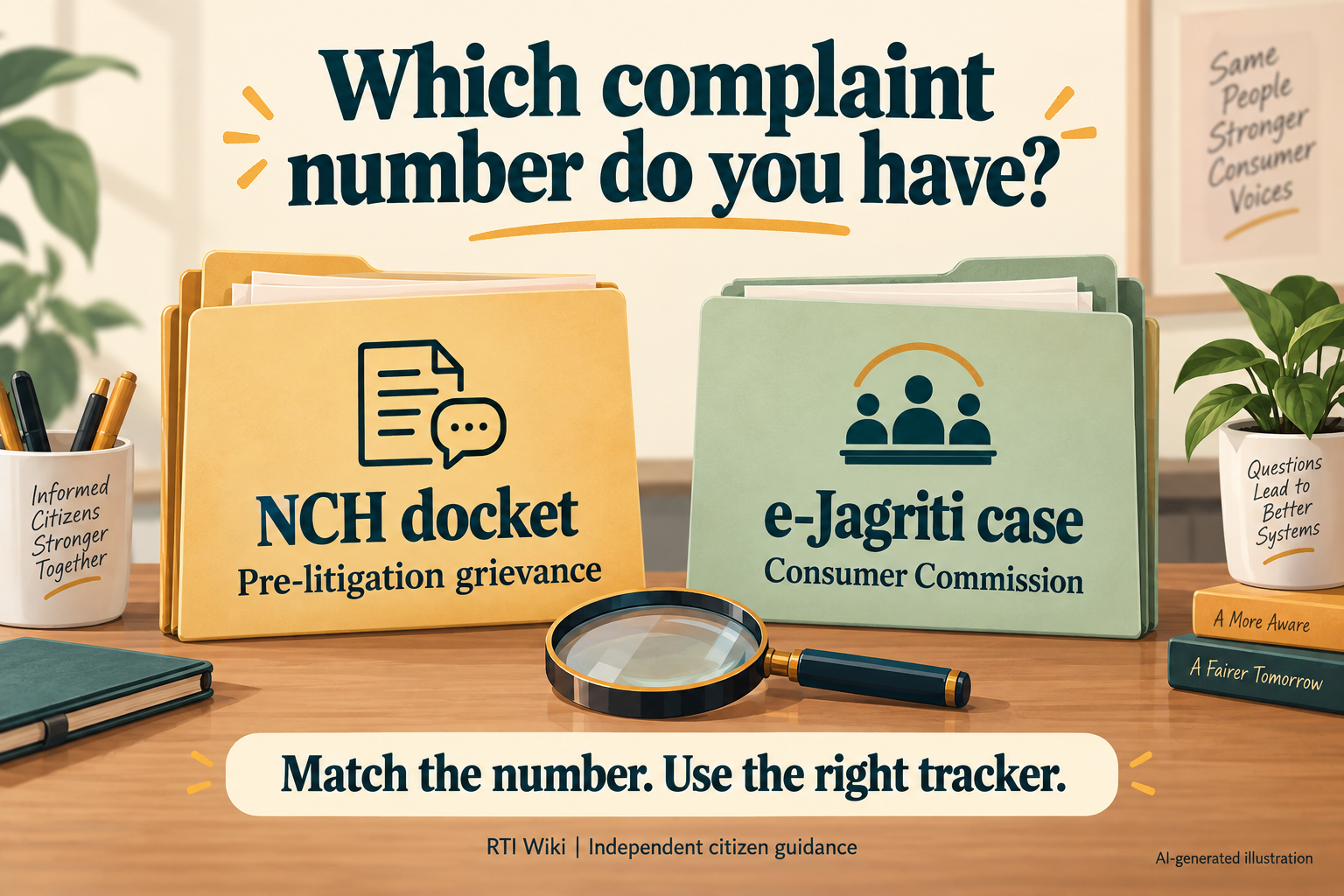
A consumer complaint can have two very different tracking numbers: an NCH docket for pre-litigation grievance handling, or an e-Jagriti reference and case number for proceedings before a Consumer Commission. Start by identifying which number you received. Using the wrong tracker is the main reason a valid complaint appears to be missing.
Quick answer: Track an NCH docket at consumerhelpline.gov.in using “Track Grievance.” Track a Consumer Commission case at e-jagriti.gov.in using its case-status or file-search facility. NCH is a pre-litigation channel. e-Jagriti is the filing and case-management platform for District, State and National Consumer Commissions.
First identify your number
| What you have | Where it belongs | What it proves |
|---|---|---|
| NCH docket number | National Consumer Helpline | A grievance was registered and forwarded for redress. It is not a court case number. |
| e-Jagriti reference or file number | e-Jagriti | A filing or draft exists on the platform. It may still be under scrutiny. |
| Consumer Commission case number | e-Jagriti / concerned Commission | The matter has been registered as a case before a Consumer Commission. |
| Old e-Daakhil, OCMS, CMS or Confonet number | e-Jagriti | The older systems were subsumed into e-Jagriti from 1 January 2025. Use the file-tracing help shown on e-Jagriti if the number is not found. |
Do not treat “forwarded,” “company response received,” or “disposed” on NCH as a judicial order. The National Consumer Helpline describes itself as an alternate, pre-litigation grievance mechanism. If the result is unsatisfactory, a consumer can still approach the appropriate Consumer Commission.
Track an NCH complaint
- Open the official National Consumer Helpline.
- Choose Track Grievance and enter the docket details requested by the portal.
- Read the latest action and the company or authority to which the grievance was forwarded.
- Download or screenshot the docket history, replies and uploaded documents.
- If the business asks for more information, answer inside the official docket and retain proof of submission.
NCH states that every registered grievance receives a unique docket number, is forwarded to the concerned company, regulator or authority, and can be tracked online. It also warns that registration does not guarantee a remedy.
The contact routes listed on the helpline's own contact page are:
- Toll-free call or SMS: 1915, or 1800-11-4000 to register a grievance by phone. SMS goes to 8800001915.
- WhatsApp: +91 8800001915.
- Apps and portal: the NCH app, the UMANG app, and the web portal.
- Hours: 8 AM to 8 PM, available daily except national holidays.
- Email: nch-ca[at]gov[dot]in.
Check the official contact page before relying on any number copied elsewhere.
Track an e-Jagriti consumer case
- Open e-Jagriti and use the public case-status area or sign in to your dashboard.
- Search with the case number when it is available. If you only have a reference or file number, use the corresponding file-search option.
- Match the Commission, case type, filing year and parties before treating a result as yours.
- Open the case history to check scrutiny defects, registration, hearing dates, orders and disposal.
- Download the order from the official case record rather than relying only on a status label or SMS.
The platform lets consumers file complaints from anywhere in India or abroad, track case progress in real time, and take part in hearings without travelling to the Commission. Onboarding is OTP-based, the interface is multilingual, and online payment runs through Bharat Kosh, PayGov and SBI ePay. Automated SMS and email alerts are sent as the case moves, and an AI chatbot and voice-to-text support assist users.
If a reference or case number cannot be traced, the route is the platform's dedicated Help Desk and ticketing system. Between October 2025 and March 2026 it resolved 4,821 of the 5,537 tickets received, and the Department has run weekly Jansunwai sessions with NCDRC and NIC since August 2025 to help users and gather feedback. The help desk email shown on the portal is helpdesk-ejagriti[at]nic[dot]in.
What common status labels usually mean
| Status | Practical meaning | What to do |
|---|---|---|
| Draft | The filing has not been finally submitted. | Open the draft, complete mandatory fields and submit only after reviewing every attachment. |
| Submitted / filed | The portal has received the filing. | Preserve the acknowledgement and watch for scrutiny objections. |
| Defect / under scrutiny | Registry review found an omission or is still checking the filing. | Read the defect note, correct only what is requested and keep the resubmission receipt. |
| Registered / admitted | A case number has been assigned or the matter has entered the Commission workflow. | Track orders and the next listed date. |
| Notice issued | The Commission has directed notice to the opposite party. | Check the order itself and service status. Do not infer service from the label alone. |
| Disposed | The forum or grievance channel has closed the matter. | Download the final response or order and read the operative directions. “Disposed” does not necessarily mean the consumer won. |
These descriptions are navigation guidance, not substitutes for the actual order. The wording used by a Commission or NCH may differ.
If the complaint cannot be found
Check these in order:
- confirm whether the number is an NCH docket, e-Jagriti reference, or Commission case number
- remove spaces and compare every digit with the acknowledgement
- confirm the filing year, Commission and case type
- check the e-Jagriti dashboard for a draft or scrutiny objection
- use the e-Jagriti Help Desk and its ticketing system for migrated records
- contact the concerned Commission registry with the acknowledgement and payment receipt, if any.
Do not create a duplicate case merely because search fails once. A duplicate filing can create conflicting records and fees.
If NCH closes the grievance without resolving it
Save the full docket, the business response and your supporting documents. You can then evaluate a Consumer Commission filing through e-Jagriti. The correct Commission and fee depend on the Consumer Protection Act, the consideration paid and the relief claimed. Use the current e-Jagriti fee table rather than an old blog post.
For a filing walkthrough, see how to file a consumer complaint on e-Jagriti. If an order is already in your favour but has not been obeyed, use the separate consumer order execution guide.
Evidence worth saving
- acknowledgement, docket, reference and case numbers
- invoice, receipt, order page and payment proof
- complaint text and every attachment as actually submitted
- company replies and NCH action history
- scrutiny defects, hearing orders and final order
- screenshots showing date, time and the official domain.
Frequently asked questions
Is an NCH docket the same as a consumer court case?
No. NCH is a pre-litigation grievance mechanism. A proceeding before a District, State or National Consumer Commission is tracked through e-Jagriti and has its own filing and case record.
Can I track an NCH grievance without filing a court case?
Yes. Use “Track Grievance” on the official NCH portal with the docket details requested there.
Where did old e-Daakhil cases go?
e-Jagriti unified e-Daakhil, OCMS, NCDRC CMS and Confonet into a single platform launched on 1 January 2025. Use the e-Jagriti Help Desk and file-tracing facility if an older reference is not visible.
Does “disposed” mean I won?
No. It means the grievance or case has been closed at that stage. Read and save the final response or signed order to learn the result and any deadline.
Can I attend my hearing without travelling to the Commission?
Yes. Virtual hearings have become the default mode on e-Jagriti, supported by hybrid video-conferencing infrastructure at all NCDRC benches and 35 State Commissions. During FY 2025-26 the number of hearings conducted this way rose from 24,181 to 87,083.
I am abroad. Can I still file and track a case?
Yes. The platform records NRI users filing and tracking complaints from outside India, with 751 NRI complaints filed and 61 disposed of through the platform to date. You can file online and follow the case without returning to India.
Can I file again if my NCH complaint was closed?
NCH closure does not by itself prevent a Consumer Commission case. Before filing, check limitation, jurisdiction, parties, relief and the current e-Jagriti requirements.
What if the portal shows a hearing date but no order?
Check the case history again and contact the concerned Commission registry. Keep a dated screenshot, but do not assume an adjournment or outcome until an order is uploaded or confirmed by the registry.
Should I pay an agent to “activate” or “speed up” the case?
No. Use only official NCH, e-Jagriti and Commission channels. Never share an OTP, password or payment credential with someone claiming they can alter a case status.
Can RTI be used to decide my consumer dispute?
RTI obtains existing government records. It does not decide a refund or compensation claim. It may help obtain records held by a public authority, while the grievance or Consumer Commission route addresses the remedy.
Related guides
Official sources
Last reviewed: 12 September 2026.