Table of Contents
How to Get an RTO NOC for a Vehicle 2026

Reviewed on 2026-06-20 by Dr. Shrawan Kumar Pathak.
Quick Reply: To take your vehicle to another state, you need a No Objection Certificate (Form 28) from the RTO that first registered it, granted under Section 48 of the Motor Vehicles Act. Apply free of heavy cost on parivahan.gov.in, clear all dues, and re-register within the 6-month validity.
Most guides start at step one and leave you guessing where it all ends. This one runs the other way. We begin at the finish line, your vehicle legally re-registered in the new state, and walk backward, so every step you take has an obvious reason behind it.
Start at the end: a vehicle re-registered in the new state
The whole exercise exists for one outcome. You have moved, say from Pune to Hyderabad, and your vehicle must carry a registration mark of the new state within twelve months of arriving. At the new RTO you file Form 27 (application for a new registration mark, under Section 47 of the Motor Vehicles Act, 1988) and attach the NOC.
So the last thing the new RTO wants from you is the NOC itself. That tells us exactly what the step before it must produce.
Work back one step: the NOC must be in your hand and still valid
The NOC is issued in Form 28 by the RTO where your vehicle was originally registered. It carries a limited shelf life: an NOC is commonly cited as valid for about 6 months from the date of issue, after which it is treated as lapsed and you start again. Validity can vary, so confirm the current window for your state on parivahan.gov.in.
This single fact decides your timing. Do not request the NOC months before you actually move. Trigger it close to the shift so the 6-month clock does not run out before you reach the new RTO with Form 27.
Going further back: how the old RTO grants the NOC
Before the old RTO signs Form 28, it runs an inquiry under Section 48 of the Act. It checks that nothing is pending against the vehicle. In practice that means two clearances.
- A police or NCRB check that the vehicle is not flagged for theft or involved in a pending case.
- A dues check that road tax is paid and no traffic challans are outstanding.
There is a quiet protection built into Section 48 that most owners never use. If the registering authority neither grants the NOC nor communicates a refusal with reasons within the prescribed period, the NOC is deemed to have been granted. So silence is not the end. We come back to that in the stuck branch below.
One step further back: clear the dues yourself, first
If the RTO will check for unpaid tax and challans, the obvious backward move is to clear them before you apply. Pull up your pending challans and pay them so the inquiry finds nothing. Our guide on how to check and pay an eChallan walks through this. Confirm your road tax receipts are in order too.
Your Registration Certificate must also be clean and present. If your RC is lost or damaged, sort that out first using the duplicate RC and DL process, because the NOC quotes your RC details.
The earliest step: filing Form 28 on parivahan
Now we reach where most articles begin, but you arrive here knowing why each box matters. The online route is on the Ministry of Road Transport and Highways portal.
- Open parivahan.gov.in and choose Online Services, then Vehicle Related Services.
- Select your state, enter your vehicle registration number and proceed.
- Pick Application for No Objection Certificate from the service list.
- Choose the destination state and the receiving RTO you are moving to. This routes one copy of the triplicate Form 28 to that authority.
- Upload your valid RC, insurance and PUC (pollution under control) certificate, plus address proof.
- Pay the fee online and download the generated Form 28 and receipt.
What the NOC costs
The Central Motor Vehicles Rules, 1989 do not fix a single all-India fee for granting an NOC. Your state RTO charges a small statutory fee for it, often a nominal amount. Treat any figure you see online as indicative and verify the current fee for your state on parivahan.gov.in before you pay.
One penalty is worth knowing because it bites later. Under Rule 81 of those Rules, if you delay submitting the NOC at re-registration, the new RTO can levy an additional fee of Rs 300 per month for a motor cycle and Rs 500 per month for other vehicles, counted for each month or part of a month of delay. This is the cost of letting the 6-month window slip.
When the NOC is for selling, not moving states
Not every NOC is about crossing a state border. Buyers and financiers often ask for one too.
- Selling within the same RTO or transferring ownership: you usually do not need an inter-state NOC, but you do need a clean RC and a no-dues position. See how to transfer RC ownership for that flow.
- A vehicle under loan or hypothecation: the financier must give its own NOC before the RTO will act. That is a lender document, separate from the RTO Form 28.
Decide which NOC you actually need before you apply, so you are not chasing the wrong paper.
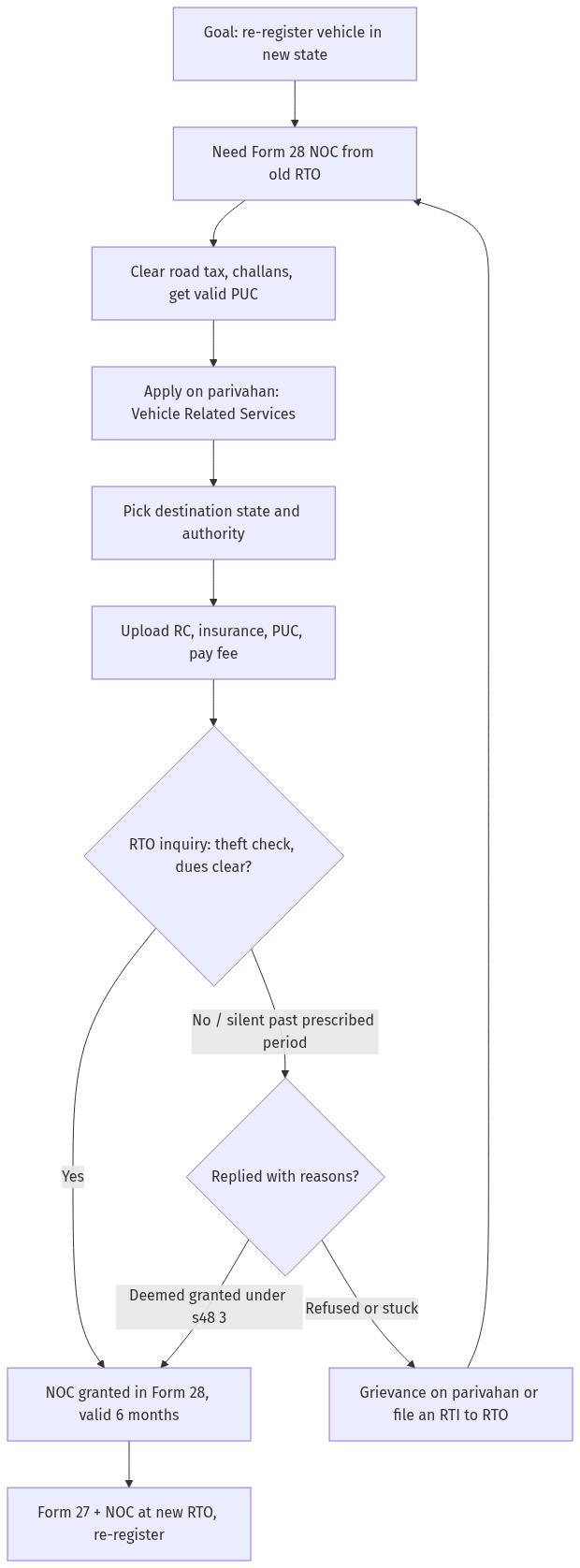
Figure: step-by-step flow. If a step stalls, use the grievance or RTI route shown.
If the NOC is refused or stuck
Run the logic backward here too. The NOC stalls for a reason, so find the reason and remove it.
- Refused with reasons: the order will name the blocker, usually unpaid tax, an open challan or a theft or hypothecation flag. Fix that specific item and re-apply.
- No response at all: note the prescribed period. Once it passes with neither a grant nor a written refusal, Section 48 treats the NOC as deemed granted. Quote this when you follow up.
- Still no movement: raise a grievance on the parivahan grievance link, and if the RTO keeps silent, file an RTI to the State Transport Department asking the status of your Form 28 application, the date of decision and the reason for any delay. An RTI often unfreezes a file faster than repeat visits.
You can keep an eye on the file the same way you track other RTO work, using the application status method explained here.
Frequently asked questions
Do I need an RTO NOC to sell my car in the same city?
Usually no. A same-RTO sale needs a clean RC, paid dues and an ownership transfer, not an inter-state Form 28. You need the Form 28 NOC mainly when the vehicle will be re-registered in a different state or RTO jurisdiction.
How long is a Form 28 NOC valid?
A Form 28 NOC is commonly cited as valid for about 6 months from the date it is issued. Re-register the vehicle at the new state RTO within that window, and confirm the current validity for your state on parivahan.gov.in. If it lapses, you must apply for a fresh NOC.
What does an RTO NOC cost?
The Central Motor Vehicles Rules do not set one nationwide NOC grant fee, so your state RTO charges a small statutory amount. Verify the current figure for your state on parivahan.gov.in. Delaying re-registration can add Rs 300 per month for a motor cycle and Rs 500 per month for other vehicles.
Can I apply for the NOC online?
Yes. On parivahan.gov.in, go to Online Services, then Vehicle Related Services, enter your vehicle number, choose Application for No Objection Certificate, select the destination state, upload your RC, insurance and PUC, and pay. Some states still need a physical visit to finish, so check yours.
What if the RTO does not respond to my NOC application?
Section 48 of the Motor Vehicles Act protects you. If the RTO neither grants the NOC nor sends a written refusal within the prescribed period, the NOC is deemed to have been granted. Cite this when following up, raise a parivahan grievance, and file an RTI if it stays stuck.
Will pending challans block my NOC?
Yes. The RTO inquiry checks for unpaid road tax and open traffic challans, and a theft or NCRB flag. Clear all pending challans and confirm your tax receipts before you apply, so the inquiry finds nothing to hold up.
Is the bank NOC the same as the RTO NOC?
No. If your vehicle is under loan or hypothecation, the financier issues its own NOC clearing the lien. That is separate from the RTO Form 28 NOC for moving states. You may need both depending on your situation.
Sources
- https://www.indiacode.nic.in (Motor Vehicles Act 1988, sections 47 and 48)
Transfer vehicle RC ownership, check and pay eChallan, duplicate RC and DL and track your RTO application status are useful companion guides.
RTO NOC for vehicle transfer: How to get No Objection Certificate and what if refused?
The RTO No Objection Certificate (NOC) is required for vehicle transfer or re-registration in another state. Here is the complete guide:
- Step 1: When is RTO NOC required? (a) selling a vehicle to a buyer in another state, (b) re-registering a vehicle in another state (after moving), © transferring vehicle ownership, (d) the NOC confirms that there are no pending dues (tax, challans, insurance) on the vehicle.
- Step 2: How to apply. (a) apply at the original RTO where the vehicle is registered, (b) fill Form 28 (application for NOC), © submit: RC book, insurance certificate, PUC certificate, address proof, vehicle photos, (d) pay the NOC fee (varies by state, typically Rs 100-500), (e) the RTO issues the NOC within 7-30 days.
- Step 3: Online application. (a) apply through the Parivahan portal — parivahan.gov.in, (b) upload documents online, © visit the RTO for physical verification, (d) the NOC can be downloaded from the portal once issued.
- Step 4: Common problems. (a) RTO refuses NOC citing pending tax — pay the tax and get receipt, then re-apply, (b) RTO refuses citing pending challans — clear challans on the e-challan portal, then re-apply, © RTO delays beyond 30 days — file RTI, (d) vehicle hypothecated to bank — get NOC from bank first (foreclosure or transfer NOC).
- Step 5: If RTO refuses NOC. (a) ask for the refusal in writing, (b) file RTI asking for the reason and the status of the application, © file a complaint with the Transport Commissioner, (d) file a writ petition before the High Court (mandamus directing RTO to issue NOC).
- Step 6: NOC validity. (a) the NOC is valid for 30 days from the date of issue (some states allow 90 days), (b) after expiry, the vehicle cannot be re-registered in the new state without a fresh NOC, © if the buyer does not re-register within the validity period, the seller remains liable for the vehicle.
- Step 7: File RTI. File RTI with the RTO asking for: (a) the status of the NOC application, (b) the reason for delay, © the number of NOC applications pending beyond 30 days.
See Driving Licence Disqualified and RTO NOC.