Table of Contents
SIR Name-Mismatch Notice: Hearing Help - Citizen Guide 2026
Received a BLO notice because your name differs from the previous voter list? Attend the hearing with your notice, the relevant old electoral-roll entry, and original supporting documents with self-attested copies. Give the officer a short written explanation linking the two names. Ask for an acknowledgement and the recorded decision.
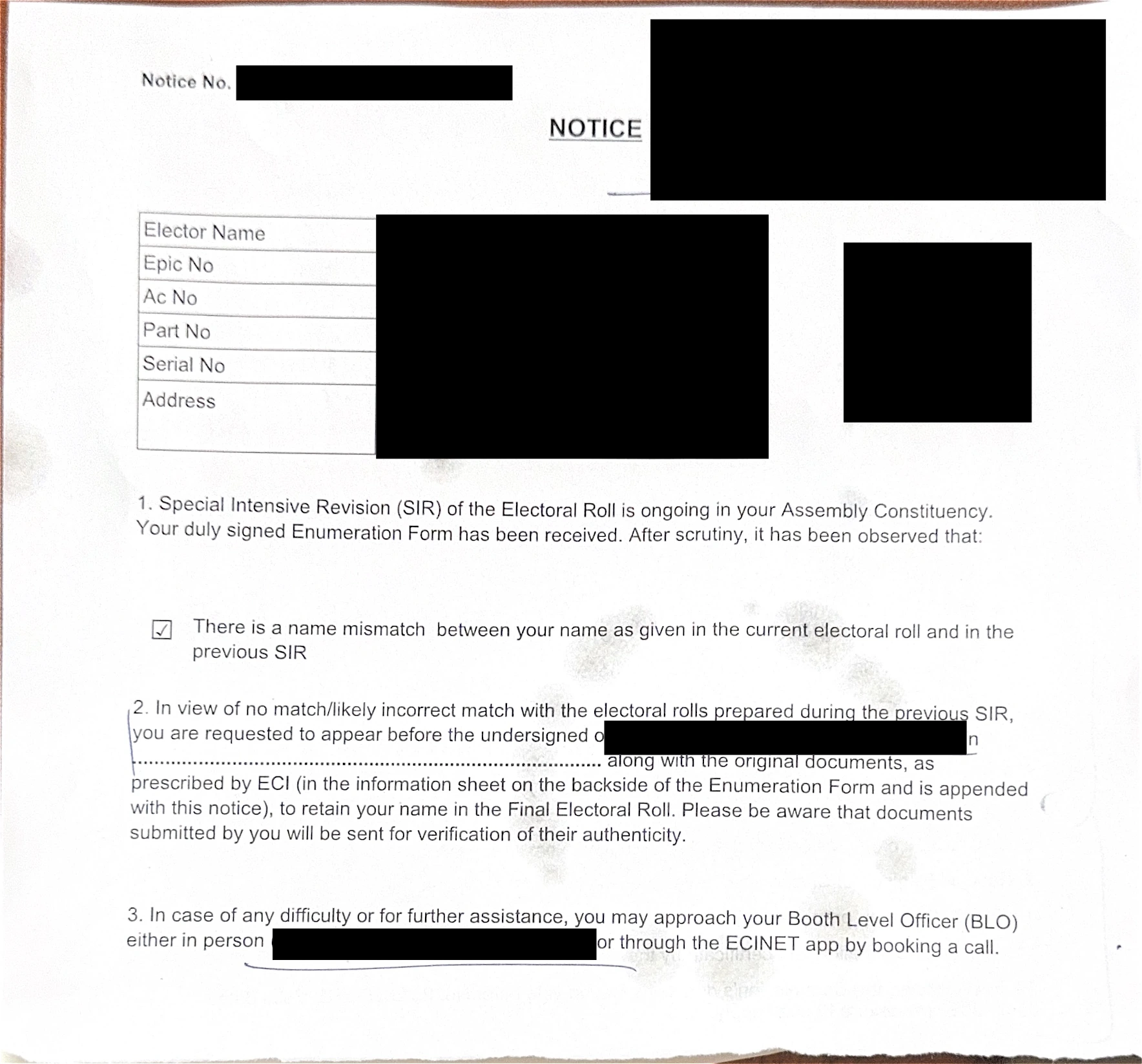
Reader-supplied notice, redacted for public education. Names, address, voter and notice identifiers, QR code, officer contact and appointment details have been removed. This copy is an example, not an official blank form or a notice addressed to the reader. Download the redacted two-page notice .
Quick answer: A name-mismatch notice is a request to resolve a discrepancy. It is not, by itself, a deletion order or a finding that you gave false information. Respond to the specific mismatch, attend on your own notice's date, submit genuine evidence, and keep proof of everything you submit.
Short on time? Prepare the comparison table below, print the short reply, and take the documents relevant to your case. The first question at the hearing is: “Please show me both entries and the exact difference that triggered this notice.”
Last checked: 15 September 2026. This guide concerns ECI electoral-roll proceedings. The Delhi schedule below is state-specific. A reader's own notice, applicable ECI directions and any case-specific court order determine the next step.
What this notice means
A Special Intensive Revision, or SIR, checks an electoral roll against eligibility requirements and earlier records. A name-mismatch notice asks an elector to explain a difference between the current entry and the previous SIR record. The issue may involve spelling, initials, a changed surname, or an incorrect match to an old entry.
The supplied notice says a signed Enumeration Form was received. Its selected reason concerns the elector's own name in the current roll compared with the previous SIR. It asks for attendance and original documents. It does not reproduce both names being compared, so the precise difference cannot be determined from the notice alone.
That distinction matters. Do not assume this is an Aadhaar mismatch, a parent's-name mismatch, or a finding about citizenship. Ask which entry was matched and what needs to be established. The CEO Delhi Enumeration Form information sheet describes notices where earlier SIR details are unavailable or do not match the database.
The published image shows the kind of notice received. Its appearance alone does not authenticate an individual notice; confirm yours through the election office or official voter portal.
Before the visit: make a small evidence file
1. Confirm the notice and your current roll entry
Use the ECI Voters' Service Portal, the ECINET app, or your election office. Check your EPIC number, constituency, and current entry. Confirm the hearing's location, time, and deciding officer through an official contact.
For Delhi, the CEO Delhi SIR page links to the current draft roll, the 2002 roll, BLO details and constituency mapping. If you lived in another state during the last SIR, search that state's relevant earlier roll. A missing Delhi 2002 entry does not establish that you were missing from every state's roll.
You can also use 1950 or the portal's Book a Call with BLO service for assistance. These routes are listed in the CEO Delhi SIR FAQ. Do not post your full notice or QR code in a public group to seek help.
2. Identify exactly what is different
Prepare a one-page comparison. Copy spellings faithfully, including the regional-language version. Do not silently “correct” the old entry while copying it.
| Record | What to write down | What to attach or ask for |
|---|---|---|
| Current electoral roll | Name exactly as printed; EPIC, constituency, part and serial | Printout of your entry |
| Previous SIR roll | Name exactly as printed; state, year, old constituency, part and serial | Relevant old roll extract, including its heading |
| Document supporting your explanation | Issuing authority, date and exact name | Original for inspection and a self-attested copy |
| Explanation | Spelling difference, initials, name order, surname change, or wrong-person mapping | A short factual statement and documents supporting it |
If the old entry is not yours, say so. Ask for the mapping to be checked. Do not claim another person's entry merely because the name looks similar.
If the current name is correct and the old record differs, explain the link. Ask whether the officer needs supporting evidence for mapping, a correction to the current roll, or both. Those are different questions.
3. Carry originals, self-attested copies and a written reply
Recommended hearing file:
- Your original notice and a copy.
- Your Enumeration Form copy or acknowledgement, if available.
- Current electoral-roll entry and EPIC card.
- Relevant previous SIR roll extract, if located.
- Original documents relevant to the notice, with signed and dated photocopies.
- Your comparison table and two copies of the short reply below.
- Existing marriage, name-change or other linking records, where they explain the difference.
- Any earlier application, hearing reply, acknowledgement or correction order about the same entry.
The extra copy is for your own receipt. Show originals for verification. Ask for them back after inspection. If an office says it must retain an original, ask for the reason and an itemised receipt.
Which documents are relevant?
The reverse of the supplied notice calls its list indicative, not exhaustive. That is not an instruction to obtain every listed document. Select genuine records relevant to what the officer needs to verify. Ask the ERO how an alternative document will be assessed if a listed record is unavailable.
The notice lists these categories:
- Government or public-sector employee identity card, or pension payment order.
- Specified government, local-authority, bank, post-office, LIC or PSU records issued before 1 July 1987.
- Birth certificate from the competent authority.
- Passport.
- Matriculation or educational certificate from a recognised board or university.
- Permanent residence certificate from the competent state authority.
- Forest rights certificate.
- Caste certificate issued by the competent authority.
- National Register of Citizens entry, where such a register exists.
- Family register prepared by state or local authorities.
- Government land or house allotment certificate.
- Aadhaar, subject to ECI's directions dated 9 September 2025.
This list can also be checked in the official Delhi Enumeration Form information sheet. A recent bank statement is not the pre-July 1987 record described in item 2. A residence document and a document explaining an old name may answer different questions.
Are parents' documents always required?
No blanket demand should be inferred from the phrase “name mismatch”. Check the category and the specific issue with the ERO. The Delhi information sheet sets out the following documentary categories for recipients of notices:
| Birth category in the information sheet | Documents described there |
|---|---|
| Born in India before 1 July 1987 | Document for self establishing date and/or place of birth |
| Born in India from 1 July 1987 through 2 December 2004 | Documents for self and either father or mother |
| Born in India after 2 December 2004 | Documents for self and both parents; additional passport/visa evidence if a parent was not Indian |
| Born abroad, or citizenship obtained through registration or naturalisation | The relevant Indian Mission birth-registration or citizenship-registration evidence specified in the sheet |
These are the published document categories, not a decision about an individual's citizenship. If a parent is deceased, a record cannot be found, or the category is unclear, explain this in writing and request guidance on available evidence. Do not invent a date, birthplace or family link to complete a form.
Does Aadhaar settle the matter?
Aadhaar can establish identity within the applicable directions. It does not by itself establish citizenship. ECI's letter No. 23/2025-ERS/Vol.II dated 9 September 2025 treats it as the twelfth document and explains this limit. See Annexure II, PDF pages 23–24 of the official ECI compilation hosted by CEO Kerala.
Take additional records where the question is an old-roll link, birth information or a relationship. Having the same spelling on Aadhaar and the current EPIC does not, by itself, explain a different name in the previous SIR.
Do I need an affidavit or Gazette name change?
There is no universal affidavit or Gazette requirement stated in this notice. If an actual legal name change occurred, take the relevant existing records. For a spelling or transliteration difference, begin with the records and explanation. If additional evidence is required, ask for the specific deficiency and applicable direction in writing. An affidavit alone does not guarantee acceptance.
At the hearing: what to say and ask
The Booth Level Officer (BLO) helps with field verification and delivery of notices. The Electoral Registration Officer (ERO) decides electoral-roll matters; an Assistant ERO (AERO) can perform authorised functions under the ERO's control. Sections 13B and 13C of the Representation of the People Act, 1950 establish these roles. Confirm who is hearing your case. A verbal assurance from the person delivering a notice is not the recorded disposal of it.
- Show the notice and ask for the exact discrepancy. “Which current entry and which earlier SIR entry are being compared? May I see or receive a copy of the relevant extract?”
- Explain the difference briefly. “These records refer to the same person because [facts supported by your documents]. The difference is [describe it].” If the match is wrong, say that instead.
- Hand over your comparison and evidence. Point to the exact field in each document. Ask that your written explanation and enclosure list be placed on the record.
- Clarify the scope. “Is this only a name-linkage discrepancy, or is any other eligibility issue being examined? Which further document is required for that issue?”
- Read before signing. Ask for the statement to be read or explained in a language you understand. Request correction of an inaccurate transcription before signing. Never sign a blank statement.
- Get proof of submission. Request a dated acknowledgement on your copy, listing the documents received and the notice or case reference.
- Ask how the decision will be communicated. “Is any further visit required? How can I obtain the recorded decision and check the final roll?”
This is a suggested meeting approach, not a prescribed ECI script. The aim is a clear explanation supported by a traceable set of records.
A simple Hindi opening:
मेरे वर्तमान मतदाता रिकॉर्ड और पिछली SIR की प्रविष्टि में नाम का अंतर बताया गया है। कृपया दोनों प्रविष्टियाँ और सटीक अंतर दिखाएँ। मैंने अपना लिखित स्पष्टीकरण और संबंधित दस्तावेज़ साथ रखे हैं। कृपया इन्हें रिकॉर्ड पर लेकर प्राप्ति दें और निर्णय की जानकारी दें।
If you cannot attend, or need more time
Contact the ERO before the appointment where possible. Submit a written request explaining the difficulty, attach supporting material, and request another date or an available assisted procedure. Keep proof of submission and ask for a written response.
Do not assume that a relative, a BLO visit, or an online upload automatically replaces personal attendance. Rule 20(3) of the Registration of Electors Rules permits the registration officer to require personal appearance in a claims-and-objections inquiry. A request for an adjournment is not an adjournment until accepted.
If you missed the hearing, approach the ERO promptly, submit your explanation and ask whether a decision has already been made. If there is an adverse order, obtain it and check the appeal deadline immediately.
A short reply to take to the officer
Use this as an ordinary written representation. Complete only statements that are true. It does not replace a prescribed form or declaration requested by the election office.
To: The Electoral Registration Officer / authorised hearing officer
[Assembly constituency, district and state]

Subject: Reply to SIR name-mismatch notice [reference]

I have received the above notice concerning a difference between my name
in the current electoral roll and the previous SIR record.

Current entry: [exact name, EPIC, constituency, part and serial]
Earlier entry: [exact name, state, year, old constituency, part and serial]

My explanation is: [briefly state the actual difference and supporting facts].

[If applicable: I cannot identify the earlier entry used for comparison.
Please provide or show me that entry so I can respond accurately.]

I enclose a comparison sheet and the following supporting documents:
1. [Document and what it establishes]
2. [Document and what it establishes]
3. [Document and what it establishes]

Please take this reply and the documents on record, verify the relevant
entries, and resolve the discrepancy in accordance with law. Please tell
me in writing if further evidence is needed and provide the recorded
decision. I request an acknowledgement of this submission.

[Name and signature of elector]
[Date, contact details and address for communication]
Which sections is ECI relying on?
There are two different legal questions: the power to revise and decide the roll, and the warning against knowingly false information.
The supplied notice explicitly prints BNS Section 217 and RPA 1950 Section 31 on its reverse. It does not print a complete legal basis for the SIR on its face. The broader authority comes from the law and ECI directions, including the framework described by CEO Delhi and the Supreme Court.
| Provision | Relevance to this notice |
|---|---|
| Constitution, Article 324 | ECI's control over preparation of electoral rolls and elections |
| RPA 1950, Section 21, particularly 21(3) | Preparation and revision, including the power to direct a special revision |
| RPA 1950, Sections 13B and 13C | ERO and AERO functions |
| RPA 1950, Section 22 | Correction and specified deletion/transposition powers, with a hearing safeguard for the actions covered by its proviso |
| Registration of Electors Rules 1960, Rules 19 and 20 | Notice and inquiry when deciding claims and objections |
| Registration of Electors Rules 1960, Rule 21A | Procedure and opportunity to show cause for relevant proposed deletions before final publication |
| RPA 1950, Section 24; Rules 23/27 as applicable | Appeal routes depend on the type of order and proceeding |
| RPA 1950, Section 31 | Knowingly false written electoral-roll statements or declarations |
| BNS 2023, Section 217 | False information given with the knowledge and intended or likely consequences specified in that section |
Source notes: The CEO Delhi SIR FAQ identifies Article 324 and Section 21. The RPA text hosted by CEO Delhi supplies Sections 13B, 13C, 21, 22 and 31. Its older appeal text should not be used for current routing; use current directions and the decision itself. The Registration of Electors Rules set out the cited hearing safeguards. Not every provision in this table is expressly invoked by every notice.
What the Supreme Court has said
In Association for Democratic Reforms v. Election Commission of India, 2026 INSC 564, decided 27 May 2026, the Supreme Court upheld the Bihar SIR under Section 21(3) read with Article 324. Its reasoning discusses preservation of notice-and-hearing safeguards and limits on electoral inquiries into citizenship. See paragraphs 130–144 and 174–186 of the judgment hosted by CEO Goa.
That judgment supports the broader legal framework. It does not determine whether this particular reader's mismatch is correct or whether an individual notice was properly issued. Those facts must be addressed in the person's proceeding.
Does a spelling difference amount to an offence?
Not merely because two records differ. Section 31 concerns a false written statement or declaration which the maker knows or believes is false, or does not believe to be true. It provides for imprisonment up to one year, or a fine, or both. The same warning appears in ECI's Form 8 guidelines.
BNS Section 217 is also more specific than a generic warning about incorrect information. It concerns information known or believed to be false, given intending or knowing it likely to cause the public servant to act or omit to act improperly, or to use lawful power to injure or annoy someone. Its maximum punishment is one year's imprisonment, a fine up to ₹10,000, or both. See Section 217 in the Bureau of Police Research and Development's BNS text.
An honest discrepancy should be explained with genuine records. Do not alter a certificate, make up a family link, backdate a document or sign an explanation you know is wrong. The printed warning is not, by itself, a finding that its offence conditions are met.
Is Form 8 required as well?
Use Form 8 when an existing electoral-roll entry needs correction. The official Form 8 guidelines require a document supporting the requested correction.
If your current entry is correct and only the link to the previous SIR is disputed, first respond to that discrepancy. Ask whether any current entry actually needs changing. Filing Form 8 does not establish that the hearing notice has been cancelled.
If your name is absent from the draft, check the applicable Form 6 plus declaration claim procedure for your revision. The official ECI forms page distinguishes inclusion and correction forms. Keep separate references for a hearing reply and any correction or inclusion application.
Delhi's current SIR dates
As checked on 15 September 2026, CEO Delhi's 19 August revised schedule, also reflected in its current FAQ, gives these dates:
| Activity | Published Delhi schedule |
|---|---|
| Draft electoral roll | 31 August 2026 |
| Claims and objections | 31 August–30 September 2026 |
| Notice phase and disposal | 31 August–29 October 2026 |
| Final publication | 4 November 2026 |
Source: CEO Delhi revised schedule, 19 August 2026, linked on its official website. Check the CEO Delhi website for later revisions. These dates do not extend the appointment printed on your notice. Other states have their own schedules.
After the meeting: decision, correction or appeal
- Keep the acknowledged reply, enclosure list and any further direction together.
- Check the relevant roll and application status. An upload acknowledgement shows submission, not acceptance of your explanation.
- If the decision is adverse, ask for the written order, its date, reasons, applicable provision and appeal details immediately.
- Follow the appeal route for that order. CEO Delhi's current FAQ describes a 15-day appeal to the concerned DEO/DM where a name is still absent from the final roll. Do not treat that FAQ as an extension of a deadline attached to an earlier order.
- Section 24 and Rule 27 provide the statutory appeal framework for relevant ERO orders. The Supreme Court's 2026 SIR judgment also describes first appeal to the District Magistrate and further appeal to the CEO. Rule 23 separately governs specified revision-stage decisions. Check which route applies to your order and seek legal help promptly if unclear.
- An ordinary grievance or an RTI application does not automatically stay the decision or pause an electoral appeal deadline.
For status records, see RTI for voter ID delay. For the underlying law of access to records, see the RTI Act guide.
Use RTI for the records behind the mismatch
First request the relevant records directly at the hearing. If they are not supplied, an RTI can seek the existing record of what was compared, what was submitted and what was decided. It cannot itself correct the voter list. Do not wait for an RTI reply before responding to the notice or filing a time-sensitive appeal.
Address the request to the PIO of the authority holding the records. For a Delhi election-office file, use the PIO directory or Delhi RTI route linked by the CEO Delhi website. For a central ECI instruction, use ECI's relevant RTI route. Choose the record holder rather than sending every request to ECI headquarters.
Subject: RTI application under Section 6(1), RTI Act 2005
Records concerning SIR notice [reference] and my electoral entry

Please provide certified copies or electronic copies of:
1. The notice and the recorded reason/discrepancy for issuing it to me.
2. My current entry and the previous SIR entry used for comparison,
   including their state, year, constituency, part and serial details.
3. My Enumeration Form and the scrutiny/verification report concerning it.
4. The applicable ECI/CEO instructions on name mismatch and documents.
5. The record of receipt of my reply/documents dated [date], the hearing
   proceedings, and the decision/order, if made.
6. The recorded current status and date-wise action on my case.

If information is held by another public authority, please transfer the
relevant part under Section 6(3) and inform me. If a portion is exempt,
please apply Section 10 and provide the reasonably severable remainder,
with the legal reasons for any refusal.

[Applicant name, communication address, date and signature]
[Prescribed fee details or applicable exemption]
The normal response period is 30 days under Section 7(1), subject to the Act's applicable provisions. Section 6(3) specifies transfer within five days. Section 19(1) provides the first-appeal route for non-response or an adverse RTI decision. These are RTI deadlines, not deadlines for resolving the SIR hearing. See the RTI Act published by DoPT.
For help preparing a records request, use the AI RTI Drafter. The First Appeal Builder is for an RTI first appeal, not an electoral-roll appeal.
Common mistakes to avoid
- Assuming the notice proves wrongdoing. Sections 31 and 217 have specific false-information conditions; a discrepancy alone does not establish them.
- Ignoring the hearing because your EPIC exists. Respond to the revision inquiry; relevant hearing and deletion safeguards are in Rules 19–21A.
- Changing the wrong record. Form 8 is for an existing entry that actually needs correction; explain a disputed old-roll match separately.
- Buying an affidavit before identifying the problem. The supplied notice does not make one universally compulsory. Follow its document instructions and ask what remains deficient.
- Treating Aadhaar as complete citizenship evidence. ECI's 9 September 2025 direction expressly distinguishes identity from citizenship.
- Waiting for RTI before appealing. RTI Section 7(1) and electoral appeal provisions run separately.
What the redacted example teaches
The two-page example contains a selected self-name mismatch, an appointment request, a document list and false-declaration warnings. It does not contain the earlier name being compared or a final decision. No hearing outcome, acceptance or restoration has been established for this example.
The useful response is therefore an evidence file: ask for the old entry, explain the actual difference, submit genuine records, and obtain proof of submission.
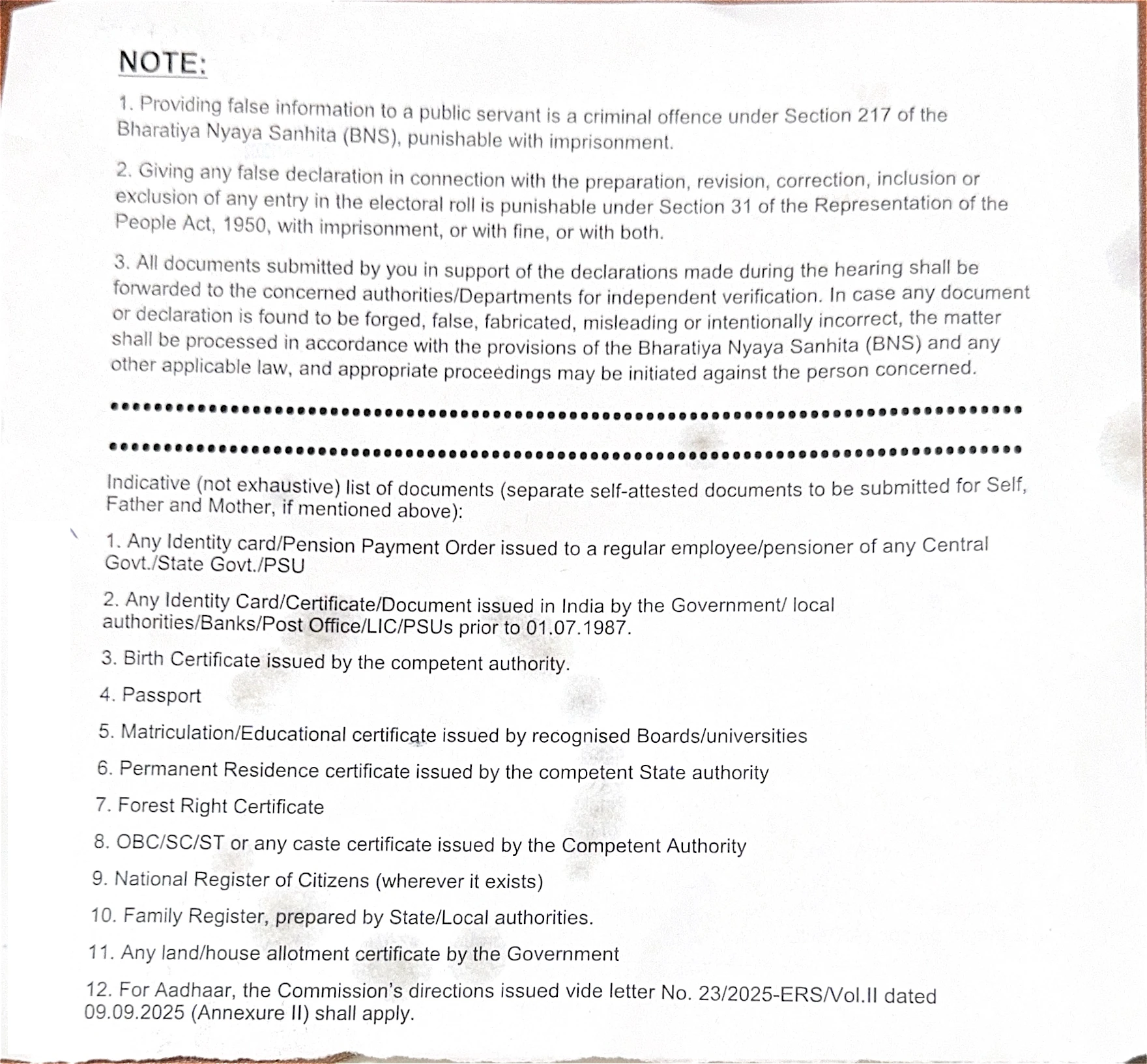
Reverse of the same example. Read the legal explanation above alongside the printed warning. Download both redacted pages .
Frequently asked questions
Does the notice mean my name has already been deleted?
Not by itself. This example requests attendance and evidence. Check your current entry and whether an order has been issued. Respond by the appointment on your notice.
Is this the same as an Aadhaar-name mismatch?
No. The example compares the current electoral roll with the previous SIR. An Aadhaar mismatch can affect a separate authentication process. Ask which two records are in dispute.
What if the spelling differs only in English or Hindi?
Bring both language versions if available. Identify whether the difference is transliteration, initials, name order or something else. Ask the officer to record your explanation and compare the accompanying identifiers. Acceptance depends on verification, not spelling alone.
What if I cannot find the previous SIR entry?
Ask the BLO or ERO for the specific old record used in the mismatch. Search the relevant state and earlier address, with reasonable spelling variations. Attend with available records and explain the gap. Do not borrow a similar entry belonging to somebody else.
Can my family member attend for me?
Ask the hearing officer in advance. The ability to help with an Enumeration Form does not automatically confer permission to replace the elector at a hearing. Personal attendance may be required. Obtain a response to any accommodation request.
Must I obtain all 12 documents?
The notice describes an indicative list. Take documents relevant to your category and the issue raised. Ask what each further requested document needs to establish. A document in one category does not necessarily prove every eligibility fact.
Can I upload documents and skip the appointment?
Do not assume that. Save the upload receipt and ask whether the officer has dispensed with attendance. Follow the notice unless a changed arrangement is confirmed.
Can an RTI force the ERO to accept my explanation?
An RTI obtains records. The ERO or the relevant appellate authority decides the electoral issue. Use RTI alongside the hearing or appeal, without allowing its reply period to consume your electoral deadline.
What to do in the next 30 minutes
- Read both sides of your own notice and note its appointment separately from the general SIR schedule.
- Find the current and old entries, or write a request asking the officer to show the old match.
- Complete the comparison sheet and a truthful short reply.
- Put the relevant originals and self-attested copies in a folder.
- Plan to request an acknowledgement, any written deficiency and the recorded decision.
Official sources and further reading
- CEO Delhi SIR portal: current notices, old-roll search and official service links.
- CEO Delhi SIR FAQ: local process, document categories, assistance and schedule.
- Delhi Enumeration Form and information sheet: mismatch notices, birth categories and indicative documents.
- RPA 1950 text hosted by CEO Delhi: cited provisions on officers, revision, hearing and false declarations; consult current directions for appeal routing.
- Registration of Electors Rules, CEO Kerala: cited hearing provisions; older form and appeal material must be read with later amendments and current instructions.
- Supreme Court judgment, 2026 INSC 564: SIR power, safeguards and limited electoral citizenship inquiry.
- ECI compilation with 9 September 2025 Aadhaar direction: Annexure II. The compilation's state-specific 2025 schedule is not Delhi's 2026 schedule.
- BNS text, Bureau of Police Research and Development: Section 217.
- RTI Act, DoPT: records requests and RTI appeals.