Table of Contents
How to Check a RERA Project 2026

Reviewed on 2026-06-20 by Dr. Shrawan Kumar Pathak.
Quick Reply: Treat the RERA number like a fingerprint. Open your state RERA portal, search Registered Projects by the number or builder name, and confirm the promoter, status, completion date and quarterly updates match the brochure. Under Section 3 of the RERA Act, a builder cannot legally sell an unregistered qualifying project.
Start with one question: is this project even registered?
Before you fall for the show flat, the gym render or the limited-time offer, behave like an investigator. Every claim a builder makes can be cross-checked against a public record that the builder themselves had to file. That record sits on your state RERA portal, and reading it costs nothing.
The Real Estate (Regulation and Development) Act, 2016 is a central law, but each state and union territory runs its own authority and its own website. Maharashtra has MahaRERA, Karnataka, Tamil Nadu, Telangana, Kerala and the rest each have a portal on a .gov.in address. Your first job is to open the right one for the state where the land sits, not where the builder's office is.
When registration is compulsory
Under Section 3(2)(a) of the Act, a project must be registered if the land area being developed is more than 500 square metres, or if more than eight apartments are proposed across all phases. If a salesperson tells you the project is “too small to need RERA”, count the units and ask for the plot size. Above either threshold, Section 3(1) makes it illegal to advertise, market, book or sell without a registration number. A missing number is your first red flag, not a technicality.
The paper trail: what the portal must show
When the authority registers a project, Section 11 forces the promoter to build a public web page and load every detail filed under Section 4. This is the heart of your investigation. A genuine listing will show you the promoter's legal name, the registration number, the current status, the original and revised completion dates, the carpet area, the approved layout and sanction plans, and a set of approvals such as building plan and environment clearance.
Follow the money: the 70 per cent rule
Section 4(2)(l)(D) requires the builder to declare on affidavit that 70 per cent of the money collected from buyers will sit in a separate project bank account, spent only on that project's land and construction. You will not see the bank statements, but the declaration is part of the registration. A builder who is vague about this when you ask in person, while the portal shows a clean declaration, is a contradiction worth probing.
Read the quarterly updates like a detective
The single most telling page is the quarterly update. Section 11(1) makes the promoter refresh the project status every quarter, including how many units are booked and sold and how far construction has reached. Open the latest quarter and the one a year earlier. If the completion date keeps sliding, or booked numbers jump while construction barely moves, the gap between the glossy pitch and the filed reality is now in front of you in black and white.
Your step-by-step verification
- Get the exact RERA number from the brochure, hoarding or builder, plus the project's spelt-out name.
- Open the RERA portal for the state where the project is located.
- Go to the Registered Projects search and enter the number, or the project and promoter name.
- Open the project page and match the promoter name, status and completion date against what you were told.
- Download the approved plans and approvals, and note any condition or pending approval.
- Open the latest quarterly update and an older one, and watch how dates and unit counts moved.
- Separately search Registered Agents for the broker's name, since under Section 9 agents must register too.
- Save screenshots and PDFs with the date, so you have a record if a dispute starts later.
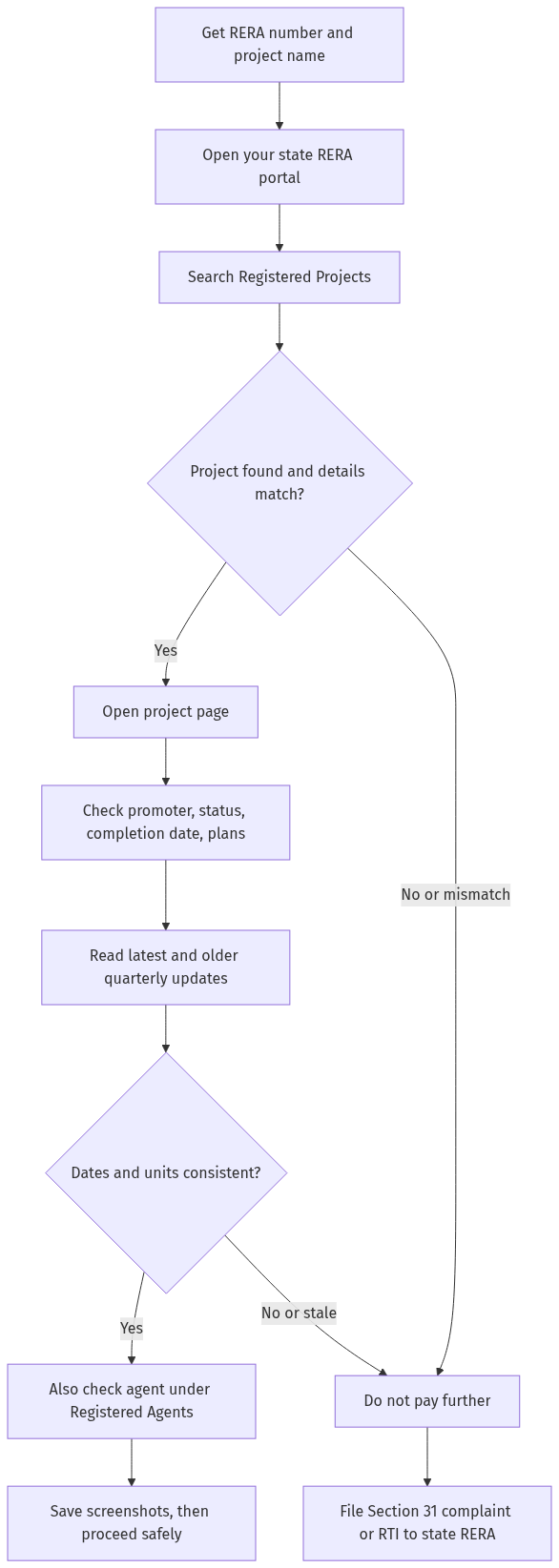
Figure: step-by-step flow. If a step stalls, use the grievance or RTI route shown.
If the project is not on the portal, or the page is hidden
Sometimes the search returns nothing, the page is half empty, or the builder gives you a number that does not match. Do not accept a verbal assurance. Under Section 31, any aggrieved person can file a complaint with the state authority against a promoter or agent for any contravention of the Act. The form, manner and fee are set by your state's rules, so check the current complaint fee on your state RERA portal rather than relying on a figure quoted to you.
Section 79 bars civil courts from hearing matters the authority is empowered to decide, so RERA, not a regular civil suit, is usually your forum. If the page is simply missing public information that the law requires, you can also file an RTI application with the authority asking for the project file, since a state RERA is a public authority. Our guide on a builder delay RERA complaint walks through the complaint route, and builder delayed possession remedies covers what you can claim if a registered project still runs late.
Before you sign anything
Verification does not end at the RERA page. Match the carpet area on the portal with the figure in your draft agreement, because the two must agree. Confirm the stamp duty and registration charges you will pay, understand the difference between a sale deed and an agreement to sell, and keep the home loan property documents checklist handy so your lender's list and the builder's papers line up.
A national unified RERA portal was launched in September 2025 to pull state data into one window, which may make cross-state searches easier over time. Treat it as a convenience, confirm its current address before trusting it, and keep your own state portal as the authoritative source.
Frequently asked questions
Where do I check a RERA number?
On the official RERA portal of the state or union territory where the project is located. Search the Registered Projects section by the RERA number, project name or promoter name. There is no single all-India search you should rely on yet, so start with the correct state portal.
What does a valid RERA number prove?
It proves the project is registered and that the builder has filed plans, approvals, a completion date and a financial declaration with the authority. It does not guarantee the project will finish on time or that quality will be perfect. It gives you a public record to hold the builder to.
Is every project required to have a RERA number?
No. Under Section 3(2)(a), registration is mandatory only when the land area exceeds 500 square metres or more than eight apartments are proposed. Smaller projects can be exempt. For any qualifying project, selling without registration is barred by Section 3.
The builder gave me a number but the portal shows nothing. What now?
Do not pay further. A mismatch or a blank page is a serious warning. You can lodge a complaint under Section 31 with your state authority against the promoter, and you can also seek the project file by RTI. Keep dated screenshots of every search you ran.
How recent should the project details be?
Section 11 requires quarterly updates, so the latest update should be from the current or previous quarter. Stale updates, or a completion date that keeps shifting across quarters, tell you the project is not moving as advertised.
Should I also check the broker?
Yes. Section 9 requires real estate agents to register with the state RERA. Search the Registered Agents section for the broker's name and number. An unregistered agent collecting bookings is itself a contravention you can report.
Can I take the builder to a normal civil court instead?
Usually not for matters RERA covers. Section 79 bars civil courts from entertaining suits the authority, adjudicating officer or appellate tribunal can decide. Most homebuyer disputes go to the state RERA first, with an appeal to the Real Estate Appellate Tribunal.