Table of Contents
Pay Holding / Property Tax Locally 2026
Reviewed on 2026-06-20 by Dr. Shrawan Kumar Pathak.
Quick Reply: Holding tax and property tax are the same yearly local levy. Find your holding number on an old receipt or demand notice, open your city or ULB municipal portal, search by ward and holding number, pay online, and download the receipt. Rates, rebates and due dates are set by your own ULB, so always confirm them there.
Holding tax at a glance
Keep this strip handy. It is the whole job in one screen.
- What it is: a yearly tax on land and buildings, charged by your municipality.
- Other names: holding tax (Bihar, Jharkhand, Odisha, West Bengal), property tax, house tax, assessment tax. Same thing.
- Who pays: the owner of record. Tenants usually do not, unless the lease says so.
- Your key number: the holding number (also called property ID, PID, or assessment number).
- Where to pay: your Urban Local Body (ULB) or city municipal portal, a counter, a common service centre, or net banking and UPI.
- Proof you must keep: the paid e-receipt for every year. It is needed for sale, loan, mutation and water or electricity connections.
- If the bill is wrong or no one fixes it: municipal grievance, then CPGRAMS at pgportal.gov.in, then an RTI.
Find your holding number first
You cannot pay until you know your holding number. Look in this order:
- Last year's paid tax receipt (it prints near the top).
- The demand notice or bill the municipality posted or pasted.
- The Khata, patta, or assessment register entry for the property.
- The ULB portal search: enter ward plus owner name plus door or holding number.
If you bought a flat or plot and the holding is still in the old owner's name, the number still works to pay, but get the name corrected so future receipts are in your name. Our guide on the property tax name change walks you through that.
How your tax is worked out
You do not need to do the maths by hand, but knowing the method tells you whether a demand looks right. Indian ULBs use one of three systems.
| Method | Tax is based on | Used by (examples) |
|---|---|---|
| Annual Rental Value (ARV) | the yearly rent the property could fetch | many older municipal bodies |
| Unit Area System (UAS) | a fixed rate per square foot or metre, times built-up area, times use and age factors | Delhi, Bengaluru, Patna, Kolkata |
| Capital Value System (CVS) | a percentage of the property's market value | Mumbai |
Your ULB uses exactly one of these. The rate, the slabs, and the multipliers are fixed by your municipality and change from time to time, so do not copy another city's figure. Confirm the current rate on your own ULB portal.
Pay in five steps
This is the fast path on almost every city portal.
- Open your ULB portal. Search the name of your municipal corporation or council plus “property tax”. Use the official site, not a private bill-pay app.
- Search your holding. Enter ward, holding number, or owner name. Your dues for each year appear.
- Clear old years first. Most portals will not let you pay the current year until past arrears are cleared.
- Pay online. Use UPI, net banking, or card. A counter or common service centre also works if you prefer cash.
- Download the receipt. Save the PDF and note the transaction ID. No receipt means no proof you paid.
Rebates and penalties: confirm, do not assume
- Early or full-year payment: many ULBs give a small rebate if you pay the whole year by an early cut-off date. The percentage and the date differ by city and change yearly, so verify the current rebate on your ULB portal.
- Arrears: unpaid tax usually attracts interest or a penalty each month. The longer you wait, the more you owe.
- Self-assessment: several cities let you self-assess and pay. If you understate the area or use, a later survey can raise a fresh demand with arrears.
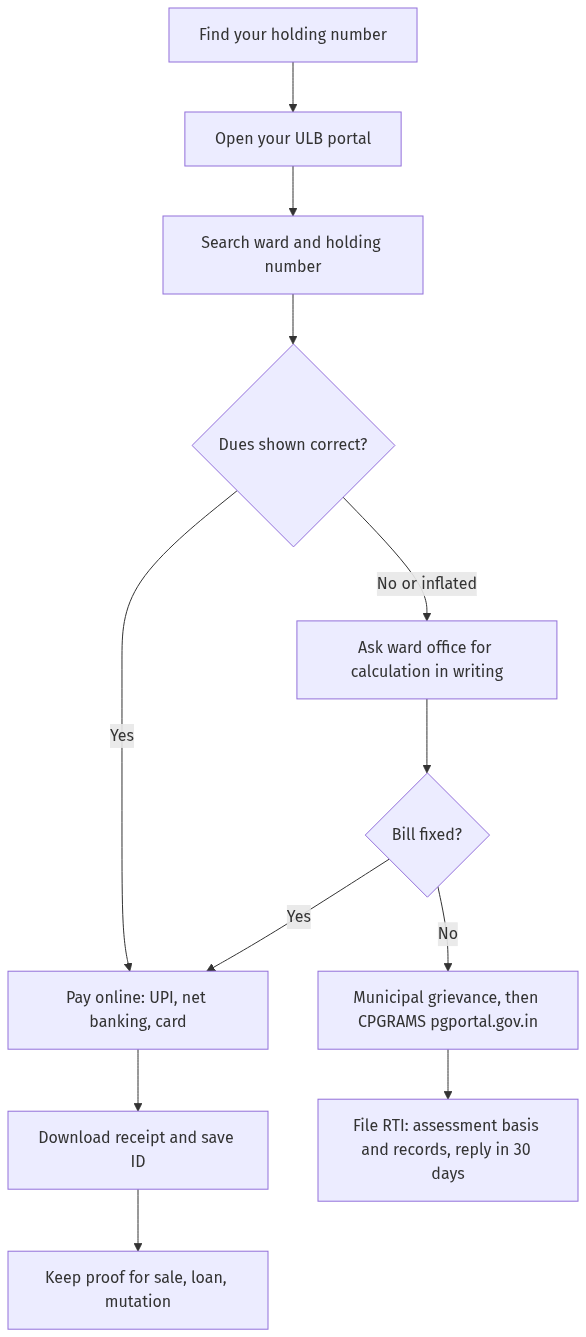
Figure: step-by-step flow. If a step stalls, use the grievance or RTI route shown.
When the demand is wrong or the portal fails
Do not just pay a bill you think is inflated, and do not ignore one either. Escalate in order.
- Raise it with the ward revenue office. Carry your old receipts, the demand notice, and proof of area or use. Ask for the calculation in writing.
- Use the municipal grievance channel. File on the ULB's grievance portal or helpline. Save the complaint number. Our municipal grievance guide shows how to make it stick.
- Escalate to CPGRAMS. If the city does not act, lodge the same grievance on the central portal at pgportal.gov.in and quote the earlier complaint number.
- File an RTI. Ask the Public Information Officer of your municipality for the assessment basis, the demand register entry, and the payment record for your holding. Under section 7(1) of the RTI Act 2005 the PIO must reply within 30 days. If there is no reply or it is unsatisfactory, file a First Appeal under section 19(1) to the First Appellate Authority, usually the Municipal Commissioner, and then a second appeal to the State Information Commission. The RTI fee is the amount set by your state, often around Rs 10, because a municipality is a state public authority.
An RTI is the cleanest way to force out the exact figures behind a disputed demand, and the paper trail it creates often gets the bill corrected without a fight.
Quick links you will also need
- Setting up a new home and need power too? See our new electricity connection guide.
- Running a shop or business from the property? Keep the trade licence renewal current alongside your tax.
Frequently asked questions
Is holding tax the same as property tax?
Yes. Holding tax is just the name used in much of eastern India, mainly Bihar, Jharkhand, Odisha and West Bengal. Elsewhere it is called property tax or house tax. It is the same yearly municipal levy on land and buildings, and your holding number is your property ID.
Where do I pay my holding tax online?
On your own city or ULB municipal portal. Search your municipal corporation or council name plus “property tax”, or start from your state urban development department site. Avoid private bill-pay apps and always download the official receipt from the ULB portal itself.
What is a holding number and where do I find it?
It is the unique ID for your property in the municipal register, also called property ID, PID or assessment number. Find it on last year's receipt, the demand notice, your Khata or patta, or by searching the ULB portal with your ward and owner name.
Why is my property tax different from my neighbour's?
Tax depends on the method your ULB uses, your built-up area, the use of the property, its age, and the locality rate. A bigger area, commercial use, or a higher-value zone all raise the demand. If yours still looks wrong, ask the ward office for the calculation in writing.
Can I get a rebate for paying early?
Often yes. Many ULBs offer a small rebate for paying the full year by an early cut-off date, but the percentage and deadline differ by city and change each year. Do not rely on another city's figure. Confirm the current rebate and date on your own ULB portal before you pay.
What happens if I do not pay holding tax?
Unpaid tax usually attracts monthly interest or a penalty, and arrears must be cleared before you can pay the current year, get a no-dues certificate, or complete a sale or loan. Long defaults can lead to recovery action by the municipality.
The municipality sent a wrong or inflated bill. What can I do?
First ask the ward revenue office for the calculation in writing. If that fails, use the municipal grievance channel, then CPGRAMS at pgportal.gov.in. To pin down the exact figures, file an RTI for the assessment basis and payment record; the PIO must reply within 30 days.
Do tenants have to pay holding tax?
Usually no. The owner of record is liable. A tenant pays only if the rent agreement specifically makes them responsible. If your landlord asks you to pay, get it in writing and keep every receipt for your own protection.
Sources
Municipal holding tax: Assessment and dispute resolution (2026)
- Step 1: What is municipal holding tax and how to dispute? (a) Holding tax: (i) property tax levied by municipality — residential/commercial, (ii) includes: property tax + water tax + sewage tax + lighting tax, (iii) assessment: municipal authority assesses annual value, (b) key rules: (i) Municipal Act (state-specific): property tax assessment, (ii) tax based on: annual rental value or capital value or unit area method, (iii) dispute: assessment too high — can appeal, © common scenarios: (i) holding tax too high — over-assessed, (ii) tax paid but receipt not generated, (iii) property wrongly classified — residential vs commercial, (iv) arrears disputed — old dues, (v) rebate not given — for early payment, (d) rights: (i) property owner has right to fair assessment, (ii) right to appeal — Assessment Revision, (iii) right to rebate — early payment, (e) authority: Municipal Corporation + Municipal Commissioner + Revisional Authority, (f) law: State Municipal Act + Property Tax Bye-laws.
- Step 2: Comparison table — holding tax dispute scenarios. (a) Over-assessed: (i) issue: annual value too high, (ii) remedy: revision petition + evidence, (iii) timeline: 30-90 days, (iv) example: over-assessed; revised; reduced, (b) Receipt not generated: (i) issue: tax paid but no receipt, (ii) remedy: bank proof + municipal complaint, (iii) timeline: 15 days, (iv) example: paid; complained; receipt issued, © Wrong classification: (i) issue: residential taxed as commercial, (ii) remedy: revision + property docs, (iii) timeline: 30-60 days, (iv) example: wrong; revised; corrected, (d) Arrears disputed: (i) issue: old arrears disputed, (ii) remedy: RTI + revision, (iii) timeline: 60 days, (iv) example: disputed; RTI; corrected, (e) Rebate denied: (i) issue: early payment rebate not given, (ii) remedy: complaint + receipt, (iii) timeline: 15 days, (iv) example: denied; complained; rebate given. (Note: Revision petition to Municipal Commissioner. RTI for assessment details. Rebate for early payment is mandatory.)
- Step 3: How to dispute holding tax assessment. (a) Step 1: Obtain assessment order — from municipality, (b) Step 2: File revision petition — to Municipal Commissioner, © Step 3: Attach evidence — property docs + comparable properties, (d) Step 4: Hearing — present case, (e) Step 5: Revised assessment — if accepted, (f) Step 6: Appeal — to Revisional Authority if rejected.
- Step 5: Practical tips. (a) check assessment method — UAS/RV/CV, (b) compare with similar properties — evidence, © file revision within 30 days — of assessment, (d) RTI for assessment details — very effective, (e) Example: A property owner's holding tax was over-assessed by 40%; filed revision; reduced by 30%.
- Step 6: Key provisions. (a) State Municipal Act, (b) Property Tax Bye-laws, © UAS/RV/CV: assessment methods, (d) Revision: 30 days, (e) Rebate: early payment.
See Holding Tax and Municipal and How to File RTI.