Table of Contents
Maintenance Under Section 125 CrPC 2026
Reviewed on 2026-06-20 by Dr. Shrawan Kumar Pathak.
Quick Reply: A wife, child or parent who cannot maintain themselves can ask a first-class Magistrate or Family Court for a monthly allowance under Section 125 CrPC, now re-enacted as Section 144 BNSS. The Supreme Court rule in Rajnesh v Neha makes maintenance payable from the date you apply, so file early.
The courtroom has spoken on this section more often than almost any other, and that is the best news for an applicant. You do not have to argue the law from scratch. Decades of Supreme Court judgments have already settled who can claim, how the figure is fixed and how to stop a wealthy spouse from stalling. This guide walks you through that settled law and the exact steps that follow from it.
One section, two names
If you searched for “Section 125 CrPC”, you found the right provision. From 1 July 2024 the old Code of Criminal Procedure was replaced by the Bharatiya Nagarik Suraksha Sanhita, 2023. The maintenance section now lives at Section 144 BNSS, with the same words and the same reach. Cases filed before that date continue under Section 125. Whichever number applies to you, the rights below are identical, so this guide treats them as one.
Who the law lets claim
The section protects four classes of people who cannot maintain themselves:
- a wife, including a divorced wife who has not remarried;
- a **minor child**, legitimate or illegitimate;
- a major child (not a married daughter) who cannot earn because of a physical or mental disability or injury;
- a father or mother unable to support themselves.
A landmark Constitution Bench, in Mohd. Ahmed Khan v Shah Bano Begum (1985), settled that this remedy cuts across personal law. A divorced Muslim woman who cannot maintain herself was held entitled to maintenance under this very section. That principle still governs.
The 2024 ruling worth knowing
The Supreme Court reaffirmed the same idea in Mohd Abdul Samad v State of Telangana, 2024 INSC 506, decided on 10 July 2024. Justices B.V. Nagarathna and Augustine George Masih held that a divorced Muslim woman may seek maintenance under Section 125 CrPC even after the Muslim Women (Protection of Rights on Divorce) Act, 1986. The two remedies coexist; she may choose either or both, though she cannot be paid twice for the same period. If your right is being denied on a personal-law argument, this is the precedent to cite.
How a Magistrate fixes the figure
There is no fixed percentage in the statute. The court weighs your reasonable needs, the standard of living during the marriage, your own income if any, and the other side's income, assets and genuine liabilities. The guiding voice here is Shamima Farooqui v Shahid Khan (2015), where the Supreme Court warned that maintenance must be realistic and not meagre, so that the claimant can live with the dignity she knew in the matrimonial home.
You may read that some courts award around a quarter of the paying spouse's net salary. That figure traces to Kalyan Dey Chowdhury v Rita Dey Chowdhury, (2017) 14 SCC 200, where 25 per cent of net salary was held just and proper on those particular facts. Treat it as an illustration, not a rule. The court tailors the amount to your case.
The disclosure rule that levels the field
The single most useful judgment for an ordinary applicant is Rajnesh v Neha, (2021) 2 SCC 324. The Supreme Court found that maintenance hearings were turning into guesswork, with one side exaggerating and the other concealing. It therefore directed that both parties file a uniform Affidavit of Disclosure of Assets and Liabilities. File yours honestly and in full; an incomplete affidavit delays your own case.
File early: the date that protects you
Rajnesh v Neha also fixed a rule that rewards prompt action. Maintenance runs from the date of your application, not the date the order is finally signed. A spouse who drags the case out for two years still owes you for those two years. The same judgment directs courts to try to decide interim maintenance within four to six months, so ask for interim relief in your very first application rather than waiting for the final order.
Step by step
- Gather proof: marriage or birth records, evidence of the other side's income (salary slips, bank entries, business records) and proof of your own need.
- Draft the petition under Section 125 CrPC / Section 144 BNSS, with a prayer for both interim and final maintenance.
- Attach your Affidavit of Disclosure in the Rajnesh v Neha format.
- File before the first-class Magistrate, or the Family Court where one exists, in the district where you or the respondent lives or last lived together.
- Press for an early interim order; note that the clock for arrears starts the day you file.
- If the order is passed but the money does not come, return to the same court for recovery.
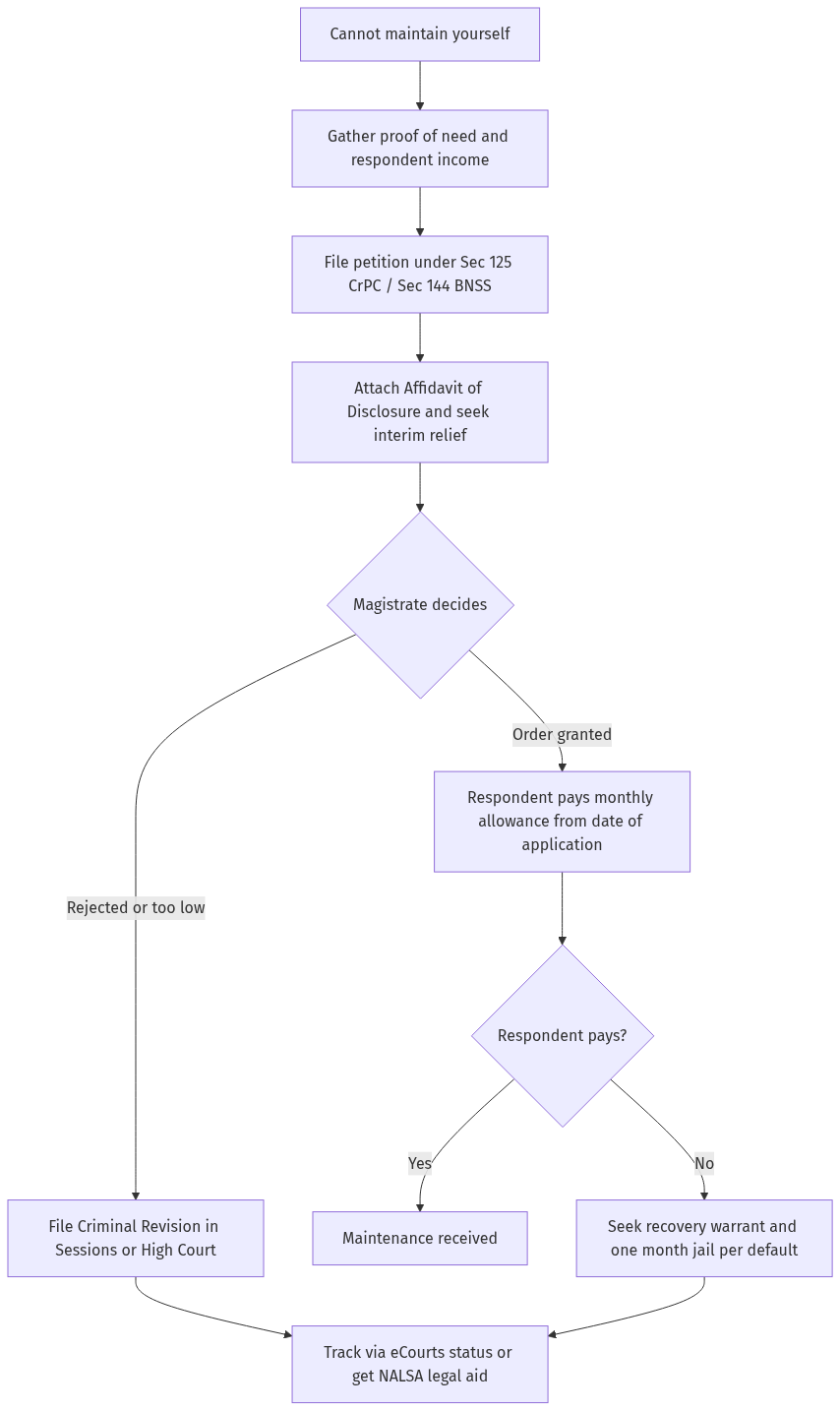
Figure: step-by-step flow. If a step stalls, use the grievance or RTI route shown.
If you get stuck
An order in your favour is only half the battle. If the respondent will not pay, the same section lets the Magistrate issue a warrant to recover the amount by attaching and selling movable property, and can order imprisonment of up to one month for each month of default until payment.
If your application is rejected or the amount is far too low, you have a remedy: file a Criminal Revision before the Sessions Court or High Court. If the case is simply not moving, track it through eCourts case status and, where the delay looks deliberate, raise it with the court. A Lok Adalat can also settle quantum quickly by consent. If you cannot afford a lawyer, you are entitled to free legal aid from NALSA, which covers women as of right and extends to senior citizens under its schemes.
A word before you serve any letter
Sometimes a clear demand brings payment without litigation. A properly drafted legal notice sets out your right and a date by which to comply, and it later shows the court you tried to settle. It is not a substitute for the petition, but it can shorten the road.
Frequently asked questions
Can a working wife still claim maintenance?
Yes. Earning does not by itself bar a claim. The court compares your income with what you reasonably need to live as you did in the marriage. If your earnings fall short of that standard, a top-up allowance can still be ordered.
From which date is maintenance payable?
From the date you file the application. The Supreme Court in Rajnesh v Neha made this the rule, so a spouse cannot benefit by delaying the hearing. File early to protect your arrears.
Do I have to file an income affidavit?
Yes. Both sides must file a uniform Affidavit of Disclosure of Assets and Liabilities under the Rajnesh v Neha directions. Fill it honestly and completely, because gaps in your own affidavit can stall your case.
Can parents claim maintenance from children?
Yes. A father or mother who cannot maintain themselves can claim a monthly allowance from a child who has the means. The same section covers wives, children and parents alike.
Can a divorced Muslim woman use Section 125?
Yes. From Shah Bano in 1985 to Mohd Abdul Samad in 2024, the Supreme Court has held that a divorced Muslim woman may claim under this section, in addition to her rights under the 1986 Act, though not double payment for the same period.
What if the husband refuses to pay the ordered amount?
The Magistrate can issue a warrant to recover the money by selling his movable property and can order imprisonment of up to one month for each month of default. Go back to the same court that passed the order to begin recovery.
My maintenance plea was rejected. What now?
You can file a Criminal Revision before the Sessions Court or High Court against the order. If money is the obstacle, NALSA legal aid can provide a lawyer free of cost.