Table of Contents
No Work in 15 Days? Claim G RAM G Allowance
If you asked for work under the new rural employment law and the Gram Panchayat did not give you any within 15 days, you are entitled to a daily unemployment allowance. It is not charity and you do not have to beg for it. Section 11 of the VB-G RAM G Act, 2025 (Act 36 of 2025) makes it your legal right, and the State Government has to pay it.
The short version. Demand work in writing. Insist on a dated receipt. Count 15 days from that date. If no work comes, the allowance starts on day 16. For the first 30 days in a financial year it cannot be less than one-fourth of your State's notified wage rate. After that it cannot be less than half. The lowest notified wage in the country is now ₹300 a day.
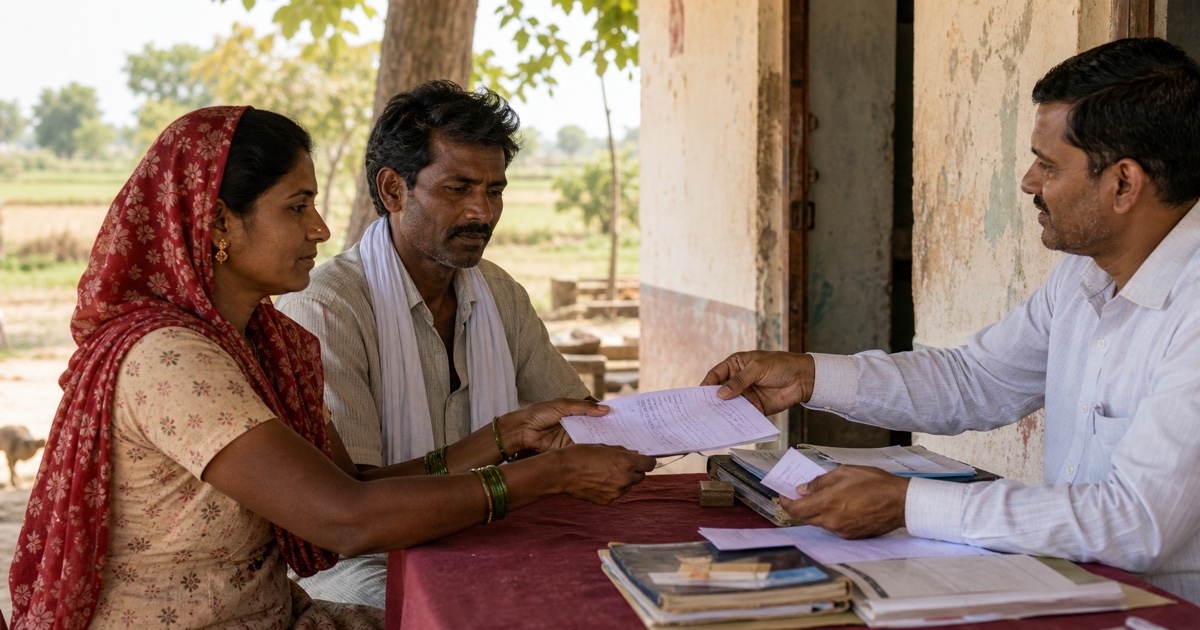
A written work demand and its dated receipt create the paper trail for an unemployment allowance claim. Photorealistic editorial illustration created for this guide.
First, the money: what is this actually worth
Most people never claim this allowance because nobody tells them what it comes to. So here is the arithmetic before anything else.
Section 11(2) does not fix one national figure. Your State Government notifies the rate, but the Act puts a floor under it that the State cannot go below:
- For the first 30 days of unemployment in a financial year: not less than one-fourth of the notified wage rate.
- For the rest of that financial year: not less than one-half of the notified wage rate.
Since 1 July 2026, no notified wage anywhere in India is below ₹300 a day. So the minimum allowance works out like this.
| Notified daily wage | First 30 days | After 30 days | 15 idle days |
|---|---|---|---|
| ₹300 (national floor) | ₹75 | ₹150 | ₹1,125 |
| ₹327.40 (national average) | ₹81.85 | ₹163.70 | ₹1,227.75 |
| ₹401 (Kerala) | ₹100.25 | ₹200.50 | ₹1,503.75 |
| ₹406 (Goa) | ₹101.50 | ₹203 | ₹1,522.50 |
| ₹409 (Haryana) | ₹102.25 | ₹204.50 | ₹1,533.75 |
| ₹450 (Sikkim, high-altitude Gram Panchayats) | ₹112.50 | ₹225 | ₹1,687.50 |
Reading the table: columns two and three are the minimum allowance per day, for the first 30 days of unemployment in the financial year and for the period after that. The last column is the total for a 15-day idle spell at the first-30-days rate. Wage figures are the rates notified under section 10 of the VB-G RAM G Act, 2025, effective 1 July 2026 (Press Information Bureau, Ministry of Rural Development, 30 June 2026). The ₹327.40 row is the national average notified wage, not a rate notified for any one State. Allowance figures are our calculation, applying the statutory floor in section 11(2) to those wage rates. Accessed 17 August 2026.
Read that table honestly. These are minimums, not promises. Your State can notify more. It cannot notify less. And the amounts are small per day, which is exactly why the second column matters: once you cross 30 idle days in a financial year, the rate doubles.
Who this guide is for
This is for you if all of the following are true:
- You live in a rural area where the Act now applies.
- Your household is registered and holds a job card, now called a Gramin Rozgar Guarantee Card.
- You are an adult member named on that card.
- You applied for unskilled manual work and did not get it within 15 days.
It is not for urban workers, and it is not for skilled or contract work. If your problem is unpaid wages for work you already did, that is a different payment with a different formula. Both are covered below, because people constantly mix them up.
The 15-day clock: when it starts, and what starts it
The clock in section 11(1) starts from the date your application for work is received, or from the date you asked to begin work if you filed an advance application, whichever is later.
This one line decides your entire claim. If there is no record of when you applied, there is no clock, and without a clock there is no allowance. So the paperwork matters more than the argument.
Schedule II of the Act is unusually clear here. Every application for work shall be compulsorily registered, and a receipt issued with the date, and that entry goes into the digital platform. That receipt is your proof.
A few practical points from Schedule II that workers are rarely told:
- Your application can be oral or written. You can give it to the Ward member, the Gram Panchayat, the Programme Officer, an officer authorised by the State, or through the digital platform. The Ministry has confirmed that workers may continue to demand employment orally, in writing through the existing Form 6 framework, or digitally.
- You can apply as a group, not only as an individual. A group application is harder to lose.
- There is no limit on the number of days you may apply for, subject to your household's overall 125-day guarantee.
- An application should normally be for at least six days of continuous work.
- You may file an advance application before the date you want work to start.
Ask for the receipt and do not leave without it. If the office refuses to give a dated receipt, that refusal is itself a grievance you can file under section 25. Note the date, the time, and the name of the person who refused. A group of applicants refused together is stronger evidence than one person's word.
What stops the allowance, and what does not
Section 11(3) lists exactly when the State's liability ends. There are four grounds and nothing else counts. If an official gives you a different reason, ask which of the four applies. The last two rows below are the excuses heard most often, and neither is in the section.
| What happens | Does the allowance stop? | What you should do |
|---|---|---|
| The Gram Panchayat or Programme Officer directs you to report for work | Yes, it stops | Report, or send at least one adult member of the household. Refusing ends the claim |
| The period you asked for ends and nobody from your household turned up | Yes, it stops | Turn up, or withdraw the application in writing before the period ends |
| Your household has already received 125 days of work this financial year | Yes, it stops | The guarantee is exhausted for the year. Check your card entries |
| Your household's wages and allowance together already equal 125 days of wages | Yes, it stops | Ask for the calculation in writing |
| The office says there is “no budget” or “no work sanctioned” | No | This is not a ground in section 11(3). File a grievance |
| The office says your Aadhaar or bank seeding failed | No | Not a ground either. Fix the seeding, but the claim stands |
The last two rows are the ones worth remembering. Shortage of funds is a problem for the administration, not a legal answer to your claim.
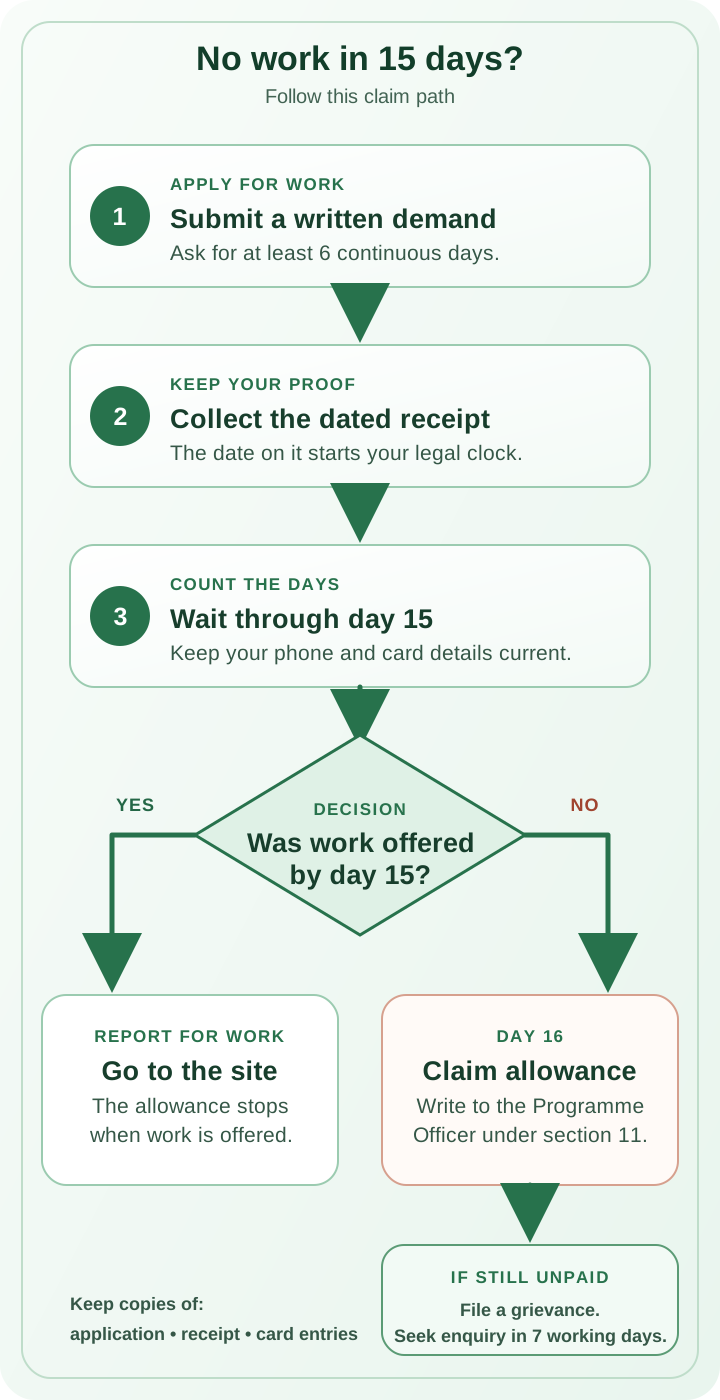
The claim flow in one view: apply, keep the dated receipt, count 15 days, then report for work or claim the allowance from day 16.
Step by step: building a claim that survives
- Check your card is live. The Gramin Rozgar Guarantee Card is valid for three years. It can only be cancelled if it is a duplicate, if the whole household has permanently migrated out, or if all adult members have died. Nothing else is a lawful ground for cancellation.
- Apply for work in writing. Use the sample below. Ask for at least six continuous days. Name every adult member who wants work.
- Collect the dated receipt. Photograph it immediately. Keep the paper.
- Mark day 16 on a calendar. Count 15 clear days from the date on the receipt, or from your requested start date for an advance application.
- If no work comes, write once more. On day 16, submit a short letter stating that no employment was provided and claiming the allowance under section 11.
- Track the entries on your card. The State has to keep the card updated with days demanded, days allocated, muster roll number, measurements, unemployment allowance paid, date-wise wages paid, and delay compensation paid. Blank columns are evidence.
- Escalate on a schedule, not on a mood. The grievance timeline in Schedule I is short. Use it before the trail goes cold.
Sample application for work
Change the details in brackets. Keep a photocopy and get the receipt stamped.
To,
The Gram Panchayat / Programme Officer,
[Gram Panchayat name], Block [ ], District [ ], [State]

Subject: Application for unskilled manual work under the VB-G RAM G Act, 2025

Sir / Madam,

My household is registered under the Gramin Rozgar Guarantee Card
number [ ]. The following adult members of my household seek
unskilled manual work under the Act:

1. [Name], [age]
2. [Name], [age]

We request work for [number, at least six] continuous days
beginning [date].

Please register this application and issue me a dated receipt as
required under Schedule II of the Act.

Name: [ ]
Card number: [ ]
Mobile: [ ]
Signature / thumb impression:
Date: [ ]      Place: [ ]
Sample letter claiming the allowance
Send this on day 16 or later. It converts a complaint into a dated claim.
To,
The Programme Officer, Block [ ], District [ ], [State]
Copy to: The Gram Panchayat, [name]

Subject: Claim for unemployment allowance under section 11,
VB-G RAM G Act, 2025

Sir / Madam,

I applied for unskilled manual work on [date]. The dated receipt
number is [ ]. Fifteen days have passed from that date and no
employment has been provided to my household.

Under section 11(1) of the VB-G RAM G Act, 2025, my household is
entitled to a daily unemployment allowance from the sixteenth day.
None of the conditions in section 11(3) applies to us. We were not
directed to report for work, we have not completed 125 days this
financial year, and we have not withdrawn our application.

I request that the unemployment allowance be sanctioned and
disbursed, and that the amount be entered in our Gramin Rozgar
Guarantee Card. Please issue a dated acknowledgement of this
letter.

Name: [ ]
Card number: [ ]
Date: [ ]      Place: [ ]
These are sample drafts. Change the wording to match your own facts before you send them.
Delay compensation is a different payment
If you actually did the work and the wages are late, that is not unemployment allowance. It is delay compensation, and Schedule II sets it out separately.
Wages must be paid weekly, and in any case within a fortnight of the work being done. The delay is measured from the muster roll. If payment does not arrive within 15 days of the muster roll closing, compensation starts. The rate is 0.05 per cent of the unpaid wages for each day of delay beyond the sixteenth day.
A worked example. Suppose ₹2,400 of your wages are unpaid, and payment finally arrives 30 days after the sixteenth day:
- 0.05 per cent of ₹2,400 is ₹1.20 a day.
- ₹1.20 multiplied by 30 days of delay is ₹36.
Small, but it is automatic. The Act requires the computer system to work this out on its own, from the muster roll closure date and the date the money reaches your account. The State must pay it upfront. It then recovers the amount from whoever caused the delay. And if the compensation itself is more than 15 days late, it is treated as delayed wages all over again.
| Which payment? | When it applies | How it is worked out |
|---|---|---|
| Unemployment allowance | You asked for work and did not get it | Not less than one-fourth of the wage rate for the first 30 days, then not less than half |
| Delay compensation | You did the work and the wages are late | 0.05% of unpaid wages per day beyond the sixteenth day from muster roll closure |
Your job card has a new name
The Act renamed the job card. It is now the Gramin Rozgar Guarantee Card, issued by the Gram Panchayat within 15 days of your registration application, carrying a unique number, the names and photos of registered adult members, and bank or post office account details.
There is also a Special Gramin Rozgar Guarantee Card, in a distinct colour. You can ask for it if you are:
- a single woman;
- a person with disability;
- a person above 60 years of age;
- a released bonded labourer;
- a member of a Particularly Vulnerable Tribal Group;
- a transgender person.
The Act says this card carries special protection in three things: how work is given, how work is evaluated, and worksite facilities. If you qualify, ask for it by name.
Your existing job card has not stopped working. The Ministry of Rural Development has said existing e-KYC-verified job cards remain valid until Gramin Rozgar Guarantee Cards are issued. You do not need to re-register. If you have never held a card, apply at the Gram Panchayat.
One protection is worth reading twice. The Ministry has stated that workers shall not be denied employment merely because e-KYC is pending, with facilitation provided including at worksites. So “your e-KYC is not done” is not a lawful reason to turn you away at the demand stage. Get it done, but do not let it block your application or your clock.
Why work may be refused for 60 days a year
This one surprises people, and it is a lawful refusal. Section 6 requires every State Government to notify a period totalling 60 days in a financial year. It covers the peak sowing and harvesting seasons. During those days no work under the Act may be started or executed. The idea is to keep farm labour available at harvest time.
Two things follow that are worth knowing:
- The State must notify the period in advance. It cannot be announced after the fact to explain away a refusal. Ask to see the notification.
- The State may issue different notifications for different districts, blocks or Gram Panchayats based on agro-climatic zones. Your neighbouring block may have different dates.
So if you are told there is no work because of the agricultural pause, the fair question is: which notification, and for which dates? If your application falls outside those notified dates, the pause is not an answer.
If nothing happens: the escalation ladder
Schedule I of the Act sets out a grievance mechanism with real deadlines. Non-payment of unemployment allowance is named in section 25 as one of the grievances it must handle, along with failure to provide employment in time and non-payment or delayed payment of wages.
| Step | Where you go | The deadline the Act sets |
|---|---|---|
| 1 | Ward, Gram Panchayat, Block or District grievance point. At least one day each week is a mandatory grievance day | Dated acknowledgement on submission. Enquiry and disposal within 7 working days |
| 2 | Same authority, corrective action | Grievance resolved within 15 days |
| 3 | Automatic escalation to the next higher level through the digital system | Triggers if unresolved in 15 days |
| 4 | Appeal against the Gram Panchayat to the Programme Officer | File within 45 days, disposed within 30 days |
| 5 | Appeal against the Programme Officer to the District Programme Coordinator | File within 45 days, disposed within 30 days |
| 6 | Appeal against the District Programme Coordinator to the State Grievance Redressal Authority | File within 45 days, disposed within 30 days |
| 7 | District Ombudsperson, appointed for each district to receive grievances, hold enquiries and issue awards | As per the notified guidelines |
Two useful details. Failure to dispose of a grievance within seven working days is itself treated as a contravention of the Act. And contravention of any provision of the Act attracts a penalty which may extend to ₹10,000 under section 27.
Our guide to the rural employment ombudsman complaint route walks through what an ombudsperson complaint looks like in practice.
Records you can demand, free of cost
This is the part that turns a weak complaint into a strong one, and it does not even need an RTI application.
Schedule I says all accounts and records, including muster rolls, shall be open to public scrutiny free of cost. Anyone who wants a copy or extract is to be given it within three working days of applying.
Separately, for the social audit, the Gram Panchayat has to place before the Gram Sabha the muster rolls, bills, vouchers, measurement books, sanction orders, digital records and geo-tagged photographs. The Gram Sabha conducts regular social audits of all works in the Panchayat.
So before you argue, ask for:
- The muster rolls for the period you claim you were idle.
- The register of work applications, showing your entry and receipt number.
- The list of persons provided with work, which has to be displayed on the Gram Panchayat notice board anyway.
- The State notification for the peak agricultural season, if that is the reason you were given.
If the three-working-day route is ignored, that is when the RTI Act, 2005 becomes useful. A Gram Panchayat and a Programme Officer are public authorities. Our AI RTI Drafter will put the request into the right form, and the Timeline Tracker tells you the exact date your reply is due. If the reply does not come, the First Appeal Builder drafts the appeal.
Two worked examples
Example 1. The idle fortnight. A household in a district where the notified wage is ₹300 applies on 4 August for fifteen days of work and collects a dated receipt. No work is allotted. The 15-day period in section 11(1) runs out on 19 August, so entitlement begins from 20 August. For the first 30 days of unemployment in the financial year the floor is one-fourth of ₹300, that is ₹75 a day. Across a 15-day spell that comes to at least ₹1,125. The household writes to the Programme Officer on 20 August citing section 11 and asks for a dated acknowledgement.
Example 2. The wrong reason. A worker in a State where the notified wage is ₹409 is told in September that no work can be given because the block has no sanctioned works. That is not one of the four grounds in section 11(3). The worker asks, in writing, for the register of applications and the list of persons provided with work, both of which are public records available free of cost. With the receipt and the register extract, the worker files a grievance. If it is not disposed of within seven working days, that failure is itself a contravention.
What is still being settled
Be careful with any website that tells you there is a national online form for claiming this allowance. There is not one, and here is why.
When the Ministry of Rural Development notified the commencement of the Act, it also listed rules that were still being drafted and would be published for public consultation. Two of them matter directly here: the Rules on the Manner of Payment of Wages and Unemployment Allowance, and the Transitional Provisions Rules.
Section 11(2) also leaves the exact rate, and the terms and conditions of eligibility, to the State Government by notification, and section 11(6) lets the State prescribe the payment procedure. So the floor is national and fixed by the Act, but the machinery is being built State by State.
What this means for you in practice:
- The right in section 11 is already in force. It does not wait for rules.
- The rate in your State should be checked against your State's notification.
- The procedure may differ between States, and may change once the central rules are published.
- Do not pay anyone to file this for you. There is no fee for applying for work, for the receipt, or for inspecting muster rolls.
Frequently asked questions
Is MGNREGA finished?
Yes. The Mahatma Gandhi National Rural Employment Guarantee Act, 2005 stands repealed from 1 July 2026, the date the VB-G RAM G Act, 2025 came into force across rural India. Our explainer on the switch from MGNREGA to VB-G RAM G covers the transition in more detail.
The office refused to give me a dated receipt. What now?
Do not let it go. Schedule II says every application shall be compulsorily registered and a receipt issued with the date, so a refusal is itself a grievance under section 25. Note the date, time and name of the person who refused. Then apply again in a way that creates its own proof: through the digital platform, or by post keeping the acknowledgement, or as a group so several people can attest to the same refusal.
Does the allowance keep running during the 60-day agricultural pause?
The Act does not answer this in so many words, so treat confident claims elsewhere with caution. Section 6 bars work during the notified peak season. But section 11(3) lists only four grounds on which the State's liability ends, and a notified pause is not one of them. The practical course is to ask for your State's notification, check whether your dates fall inside it, and apply for days outside the pause. If work is refused during the pause, get the refusal in writing and file a grievance so the question is on record.
Can several of us apply together?
Yes. Schedule II expressly allows applications for work to be filed individually or for a group together, and a group application is much harder for an office to misplace. Keep in mind that the 125-day guarantee and the allowance are calculated per household, not per person, and the allowance is payable to the household of an applicant jointly.
Who actually pays the unemployment allowance?
The State Government carries the liability. The allowance is sanctioned and disbursed by the Programme Officer, or by a local authority that the State Government authorises by notification.
How quickly must the allowance be paid once it is due?
Every payment of unemployment allowance has to be made or offered not later than 15 days from the date it became due for payment.
My old MGNREGA wages were never paid. Are they lost?
No. Wage liability that had already accrued is carried over by the repeal provision. For the full route on old dues, see our guide on using RTI for unpaid rural employment wages.
The office says my Aadhaar seeding failed. Does that kill my claim?
No. Seeding failure is not one of the four grounds in section 11(3) that stop the allowance. Fix the seeding, because wages and allowance are paid into bank or post office accounts, but the entitlement itself does not disappear. You can check whether your bank account is DBT-linked separately.
Can I be sent to work far from my village?
As far as possible, work should be within five kilometres of your village. If it is provided beyond that radius, it must still be within the Block, and you are to be paid 10 per cent of the wage rate as extra wages towards transport and living costs.
What if I am injured at the worksite?
You are entitled to free medical treatment for an injury arising out of and in the course of employment. If hospitalisation is needed, the State has to arrange it and pay a daily allowance of not less than half the wage rate. In case of death or permanent disability from a work accident, ex-gratia is payable as per the entitlement under the Pradhan Mantri Suraksha Bima Yojana.
Is there any fee for any of this?
No. Applying for work is free. The dated receipt is free. Inspecting accounts and muster rolls is expressly free of cost, and copies are to be given within three working days.
Your next 30 minutes
- Find your job card or Gramin Rozgar Guarantee Card and check the number is readable.
- Write the application for work using the sample above. Ask for at least six continuous days.
- Hand it in and do not leave without a dated receipt.
- Photograph the receipt and write day 16 on a calendar.
- If you already applied and 15 days have gone, send the claim letter today and ask for a dated acknowledgement.
- Ask for the register of applications and the list of persons provided with work. Both are free.
If you want the whole accountability sequence in one place, from first application to appeal, The RTI Playbook sets out how to build a paper trail that officials cannot ignore.
Sources
- The Viksit Bharat - Guarantee for Rozgar and Ajeevika Mission (Gramin): VB-G RAM G Act, 2025 (Act No. 36 of 2025), bare Act as on 1 July 2026. Sections 5, 6, 10, 11, 20, 25, 27 and 37 and Schedules I and II. Read the enacted Act on India Code. Accessed 17 August 2026.
- Press Information Bureau, Ministry of Rural Development, official FAQ on the Viksit Bharat-G RAM G Act, 2025, confirming the 15-day rule and the one-fourth and one-half allowance rates. Read the FAQ. Accessed 17 August 2026.
- Gazette of India, Extraordinary, Part II Section 3(ii), Notification S.O. 2382(E) dated 11 May 2026, Ministry of Rural Development, appointing 1 July 2026 as the date the Act comes into force in all States and Union territories. Read the gazette notification. Accessed 17 August 2026.
- Press Information Bureau, Ministry of Rural Development, “President gives assent to Viksit Bharat - Guarantee for Rozgar and Ajeevika Mission (Gramin) (VB-G RAM G) Bill, 2025”, 21 December 2025, which cites sections 5(1), 5(3), 6, 4 and 22(4) of the Act. Read the release. Accessed 17 August 2026.
- Ministry of Rural Development detailed explainer, May 2026, for the unemployment allowance rate, the Form 6 demand route, e-KYC protection and job card transition. Read the explainer. Accessed 17 August 2026.
- Press Information Bureau, Ministry of Rural Development, “Historic Commencement of Viksit Bharat - G RAM G Act Across Rural India from July 1st 2026”, 11 May 2026. Read the release. Accessed 17 August 2026.
- Press Information Bureau, Ministry of Rural Development, “Government Notifies Revised Wage Rates under the VB-G RAM G Act, 2025”, 30 June 2026. Read the release. Accessed 17 August 2026.
Last verified: 17 August 2026. State rates, notified peak agricultural seasons and grievance procedures differ from State to State, and the central rules on the manner of payment of wages and unemployment allowance were still to be published when this page was written. Where this page and an official notification differ, the notification prevails.